
BuddhistCatholicContemplativeEvangelicalGeneral ChristianHinduJewishLatter-day SaintMuslimNew VisionsProgressive Christian
Beliefs
- Buddhist
- Catholic
- Contemplative
- Evangelical
- General Christian
- Hindu
- Jewish
- Latter-day Saint
- More Voices
- Muslim
- New Visions
- Pagan
- Progressive Christian
Topics
- Religion News
- Food and Religion
- Sports and Religion
- Religious Art
- Religious Music and Entertainment
- Religious Events
- History and Religion
- Style and Religion
- Politics and Religion
- Women in Religion
- Recreation Outdoors and Religion
- Business Finance and Religion
- Careers Workplace and Religion
- Education and Religion
- Family Parenting and Religion
- Health Fitness and Religion
- Home and Religion
- Relationships and Religion
- Technology and Religion
- Travel and Religion
Columnists
- Buddhist Columnists
- Business Finance and Religion Columnists
- Careers Workplace and Religion Columnists
- Catholic Columnists
- Contemplative Columnists
- Education and Religion Columnists
- Evangelists Columnists
- Family Parenting and Religion Columnists
- General Christian Columnists
- Health Fitness and Religion Columnists
- Hindu Columnists
- History and Religion Columnists
- Home and Religion Columnists
- Jewish Columnists
- More Voices Columnists
- Latter Day Columnists
- Muslim Columnists
- New Visions Columnists
- Nonreligious Columnists
- Pagan Columnists
- Politics and Religion Columnists
- Progressive Columnists
- Recreation Outdoors and Religion Columnists
- Relationships and Religion Columnists
- Religion News Columnists
- Religious Art Columnists
- Religious Events Columnists
- Religious Music and Entertainment Columnists
- Sports and Religion Columnists
- Style and Religion Columnists
- Technology and Religion Columnists
- Travel and Religion Columnists
- Women in Religion Columnists
Resource Library
- 2026 Calendar
- Library of World Religions
- The 100 Most Holy Places on Earth
- Patheos Answers
- Podcasts
- Videos
- Faith Leaders Database
- Anglican Episcopalian
- Bahai
- Baptist
- Buddhism
- Christianity
- Confucianism
- Eastern Orthodoxy
- Hinduism
- Holiness and Pentecostal
- ISKCON
- Islam
- Judaism
- Lutheran
- Methodist
- The Church of Jesus Christ of Latter-day Saints
- New Age
- Paganism
- Presbytarian and Reformed
- Protestantism
- Religion Behind the Scenes
- Roman Catholic
- Scientology
- Shia Islam
- Sikhism
- Sufism
- Sunni Islam
- Taoism
- Zen
- See all religions
Research Tools
 Ad-Free & Subscriber Log-In Subscription Support
Ad-Free & Subscriber Log-In Subscription Support
Follow Patheos 

- Trending:
- Forgiveness
- |
- Marriage
- |
- Consciousness
- |
- Death Penalty
- |
- Election
- |
- Halloween
 Wild Fox Zen
- Home
- Buddhist
- Dark Night, Broken Bridge: What To Do When What’s Worked Doesn’t
Dark Night, Broken Bridge: What To Do When What’s Worked Doesn’t
Last updated on: June 2, 2022 at 6:42 am by Dosho Port
Dark Night, Broken Bridge: What To Do When What’s Worked Doesn’t 2022-06-02T06:42:44-06:00 Dosho Port
Patheos Explore the world's faith through different perspectives on religion and spirituality! Patheos has the views of the prevalent religions and spiritualities of the world.

The Broken Bridge, West Lake, Hangzhou, China
Many of us come to a place in our journey where what once worked is broken, where the path is dark, where we’re at a loss – especially in these dark days of ongoing pandemic, climate crisis, social divisions, and political dis-ease.
The phrase “dark night of the soul,” used variously in Christian mysticism, is often about the whole journey to union with God. In Western Zen, starting with Aitken Roshi, it is sometimes used for those very dry places on the Zen journey.
It was this that I was thinking about in Keep Me In Your Heart A While in “Cleaning Under the Hedge” (p. 53):
“Somehow I had survived the idealization, covert clinging to hopes for magical gain, and very crabby stages—this time around (but, the path being a spiral, I could have known this stage would come around again). Nonetheless, a level field was opening up. This was steadily walking without getting anywhere. More subtle work begins here. The practice at this stage is simply done for the sake of the practice itself. Searching for a motive at this stage is adding a head on top of a head. If we just stay with it, we might even start to get over our self a bit and direct our life to actualizing a purpose greater than our self.”
During such times in the path of earnest dharma practice, turbulence, past trauma, or other psychological and/or physical issues emerge to seemingly block the Way. Sometimes a practitioner secretly believes that the arising of these issues is proof of their own lack of true practice or the dharma’s lack of efficacy.
However, when worked through skillfully, these very times will later be seen as the fruit of the path. How? Subtle work is certainly called for. Some methods of engaging with whatever is arising may not work, are contraindicated, and so a freshness of view and careful attending to what is working and what is NOT is so important.
This requires a letting go of dogma, of what is “supposed” to work.
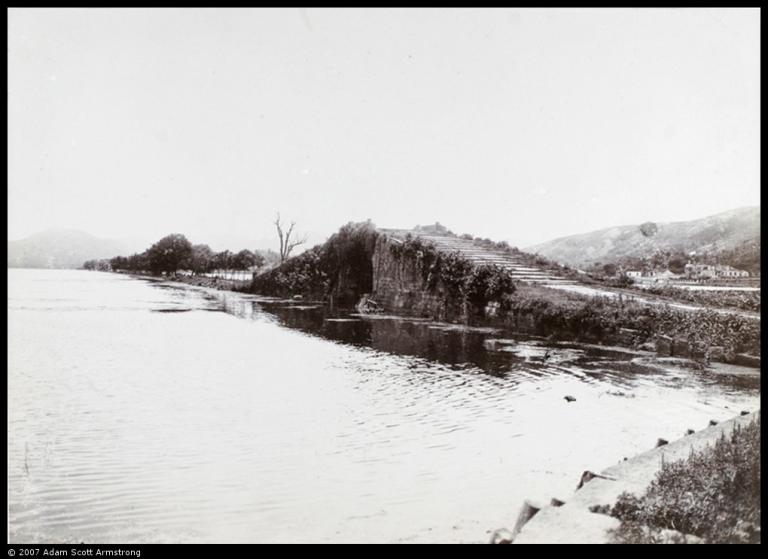
The Broken Bridge (long ago), West Lake, Hangzhou, China
Proceeding tenderly and honestly is the Way. A teacher’s guidance, of course, can be important. Going against one’s proclivities to avoid interaction with others and being with dharma friends can also be a vital lifeline during these times. And it is at these times that we can seem so utterly alone even when we are with others.
I think here of *No Gate Barrier, “*Case 44: Bājiāo’s Walking Staff:”
The Venerable Bājiāo, presented to the assembly, saying, “If you have a walking staff, I will give you a walking staff. If you have no walking staff, I will seize your walking staff.”
Wúmén’s Comment
It supports you as you cross the water over the Broken Bridge. It is your companion, returning to the village, no moon. If you call it a walking staff, you enter hell straight as an arrow.
Verse
Everyplace – deep and shallow
Entirely in its grip
Supporting the sky and propping up the earth
Everywhere shaken by the school’s wind
The staff here might represent the practice-awakening that we’ve discovered through our sincere efforts on the Way and that we’ve settled into using to support us on our journey through the tough spots on the road. So we might think we have a staff, but it is at these times that the staff is taken and we find that we have no staff.
As Wúmén compassionately points out, clinging to our old staff sends us to hell.
On the other hand, we might think we have no staff, no support, no refuge. But it is at these times of difficulty that we really learn what no-staff truly is.
This no-staff staff supports us as we cross the bridge from this time to another phase of the journey, from isolation to community, or from community to a period of isolation – across the bridge that only seems to be broken, wholeness confirmed through continuing on the Way. The no-staff staff is our only friend as we walk through the village at midnight.
Wúmén’s verse ends with “Everywhere shaken by the school’s wind.” “School’s wind” is the style, the customs, and the tradition of a lineage (宗風, Japanese, shūjo). Rather than these times of difficulty reflecting something wrong with us, this line radically affirms these periods – this too is the Way.
It is the wind of our Zen Way that shakes such things loose and exposes them. Our skillful practice is what makes possible our steady (and sometimes steady within the not-so-steady) walking with it all.
Additional recommended resource: Philip Taiho Martin, The Zen Path Through Depression.

Dōshō Port began practicing Zen in 1977 and now co-teaches with his wife, Tetsugan Zummach Sensei, with the Vine of Obstacles: Online Support for Zen Training, an internet-based Zen community. Dōshō received dharma transmission from Dainin Katagiri Rōshi and inka shōmei from James Myōun Ford Rōshi in the Harada-Yasutani lineage. Dōshō’s translation and commentary on The Record of Empty Hall: One Hundred Classic Koans, is now available (Shambhala). He is also the author of Keep Me In Your Heart a While: The Haunting Zen of Dainin Katagiri. Click here to support the teaching practice of Tetsugan Sensei and Dōshō Rōshi.
Previous Post

May 23, 2022
Disclosing the Hidden Teaching of the Ten Line Kannon Sutra
Next Post

June 9, 2022 The Vital Importance of Studying Buddhadharma: Why and How
Browse Our Archives
Select a Category Uncategorized
Select a Month August 2023 July 2023 June 2023 May 2023 April 2023 March 2023 February 2023 January 2023 December 2022 November 2022 October 2022 September 2022 August 2022 July 2022 June 2022 May 2022 April 2022 March 2022 February 2022 January 2022 December 2021 November 2021 August 2021 June 2021 April 2021 February 2021 January 2021 November 2020 September 2020 August 2020 July 2020 June 2020 May 2020 April 2020 January 2020 December 2019 November 2019 August 2019 June 2019 May 2019 April 2019 February 2019 January 2019 December 2018 November 2018 October 2018 September 2018 August 2018 July 2018 June 2018 May 2018 April 2018 March 2018 February 2018 January 2018 December 2017 November 2017 October 2017 September 2017 August 2017 July 2017 June 2017 December 2016 October 2016 June 2016 April 2016 February 2016 January 2016 December 2015 November 2015 October 2015 August 2015 June 2015 May 2015 April 2015 March 2015 February 2015 January 2015 December 2014 November 2014 October 2014 September 2014 August 2014 July 2014 June 2014 May 2014 April 2014 March 2014 February 2014 January 2014 December 2013 November 2013 October 2013 September 2013 August 2013 July 2013 June 2013 May 2013 April 2013 March 2013 February 2013 January 2013 December 2012 November 2012 October 2012 September 2012 August 2012 July 2012 June 2012 May 2012 April 2012 March 2012 February 2012 January 2012 December 2011 November 2011 October 2011 September 2011 August 2011 July 2011 June 2011 May 2011 April 2011 March 2011 February 2011 January 2011 December 2010 November 2010 October 2010 September 2010 August 2010 July 2010 June 2010 May 2010 April 2010 March 2010 February 2010 January 2010 December 2009 November 2009 October 2009 September 2009 August 2009 July 2009 June 2009 May 2009 April 2009 March 2009 February 2009 January 2009 December 2008 November 2008 October 2008 September 2008 August 2008 July 2008 June 2008 May 2008
Follow Us!
TAKE THE
Religious Wisdom Quiz
Who said: "Now to him who is able to keep you from stumbling and to present you before his glorious presence without fault"?
Select your answer to see how you score.
Peter Jude Paul John
Related posts from Wild Fox Zen

Throw Yourself Into the House of Buddha: The...

New Vine Ghost Site for Dosho's Creative Endeavors...

Gnawing Through Qiánfēng’s Three Illnesses and Two Lights

"Why, Oh Why, Is My Practice Not Progressing?"
TRENDING AT PATHEOS Buddhist

On Taking Refuge in the Dharma
(Here I continue the feature of sharing talks and essays by teachers...

(Continuing my intention to share talks and essays by other members of Empty...
The Subtle Art of Bowing: A Dharma Discourse
(This presentation was first offered by my dear friend Dharma Holder Tom...

Internal Family Systems Can Heal you Mentally &...
How IFS Helped Me Stop Fighting Myself Internal Family Systems (IFS) is...

The Bible No One Spoke About: A Family’s...
A mysterious family Bible, unspoken faith, and a journey from curiosity to...

How Uncertainty Can Transform Your Life in 2025
Embracing Uncertainty: A New Year’s Resolution for the Brave As 2025 approaches,...
view all Buddhist blogs
Ad-Free & Subscriber Log-In Subscription Support
- About Us
- 2026 Calendar
- Videos
- Podcasts
- Library of World Religions
- Faith In Media Tracker
- Advertise With Us
- Write for Us
- Privacy Policy
- Terms of Service
- Do Not Sell My Data
- Contact Us
- Radiant Digital
- Manage Newsletter Subscriptions
- Unsubscribe From Notifications
- Sitemap
Copyright 2008-2026, Patheos. All rights reserved.
Subscription Support Ad-Free & Subscriber Log-In
Follow Patheos