
BuddhistCatholicContemplativeEvangelicalGeneral ChristianHinduJewishLatter-day SaintMuslimNew VisionsProgressive Christian
Beliefs
- Buddhist
- Catholic
- Contemplative
- Evangelical
- General Christian
- Hindu
- Jewish
- Latter-day Saint
- More Voices
- Muslim
- New Visions
- Pagan
- Progressive Christian
Topics
- Religion News
- Food and Religion
- Sports and Religion
- Religious Art
- Religious Music and Entertainment
- Religious Events
- History and Religion
- Style and Religion
- Politics and Religion
- Women in Religion
- Recreation Outdoors and Religion
- Business Finance and Religion
- Careers Workplace and Religion
- Education and Religion
- Family Parenting and Religion
- Health Fitness and Religion
- Home and Religion
- Relationships and Religion
- Technology and Religion
- Travel and Religion
Columnists
- Buddhist Columnists
- Business Finance and Religion Columnists
- Careers Workplace and Religion Columnists
- Catholic Columnists
- Contemplative Columnists
- Education and Religion Columnists
- Evangelists Columnists
- Family Parenting and Religion Columnists
- General Christian Columnists
- Health Fitness and Religion Columnists
- Hindu Columnists
- History and Religion Columnists
- Home and Religion Columnists
- Jewish Columnists
- More Voices Columnists
- Latter Day Columnists
- Muslim Columnists
- New Visions Columnists
- Nonreligious Columnists
- Pagan Columnists
- Politics and Religion Columnists
- Progressive Columnists
- Recreation Outdoors and Religion Columnists
- Relationships and Religion Columnists
- Religion News Columnists
- Religious Art Columnists
- Religious Events Columnists
- Religious Music and Entertainment Columnists
- Sports and Religion Columnists
- Style and Religion Columnists
- Technology and Religion Columnists
- Travel and Religion Columnists
- Women in Religion Columnists
Resource Library
- 2026 Calendar
- Library of World Religions
- The 100 Most Holy Places on Earth
- Patheos Answers
- Podcasts
- Videos
- Faith Leaders Database
- Anglican Episcopalian
- Bahai
- Baptist
- Buddhism
- Christianity
- Confucianism
- Eastern Orthodoxy
- Hinduism
- Holiness and Pentecostal
- ISKCON
- Islam
- Judaism
- Lutheran
- Methodist
- The Church of Jesus Christ of Latter-day Saints
- New Age
- Paganism
- Presbytarian and Reformed
- Protestantism
- Religion Behind the Scenes
- Roman Catholic
- Scientology
- Shia Islam
- Sikhism
- Sufism
- Sunni Islam
- Taoism
- Zen
- See all religions
Research Tools
 Ad-Free & Subscriber Log-In Subscription Support
Follow Patheos 

- Trending:
- Advent
- |
- Forgiveness
- |
- Thanksgiving
- |
- Election
- |
- Seasonal Holidays
- |
- Marriage
 Wild Fox Zen
- Home
- Buddhist
- The Death of Harada Daiun Sogaku Roshi: 60th Year Memorial
The Death of Harada Daiun Sogaku Roshi: 60th Year Memorial
Last updated on: December 12, 2021 at 9:04 am by Dosho Port
The Death of Harada Daiun Sogaku Roshi: 60th Year Memorial 2021-12-12T09:04:53-06:00 Dosho Port
Patheos Explore the world's faith through different perspectives on religion and spirituality! Patheos has the views of the prevalent religions and spiritualities of the world.

Dosho’s Note: Below you’ll find a translation of an article that first appeared in a magazine from Hosshin-ji, Shoyu (勝友, “Victorious Friend”), written by Chisen Shiroyama, a nun who trained as a lay woman with Harada Daiun Roshi (October 13, 1871 – December 12, 1961) and received inka shomei from him. Later in life, she became a nun and attended to Daiun Rodaishi after Harada Tangen Roshi became the abbot of Bukkoku-ji. For more on our great ancestor, Harada Daiun Sogaku Roshi, see The Lingering Radiance of Harada Daiun Sogaku.
This is a translation by Bukkokuji monk, Kogen Czarnik:
On the last day of rohatsu sesshin, on the 7th, the warm weather radically changed and a cold wave hit, with hail and thunder preceding the snow. It was a really intense onset of bad weather. Roshi’s 91 years-old body, which was quite weak from the acute pneumonia he had the previous summer, was likely influenced by this sudden change of weather, and from the morning of the 7th, he fell sick.
Quickly we called his main physician, Dr. Ozu, who came and checked on Roshi. He found Roshi’s pulse, breathing and blood pressure were normal, he had no fever, and there were no other symptoms. Dr. Ozu said that because of old-age related weakness, Roshi should be very careful and rest.

Roshi ate three meals that day as always, and was just resting in his bedroom, but from the next day, the 8th, he slept almost all day and night. During those next few days, until the morning of the 11th, if I would put a spoon to his mouth with fruit juice or milk, he would drink it, and on the evening of the 10th he ate some mashed banana that he always loved with yam juice that I offered to him. I asked him “Is it good?” “Very good,” Roshi answered. “Was it enough?” “Yes, enough,” he replied in a small voice, and these were his last words.
After that Roshi just slept all the time and from noon on the 11th he didn’t eat or drink anything. On the 12th, at 11:25 a.m., his body finally entered eternal sleep. Dr. Ozu said, “There was no sickness, it was a perfectly natural death from old age. I have seen many people dying, but I have never seen someone die with such a beautiful face. He looks more beautiful than when he was alive.” And he looked at Roshi’s face for a while.
It was truly a peaceful death. He didn’t suffer a bit. It was just like a lamp gradually dimming down and finally extinguishing – that quiet kind of last moment.

A telegram was sent to Roshi’s disciples and attendants, who rushed in shock and grief to come; the Bukkoku-ji abbot, the Shinpuku-ji abbot and myself. Three temple-member practitioners – Mrs. Kawa, Mrs. Hayashi and Mrs. Tsukuda – were asked to help, and respectfully wiped Roshi’s body with a wet cloth, dressed him in a white kimono, a white koromo he liked, and put on the hand-made linen 25-panel okesa made by the late Mrs. Sumiko. His body was enshrined in the same bedroom he was in.

Many students, one by one, started to come to pay respects, many of them saying, “How noble Roshi’s face looks. Just like during dokusan.” Some people were bringing their ears close to his tightly closed mouth saying, “Roshi doesn’t look tired, his face color looks good, he looks as if he was just about to say something.”
That evening, Docho Roshi (Sessui Harada Roshi) and 35 other priests gathered by his bedside chanting sutras, performing otsuya, and on the 13th, there was another otsuya at Kakusho-ken. On the 14th we waited for Sozen Nagasawa Roshi with three of her disciples to come from Mitaka,Tokyo, to transport the coffin to Hosshin-ji hatto. That evening we had a big otsuya in the Hosshin-ji hatto which was full of temple supporters, and people from the Fushiwara area. Gagyu Kawase Roshi, the abbot of Manpuku-ji in the Murakami city, Niigata prefecture, was doshi and the “Bequeathed Teachings Sutra” was chanted. After that, the recording of Roshi’s teisho from the previous sesshin was played, on the 47th case from the Mumonkan,
“Tosotsu’s Three Barriers,” and the 48th case, “Kanpo’s One Road”. His voice was flowing as if it were his living words coming to us, and I remember seeing an image of him in front of my eyes, gesturing when talking.

On the 15th, at 1pm, with the hatto tightly packed with students and temple supporters, the funeral service was solemnly performed with Ryoten Ueno Roshi, the abbot of Garyu-in from neighboring Mikata as doshi. After that, people boarded a few buses and following the hearse, everybody went outside of Obama to a crematory ground on a low hill, and following Roshi’s last wishes, he was burned outdoors in traditional style just like Shakyamuni Buddha. There was a big mortuary tablet saying, “Freshly entered nirvana, the 27th abbot of Hosshin-ji, Daiun Sogaku Osho Zenji”. Roshi’s ashes were put into a small urn which was enshrined on the main altar at Hosshin-ji. Everyday, a constant stream of students were visiting and saying some prayers to it.
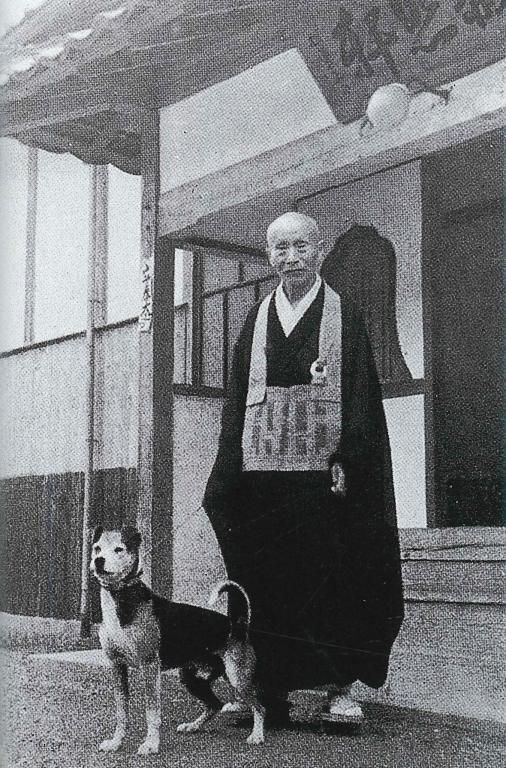
For the following weeks, it was moving how many people showed Dharma-love for Roshi in different ways. People from every part of Japan were coming just to offer incense for Roshi, and many more were sending letters of condolences to Hosshin-ji, and sending offerings and gifts which were put near the altar before Roshi’s urn. On each seventh day from his death, a taiya ceremony would be solemnly performed. After the 49th day ceremony, all the board of temple supporters, Roshi’s successors and attendants, and people with close connection to the temple gathered to discuss the main funeral ceremony, which happened on May 12th.
It was a day that all of us will remember forever. From May 11th, all Dharma heirs, close disciples and followers, from Hokkaido, Kyushu, Tokyo, and every part of the country, made time, put everything aside, and came to participate in ceremonies for the farewell of our Roshi. On the 11th evening there was a taiya ceremony in Hosshin-ji hatto, and then as before, we listened to an old tape with Roshi’s teisho, hearing his energetic voice.
From the morning of May 12th, it started to rain more and more. Roshi always used to say, “Usually I bring nice weather,” but on this occasion it felt like the sky was mourning with us and crying. Thanks to that rain, the mountains that were re-forested by Roshi, became lushly green, making Hosshin-ji look magnificent for that day. However, from 2pm, when the ceremony started the clouds were clearing, and at 4pm, when everybody was going to depart, it was perfectly sunny. Everyone thought, “Ah, just like Roshi said,” thanking his great merit, and everyone was able to go home. Of course, some people said that maybe without rain even more guests from the town would have come, but the hatto was already completely full, and the tatami that were put for the day on the outside wooden corridors, were packed tightly.

With Philip Kapleau (right)
For the ceremony there were delegations from both Daihonzan, and over 200 people from various temples. There were seven doshi’s, to perform the ceremony with utmost dignity: Monji Tokutake Roshi from Hoon-ji in Morioka; Gagyu Kawase Roshi from Manpuku-ji in Murakami, Niigata prefecture; Ryuko Kishimoto Roshi from Kuin-ji in Obama; Kenshu Matsumoto Roshi from Shinmei-ji in Sanda, Hyogo prefecture; Senkai Takahashi Roshi, from Eikyu-in in Miyazu; Yuko Fushii Roshi from Kotoku-ji in Obama; Etsudo Nishiwaki Roshi from Chugaku-in in Haibara, Shizuoka prefecture; and other venerable teachers.
At the end, there was a moment for the lay community to offer incense, but the voice of the person instructing was not reaching everyone. Lay practitioners and temple supporters started to get up all at once from every side of the hall, going in front of the altar decorated with Roshi’s photo to offer incense. It became complete chaos, but also it felt like it was a natural manifestation and outpouring of genuine deep feelings for Roshi. I was moved, reverently watching it.
After the funeral, everybody participated in the ceremony of placing Roshi’s ashes at the abbot’s grave, in the cemetery behind the temple. The ashes were divided and buried also at the various temples where Roshi was the abbot: Kakusho-ken; Tosho-ji in Tokyo; Chigen-ji in Miyazu; Hoon-ji in Morioka; Choan-ji in Chiba prefecture; Ankoku-ji; and Chisai-in; and at the temples that Roshi had deep karmic connection with, like Kannon-ji in Tokyo; Kosho-ji; Engaku-ji in Niigata; and Senpuku-ji in Fukui.
Roshi’s nirvana poem is:
“For 40 years, selling water by the river.
Ha ha ha ha! All my labours – no merit.
KATZ! No merit, great merit.
Do you see it or not?”

Harada-Yasutani kōan curriculum
Previous Post

November 26, 2021
The End of Zen in Japan?
Next Post
January 9, 2022 The Luminous Koun Ejō Zenji: Background, Awakening, Legacy
Browse Our Archives
Select a Category Uncategorized
Select a Month August 2023 July 2023 June 2023 May 2023 April 2023 March 2023 February 2023 January 2023 December 2022 November 2022 October 2022 September 2022 August 2022 July 2022 June 2022 May 2022 April 2022 March 2022 February 2022 January 2022 December 2021 November 2021 August 2021 June 2021 April 2021 February 2021 January 2021 November 2020 September 2020 August 2020 July 2020 June 2020 May 2020 April 2020 January 2020 December 2019 November 2019 August 2019 June 2019 May 2019 April 2019 February 2019 January 2019 December 2018 November 2018 October 2018 September 2018 August 2018 July 2018 June 2018 May 2018 April 2018 March 2018 February 2018 January 2018 December 2017 November 2017 October 2017 September 2017 August 2017 July 2017 June 2017 December 2016 October 2016 June 2016 April 2016 February 2016 January 2016 December 2015 November 2015 October 2015 August 2015 June 2015 May 2015 April 2015 March 2015 February 2015 January 2015 December 2014 November 2014 October 2014 September 2014 August 2014 July 2014 June 2014 May 2014 April 2014 March 2014 February 2014 January 2014 December 2013 November 2013 October 2013 September 2013 August 2013 July 2013 June 2013 May 2013 April 2013 March 2013 February 2013 January 2013 December 2012 November 2012 October 2012 September 2012 August 2012 July 2012 June 2012 May 2012 April 2012 March 2012 February 2012 January 2012 December 2011 November 2011 October 2011 September 2011 August 2011 July 2011 June 2011 May 2011 April 2011 March 2011 February 2011 January 2011 December 2010 November 2010 October 2010 September 2010 August 2010 July 2010 June 2010 May 2010 April 2010 March 2010 February 2010 January 2010 December 2009 November 2009 October 2009 September 2009 August 2009 July 2009 June 2009 May 2009 April 2009 March 2009 February 2009 January 2009 December 2008 November 2008 October 2008 September 2008 August 2008 July 2008 June 2008 May 2008
Follow Us!
TAKE THE
Religious Wisdom Quiz
What does "Eli" mean in Hebrew?
Select your answer to see how you score.
Strength in God My God Holy one The Lord saves
Related posts from Wild Fox Zen
Outer and Inner Layer Utterly Dropped Off: The...
Soto Zen's Dirty Little Secret
You Might Need More Than One Dog: The...
Zen Flows Through Repetition in the Teacher-Student Relationship
TRENDING AT PATHEOS Buddhist
On Taking Refuge in the Dharma
(Here I continue the feature of sharing talks and essays by teachers...
(Continuing my intention to share talks and essays by other members of Empty...
The Subtle Art of Bowing: A Dharma Discourse
(This presentation was first offered by my dear friend Dharma Holder Tom...

Internal Family Systems Can Heal you Mentally &...
How IFS Helped Me Stop Fighting Myself Internal Family Systems (IFS) is...
The Bible No One Spoke About: A Family’s...
A mysterious family Bible, unspoken faith, and a journey from curiosity to...

How Uncertainty Can Transform Your Life in 2025
Embracing Uncertainty: A New Year’s Resolution for the Brave As 2025 approaches,...
view all Buddhist blogs
Ad-Free & Subscriber Log-In Subscription Support
- About Us
- 2026 Calendar
- Videos
- Podcasts
- Library of World Religions
- Faith In Media Tracker
- Advertise With Us
- Write for Us
- Privacy Policy
- Terms of Service
- Do Not Sell My Data
- Contact Us
- Radiant Digital
- Manage Newsletter Subscriptions
- Unsubscribe From Notifications
- Sitemap
Copyright 2008-2026, Patheos. All rights reserved.
Subscription Support Ad-Free & Subscriber Log-In
Follow Patheos