
BuddhistCatholicContemplativeEvangelicalGeneral ChristianHinduJewishLatter-day SaintMuslimNew VisionsProgressive Christian
Beliefs
- Buddhist
- Catholic
- Contemplative
- Evangelical
- General Christian
- Hindu
- Jewish
- Latter-day Saint
- More Voices
- Muslim
- New Visions
- Pagan
- Progressive Christian
Topics
- Religion News
- Food and Religion
- Sports and Religion
- Religious Art
- Religious Music and Entertainment
- Religious Events
- History and Religion
- Style and Religion
- Politics and Religion
- Women in Religion
- Recreation Outdoors and Religion
- Business Finance and Religion
- Careers Workplace and Religion
- Education and Religion
- Family Parenting and Religion
- Health Fitness and Religion
- Home and Religion
- Relationships and Religion
- Technology and Religion
- Travel and Religion
Columnists
- Buddhist Columnists
- Business Finance and Religion Columnists
- Careers Workplace and Religion Columnists
- Catholic Columnists
- Contemplative Columnists
- Education and Religion Columnists
- Evangelists Columnists
- Family Parenting and Religion Columnists
- General Christian Columnists
- Health Fitness and Religion Columnists
- Hindu Columnists
- History and Religion Columnists
- Home and Religion Columnists
- Jewish Columnists
- More Voices Columnists
- Latter Day Columnists
- Muslim Columnists
- New Visions Columnists
- Nonreligious Columnists
- Pagan Columnists
- Politics and Religion Columnists
- Progressive Columnists
- Recreation Outdoors and Religion Columnists
- Relationships and Religion Columnists
- Religion News Columnists
- Religious Art Columnists
- Religious Events Columnists
- Religious Music and Entertainment Columnists
- Sports and Religion Columnists
- Style and Religion Columnists
- Technology and Religion Columnists
- Travel and Religion Columnists
- Women in Religion Columnists
Resource Library
- 2026 Calendar
- Library of World Religions
- The 100 Most Holy Places on Earth
- Patheos Answers
- Podcasts
- Videos
- Faith Leaders Database
- Anglican Episcopalian
- Bahai
- Baptist
- Buddhism
- Christianity
- Confucianism
- Eastern Orthodoxy
- Hinduism
- Holiness and Pentecostal
- ISKCON
- Islam
- Judaism
- Lutheran
- Methodist
- The Church of Jesus Christ of Latter-day Saints
- New Age
- Paganism
- Presbytarian and Reformed
- Protestantism
- Religion Behind the Scenes
- Roman Catholic
- Scientology
- Shia Islam
- Sikhism
- Sufism
- Sunni Islam
- Taoism
- Zen
- See all religions
Research Tools
 Ad-Free & Subscriber Log-In Subscription Support
Ad-Free & Subscriber Log-In Subscription Support
Follow Patheos 

- Trending:
- Forgiveness
- |
- Marriage
- |
- Consciousness
- |
- Death Penalty
- |
- Election
- |
- Halloween
 Wild Fox Zen
- Home
- Buddhist
- Zen Conversations: 42 Zen Teachers talk … a short excerpt
Zen Conversations: 42 Zen Teachers talk … a short excerpt
Last updated on: November 1, 2021 at 12:48 pm by Dosho Port
Zen Conversations: 42 Zen Teachers talk … a short excerpt 2021-11-01T12:48:48-06:00 Dosho Port
Patheos Explore the world's faith through different perspectives on religion and spirituality! Patheos has the views of the prevalent religions and spiritualities of the world.
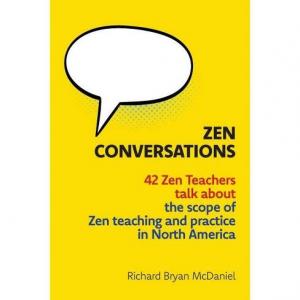
Another baby book has birthed and is making their way the world. In this case, it’s Rick McDaniel’s new book that’s out there, ready to be read. You’ll find it here: click. Zen Conversations includes a section by yours truly, see below, and features a rare section by Tetsugan Sensei, my wife, best friend, and teaching partner.
If you follow the click, you’ll also find fourteen blurbs by Zen teachers – now that’s one well-blurbed book! These blurbs represent a really wide range of Zen teachers, which is also what you’ll find in the book – a wide range of opinions about key issues in Zen practice. Indeed, the array of views might be confusing. After all, if there is this thing called Zen, then shouldn’t there be more commonality about what the heck it is?
That seems reasonable, but apparently, Zen doesn’t mind having many voices. What is the one voice?
Here’s the blurb I wrote: “In Zen Conversations, Rick McDaniel captures the voice of American Zen. It comes through as if there were one voice whispering through all the many voices chronicled here and through all the various views about practice and awakening. Rick’s extraordinary interviewing skills stand out through these many Zen teachers. He himself is almost absent, while his subjects shine through on page after page. A delightful read.”
Beyond the blurb, below you’ll find the portion of Zen Conversations that I contributed. In addition to sharing a little section in hope that might lead you to buy the book, I’m posting this because it strikes me as a pretty clear expression of my opinion – that if a Zen student’s intention is to realize the same mind as Buddha and live accordingly, koan work is more effective for most householders than just-sitting. I hope this might stimulate some conversations about best practice standards for meditation techniques, especially among Zen teachers.
We teachers have best practice standards in other areas – governance and ethics, for example – so why not have best practice standards for the heart of Zen?
I invite you to take a look at this. If you are so moved, share your opinion on the Facebook page where you found this (not Disqus, please).
If you’re interested in reflecting on the Zen movement in the West (especially the US and Canada), or if you’re looking for a teacher and would like to see them in the context of an array of other teachers, I encourage you to buy Rick’s book.
Here’s the excerpt:
Since Albert Low’s death, Dosho Port is the teacher with whom I’ve continued playing with koans. He is a Dharma heir of both Dainin Katagiri and James Ford, and his training with Katagiri was in the Soto tradition where the focus is on monastic life and shikan taza – which Dosho prefers to refer to by the English rendering “just-sitting” – rather than on koan study. It was Katagiri’s wish, however, that Dosho spend some time practicing in Japan, and, while there, he was introduced to koan work.
“I think the purpose of koan introspection and just-sitting combined with dignified behavior, the way it’s taught in Soto monasticism, are the same,” he tells me. “But if the goal is to realize the same mind as Buddha and live accordingly – or ‘to practice awakening’ as Dogen put it – koan work is more effective for most householders than just-sitting, and, despite the continuing prevalence and power of the monastic narrative within Western Zen, about 99% of Zen students are householders.
“What Harada Daiun Roshi and Yasutani Roshi did in the 20th century was simplify the Rinzai koan curriculum so that it was portable, so that practicing awakening as a householder was within reach of anyone who approached the work with persistence and skilled guidance. I don’t know that making it available to householders was their intention. It could be that they were just trimming the hedge that had grown up since Hakuin’s time, but that simplification, or refocusing, made it possible for English-speaking Westerners to do post-kensho koan training without being Chinese classics scholars.
“At about the same time, Shunryu Suzuki Roshi, Katagiri Roshi, Chino Roshi, and others were here trying to figure out how to teach people how to practice in householder life in the West, and so they simplified dignified-behavior training from the Soto monastic system in a way that was similar to what Harada Roshi and Yasutani Roshi had done with the koan curriculum. But, in my experience, without the monastic container, the impact of dignified-behavior training is rarely as effective as the koan curriculum. It just isn’t as obviously portable.
“Saying this doesn’t make me very popular in some Soto circles, but that’s my experience as a student and as a teacher, first as a teacher in the Soto system for twenty years and now as a teacher of the Harada-Yasutani koan curriculum for about ten. Without koan training, people can certainly have deep belief in the efficacy of the Buddhadharma, but it’s rare to actually taste the truth of Zen in their life without some kind of koan work. It’s possible, of course, and I’ve met about a dozen students, some of whom also started with Katagiri Roshi, who I’m convinced had clear kensho experiences while practicing just-sitting. But even if someone living as a householder has a first kensho, there isn’t a system within Soto Zen in the West, at least outside of the few Soto monasteries here, that can help people move through and beyond the first opening. And post-kensho integration is really the more important part of training. Within the koan curriculum there are hundreds of barrier koans to pass through as exercises in the ‘how to’ of vividly practicing awakening – actually integrating the kensho experience within the nitty gritty details of the life the person is living.”
 Dōshō Port began practicing Zen in 1977 and now co-teaches with his wife, Tetsugan Zummach Ōshō, with the Vine of Obstacles: Online Support for Zen Training, an internet-based Zen community. Dōshō received dharma transmission from Dainin Katagiri Rōshi and inka shōmei from James Myōun Ford Rōshi in the Harada-Yasutani lineage. Dōshō’s translation and commentary on The Record of Empty Hall: One Hundred Classic Koans, is now available (Shambhala). He is also the author of Keep Me In Your Heart a While: The Haunting Zen of Dainin Katagiri.
Previous Post

April 1, 2021
Cyber Zen: Practicing Awakening in These Very Times
Next Post
June 25, 2021 Xutang's Blurb for Dogen's Best Seller
Browse Our Archives
Select a Category Uncategorized
Select a Month August 2023 July 2023 June 2023 May 2023 April 2023 March 2023 February 2023 January 2023 December 2022 November 2022 October 2022 September 2022 August 2022 July 2022 June 2022 May 2022 April 2022 March 2022 February 2022 January 2022 December 2021 November 2021 August 2021 June 2021 April 2021 February 2021 January 2021 November 2020 September 2020 August 2020 July 2020 June 2020 May 2020 April 2020 January 2020 December 2019 November 2019 August 2019 June 2019 May 2019 April 2019 February 2019 January 2019 December 2018 November 2018 October 2018 September 2018 August 2018 July 2018 June 2018 May 2018 April 2018 March 2018 February 2018 January 2018 December 2017 November 2017 October 2017 September 2017 August 2017 July 2017 June 2017 December 2016 October 2016 June 2016 April 2016 February 2016 January 2016 December 2015 November 2015 October 2015 August 2015 June 2015 May 2015 April 2015 March 2015 February 2015 January 2015 December 2014 November 2014 October 2014 September 2014 August 2014 July 2014 June 2014 May 2014 April 2014 March 2014 February 2014 January 2014 December 2013 November 2013 October 2013 September 2013 August 2013 July 2013 June 2013 May 2013 April 2013 March 2013 February 2013 January 2013 December 2012 November 2012 October 2012 September 2012 August 2012 July 2012 June 2012 May 2012 April 2012 March 2012 February 2012 January 2012 December 2011 November 2011 October 2011 September 2011 August 2011 July 2011 June 2011 May 2011 April 2011 March 2011 February 2011 January 2011 December 2010 November 2010 October 2010 September 2010 August 2010 July 2010 June 2010 May 2010 April 2010 March 2010 February 2010 January 2010 December 2009 November 2009 October 2009 September 2009 August 2009 July 2009 June 2009 May 2009 April 2009 March 2009 February 2009 January 2009 December 2008 November 2008 October 2008 September 2008 August 2008 July 2008 June 2008 May 2008
Follow Us!
TAKE THE
Religious Wisdom Quiz
What does the name "Jesus" mean?
Select your answer to see how you score.
The Lord Saves Chosen One Son of Man Prince of Peace
Related posts from Wild Fox Zen

Throw Yourself Into the House of Buddha: The...

New Vine Ghost Site for Dosho's Creative Endeavors...

Gnawing Through Qiánfēng’s Three Illnesses and Two Lights

"Why, Oh Why, Is My Practice Not Progressing?"
TRENDING AT PATHEOS Buddhist

On Taking Refuge in the Dharma
(Here I continue the feature of sharing talks and essays by teachers...

(Continuing my intention to share talks and essays by other members of Empty...
The Subtle Art of Bowing: A Dharma Discourse
(This presentation was first offered by my dear friend Dharma Holder Tom...

Internal Family Systems Can Heal you Mentally &...
How IFS Helped Me Stop Fighting Myself Internal Family Systems (IFS) is...

The Bible No One Spoke About: A Family’s...
A mysterious family Bible, unspoken faith, and a journey from curiosity to...

How Uncertainty Can Transform Your Life in 2025
Embracing Uncertainty: A New Year’s Resolution for the Brave As 2025 approaches,...
view all Buddhist blogs
Ad-Free & Subscriber Log-In Subscription Support
- About Us
- 2026 Calendar
- Videos
- Podcasts
- Library of World Religions
- Faith In Media Tracker
- Advertise With Us
- Write for Us
- Privacy Policy
- Terms of Service
- Do Not Sell My Data
- Contact Us
- Radiant Digital
- Manage Newsletter Subscriptions
- Unsubscribe From Notifications
- Sitemap
Copyright 2008-2026, Patheos. All rights reserved.
Subscription Support Ad-Free & Subscriber Log-In
Follow Patheos