
BuddhistCatholicContemplativeEvangelicalGeneral ChristianHinduJewishLatter-day SaintMuslimNew VisionsProgressive Christian
Beliefs
- Buddhist
- Catholic
- Contemplative
- Evangelical
- General Christian
- Hindu
- Jewish
- Latter-day Saint
- More Voices
- Muslim
- New Visions
- Pagan
- Progressive Christian
Topics
- Religion News
- Food and Religion
- Sports and Religion
- Religious Art
- Religious Music and Entertainment
- Religious Events
- History and Religion
- Style and Religion
- Politics and Religion
- Women in Religion
- Recreation Outdoors and Religion
- Business Finance and Religion
- Careers Workplace and Religion
- Education and Religion
- Family Parenting and Religion
- Health Fitness and Religion
- Home and Religion
- Relationships and Religion
- Technology and Religion
- Travel and Religion
Columnists
- Buddhist Columnists
- Business Finance and Religion Columnists
- Careers Workplace and Religion Columnists
- Catholic Columnists
- Contemplative Columnists
- Education and Religion Columnists
- Evangelists Columnists
- Family Parenting and Religion Columnists
- General Christian Columnists
- Health Fitness and Religion Columnists
- Hindu Columnists
- History and Religion Columnists
- Home and Religion Columnists
- Jewish Columnists
- More Voices Columnists
- Latter Day Columnists
- Muslim Columnists
- New Visions Columnists
- Nonreligious Columnists
- Pagan Columnists
- Politics and Religion Columnists
- Progressive Columnists
- Recreation Outdoors and Religion Columnists
- Relationships and Religion Columnists
- Religion News Columnists
- Religious Art Columnists
- Religious Events Columnists
- Religious Music and Entertainment Columnists
- Sports and Religion Columnists
- Style and Religion Columnists
- Technology and Religion Columnists
- Travel and Religion Columnists
- Women in Religion Columnists
Resource Library
- 2026 Calendar
- Library of World Religions
- The 100 Most Holy Places on Earth
- Patheos Answers
- Podcasts
- Videos
- Faith Leaders Database
- Anglican Episcopalian
- Bahai
- Baptist
- Buddhism
- Christianity
- Confucianism
- Eastern Orthodoxy
- Hinduism
- Holiness and Pentecostal
- ISKCON
- Islam
- Judaism
- Lutheran
- Methodist
- The Church of Jesus Christ of Latter-day Saints
- New Age
- Paganism
- Presbytarian and Reformed
- Protestantism
- Religion Behind the Scenes
- Roman Catholic
- Scientology
- Shia Islam
- Sikhism
- Sufism
- Sunni Islam
- Taoism
- Zen
- See all religions
Research Tools
 Ad-Free & Subscriber Log-In Subscription Support
Ad-Free & Subscriber Log-In Subscription Support
Follow Patheos 

- Trending:
- Forgiveness
- |
- Marriage
- |
- Consciousness
- |
- Death Penalty
- |
- Election
- |
- Halloween
 Wild Fox Zen
- Home
- Buddhist
- Disclosing Zen Insight: A Great Flower Blossom Net
Disclosing Zen Insight: A Great Flower Blossom Net
Last updated on: January 25, 2022 at 7:26 pm by Dosho Port
Disclosing Zen Insight: A Great Flower Blossom Net 2022-01-25T19:26:57-06:00 Dosho Port
Patheos Explore the world's faith through different perspectives on religion and spirituality! Patheos has the views of the prevalent religions and spiritualities of the world.
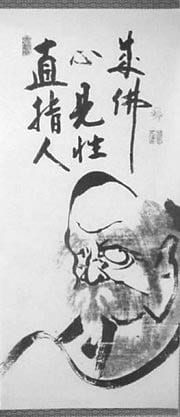
Direct pointing human heart – Calligraphy and painting by Hakuin
First, a Brief Update
As I hope you have heard, The Record of Empty Hall: One Hundred Classic Koans, translated with commentary by me, is due out on February 2. To preorder with a 30% discount and see reviews by Steven Heine, John Tarrant, Meido Moore, Bodhin Kjolhede, and Henry Shukman click here.
You can also browse inside and read Melissa Blacker Roshi’s forward, my introduction, and the first case.
I’ll soon be sharing some excerpts from the book here.
Finally, in terms of FYIs, this is a good time to join the Vine of Obstacles: Online Support for Zen Training. Click here for an overview and click here for more detailed information. It’s a good idea, btw, to attend several of our Saturday Open Zen (via Zoom) sessions, 10:00am-11:15amCT, to see if you resonate with the teachers and the community. Sign up for the email updates with information about these here.
Meanwhile, I’ve been working on another project, and will share a section of that below about disclosing Zen insight, Bodhidharma’s separate transmission, and warming ourselves before the fire. The passage is from the Tongxuan Baiwen (通玄百問), Going Through the Mystery’s One Hundred Questions. The text features three Caodong (Japanese, Soto) teachers from 13th century China: Tongxuan (Going Through the Mystery) asks the questions; Wansong (the commentator in The Book of Serenity) gives brief four or five character response; and Linquan (the commentator in The Empty Valley Collection) adds a verse. Here it is, followed by my comments:
Question 80: Disclosing Zen Insight
Tongxuan asked, “The founding teacher’s separate transmission outside the teaching – to test, I invite the Zen person to disclose their insight.”
Wansong replied, “A great flower blossom net.”
Linquan’s Verse
A great flower blossom net
Not willing to completely approve
Standing in the snow, holding up a flower
In the past they had barely met
Still he didn’t spare his eyebrows and announced the noble wisdom
Warm weather turns cold, trembling, warm yourself facing the fire
Commentary
Tongxuan begins his question with a reference to a famous verse by our founding teacher, Bodhidharma:
Separate transmission outside teaching
Not established words texts
Point directly human heart
See nature realize buddha
Another translation has it like this:
A special transmission outside the scriptures
Not founded upon words and letters;
By pointing directly to [one’s] mind
It lets one see into [one’s own true] nature and [thus] attain Buddhahood.
The first documented occurrence of this verse was by Shexian Guisheng (n.d.), a late tenth-, early eleventh-century master in the Linji line, and attributed to Bodhidharma. Our Zen Way is not established in words or texts, even those words or texts that say our Way is not established on words or texts. Indeed, the source for the stories we tell are finally unknowable and essentially unreliable. What is reliable?
First, a word or two about the translation of Bodhidharma’s verse. Each of the four lines of the verse has just four characters, so it has a symmetrical visual presentation:
教外別傳
不立文字
直指人心
見性成佛
You’ll see above that I’ve rendered it this way as well – four lines with four words each, so sixteen words in total – although, in English the symmetry doesn’t quite work as well.
The translator in the second version has added a lot of words to this text, for a total of thirty-one. Whenever a translation is almost twice as long as the original, the translator is very likely adding meaning, doing the reader’s work for them, by saying what the translator thinks the original says rather than letting the original speak.
With translation, though, there is always interpretation and it is impossible to succeed.
Specifically, in this case, the second translation makes the verse prescriptive – by pointing at the mind we see our true nature and thus attain buddhahood. It makes sense, but those elements are added.
The verse can also be interpreted in other ways, including as descriptive: “Direct pointing human heart.” From this perspective, the human heart is already directly pointing. Always. Likewise, “See nature realize buddha” can also be seen as descriptive. When we see the essential truth, aka, true nature (見性, kensho), we real-ize buddha. We do the awake buddha thing. And when we do the buddha thing, we are awake.
In this context, Tongxuan boldly asks Wansong to show him the nature that he has seen and is now seeing.
“A great flower blossom net,” reports Wansong. Such a beautiful image to embody in zazen. And off the cushion.
For the characters that Wansong uses for “great,” 摩訶, transliterate the Sanskrit, “Maha,” like in Mahayana, the Great Vehicle, instead of the more common Chinese “great,” 大. In this spirit, “This mind itself is buddha” is a Maha flower blossom net, like the net of Indra that extends throughout the multiverse, with a multifaceted jewel at each vertex.
And look! In this net of jewels is a luminous self, a word, an idea, a whole text – quite a bouquet of flower blossoms!
What about Linquan’s verse? Well, to appreciate that more fully, you may need some more context.
As you may know, as the story goes, at an advanced age, the great Indian sage, Bodhidharma, came to China and managed to get an interview with the emperor. However, the interview went badly, especially when he failed to know who he was, so he went north, and then sat facing a wall at Shaolin for nine years. Huike, a desperado waiting for a train, applied to study with the great sage by standing the snow. He finally cut off his arm to demonstrate his sincerity. In other words, “Standing in the snow, holding up a flower.”
The Buddha held up a flower on Vulture Peak and Mahakasyapa smiled. But here we have Huike’s bloody arm held up. When we wholeheartedly enter the way, we often find that we have to give up something of great value. It might seem like an arm or a fixed idea of who we are, but it turns out to be a flower blossom.
In the Soto tradition in Japan, in the evening of December 9, following the seven-day Rohatsu sesshin, Huike’s picture is put on the altar, as this is the day that it is believed that Huike cut off his arm. Then the monks again sit all through the night. In the morning of December 10, sutras are recited to requite Huike’s compassionate blessings. That which Huike had given up, is honored still.
And although Bodhidharma (and by extension, Wansong) and all the ancestors, held nothing back in expressing the noble wisdom, even eyebrows or arms, Bodhidharma and Huike had barely gotten acquainted, so the old barbarian did not approve.
Standing all night in waist deep snow and cutting off an arm, after all, is not necessarily seeing nature, doing buddha. So
don’t wait for the person standing in the snow
to cut off their arm help them now
-Ikkyu
Friend, the weather is turning cold, and, oh dear, you are trembling. Best turn toward the fire and get some warmth.
 Dōshō Port began practicing Zen in 1977 and now co-teaches with his wife, Tetsugan Zummach Ōshō, with the Vine of Obstacles: Online Support for Zen Training, an internet-based Zen community. Dōshō received dharma transmission from Dainin Katagiri Rōshi and inka shōmei from James Myōun Ford Rōshi in the Harada-Yasutani lineage. Dōshō’s translation and commentary on The Record of Empty Hall: One Hundred Classic Koans is due out in February, 2021 (Shambhala). He is also the author of Keep Me In Your Heart a While: The Haunting Zen of Dainin.
Previous Post

November 8, 2020
Reflections on Zen Practice Now and What Comes Next
Next Post
January 18, 2021 Flowers Blooming on a Withered Tree: Incredible!
Browse Our Archives
Select a Category Uncategorized
Select a Month August 2023 July 2023 June 2023 May 2023 April 2023 March 2023 February 2023 January 2023 December 2022 November 2022 October 2022 September 2022 August 2022 July 2022 June 2022 May 2022 April 2022 March 2022 February 2022 January 2022 December 2021 November 2021 August 2021 June 2021 April 2021 February 2021 January 2021 November 2020 September 2020 August 2020 July 2020 June 2020 May 2020 April 2020 January 2020 December 2019 November 2019 August 2019 June 2019 May 2019 April 2019 February 2019 January 2019 December 2018 November 2018 October 2018 September 2018 August 2018 July 2018 June 2018 May 2018 April 2018 March 2018 February 2018 January 2018 December 2017 November 2017 October 2017 September 2017 August 2017 July 2017 June 2017 December 2016 October 2016 June 2016 April 2016 February 2016 January 2016 December 2015 November 2015 October 2015 August 2015 June 2015 May 2015 April 2015 March 2015 February 2015 January 2015 December 2014 November 2014 October 2014 September 2014 August 2014 July 2014 June 2014 May 2014 April 2014 March 2014 February 2014 January 2014 December 2013 November 2013 October 2013 September 2013 August 2013 July 2013 June 2013 May 2013 April 2013 March 2013 February 2013 January 2013 December 2012 November 2012 October 2012 September 2012 August 2012 July 2012 June 2012 May 2012 April 2012 March 2012 February 2012 January 2012 December 2011 November 2011 October 2011 September 2011 August 2011 July 2011 June 2011 May 2011 April 2011 March 2011 February 2011 January 2011 December 2010 November 2010 October 2010 September 2010 August 2010 July 2010 June 2010 May 2010 April 2010 March 2010 February 2010 January 2010 December 2009 November 2009 October 2009 September 2009 August 2009 July 2009 June 2009 May 2009 April 2009 March 2009 February 2009 January 2009 December 2008 November 2008 October 2008 September 2008 August 2008 July 2008 June 2008 May 2008
Follow Us!
TAKE THE
Religious Wisdom Quiz
What is the first book of the New Testament?
Select your answer to see how you score.
Mark Luke John Matthew
Related posts from Wild Fox Zen

The Vigorous Nature of Zen Work

Soto and Rinai Zen: One School or Two?

Meeting People and Manifesting (or not): Two Slippery,...
Rujing and Six Intimate Dharma Heirs
TRENDING AT PATHEOS Buddhist

On Taking Refuge in the Dharma
(Here I continue the feature of sharing talks and essays by teachers...

(Continuing my intention to share talks and essays by other members of Empty...
The Subtle Art of Bowing: A Dharma Discourse
(This presentation was first offered by my dear friend Dharma Holder Tom...

Internal Family Systems Can Heal you Mentally &...
How IFS Helped Me Stop Fighting Myself Internal Family Systems (IFS) is...

The Bible No One Spoke About: A Family’s...
A mysterious family Bible, unspoken faith, and a journey from curiosity to...

How Uncertainty Can Transform Your Life in 2025
Embracing Uncertainty: A New Year’s Resolution for the Brave As 2025 approaches,...
view all Buddhist blogs
Ad-Free & Subscriber Log-In Subscription Support
- About Us
- 2026 Calendar
- Videos
- Podcasts
- Library of World Religions
- Faith In Media Tracker
- Advertise With Us
- Write for Us
- Privacy Policy
- Terms of Service
- Do Not Sell My Data
- Contact Us
- Radiant Digital
- Manage Newsletter Subscriptions
- Unsubscribe From Notifications
- Sitemap
Copyright 2008-2026, Patheos. All rights reserved.
Subscription Support Ad-Free & Subscriber Log-In
Follow Patheos