
BuddhistCatholicContemplativeEvangelicalGeneral ChristianHinduJewishLatter-day SaintMuslimNew VisionsProgressive Christian
Beliefs
- Buddhist
- Catholic
- Contemplative
- Evangelical
- General Christian
- Hindu
- Jewish
- Latter-day Saint
- More Voices
- Muslim
- New Visions
- Pagan
- Progressive Christian
Topics
- Religion News
- Food and Religion
- Sports and Religion
- Religious Art
- Religious Music and Entertainment
- Religious Events
- History and Religion
- Style and Religion
- Politics and Religion
- Women in Religion
- Recreation Outdoors and Religion
- Business Finance and Religion
- Careers Workplace and Religion
- Education and Religion
- Family Parenting and Religion
- Health Fitness and Religion
- Home and Religion
- Relationships and Religion
- Technology and Religion
- Travel and Religion
Columnists
- Buddhist Columnists
- Business Finance and Religion Columnists
- Careers Workplace and Religion Columnists
- Catholic Columnists
- Contemplative Columnists
- Education and Religion Columnists
- Evangelists Columnists
- Family Parenting and Religion Columnists
- General Christian Columnists
- Health Fitness and Religion Columnists
- Hindu Columnists
- History and Religion Columnists
- Home and Religion Columnists
- Jewish Columnists
- More Voices Columnists
- Latter Day Columnists
- Muslim Columnists
- New Visions Columnists
- Nonreligious Columnists
- Pagan Columnists
- Politics and Religion Columnists
- Progressive Columnists
- Recreation Outdoors and Religion Columnists
- Relationships and Religion Columnists
- Religion News Columnists
- Religious Art Columnists
- Religious Events Columnists
- Religious Music and Entertainment Columnists
- Sports and Religion Columnists
- Style and Religion Columnists
- Technology and Religion Columnists
- Travel and Religion Columnists
- Women in Religion Columnists
Resource Library
- 2026 Calendar
- Library of World Religions
- The 100 Most Holy Places on Earth
- Patheos Answers
- Podcasts
- Videos
- Faith Leaders Database
- Anglican Episcopalian
- Bahai
- Baptist
- Buddhism
- Christianity
- Confucianism
- Eastern Orthodoxy
- Hinduism
- Holiness and Pentecostal
- ISKCON
- Islam
- Judaism
- Lutheran
- Methodist
- The Church of Jesus Christ of Latter-day Saints
- New Age
- Paganism
- Presbytarian and Reformed
- Protestantism
- Religion Behind the Scenes
- Roman Catholic
- Scientology
- Shia Islam
- Sikhism
- Sufism
- Sunni Islam
- Taoism
- Zen
- See all religions
Research Tools
 Ad-Free & Subscriber Log-In Subscription Support
Ad-Free & Subscriber Log-In Subscription Support
Follow Patheos 

- Trending:
- Forgiveness
- |
- Marriage
- |
- Consciousness
- |
- Death Penalty
- |
- Election
- |
- Halloween
 Wild Fox Zen
- Home
- Buddhist
- “Hidden Zen: Practices for Sudden Awakening & Embodied Realization” Review
“Hidden Zen: Practices for Sudden Awakening & Embodied Realization” Review
Last updated on: July 16, 2020 at 5:45 am by Dosho Port
“Hidden Zen: Practices for Sudden Awakening & Embodied Realization” Review 2020-07-16T05:45:25-06:00 Dosho Port
Patheos Explore the world's faith through different perspectives on religion and spirituality! Patheos has the views of the prevalent religions and spiritualities of the world.
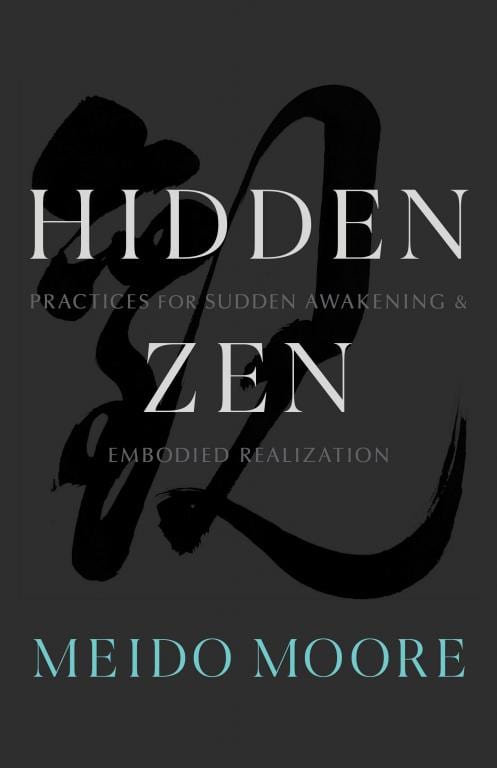
In 2009, I had the pleasure of teaching at what is now the Zen Life & Meditation Center in Chicago. After the teaching event, the teachers, Robert Joshin Althouse and June Ryushin Tanoue, graciously invited several other local Zen teachers over for dinner. The group included a couple of mysterious figures from Daiyuzenji Rinzai Zen Temple, So’zan Miller and Meidō Moore. I say “mysterious,” because neither I nor the Zen folks I hung out with had anything more than scant knowledge of the Omori Rinzai Zen lineage in the US.
My sense of So’zan Miller and Meidō Moore was that these were grounded, well-trained, and like-minded practitioners. So’zan, at one point, mentioned that Meidō, then in his early 40’s, would be starting a Rinzai Zen monastery in rural Wisconsin. I remember thinking that he was just the guy for the job.
Scroll ahead just a little more than a decade and you’ll find that Meidō Rōshi has established Korinji, a satellite group in Madison, written two books – The Rinzai Zen Way: A Guide to Practice and the forthcoming Hidden Zen: Practices for Sudden Awakening & Embodied Realization (now available for pre-order here) – hosts the best Zen page on Facebook (Rinzai Zen Discussion), and widely teaches Zen and martial arts. And that list is quite abbreviated. Indeed, Meidō is a person with a broad and impressive skill set (see Bright Forest Forge at Etsy, for example), not limited to traditional Rinzai Zen practice.
The Omori Rinzai Zen lineage, hidden no more, is a branch of the Inzan line of modern Rinzai Zen. Daiun Harada Rōshi, in whose lineage I am a sixth generation successor, received inka shomei from Dokutan Sosan Rōshi in the other main Rinzai branch, the Takuju line. “Inzan” and “Takuju” are the names of two of the successors of Hakuin Zenji’s successor, Gasan Jitō Zenji, whose lineages have continued to the present day. What’s the difference between their two lines?
“Inzan and Takuju had completely different personalities. Inzan was vigorous, very dynamic; Takuju was meticulous, very careful in his study. And thus two koan systems developed, having the characteristics of each teacher: one very dynamic, and one system requiring you to be very meticulous in examining all elements of each point of a koan.” (1)
The Omori lineage is a branch of the Inzan line and emphasizes art and body practice. The Korinji website summarizes the focal point of the Omori lineage as “…the unity of Zen-ken-sho: literally, Zen, the Sword (martial arts or physical culture), and the Brush (fine arts).”
This emphasis on martial arts and the fine arts, although present in varying degrees in most other Zen lineages, is probably the most distinctive feature of the Omori line.
Critique of Zen in the West
Meidō Rōshi is a critic of some aspects of Zen in the West, especially regarding how many lineages have jettisoned their traditional collection of training tools for psycho-physical embodiment in favor of modernity, and so are left with a merely psychological teaching and practice. “Zen in the head,” in other words, but not the awesome presence of active buddhas.
Meidō Rōshi writes,
“But whatever the origins of this modern approach (and whatever beliefs one may have about what happens when we die), this at least must be stated: in the Rinzai Zen view, a purely psychological realization is mostly conceptual and so inevitably shallow. It is a mirage, lacking sufficient power to cut the roots of ignorance in a lasting manner. More bluntly: it is not the awakening of Zen and is unworthy of comparison with the profound attainment for which the great Zen masters labored so exhaustively. The fruition of Zen practice must be experienced as a wholly psycho-physical transformation of the human being, causing not only experiential change within the mind but also visible change in the body.” (1)
Some who’ve simplified Zen or attempted to eliminate “cultural elements” that are off-putting or perplexing to modern Western people might respond that Americanizing was necessary to bring Zen into Western culture in this time. Still, it could be counter-argued that the Boomer generation of Zen teachers, with more than a tinge of Western cultural arrogance, have often not fully respected the integrity of the training tool kit they inherited from their teachers, and so were quick to blur things up. Too much emptiness, so to speak. Meidō Rōshi seems to be compensating for that.
Which begs the question: are there enough interested practitioners in a full collection of methods, ensconced in pre-modern Japanese culture, for the Omori lineage to continue? Time will tell. Meidō Rōshi acknowledges what I’ve also seen: “Persons willing to undergo the truly arduous path of lifelong Zen training are becoming even less common than in the past.”
Two entries: principle and practice
A sidebar from Bodhidharma’s Two Entrances:
“Now, in entering the path there are many roads. To summarize them, they reduce to two types. The first is entrance by principle, and the second, entrance by practice.” (2)
Dōgen (1200-1253), founder of the Japanese Sōtō lineage, was all about principle (理 or “inner pattern”). Pick up the Shobogenzo almost anywhere and you get the inner pattern through a firehose. The downside of inner-pattern focus is that it can become ideology, lacking in skillful means to help beings actualize it.
Dàhuì (1089–1163), a seminal teacher in the Chinese Línjì lineage, was clearly a practice guy (行, practice, doing, religious acts, deeds, or exercises, aka, method). He focused on refining a method for helping people realize kenshō by arousing Great Doubt, gaining energy for the way, and skillfully employing the keyword (e.g., mu). Throughout his career Dàhuì seems to have continued this inquiry, modifying his teaching practice based on experience.
The downside of the focus on method is that everything can become a tool. Sometimes a cigar is just a cigar. Sometimes the sound of the han is just the sound of the han.
Principle and practice, then, are two entries. One of them isn’t better than the other. Think two foci in intimate dialogue. Some of the great teachers were inclined to emphasize one of the gates more than the other, due to their personal proclivities, and the needs of the times.
Meidō Rōshi, in my view, is a method teacher and says this about principle and method (creatively collapsing the distinction):
“It is naturally incumbent upon Zen teachers in each generation to maintain the core principles of practice, while also seeking innovative ways to present the teachings in a manner matching the needs of contemporary people (whether that is by according with current conditions or decisively challenging them). Yet principles are transmitted using methods and forms, and the process of adaptation and transformation is most successfully accomplished when allowed to happen organically” (emphasis added).
Methods
Hidden Zen is a different kind of Zen book. Most Zen books talk about Zen or unpack the Zen narrative. Hidden Zen offers detailed instruction for how to do Zen. Indeed, perhaps due to Meidō Rōshi’s extensive experience teaching aikidō, he presents sometimes complex practices in a step-by-step and easily followed manner with the ease of a master teacher.
“I should say, though,” Meidō Rōshi writes, “that this book is not titled Hidden Zen because these instructions are intentionally concealed or stamped as secret; in most instances this is not the case. Rather, they are simply things that one is not likely to encounter as an observer, a casual practitioner, or outside the circle of a committed teacher-student relationship.”
Hidden Zen has dozens of exercises divided into two parts – “Direct Pointing” and “Internal Energetic Cultivation.” “Direct Pointing” includes “Spreading Out the Vision,” “Bowing,” “Walking in a Fearful Place,” and “Silent A-Un Breathing.” “Internal Energetic Cultivation” include exercises like “Radiating Vital Energy,” “Basic Tanden Soku (breathing),” and “Fukushiki Kokyu (abdominal breathing),” and the best description of Hakuin’s “Nanso No Ho Practice (soft-butter method)” in print.
Some of these methods are hardwired within the forms of the training hall and others unpack the inner dynamic of practices that often are not explicitly taught.
Meidō Rōshi notes that, “Within both the Soto and Rinzai schools there are in fact many different teaching lines, and these often preserve rather varied—and incredibly interesting—practice material reflecting the histories and interests of lineage ancestors.”
Indeed, a similar book could be written that unpacks the inner workings of the forms of traditional Sōtō Zen, although most lineages in the US have modified and abbreviated these forms, as mentioned above, inadvertently and often unknowingly squeezing out the deep and ancient intelligence that the training forms embody.
Shunryū Suzuki Rōshi is reported to have said, “If I come back here twenty years after my death, you will all be Lutherans.”
He was partly right. Fifty years after his death, many Western Zen priests are Lutherans in Zen robes.
Frosting on the Hidden Cake
Hidden Zen culminates and closes with two especially vivid sections. The first is “Approaching Koan through the Body,” where Meidō Rōshi unpacks Mumon’s (Chinese, Wúmén) classic instructions for how to fully embody the mu koan, beginning with “Arouse your entire body with its three hundred and sixty bones and joints and its eighty-four thousand pores of the skin.”
Meidō writes: “In these first few precious words, Mumon sums up the situation completely and presents the core of koan practice freely, hiding nothing at all. To work with this practice of penetrating the wato (keyword) ‘Mu’ you must use your whole being. ‘Three hundred and sixty bones and joints’ and ‘eighty-four thousand pores of the skin’ taken together means your entire body-mind.
“What does this mean practically? It is that one must unify the whole body-mind with the wato. Joining with the koan in samadhi, exhaling the wato ‘Mu’ with each breath through the whole body and down into the tanden, and causing it thus to ride upon the radiating energetic currents that permeate the body, this ‘Mu’ must be encountered within and digested by means of every fiber of one’s flesh and bone. There is a common instruction given in this regard that one should put the wato or koan in one’s belly and work on it there. But even more than these words for beginners, we should say that the koan must eventually come alive within one’s entire frame through tanden soku: the bodily way of breathing ‘Mu’ with one’s whole being that causes it to percolate through the entire body-mind.”
The second is the “Conclusion: Kyosei’s Voice of the Raindrops” from a teisho given at Korinji:
“Sometimes students ask me about direct pointing in Zen. People ask me to point something out, to cause them to have an experience. I’ve actually received requests like that a few times by email: ‘Can you make me have kensho?’
“But I wish people had more confidence. They don’t know that they are the direct pointing. They don’t recognize that the holy one who reveals the truth and the bodhisattva who works endlessly, lifetime after lifetime, to benefit beings isn’t out there in the rain. They don’t recognize that the original face of Zen isn’t attached to someone else’s head.”
Meidō Rōshi has written a powerful how-to-do Zen book. I suggest, though, that if you are interested in Zen training, that you don’t mistakenly believe you can learn it from a book, even such a fine book. Find a teacher. Meidō Rōshi, for instance. And don’t waste time.
(1)Taizan Maezumi and Bernie Glassman, On Zen Practice, 84.
(2) All Meidō Rōshi quotations are from Hidden Zen: Practices for Sudden Awakening and Embodied Realization, by Meido Moore Rōshi, (Shambhala, 2020).
(3) The Bodhidharma Anthology, “Two Entrances,” trans., Jeffrey L. Broughton, 9.

Dōshō Port began practicing Zen in 1977 and now co-teaches at the Nebraska Zen Center with his wife, Tetsugan Zummach Ōshō. Dōshō also teaches with the Vine of Obstacles: Online Support for Zen Training, an internet-based Zen community. Dōshō received dharma transmission from Dainin Katagiri Rōshi and inka shōmei from James Myōun Ford Rōshi in the Harada-Yasutani lineage. Dōshō’s translation and commentary on The Record of Empty Hall is due out in early 2021 (Shambhala). He is also the author of Keep Me In Your Heart a While: The Haunting Zen of Dainin Katagiri.
Previous Post

June 23, 2020
Dàhuì's Second List of Don'ts for the Dog Kōan
Next Post
July 14, 2020 "Please Sit By The Heater": On Following A Teacher's Instructions
Browse Our Archives
Select a Category Uncategorized
Select a Month August 2023 July 2023 June 2023 May 2023 April 2023 March 2023 February 2023 January 2023 December 2022 November 2022 October 2022 September 2022 August 2022 July 2022 June 2022 May 2022 April 2022 March 2022 February 2022 January 2022 December 2021 November 2021 August 2021 June 2021 April 2021 February 2021 January 2021 November 2020 September 2020 August 2020 July 2020 June 2020 May 2020 April 2020 January 2020 December 2019 November 2019 August 2019 June 2019 May 2019 April 2019 February 2019 January 2019 December 2018 November 2018 October 2018 September 2018 August 2018 July 2018 June 2018 May 2018 April 2018 March 2018 February 2018 January 2018 December 2017 November 2017 October 2017 September 2017 August 2017 July 2017 June 2017 December 2016 October 2016 June 2016 April 2016 February 2016 January 2016 December 2015 November 2015 October 2015 August 2015 June 2015 May 2015 April 2015 March 2015 February 2015 January 2015 December 2014 November 2014 October 2014 September 2014 August 2014 July 2014 June 2014 May 2014 April 2014 March 2014 February 2014 January 2014 December 2013 November 2013 October 2013 September 2013 August 2013 July 2013 June 2013 May 2013 April 2013 March 2013 February 2013 January 2013 December 2012 November 2012 October 2012 September 2012 August 2012 July 2012 June 2012 May 2012 April 2012 March 2012 February 2012 January 2012 December 2011 November 2011 October 2011 September 2011 August 2011 July 2011 June 2011 May 2011 April 2011 March 2011 February 2011 January 2011 December 2010 November 2010 October 2010 September 2010 August 2010 July 2010 June 2010 May 2010 April 2010 March 2010 February 2010 January 2010 December 2009 November 2009 October 2009 September 2009 August 2009 July 2009 June 2009 May 2009 April 2009 March 2009 February 2009 January 2009 December 2008 November 2008 October 2008 September 2008 August 2008 July 2008 June 2008 May 2008
Follow Us!
TAKE THE
Religious Wisdom Quiz
How many daughters did Job have after his restoration?
Select your answer to see how you score.
Two Three Seven Five
Related posts from Wild Fox Zen
The Pivotal Linji Master Xutang and his Profuse...

Soto and Rinai Zen: One School or Two?
Keizan's "Answers to Ten Questions from the Emperor"
Suzuki Rōshi on Kenshō, Householder Practice, and Rinzai...
TRENDING AT PATHEOS Buddhist

On Taking Refuge in the Dharma
(Here I continue the feature of sharing talks and essays by teachers...

(Continuing my intention to share talks and essays by other members of Empty...
The Subtle Art of Bowing: A Dharma Discourse
(This presentation was first offered by my dear friend Dharma Holder Tom...

Internal Family Systems Can Heal you Mentally &...
How IFS Helped Me Stop Fighting Myself Internal Family Systems (IFS) is...

The Bible No One Spoke About: A Family’s...
A mysterious family Bible, unspoken faith, and a journey from curiosity to...

How Uncertainty Can Transform Your Life in 2025
Embracing Uncertainty: A New Year’s Resolution for the Brave As 2025 approaches,...
view all Buddhist blogs
Ad-Free & Subscriber Log-In Subscription Support
- About Us
- 2026 Calendar
- Videos
- Podcasts
- Library of World Religions
- Faith In Media Tracker
- Advertise With Us
- Write for Us
- Privacy Policy
- Terms of Service
- Do Not Sell My Data
- Contact Us
- Radiant Digital
- Manage Newsletter Subscriptions
- Unsubscribe From Notifications
- Sitemap
Copyright 2008-2026, Patheos. All rights reserved.
Subscription Support Ad-Free & Subscriber Log-In
Follow Patheos