
BuddhistCatholicContemplativeEvangelicalGeneral ChristianHinduJewishLatter-day SaintMuslimNew VisionsProgressive Christian
Beliefs
- Buddhist
- Catholic
- Contemplative
- Evangelical
- General Christian
- Hindu
- Jewish
- Latter-day Saint
- More Voices
- Muslim
- New Visions
- Pagan
- Progressive Christian
Topics
- Religion News
- Food and Religion
- Sports and Religion
- Religious Art
- Religious Music and Entertainment
- Religious Events
- History and Religion
- Style and Religion
- Politics and Religion
- Women in Religion
- Recreation Outdoors and Religion
- Business Finance and Religion
- Careers Workplace and Religion
- Education and Religion
- Family Parenting and Religion
- Health Fitness and Religion
- Home and Religion
- Relationships and Religion
- Technology and Religion
- Travel and Religion
Columnists
- Buddhist Columnists
- Business Finance and Religion Columnists
- Careers Workplace and Religion Columnists
- Catholic Columnists
- Contemplative Columnists
- Education and Religion Columnists
- Evangelists Columnists
- Family Parenting and Religion Columnists
- General Christian Columnists
- Health Fitness and Religion Columnists
- Hindu Columnists
- History and Religion Columnists
- Home and Religion Columnists
- Jewish Columnists
- More Voices Columnists
- Latter Day Columnists
- Muslim Columnists
- New Visions Columnists
- Nonreligious Columnists
- Pagan Columnists
- Politics and Religion Columnists
- Progressive Columnists
- Recreation Outdoors and Religion Columnists
- Relationships and Religion Columnists
- Religion News Columnists
- Religious Art Columnists
- Religious Events Columnists
- Religious Music and Entertainment Columnists
- Sports and Religion Columnists
- Style and Religion Columnists
- Technology and Religion Columnists
- Travel and Religion Columnists
- Women in Religion Columnists
Resource Library
- 2026 Calendar
- Library of World Religions
- The 100 Most Holy Places on Earth
- Patheos Answers
- Podcasts
- Videos
- Faith Leaders Database
- Anglican Episcopalian
- Bahai
- Baptist
- Buddhism
- Christianity
- Confucianism
- Eastern Orthodoxy
- Hinduism
- Holiness and Pentecostal
- ISKCON
- Islam
- Judaism
- Lutheran
- Methodist
- The Church of Jesus Christ of Latter-day Saints
- New Age
- Paganism
- Presbytarian and Reformed
- Protestantism
- Religion Behind the Scenes
- Roman Catholic
- Scientology
- Shia Islam
- Sikhism
- Sufism
- Sunni Islam
- Taoism
- Zen
- See all religions
Research Tools
 Ad-Free & Subscriber Log-In Subscription Support
Ad-Free & Subscriber Log-In Subscription Support
Follow Patheos 

- Trending:
- Forgiveness
- |
- Marriage
- |
- Consciousness
- |
- Death Penalty
- |
- Election
- |
- Halloween
 Wild Fox Zen
- Home
- Buddhist
- You Can’t Do It Alone Even On the Internet: A Few Thoughts on Calming and Seeing
You Can’t Do It Alone Even On the Internet: A Few Thoughts on Calming and Seeing
Last updated on: November 29, 2019 at 12:07 pm by Dosho Port
You Can’t Do It Alone Even On the Internet: A Few Thoughts on Calming and Seeing 2019-11-29T12:07:28-06:00 Dosho Port
Patheos Explore the world's faith through different perspectives on religion and spirituality! Patheos has the views of the prevalent religions and spiritualities of the world.
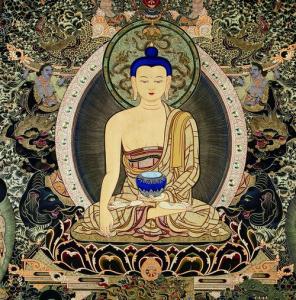 You can’t do what alone?
Traditionally in the buddhadharma across schools, samādhi (calming, concentration or absorption) and vipaśyanā (insight, or in Zen, “kenshō,” seeing true nature) are regarded as the two wings of meditation. And although there seems to be wide agreement in the general tradition that both are necessary for waking up and living accordingly, there is a wide range of views on the emphasis of the two wings, including within the Zen tradition.
At it’s best, the present just-sitting tradition, for example, emphasizes samadhi (e.g., Bokusan’s “Deeply settled heart of the Sōtō school”), while the kōan-introspection tradition emphasizes kenshō (e.g., “mu,” “who?” and “sound of one hand”). It is generally agreed, however, that some degree of samādhi is necessary for awakening, but, as I said, you will find a great deal of variance between and within schools, as well as within and between sub-lineages.
Personally, samādhi was vital for my process and continues to be, as Dōgen said, “the dharma gate of peace and happiness.” But it is seeing through kōan that really enlivens and provides clear instruction for how to integrate samādhi and kenshō within the vertiginous vicissitudes of daily life.
One genius aspect of the mu kōan is how it serves as both a samādhi practice (“be mu“) and an insight practice (“what is mu?”). Subsequent kōan serve to clarify awakening, while also encouraging cultivating verification. Authentic samādhi, by the way, generally requires extensive retreats, while kōan were developed in order to support people doing the work of awakening during chaotic times and in the midst of householder lives.
Through my Zen teaching practice, I’ve seen quite a wide range of capacity for samādhi. That is, some students find settling the mind easy and some find it difficult. And even after the mind settles, there are numerous challenges that arise before a student settles into samādhi and doesn’t mistake subtle laxity, for example, for one-pointedness.
Because some degree of samādhi is usually necessary for awakening, it is important to work with a skilled teacher to cultivate a settled mind to the degree possible for you and within your life circumstances. During this “setting the heart” stage of practice, it is necessary to focus and restrain from chasing after shiny objects, even/especially shiny dharma objects.
Although there are many positives to our present “dharma scene,” including access to a multitude of teachings and teachers via the internet and also “coming soon to a dharma center near you,” given that none of us have much time in this life, it may be best to practice some serious restraint. The many teachings and teachers quickly become noise in the system.
Take kōan for instance. You’ll hear many things about them, pro and con, often from people who haven’t seen through a single kōan, so most of what you’ll read is much like gossip. Of course, some amount of information about the pros and cons can be helpful, and it is wise to know something about what you’re getting yourself into. And then, if you are determined to see it through and through (mu or who? or whatever you’re assigned), then wide reading and learning can just result in dissipation and confusion. So I recommend finding a skilled teacher with whom you feel some affinity, and then taking up the practice you’re offered, throwing yourself into with wholeheartedness, uncommon focus and integrity, and minimal looking around.
Perhaps the essential quality of taking the student seat is to acknowledge that we don’t know what we’re doing, and we aren’t sure where we are on the path. We then inquire of our teacher (e.g., the practitioner on the teacher’s seat) to learn about samādhi and subtle realization. We place ourself in the care, under the guidance, of someone who has direct experience through their own process, not just from browsing on the internet. We allow our teacher to see where we’re at on this journey, and make adjustments to our practice as prescribed. This relational aspect of practice is an essential skill very different from the self-diagnosis of both samādhi and kenshō that seem to be raging on the internet now, especially in Facebook forums.
The possibilities of samadhi and kenshō do not function apart from the teacher-student and community relationships. These are essential for the full functioning of awakening, carrying all beings across.
May we all fully awaken and function freely.
Previous Post

August 23, 2019
Harmony of Difference and Sameness (Alternate Translation)
Next Post
December 6, 2019 Issues in Translation: On 19 Ways of Looking at Wang Wei
Browse Our Archives
Select a Category Uncategorized
Select a Month August 2023 July 2023 June 2023 May 2023 April 2023 March 2023 February 2023 January 2023 December 2022 November 2022 October 2022 September 2022 August 2022 July 2022 June 2022 May 2022 April 2022 March 2022 February 2022 January 2022 December 2021 November 2021 August 2021 June 2021 April 2021 February 2021 January 2021 November 2020 September 2020 August 2020 July 2020 June 2020 May 2020 April 2020 January 2020 December 2019 November 2019 August 2019 June 2019 May 2019 April 2019 February 2019 January 2019 December 2018 November 2018 October 2018 September 2018 August 2018 July 2018 June 2018 May 2018 April 2018 March 2018 February 2018 January 2018 December 2017 November 2017 October 2017 September 2017 August 2017 July 2017 June 2017 December 2016 October 2016 June 2016 April 2016 February 2016 January 2016 December 2015 November 2015 October 2015 August 2015 June 2015 May 2015 April 2015 March 2015 February 2015 January 2015 December 2014 November 2014 October 2014 September 2014 August 2014 July 2014 June 2014 May 2014 April 2014 March 2014 February 2014 January 2014 December 2013 November 2013 October 2013 September 2013 August 2013 July 2013 June 2013 May 2013 April 2013 March 2013 February 2013 January 2013 December 2012 November 2012 October 2012 September 2012 August 2012 July 2012 June 2012 May 2012 April 2012 March 2012 February 2012 January 2012 December 2011 November 2011 October 2011 September 2011 August 2011 July 2011 June 2011 May 2011 April 2011 March 2011 February 2011 January 2011 December 2010 November 2010 October 2010 September 2010 August 2010 July 2010 June 2010 May 2010 April 2010 March 2010 February 2010 January 2010 December 2009 November 2009 October 2009 September 2009 August 2009 July 2009 June 2009 May 2009 April 2009 March 2009 February 2009 January 2009 December 2008 November 2008 October 2008 September 2008 August 2008 July 2008 June 2008 May 2008
Follow Us!
TAKE THE
Religious Wisdom Quiz
Who was the mother of Samuel?
Select your answer to see how you score.
Deborah Hannah Ruth Rebekah
Related posts from Wild Fox Zen

Gnawing Through Qiánfēng’s Three Illnesses and Two Lights

"Why, Oh Why, Is My Practice Not Progressing?"

What is the Heart of Zen? Reflections on...

A Black Lacquer Person Runs Through the Night:...
TRENDING AT PATHEOS Buddhist

On Taking Refuge in the Dharma
(Here I continue the feature of sharing talks and essays by teachers...

(Continuing my intention to share talks and essays by other members of Empty...
The Subtle Art of Bowing: A Dharma Discourse
(This presentation was first offered by my dear friend Dharma Holder Tom...

Internal Family Systems Can Heal you Mentally &...
How IFS Helped Me Stop Fighting Myself Internal Family Systems (IFS) is...

The Bible No One Spoke About: A Family’s...
A mysterious family Bible, unspoken faith, and a journey from curiosity to...

How Uncertainty Can Transform Your Life in 2025
Embracing Uncertainty: A New Year’s Resolution for the Brave As 2025 approaches,...
view all Buddhist blogs
Ad-Free & Subscriber Log-In Subscription Support
- About Us
- 2026 Calendar
- Videos
- Podcasts
- Library of World Religions
- Faith In Media Tracker
- Advertise With Us
- Write for Us
- Privacy Policy
- Terms of Service
- Do Not Sell My Data
- Contact Us
- Radiant Digital
- Manage Newsletter Subscriptions
- Unsubscribe From Notifications
- Sitemap
Copyright 2008-2026, Patheos. All rights reserved.
Subscription Support Ad-Free & Subscriber Log-In
Follow Patheos