
BuddhistCatholicContemplativeEvangelicalGeneral ChristianHinduJewishLatter-day SaintMuslimNew VisionsProgressive Christian
Beliefs
- Buddhist
- Catholic
- Contemplative
- Evangelical
- General Christian
- Hindu
- Jewish
- Latter-day Saint
- More Voices
- Muslim
- New Visions
- Pagan
- Progressive Christian
Topics
- Religion News
- Food and Religion
- Sports and Religion
- Religious Art
- Religious Music and Entertainment
- Religious Events
- History and Religion
- Style and Religion
- Politics and Religion
- Women in Religion
- Recreation Outdoors and Religion
- Business Finance and Religion
- Careers Workplace and Religion
- Education and Religion
- Family Parenting and Religion
- Health Fitness and Religion
- Home and Religion
- Relationships and Religion
- Technology and Religion
- Travel and Religion
Columnists
- Buddhist Columnists
- Business Finance and Religion Columnists
- Careers Workplace and Religion Columnists
- Catholic Columnists
- Contemplative Columnists
- Education and Religion Columnists
- Evangelists Columnists
- Family Parenting and Religion Columnists
- General Christian Columnists
- Health Fitness and Religion Columnists
- Hindu Columnists
- History and Religion Columnists
- Home and Religion Columnists
- Jewish Columnists
- More Voices Columnists
- Latter Day Columnists
- Muslim Columnists
- New Visions Columnists
- Nonreligious Columnists
- Pagan Columnists
- Politics and Religion Columnists
- Progressive Columnists
- Recreation Outdoors and Religion Columnists
- Relationships and Religion Columnists
- Religion News Columnists
- Religious Art Columnists
- Religious Events Columnists
- Religious Music and Entertainment Columnists
- Sports and Religion Columnists
- Style and Religion Columnists
- Technology and Religion Columnists
- Travel and Religion Columnists
- Women in Religion Columnists
Resource Library
- 2026 Calendar
- Library of World Religions
- The 100 Most Holy Places on Earth
- Patheos Answers
- Podcasts
- Videos
- Faith Leaders Database
- Anglican Episcopalian
- Bahai
- Baptist
- Buddhism
- Christianity
- Confucianism
- Eastern Orthodoxy
- Hinduism
- Holiness and Pentecostal
- ISKCON
- Islam
- Judaism
- Lutheran
- Methodist
- The Church of Jesus Christ of Latter-day Saints
- New Age
- Paganism
- Presbytarian and Reformed
- Protestantism
- Religion Behind the Scenes
- Roman Catholic
- Scientology
- Shia Islam
- Sikhism
- Sufism
- Sunni Islam
- Taoism
- Zen
- See all religions
Research Tools
 Ad-Free & Subscriber Log-In Subscription Support
Ad-Free & Subscriber Log-In Subscription Support
Follow Patheos 

- Trending:
- Forgiveness
- |
- Marriage
- |
- Consciousness
- |
- Death Penalty
- |
- Election
- |
- Halloween
 Wild Fox Zen
- Home
- Buddhist
- Zen Practice for Everyone and More
Zen Practice for Everyone and More
Last updated on: January 25, 2022 at 7:37 pm by Dosho Port
Zen Practice for Everyone and More 2022-01-25T19:37:49-06:00 Dosho Port
Patheos Explore the world's faith through different perspectives on religion and spirituality! Patheos has the views of the prevalent religions and spiritualities of the world.
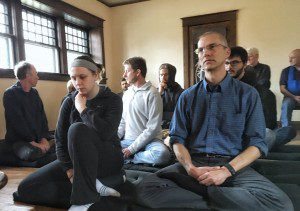
My wife and co-teacher, Tetsugan, and I have been noticing how participation falls into five types (give or take): visitor, member, student, apprentice, and successor. In this post, I’ll briefly flesh out those levels of participation.
By the way, and with synchronicity, James Myōūn Ford Rōshi has a recent post, Zen Practice for Everyone, with two levels: Openers of the Way and Followers of the Way. What I’m doing here is offering a way to see James’ “Followers of the Way” with more nuance. Or perhaps, as he cautions against, I’m holding “… the distinctions too tightly.” You get to be the judge.
Another piece of background is a psychological approach that I find helpful. It looks at the group dynamics at play in group membership – the FIRO Theory – and posits that people are sorting out three questions, simply put as:
“In or out?” (inclusion)
“Up or down?” (control) and
“Near or far?” (affection)
I sense that many people that come through the door are looking for something, but many are not yet clear what that is. The process of Zen practice can help clarify the heart’s innermost request, and we have skills that can assist visitors through the process of clarifying intention.
And like James said in his post, “One may participate at this level for as long as one wishes. There are many reasons this might be one’s best option for a lifetime. Family concerns. Work. Those other spiritual obligations. Life is messy, and there should be no judgement. This ‘light’ connection can bring forth good fruit.”
And in the end, we’ll all visitors here.
Member
The second level of participation is that of a member in the community. After some time checking out the community and teachers, some visitors will feel moved to support what’s happening with regular participation, a regular financial contribution, and a more regular practice, usually once a week or more. Some members practice zazen at home, and others don’t. No problem.
Hopefully, membership will fulfill a member’s need for belonging. Excellent. We live in a time of atomization and alienation, so this is not only understandable, but it is one of the services that we offer. Some people remain as members for years, and that’s fine. When a person participates at the member level, the community is more important than the teachers.
To members, we say with Rumi, “Are you stranger who just wandered in? Welcome home, my friend, welcome home.”
Some people become members as a way of taking another step closer to see if participation here in this community, with these teachers, addresses their heart’s longing to return home, and to be at home wherever they are. If that’s the case, then a member is on their way to becoming a student.
Student
Students begin to focus more of their time and energy into “open-hearted inquiry and audacious awakening”. How does that look? Students show up for zazen, classes, and sesshin. They engage the teachers regularly in dokusan (brief one-to-ones that happen during zazen) and occasional practice meetings (longer, relaxed, and scheduled when it works). They become more involved in the work of the center, becoming timekeepers, liturgists, and board members. Although visitors and members are also welcome – and encouraged – to join in the work of the center, it is often students who weed the garden, oil the hinges on the back door when needed, clean, serve tea and coffee, and notice when visitors and members need help. Yet the work of a student is primarily about their own zazen, study, and engagement (living the way), and secondarily about serving others.
Some students will begin working with kōan, while others will continue with the breath. Some students will decide to deepen their involvement and commitment to the buddhadharma through focused study of the precepts, with the intention to hone their capacity to not only do no harm, but to benefit living beings. They may go on to sew a rakusu, and then formally receive the precepts (Japanese, jukai). At that point, most will choose to remain students. Some will explore a closer relationship with the teachers and become apprentices.
Apprentice
Becoming an apprentice involves more fully making the above-mentioned shift from “what do I get?” to “what can I give?” Apprentices answer the FIRO questions – “In or out?” “Up or down?” “Near or far?” – by saying “In,” “Down,” and “Near.” For an apprentice, zazen, study, and engagement become about clarifying the great matter so that they can help others clarify the great matter, not necessarily by becoming teachers, but by however they can serve. If a visitor needs a support cushion, a support cushion appears. If a meal needs to be cooked, a tenzo appears. If a toilet needs cleaning, an apprentice holding a toilet-cleaning brush appears.
An apprentice has a close teacher-student relationship, is devoted to daily zazen, and vigorously participates in sesshin as often as possible. In addition to classes offered through the center, under the guidance of the teachers, the apprentice also engages in a rigorous study of the sutras and commentaries that are of significance on the Zen path. We have a Formal Training Curriculum for this.
Apprentices are also expected to play through the Harada-Yasutani kōan curriculum, which serves as a trellis for kenshō, deepening and clarifying the initial kenshō, then more and more fully cultivating verification within the myriad vexations of daily life.
One of the key decisions that apprentices make is whether to undergo the training as a householder or a homeleaver (aka, Zen priest). This is a big topic beyond the scope of this post, so I’ll keep it simple. The key difference in the training of a householder and homeleaver centers around the mastery of Sōtō Zen forms or rituals. This includes how to wear priest robes, zendo decorum, liturgical positions, and conducting ceremonies. In order to master these Zen forms, a period of monastic practice is necessary.
By the way, Robert Aitken Rōshi said somewhere (I believe he did, but this is from memory and I can’t find the source, so it could be me), that he found that it took 2,500 people coming through the door for even one to stay ten years.
Successor
For both householder and homeleaver apprentices, the process usually takes about ten years. After their apprenticeship, some will become teachers, but others will not. We don’t offer this program with any guarantee that it will “make you a teacher.” We recommend to people that explore apprenticeship training to do it if it is what they love to do, and not for what they will get out of it. Especially not for any credential. After all, teaching Zen in our culture is likely to pay less than minimum wage.
Most successors will have completed the Harada-Yasutani kōan curriculum and participated in at least several hundred days of sesshin. They will be fluent enough with the literature of the buddhadharma to know how to use big chunks of it as mirrors for people who want to see who they are. Also, a successor will know how to serve people in the context of Zen practice. In order to teach, a person should have the appropriate psychological, pedagogical, and interpersonal skills for such an undertaking, as well as be in life circumstances that support it.
And they need to be ready to not know what they’re getting into.
Next Post

May 20, 2019 Rinzai and Sōtō Meet Face-to-Face
Browse Our Archives
Select a Category Uncategorized
Select a Month August 2023 July 2023 June 2023 May 2023 April 2023 March 2023 February 2023 January 2023 December 2022 November 2022 October 2022 September 2022 August 2022 July 2022 June 2022 May 2022 April 2022 March 2022 February 2022 January 2022 December 2021 November 2021 August 2021 June 2021 April 2021 February 2021 January 2021 November 2020 September 2020 August 2020 July 2020 June 2020 May 2020 April 2020 January 2020 December 2019 November 2019 August 2019 June 2019 May 2019 April 2019 February 2019 January 2019 December 2018 November 2018 October 2018 September 2018 August 2018 July 2018 June 2018 May 2018 April 2018 March 2018 February 2018 January 2018 December 2017 November 2017 October 2017 September 2017 August 2017 July 2017 June 2017 December 2016 October 2016 June 2016 April 2016 February 2016 January 2016 December 2015 November 2015 October 2015 August 2015 June 2015 May 2015 April 2015 March 2015 February 2015 January 2015 December 2014 November 2014 October 2014 September 2014 August 2014 July 2014 June 2014 May 2014 April 2014 March 2014 February 2014 January 2014 December 2013 November 2013 October 2013 September 2013 August 2013 July 2013 June 2013 May 2013 April 2013 March 2013 February 2013 January 2013 December 2012 November 2012 October 2012 September 2012 August 2012 July 2012 June 2012 May 2012 April 2012 March 2012 February 2012 January 2012 December 2011 November 2011 October 2011 September 2011 August 2011 July 2011 June 2011 May 2011 April 2011 March 2011 February 2011 January 2011 December 2010 November 2010 October 2010 September 2010 August 2010 July 2010 June 2010 May 2010 April 2010 March 2010 February 2010 January 2010 December 2009 November 2009 October 2009 September 2009 August 2009 July 2009 June 2009 May 2009 April 2009 March 2009 February 2009 January 2009 December 2008 November 2008 October 2008 September 2008 August 2008 July 2008 June 2008 May 2008
Follow Us!
TAKE THE
Religious Wisdom Quiz
What did God speak to Job out of?
Select your answer to see how you score.
A pillar of fire A burning bush A cloud A whirlwind
Related posts from Wild Fox Zen

Throw Yourself Into the House of Buddha: The...

New Vine Ghost Site for Dosho's Creative Endeavors...

Gnawing Through Qiánfēng’s Three Illnesses and Two Lights

"Why, Oh Why, Is My Practice Not Progressing?"
TRENDING AT PATHEOS Buddhist

On Taking Refuge in the Dharma
(Here I continue the feature of sharing talks and essays by teachers...

(Continuing my intention to share talks and essays by other members of Empty...
The Subtle Art of Bowing: A Dharma Discourse
(This presentation was first offered by my dear friend Dharma Holder Tom...

Internal Family Systems Can Heal you Mentally &...
How IFS Helped Me Stop Fighting Myself Internal Family Systems (IFS) is...

The Bible No One Spoke About: A Family’s...
A mysterious family Bible, unspoken faith, and a journey from curiosity to...

How Uncertainty Can Transform Your Life in 2025
Embracing Uncertainty: A New Year’s Resolution for the Brave As 2025 approaches,...
view all Buddhist blogs
Ad-Free & Subscriber Log-In Subscription Support
- About Us
- 2026 Calendar
- Videos
- Podcasts
- Library of World Religions
- Faith In Media Tracker
- Advertise With Us
- Write for Us
- Privacy Policy
- Terms of Service
- Do Not Sell My Data
- Contact Us
- Radiant Digital
- Manage Newsletter Subscriptions
- Unsubscribe From Notifications
- Sitemap
Copyright 2008-2026, Patheos. All rights reserved.
Subscription Support Ad-Free & Subscriber Log-In
Follow Patheos