
BuddhistCatholicContemplativeEvangelicalGeneral ChristianHinduJewishLatter-day SaintMuslimNew VisionsProgressive Christian
Beliefs
- Buddhist
- Catholic
- Contemplative
- Evangelical
- General Christian
- Hindu
- Jewish
- Latter-day Saint
- More Voices
- Muslim
- New Visions
- Pagan
- Progressive Christian
Topics
- Religion News
- Food and Religion
- Sports and Religion
- Religious Art
- Religious Music and Entertainment
- Religious Events
- History and Religion
- Style and Religion
- Politics and Religion
- Women in Religion
- Recreation Outdoors and Religion
- Business Finance and Religion
- Careers Workplace and Religion
- Education and Religion
- Family Parenting and Religion
- Health Fitness and Religion
- Home and Religion
- Relationships and Religion
- Technology and Religion
- Travel and Religion
Columnists
- Buddhist Columnists
- Business Finance and Religion Columnists
- Careers Workplace and Religion Columnists
- Catholic Columnists
- Contemplative Columnists
- Education and Religion Columnists
- Evangelists Columnists
- Family Parenting and Religion Columnists
- General Christian Columnists
- Health Fitness and Religion Columnists
- Hindu Columnists
- History and Religion Columnists
- Home and Religion Columnists
- Jewish Columnists
- More Voices Columnists
- Latter Day Columnists
- Muslim Columnists
- New Visions Columnists
- Nonreligious Columnists
- Pagan Columnists
- Politics and Religion Columnists
- Progressive Columnists
- Recreation Outdoors and Religion Columnists
- Relationships and Religion Columnists
- Religion News Columnists
- Religious Art Columnists
- Religious Events Columnists
- Religious Music and Entertainment Columnists
- Sports and Religion Columnists
- Style and Religion Columnists
- Technology and Religion Columnists
- Travel and Religion Columnists
- Women in Religion Columnists
Resource Library
- 2026 Calendar
- Library of World Religions
- The 100 Most Holy Places on Earth
- Patheos Answers
- Podcasts
- Videos
- Faith Leaders Database
- Anglican Episcopalian
- Bahai
- Baptist
- Buddhism
- Christianity
- Confucianism
- Eastern Orthodoxy
- Hinduism
- Holiness and Pentecostal
- ISKCON
- Islam
- Judaism
- Lutheran
- Methodist
- The Church of Jesus Christ of Latter-day Saints
- New Age
- Paganism
- Presbytarian and Reformed
- Protestantism
- Religion Behind the Scenes
- Roman Catholic
- Scientology
- Shia Islam
- Sikhism
- Sufism
- Sunni Islam
- Taoism
- Zen
- See all religions
Research Tools
 Ad-Free & Subscriber Log-In Subscription Support
Ad-Free & Subscriber Log-In Subscription Support
Follow Patheos 

- Trending:
- Forgiveness
- |
- Marriage
- |
- Consciousness
- |
- Death Penalty
- |
- Election
- |
- Halloween
 Wild Fox Zen
- Home
- Buddhist
- Rinzai and Sōtō Meet Face-to-Face
Rinzai and Sōtō Meet Face-to-Face
Last updated on: February 20, 2022 at 7:58 pm by Dosho Port
Rinzai and Sōtō Meet Face-to-Face 2022-02-20T19:58:10-06:00 Dosho Port
Patheos Explore the world's faith through different perspectives on religion and spirituality! Patheos has the views of the prevalent religions and spiritualities of the world.
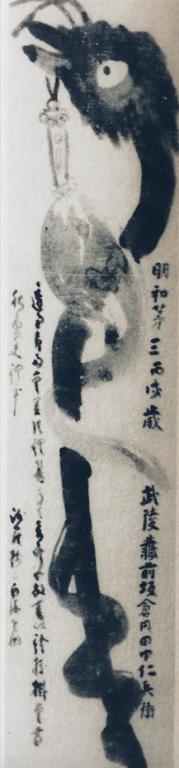
Hakuin’s “Dragon Staff,” given to those who heard the sound of one hand
Was Hakuin Ekaku (1686 – 1768), the great Japanese revitalizer of Rinzai Zen and the inspiration for much of modern-day kōan introspection, a hater of that other Zen school – Sōtō Zen? What would have happened if Hakuin and a Sōtō monk had met face-to-face?
The short answer to the first question is “No, Hakuin was not a Sōtō hater.”
The short answer to the second question is that it happened a lot and, well, see below. From Hakuin’s reports, a good number of Sōtō monks studied with him and when Hakuin was a young monk, he also studied in Sōtō monasteries.
Hakuin did, however, have blistering criticisms of the silent illumination tendencies of the Sōtō Zen of his day. See my Hakuin’s Blistering Criticisms of Sōtō Zen: Who and What for a more detailed look at this. Briefly, Hakuin had at least these four criticisms:
- The zazen of silent illumination Zen is a passive pursuit of a state of perfect purity, and sometimes just a do-nothing practice of zoning out, sleeping, and generally wasting the resources of donors.
- Silent illumination Zen takes kensho as something that is inherent, too pure to experience, or already realized, and so denies the reality and significance of a personal experience of kenshō.
- Because silent illumination Zen denies kenshō, it has no inclination for post-satori development like Hakuin’s method for post-satori practice – digging into many kōans and sutras.
- Silent illumination Zen takes the dharma as a belief system and so the power of such teachings as “formlessness” and “no mind” is lost in doctrinal dharma (as opposed to personally putting it to work).
You may notice that some of the above seem to apply to much of today’s Sōtō Zen. Nevertheless….
Rinzai and Sōtō: Never the Twain Shall Meet?
Despite his often-repeated negative criticisms of Sōtō Zen, especially Sōtō with a silent illumination emphasis, Hakuin borrowed the Five Ranks teaching of Dòngshān from the Cáodòng (Sōtō) school, rather than use Línjì‘s Four Views, for example. Hakuin received instruction in the Five Ranks from either his main teacher, Shōju Rōjin (aka, Dōkyū Etan, 1642–1721), or from his own encounter with Sōtō priests at Inryō-ji, teh Sōtō temple referred to above that Hakuin stayed at for a practice period shortly after he left Shōju Rōshi. (1) Or perhaps both.
By this time, Hakuin was already suffering from Zen sickness, but had yet to meet Hakuyū and learn the “soft-butter method” that cured him. (2) Due to Hakuin’s affinity with the Five Ranks, they now serve as central (but quiet) organizing principles in both the contemporary Rinzai kōan curriculum and the reformed Hakuin-Yasutani kōan curriculum transplanted to the West by the likes of Rōshis Yasutani, Maezumi, Kapleau, and Aitken.
In Hakuin’s day, it should be noted, Sōtō and Rinzai were not as separate as they are today, at least, in Japan, where I’m told that if a Sōtō monk wants to train in a Rinzai monastery, they would need to reordain. Apparently, the reverse is also the case. This was not the case in Hakuin’s time.
In my view, it is a sad development. I have greatly benefited from study in Rinzai Zen and in the Harada-Yasutani kōan tradition, and would like to see more Sōtō practitioners have that opportunity, and visa versa. At the same time, both Sōtō and Rinzai lineages have a “family style” with integrity and could both make important contributions to sincere practitioners more interested in awakening than to sectarian purity, as well as to our fledgling global culture. So my hope is that both continue vigorously.
To complicate the situation, however, there are also some lineages that are neither Sōtō nor Rinzai in the traditional sense. I’m referring to all those who are descendents of Harada Daiūn Rōshi (1871 – 1961), the Sōtō monk who trained extensively in Rinzai Zen and received inka shōmei (proof of succession) from Tōyōta Dōkutan Rōshi (1840-1917), a Rinzai Zen master. Harada Daiūn Rōshi had a long teaching career in a Sōtō monastery, Hōshinji, used a reformed kōan curriculum, and also trained lay people together with monks, something that just was not done in his day.
Some of Harada Daiūn Rōshi’s present day successors regard themselves as Rinzai, some see themselves as Sōtō. In my case, due to the good steeping in Sōtō I received from my time with Katagiri Roshi, I emphasize the flow of Sōtō (aka, “forms”), and the importance of Dōgen’s teaching. At the same time, I think that kōan introspection inspired by Hakuin and Tōrei, is the greatest meditation innovation since the Buddha saw the morning star. From this hybrid perspective, Dōgen’s teaching is esteemed but not privileged. After all, there have been a lot of great Zen teachers.
But let’s get back to Inryō-ji
where Hakuin had a lovely practice period in a Sōtō monastery. Later, he described fifty monks practicing earnestly, including a monk named Jukaku Jōza, someone Hakuin felt he’d know for many years, and who Hakuin recognized for his genuine aspiration for the Way. At first, though, Hakuin saw him as “…an old man who seemed half-demented, with an unsightly face and a robe hanging in tatters from his body . . . who ran off when he saw me coming.” (2)
Fortunately, Hakuin sat next to Jukaku during the 90-day practice session. When Hakuin finally cornered Jukaku and they had a chance to talk, Hakuin says that they found their minds to be in complete agreement. This inspired them to sit an extreme sesshin together.
Here’s how Hakuin told the story:
“On one occasion, the two of us engaged in a private practice session. We pledged to continue it for seven days and nights. No sleep. No lying down. We cut a three-foot section of bamboo and fashioned it into a makeshift shippei. We sat facing each other with the shippei placed on the ground between us. We agreed that if one of us saw the other’s eyelids drop, even for a split second, he would grab the staff and crack him with it between the eyes. For seven days, we sat ramrod-straight, teeth clenched tightly in total silence. Not so much as an eyelash quivered. Right through to the end of the seventh night, neither one of us had occasion to reach for that cudgel. One night, a heavy snowfall blanketed the area. The dull, muffled thud of snow falling from the branches of the trees created a sense of extraordinary stillness and purity. I made an attempt at a poem to describe the joy I felt:
If only you could hear
the sound of snow
falling late at night
from the trees
of the old temple
in Shinoda!” (4)
The abbot of the Inryō-ji, a Sōtō lineage monk, even asked Hakuin, a Rinzai lineage monk, to be his successor at Inryō-ji. Hakuin seems to have been tempted, noting that “…the temple holdings included some very rich and productive fields, making it possible to provide for forty or even fifty visiting monks at annual summer retreats.” (5)
It wasn’t an easy choice, but Hakuin eventually decided he was not ready to settle down, so he declined the offer, and went on with his pilgrimage. On the day that Hakuin left Inryō-ji, he reported that “… Jukaku slipped away from the assembly, walked along at my side for several leagues, and then turned back.” (6)
So tender!
What would happen if Hakuin met a Sōtō monk face-to-face? In this case, they entangled eyebrows, and became fast dharma friends.
(1) See Complete Poison Blossoms from a Thicket of Thorn, trs., Norman Waddell, “58. Informal Talk on a Winter Night,” for Hakuin on Rujing and Dōgen. Here and in other places, Hakuin spoke highly of Dōgen, who, by the way, was also critical of silent illumination.
(2) See Wild Ivy: The Spiritual Autobiography of Zen Master Hakuin, trs., Norman Waddell, “The Soft Butter Method,” pp. 105-107.
(3) Precious Mirror Cave, trs., Norman Waddell, pp. 185–6.
(4) Wild Ivy: The Spiritual Autobiography of Zen Master Hakuin, trs., Norman Waddell, pp. 50-51.
(5) Ibid.
(6) Ibid.

Dōshō Port began practicing Zen in 1977 and now co-teaches with his wife, Tetsugan Zummach Sensei, with the Vine of Obstacles: Online Support for Zen Training, an internet-based Zen community. Dōshō received dharma transmission from Dainin Katagiri Rōshi and inka shōmei from James Myōun Ford Rōshi in the Harada-Yasutani lineage. Dōshō’s translation and commentary on The Record of Empty Hall: One Hundred Classic Koans, is now available (Shambhala). He is also the author of Keep Me In Your Heart a While: The Haunting Zen of Dainin Katagiri. Click here to support the teaching practice of Dōshō Rōshi at Patreon.
Previous Post

May 14, 2019
Zen Practice for Everyone and More
Next Post
May 30, 2019 Is Zen Weak on Compassion Teachings? The Dust and Dirt of the Third Rank
Browse Our Archives
Select a Category Uncategorized
Select a Month August 2023 July 2023 June 2023 May 2023 April 2023 March 2023 February 2023 January 2023 December 2022 November 2022 October 2022 September 2022 August 2022 July 2022 June 2022 May 2022 April 2022 March 2022 February 2022 January 2022 December 2021 November 2021 August 2021 June 2021 April 2021 February 2021 January 2021 November 2020 September 2020 August 2020 July 2020 June 2020 May 2020 April 2020 January 2020 December 2019 November 2019 August 2019 June 2019 May 2019 April 2019 February 2019 January 2019 December 2018 November 2018 October 2018 September 2018 August 2018 July 2018 June 2018 May 2018 April 2018 March 2018 February 2018 January 2018 December 2017 November 2017 October 2017 September 2017 August 2017 July 2017 June 2017 December 2016 October 2016 June 2016 April 2016 February 2016 January 2016 December 2015 November 2015 October 2015 August 2015 June 2015 May 2015 April 2015 March 2015 February 2015 January 2015 December 2014 November 2014 October 2014 September 2014 August 2014 July 2014 June 2014 May 2014 April 2014 March 2014 February 2014 January 2014 December 2013 November 2013 October 2013 September 2013 August 2013 July 2013 June 2013 May 2013 April 2013 March 2013 February 2013 January 2013 December 2012 November 2012 October 2012 September 2012 August 2012 July 2012 June 2012 May 2012 April 2012 March 2012 February 2012 January 2012 December 2011 November 2011 October 2011 September 2011 August 2011 July 2011 June 2011 May 2011 April 2011 March 2011 February 2011 January 2011 December 2010 November 2010 October 2010 September 2010 August 2010 July 2010 June 2010 May 2010 April 2010 March 2010 February 2010 January 2010 December 2009 November 2009 October 2009 September 2009 August 2009 July 2009 June 2009 May 2009 April 2009 March 2009 February 2009 January 2009 December 2008 November 2008 October 2008 September 2008 August 2008 July 2008 June 2008 May 2008
Follow Us!
TAKE THE
Religious Wisdom Quiz
Which prophet saw a vision of a flying scroll?
Select your answer to see how you score.
Ezekiel Jeremiah Zechariah Daniel
Related posts from Wild Fox Zen

The Vigorous Nature of Zen Work
The Pivotal Linji Master Xutang and his Profuse...
Cultivating Verification in One School Zen: A New...
The "Soto Zen" of the PMSO: A New...
TRENDING AT PATHEOS Buddhist

On Taking Refuge in the Dharma
(Here I continue the feature of sharing talks and essays by teachers...

(Continuing my intention to share talks and essays by other members of Empty...
The Subtle Art of Bowing: A Dharma Discourse
(This presentation was first offered by my dear friend Dharma Holder Tom...

Internal Family Systems Can Heal you Mentally &...
How IFS Helped Me Stop Fighting Myself Internal Family Systems (IFS) is...

The Bible No One Spoke About: A Family’s...
A mysterious family Bible, unspoken faith, and a journey from curiosity to...

How Uncertainty Can Transform Your Life in 2025
Embracing Uncertainty: A New Year’s Resolution for the Brave As 2025 approaches,...
view all Buddhist blogs
Ad-Free & Subscriber Log-In Subscription Support
- About Us
- 2026 Calendar
- Videos
- Podcasts
- Library of World Religions
- Faith In Media Tracker
- Advertise With Us
- Write for Us
- Privacy Policy
- Terms of Service
- Do Not Sell My Data
- Contact Us
- Radiant Digital
- Manage Newsletter Subscriptions
- Unsubscribe From Notifications
- Sitemap
Copyright 2008-2026, Patheos. All rights reserved.
Subscription Support Ad-Free & Subscriber Log-In
Follow Patheos