
BuddhistCatholicContemplativeEvangelicalGeneral ChristianHinduJewishLatter-day SaintMuslimNew VisionsProgressive Christian
Beliefs
- Buddhist
- Catholic
- Contemplative
- Evangelical
- General Christian
- Hindu
- Jewish
- Latter-day Saint
- More Voices
- Muslim
- New Visions
- Pagan
- Progressive Christian
Topics
- Religion News
- Food and Religion
- Sports and Religion
- Religious Art
- Religious Music and Entertainment
- Religious Events
- History and Religion
- Style and Religion
- Politics and Religion
- Women in Religion
- Recreation Outdoors and Religion
- Business Finance and Religion
- Careers Workplace and Religion
- Education and Religion
- Family Parenting and Religion
- Health Fitness and Religion
- Home and Religion
- Relationships and Religion
- Technology and Religion
- Travel and Religion
Columnists
- Buddhist Columnists
- Business Finance and Religion Columnists
- Careers Workplace and Religion Columnists
- Catholic Columnists
- Contemplative Columnists
- Education and Religion Columnists
- Evangelists Columnists
- Family Parenting and Religion Columnists
- General Christian Columnists
- Health Fitness and Religion Columnists
- Hindu Columnists
- History and Religion Columnists
- Home and Religion Columnists
- Jewish Columnists
- More Voices Columnists
- Latter Day Columnists
- Muslim Columnists
- New Visions Columnists
- Nonreligious Columnists
- Pagan Columnists
- Politics and Religion Columnists
- Progressive Columnists
- Recreation Outdoors and Religion Columnists
- Relationships and Religion Columnists
- Religion News Columnists
- Religious Art Columnists
- Religious Events Columnists
- Religious Music and Entertainment Columnists
- Sports and Religion Columnists
- Style and Religion Columnists
- Technology and Religion Columnists
- Travel and Religion Columnists
- Women in Religion Columnists
Resource Library
- 2026 Calendar
- Library of World Religions
- The 100 Most Holy Places on Earth
- Patheos Answers
- Podcasts
- Videos
- Faith Leaders Database
- Anglican Episcopalian
- Bahai
- Baptist
- Buddhism
- Christianity
- Confucianism
- Eastern Orthodoxy
- Hinduism
- Holiness and Pentecostal
- ISKCON
- Islam
- Judaism
- Lutheran
- Methodist
- The Church of Jesus Christ of Latter-day Saints
- New Age
- Paganism
- Presbytarian and Reformed
- Protestantism
- Religion Behind the Scenes
- Roman Catholic
- Scientology
- Shia Islam
- Sikhism
- Sufism
- Sunni Islam
- Taoism
- Zen
- See all religions
Research Tools
 Ad-Free & Subscriber Log-In Subscription Support
Ad-Free & Subscriber Log-In Subscription Support
Follow Patheos 

- Trending:
- Forgiveness
- |
- Marriage
- |
- Consciousness
- |
- Death Penalty
- |
- Election
- |
- Halloween
 Wild Fox Zen
- Home
- Buddhist
- The Dharma for Taking Food: The Zen Art of Oryoki
The Dharma for Taking Food: The Zen Art of Oryoki
Last updated on: December 2, 2023 at 8:40 pm by Dosho Port
The Dharma for Taking Food: The Zen Art of Oryoki 2023-12-02T20:40:01-06:00 Dosho Port
Patheos Explore the world's faith through different perspectives on religion and spirituality! Patheos has the views of the prevalent religions and spiritualities of the world.

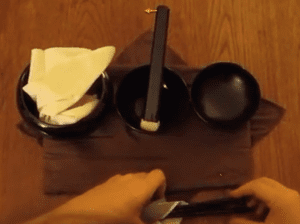
Recently, we held a three-day retreat focussed on Dōgen’s “The Dharma for Taking Food” (Japanese, “Fushukuhanpō”). (1) In this fascicle, Dōgen unpacks the meaning and details of the Sōtō Zen method for eating with bowls that hold just enough, or “oryoki” (pictured above and in the video below).
This post touches on a few points of interest for me in the Sōtō Zen art of receiving a meal. You will not learn, of course, how to eat this way from reading this post. For that, it’s best to personally study with someone who gets this dharma. But if you want to get a taste of it or refresh your skills, a good resource is the Austin Zen Center’s “Learn About Oryoki” page – click.
Ok. Back to Dōgen and “The Dharma for Taking Food.” The first point, to repeat, is that in Dōgen Zen, receiving a meal is an art. Like any art, there’s a flow to doing it. It can’t really be taught, although it does flow hand-to-hand. In my own Sōtō training, I had the great opportunity to observe Katagiri Rōshi flowing artfully through a thousand or so meals with oryoki bowls. The old boy really got this dharma! As for me, though, I’ve come to most appreciate the significance of the wiping cloth, or Wiping Cloth Sensei, as I think of them. More on that later.
Now, in contrast to how this style of eating is often framed in our contemporary Zen scene, Dōgen uses the word mindful just once in his “The Dharma for Taking Food,” saying:
“At this time the monks gassho and in a loud voice mindfully chant….”
And this one-time usage isn’t about chewing the rice in a pretentious, mindful masquerade, but chanting loudly.
Mindfulness is a factor in the art of receiving a meal, but there are a lot of simpler ways to eat mindfully, if that’s what you’re about. So no need for this elaborate practice. As for “The Dharma for Taking Food,” in addition to mindfulness, there are other factors too, like interdependence, reverence, gratitude, and wholeheartedness. But Dōgen emphasized something other than these as well.
Emptiness Comes Specifically
Dōgen begins the “The Dharma for Taking Food” with a passage from the Vimalakirti Sutra: “If you can remain the same with food, all dharmas also remain the same; if all dharmas are the same, then also with food you will remain the same.”
For Dōgen, practicing emptiness, i.e., the equality of all dharmas, is the most important aspect of this way of receiving a meal. The imbedded kōan might be, “When all things are empty, what do you eat? How do you eat? Who eats?”
Dōgen then expanded his key point – dharmas, essential nature, and awakening are all just the food before us now and the food before us now, is exactly dharma, essential nature, and awakening. That is the vital spirit of receiving a meal offering. Given essential equality, Dōgen then goes on to give detailed directions for the steps in the receiving the meal from opening to closing the wrapped bowls, with hundreds of specific directions. For example:
“With your right hand holding the edge of the place mat that is toward you so that it is over the bowls, lift the bowls with the left hand and place them down on the left side of the place mat.”
“During this ceremony, remain in gassho and do not talk, laugh, nod your head, or move around, but just sit silently.”
“After bowing in front of Manjushri, the anja then stands in shashu and announces the meal. The words must be announced clearly with the names correct. If there is any discrepancy the dharma of receiving food is not complete, and it must be announced again.”
If Everything Is Equal, Why Be So Precise?
A while ago, I heard a story second-hand that responds to this question very well. Ejo McMullen Osho, the teacher of the Buddha Eye Temple in Eugene, Oregon, told a story from his training in Japan. He was preparing for a big ceremony with a senior monk, and asked the monk to explain why it was that the green tea was always placed to the left and sweet hot water was always placed to the right of the main figure on the altar. “If I understood why it was, I think I could remember which goes where.”
This is certainly a problem for me too. Even after many years as a Zen priest, I have to consult the ceremony manual for this detail every time.
The monk is reported to have said, “Because it completely doesn’t matter which goes on the right and which goes on the left, we always place the green tea on the left and the sweet hot water on the right.”
That is the spirit of giving ourselves to the details that is emphasized Sōtō Zen.
Seventy-four Do Nots
In addition to the detailed choreography for the art of oryoki eating, Dōgen also gave instructions about what not to do. The text, in fact, contains seventy-four Do Not’s. For example:
Do not pour the leftover water on the floor.
Do not pour the water on the robe sleeves of the server.
Do not wash your hands in the [bowl-washing] water.
Do not poke your hips or elbows over into your neighbors.
Do not grab the utensils from the server’s hands and pick out whatever you want.
Do not scratch your head and let dandruff fall into your bowls.
Do not spit it out into the bowls or elsewhere.
Usually, it seems to me, we only make rules when needed. Dōgen must have been responding to monks doing exactly the things – poking, spitting, dandruff falling into bowls, etc. – that he proscribes. What wild and wooly group of mountain monks!
Wiping Cloth Sensei
Finally, all of the players in the oryoki team – each bowl, the lapkin, spoon, chopsticks, spatula (or setsu), and the utensil holder, as well as the servers and the food – all have a role to play and do so in a consistently upright manner, i.e., very precisely prescribed. All but Wiping Cloth Sensei, that is.
The photo below is the only image that I could find in all the vast internet of Wiping Cloth Sensei (white cloth on left). Wiping Cloth Sensei is totally underrepresented and ignored, despite their vital function of drying the bowls.
The setsu (spatula), by the way, is a bit crooked and should really point straightly, so I added the arrow. I just couldn’t help myself.
But back to Wiping Cloth Sensei. The only rule for Wiping Cloth Sensei in all of Dōgen’s work is to stay in the bowl (see below). Just stay in the bowl.
Within all this precise and carefully choreographic flowing – “Dharma for Taking Food” – Wiping Cloth Sensei alone gets to be a rather wadded mess. The pictured wiping cloth, by the way, is really too neat. That Wiping Cloth Sensei gets to be a mess is extremely important. Whatever you do, don’t try to organize Wiping Cloth Sensei! Let the rumpled, be the rumpled! If you try to straighten out Wiping Cloth Sensei, you will kill the spirit of the oryoki meal. And someone could get hurt, like in our last oryoki meal of the retreat when a student tried too hard to pull the wrinkles out of Wiping Cloth Sensei, who naturally resisted such treatment, and the student wound up tearing their hem clean off.
Wiping Cloth Sensei plays the vital role of not looking all that good. Keep that in mind.
(1) Dogen’s Pure Standards for the Zen Community, trs., Leighton and Okumura, p. 83 – 108.

Dōshō Port began practicing Zen in 1977 and now co-teaches at the with his wife, Tetsugan Zummach Ōshō. Dōshō also teaches with the Vine of Obstacles: Online Support for Zen Training, an internet-based Zen community. Dōshō received dharma transmission from Dainin Katagiri Rōshi and inka shōmei from James Myōun Ford Rōshi in the Harada-Yasutani lineage. He is the author of Keep Me In Your Heart a While: The Haunting Zen of Dainin Katagiri.
Previous Post

February 24, 2019
Is Zen a Joke or a Trick? Crabs, Cartoons, and Solemnity
Next Post
April 11, 2019 Zen Art of Oryoki - Some Things I Forgot to Mention
Browse Our Archives
Select a Category Uncategorized
Select a Month August 2023 July 2023 June 2023 May 2023 April 2023 March 2023 February 2023 January 2023 December 2022 November 2022 October 2022 September 2022 August 2022 July 2022 June 2022 May 2022 April 2022 March 2022 February 2022 January 2022 December 2021 November 2021 August 2021 June 2021 April 2021 February 2021 January 2021 November 2020 September 2020 August 2020 July 2020 June 2020 May 2020 April 2020 January 2020 December 2019 November 2019 August 2019 June 2019 May 2019 April 2019 February 2019 January 2019 December 2018 November 2018 October 2018 September 2018 August 2018 July 2018 June 2018 May 2018 April 2018 March 2018 February 2018 January 2018 December 2017 November 2017 October 2017 September 2017 August 2017 July 2017 June 2017 December 2016 October 2016 June 2016 April 2016 February 2016 January 2016 December 2015 November 2015 October 2015 August 2015 June 2015 May 2015 April 2015 March 2015 February 2015 January 2015 December 2014 November 2014 October 2014 September 2014 August 2014 July 2014 June 2014 May 2014 April 2014 March 2014 February 2014 January 2014 December 2013 November 2013 October 2013 September 2013 August 2013 July 2013 June 2013 May 2013 April 2013 March 2013 February 2013 January 2013 December 2012 November 2012 October 2012 September 2012 August 2012 July 2012 June 2012 May 2012 April 2012 March 2012 February 2012 January 2012 December 2011 November 2011 October 2011 September 2011 August 2011 July 2011 June 2011 May 2011 April 2011 March 2011 February 2011 January 2011 December 2010 November 2010 October 2010 September 2010 August 2010 July 2010 June 2010 May 2010 April 2010 March 2010 February 2010 January 2010 December 2009 November 2009 October 2009 September 2009 August 2009 July 2009 June 2009 May 2009 April 2009 March 2009 February 2009 January 2009 December 2008 November 2008 October 2008 September 2008 August 2008 July 2008 June 2008 May 2008
Follow Us!
TAKE THE
Religious Wisdom Quiz
What is the first book of the New Testament?
Select your answer to see how you score.
Mark Luke John Matthew
Related posts from Wild Fox Zen

New Vine Ghost Site for Dosho's Creative Endeavors...

The Vigorous Nature of Zen Work

Plucking a Blade of Grass: The Wondrous Dharma...

Dōgen’s Instruction for Householder Zen Training
TRENDING AT PATHEOS Buddhist

On Taking Refuge in the Dharma
(Here I continue the feature of sharing talks and essays by teachers...

(Continuing my intention to share talks and essays by other members of Empty...
The Subtle Art of Bowing: A Dharma Discourse
(This presentation was first offered by my dear friend Dharma Holder Tom...

Internal Family Systems Can Heal you Mentally &...
How IFS Helped Me Stop Fighting Myself Internal Family Systems (IFS) is...

The Bible No One Spoke About: A Family’s...
A mysterious family Bible, unspoken faith, and a journey from curiosity to...

How Uncertainty Can Transform Your Life in 2025
Embracing Uncertainty: A New Year’s Resolution for the Brave As 2025 approaches,...
view all Buddhist blogs
Ad-Free & Subscriber Log-In Subscription Support
- About Us
- 2026 Calendar
- Videos
- Podcasts
- Library of World Religions
- Faith In Media Tracker
- Advertise With Us
- Write for Us
- Privacy Policy
- Terms of Service
- Do Not Sell My Data
- Contact Us
- Radiant Digital
- Manage Newsletter Subscriptions
- Unsubscribe From Notifications
- Sitemap
Copyright 2008-2026, Patheos. All rights reserved.
Subscription Support Ad-Free & Subscriber Log-In
Follow Patheos