
BuddhistCatholicContemplativeEvangelicalGeneral ChristianHinduJewishLatter-day SaintMuslimNew VisionsProgressive Christian
Beliefs
- Buddhist
- Catholic
- Contemplative
- Evangelical
- General Christian
- Hindu
- Jewish
- Latter-day Saint
- More Voices
- Muslim
- New Visions
- Pagan
- Progressive Christian
Topics
- Religion News
- Food and Religion
- Sports and Religion
- Religious Art
- Religious Music and Entertainment
- Religious Events
- History and Religion
- Style and Religion
- Politics and Religion
- Women in Religion
- Recreation Outdoors and Religion
- Business Finance and Religion
- Careers Workplace and Religion
- Education and Religion
- Family Parenting and Religion
- Health Fitness and Religion
- Home and Religion
- Relationships and Religion
- Technology and Religion
- Travel and Religion
Columnists
- Buddhist Columnists
- Business Finance and Religion Columnists
- Careers Workplace and Religion Columnists
- Catholic Columnists
- Contemplative Columnists
- Education and Religion Columnists
- Evangelists Columnists
- Family Parenting and Religion Columnists
- General Christian Columnists
- Health Fitness and Religion Columnists
- Hindu Columnists
- History and Religion Columnists
- Home and Religion Columnists
- Jewish Columnists
- More Voices Columnists
- Latter Day Columnists
- Muslim Columnists
- New Visions Columnists
- Nonreligious Columnists
- Pagan Columnists
- Politics and Religion Columnists
- Progressive Columnists
- Recreation Outdoors and Religion Columnists
- Relationships and Religion Columnists
- Religion News Columnists
- Religious Art Columnists
- Religious Events Columnists
- Religious Music and Entertainment Columnists
- Sports and Religion Columnists
- Style and Religion Columnists
- Technology and Religion Columnists
- Travel and Religion Columnists
- Women in Religion Columnists
Resource Library
- 2026 Calendar
- Library of World Religions
- The 100 Most Holy Places on Earth
- Patheos Answers
- Podcasts
- Videos
- Faith Leaders Database
- Anglican Episcopalian
- Bahai
- Baptist
- Buddhism
- Christianity
- Confucianism
- Eastern Orthodoxy
- Hinduism
- Holiness and Pentecostal
- ISKCON
- Islam
- Judaism
- Lutheran
- Methodist
- The Church of Jesus Christ of Latter-day Saints
- New Age
- Paganism
- Presbytarian and Reformed
- Protestantism
- Religion Behind the Scenes
- Roman Catholic
- Scientology
- Shia Islam
- Sikhism
- Sufism
- Sunni Islam
- Taoism
- Zen
- See all religions
Research Tools
 Ad-Free & Subscriber Log-In Subscription Support
Ad-Free & Subscriber Log-In Subscription Support
Follow Patheos 

- Trending:
- Forgiveness
- |
- Marriage
- |
- Consciousness
- |
- Death Penalty
- |
- Election
- |
- Halloween
 Wild Fox Zen
- Home
- Buddhist
- Is Zen a Joke or a Trick? Crabs, Cartoons, and Solemnity
Is Zen a Joke or a Trick? Crabs, Cartoons, and Solemnity
Last updated on: March 12, 2022 at 3:01 pm by Dosho Port
Is Zen a Joke or a Trick? Crabs, Cartoons, and Solemnity 2022-03-12T15:01:34-06:00 Dosho Port
Patheos Explore the world's faith through different perspectives on religion and spirituality! Patheos has the views of the prevalent religions and spiritualities of the world.

“Crab” by Hakuin (2)
“Zen could be said to be the biggest joke that has ever been played in the spiritual realm. But it is a practical joke, very practical. However, there is a difference between a joke and a trick. One of the problems that we in America have ended up with is that when people try to be ‘Zennie,’ they do that by being tricky.” – Chogyam Trungpa Rinpoche (1)
The robes, the posture, the decorum – all of these can contribute to the trick, that Zen is a spiritual masquerade. So in this post, I want to continue chipping away at that notion, the notion that Zen is about any particular way of being. Because as Trungpa goes on to say, “…trickiness undermines others’ openness, and the whole thing feels so extremely awesome and reverent, so solid and solemn.”
Enter Hakuin and his painting above and below. Rather cute (or crude) cartoons. The drawing above presents us with a riddle: “I have eight small legs and two large legs. Who am I?”
The whisk says, “Aren’t you a crab?”
An animated presentation of the dream land (makyō), with talking crabs and whisks too. And a truth inquiry that’s hidden in the open. “Who am I?”
The lowly crab was one of Hakuin’s frequently visited themes, emphasizing the radical immanence of the buddhadharma in a not-so-flipping-serious Zen way. In that vein, Tanahashi notes Hakuin-esquely, Zen numerology (tongue-in-cheek) way (as those of you who studied Hakuin in the Vine last year would surely attest), that the eight legs represent the eightfold path and the two pincers represent the “perfection of happiness” and the “perfection of wisdom.”
Here’s Another
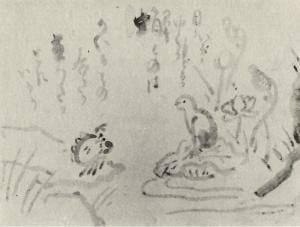
“Frog and Crag” by Hakuin (2)
The caption says,
“Mr. Crab, are you going forward or backward? Are those eyes or pimples?”
“Mr. Frog, are you sitting or standing? Or somewhere in between?”
Again, “who are you?” is the lighthearted, dead-serious theme. It’s a joke, not a trick.
The frog teases the crab for being a crab and the crab teases the frog for being a frog. Sound familiar?
Crab Sensei
And finally, here’s a longer piece for which there doesn’t appear to be a surviving graphic presentation.
286. BOTH ARMS RAISED up high, both eyes staring like stalks at the blue sky, this tiny riverside creature scrabbles its way into the reeds. On looking more closely, I discovered that it was Crab Sensei.
Addressing him, I said: “Ah! How strong and brave you are, even as you humble yourself before all things for your peace and security. The trouble comes when someone gets puffed up and arrogant. You always gaze upward as though worshipping the Buddha’s blue eyes, like you were one of the host of eighty thousand who attended the preaching at Vulture Peak. It is a gaze that takes everything in, like that of the usurper Wang Mang, (2) whose loathing enemies would even today devour him alive. It is the gaze of a cat who pretends to doze under a peony in the warm spring sun, and suddenly leaps to catch a butterfly. It is the gaze of a Zen monk steadily scanning the distant heavens and aspiring to the freedom to transcend those heights (though this is a perilous trap for him). But what is your real intent in assuming that brave and manly attitude with your six legs and two pincers and revering Heaven like that?”
Crab Sensei replied, “I have my reasons for scuttling sideways the way I do. I’m not just indulging in some cheeky sport. I must also point out that I am different from the four examples you just gave.”
With deepest respect I then said to him, “I was sure that was the case. Would you please fill me in on the particulars of that difference?”
Shuffling and scuttling around, Crab Sensei whispered in a tiny voice, “To tell the truth, I’m quite an ignorant fellow. I’m not sure myself. I’ve just always acted like this.”
“Could that be your original nature?” I asked.
Edging sideways, Crab Sensei said, “I don’t know. I don’t know” and disappeared into the reeds. (5)
Comment
Crab Sensei, with six legs and proclivity to hide away, is probably not technically a crab, but an Anomurans, aka, Hermit Crab. Hakuin looks closely to discover this hermit and then bathes them in (feint?) praise, especially in his description of the hermit’s gaze – worshipful, hungry, and set on gain, using practice as a trick to get out of the present circumstance, what Hakuin calls a “perilous trap.” Oh, Crab Sensei, what is your real intention?
Crab Sensei continues with the hermit strategy, unwilling to acknowledge being seen by the teacher. I’ve employed this a time or two, and seen some students in dokusan wiggling this way and that as well, pincers at the ready, and not necessarily ready to clamp onto the “perfection of happiness.”
Look at the skillfully delicate approach Hakuin uses, “With deepest respect … please fill me in….”
Crab Sensei, of course, is just being an unselfconscious crab. For a crab, scuttling around, glaring at the heavens, wildly fraying about with pincers, is something close to its original nature. For a human being who is crabby, though, even if that is your original nature, watch out with those damn pincers!
Crab Sensei says, “I don’t know,” and scuttles into the reeds. Could that be your original nature?
I’m going now to go have tea with my wife. How about you?
(1) From Lion’s Roar, Chogyam Trungpa Rinpoche, “Zen Mind, Vajra Mind.”
(2) Both paintings from Penetrating Laughter: Hakuin’s Zen & Art, Kazuaki Tanahashi, pp. 40 – 41.
(3) Waddell notes, “The usurper Wang Mang (1st century B.C.) After marrying his daughter to the Han emperor P’ing Ti, Wang Mang poisoned him, and then had his daughter name her infant son as emperor and appoint himself regent. He later declared himself emperor. When his own army later turned against him, his soldiers tore his corpse into pieces.” Complete Poison Blossoms from a Thicket of Thorn, p. 474.
(4) Hakuin Zenji, Complete Poison Blossoms from a Thicket of Thorn, trs. Norman Wadell, p. 473.

Dōshō Port began practicing Zen in 1977 and now co-teaches with his wife, Tetsugan Zummach Sensei, with the Vine of Obstacles: Online Support for Zen Training, an internet-based Zen community. Dōshō received dharma transmission from Dainin Katagiri Rōshi and inka shōmei from James Myōun Ford Rōshi in the Harada-Yasutani lineage. Dōshō’s translation and commentary on The Record of Empty Hall: One Hundred Classic Koans, is now available (Shambhala). He is also the author of Keep Me In Your Heart a While: The Haunting Zen of Dainin Katagiri. Click here to support the teaching practice of Dōshō Rōshi at Patreon.
Previous Post

February 16, 2019
Is Awakening (Kenshō) a Hallucination (Makyō)?
Next Post
April 9, 2019 The Dharma for Taking Food: The Zen Art of Oryoki
Browse Our Archives
Select a Category Uncategorized
Select a Month August 2023 July 2023 June 2023 May 2023 April 2023 March 2023 February 2023 January 2023 December 2022 November 2022 October 2022 September 2022 August 2022 July 2022 June 2022 May 2022 April 2022 March 2022 February 2022 January 2022 December 2021 November 2021 August 2021 June 2021 April 2021 February 2021 January 2021 November 2020 September 2020 August 2020 July 2020 June 2020 May 2020 April 2020 January 2020 December 2019 November 2019 August 2019 June 2019 May 2019 April 2019 February 2019 January 2019 December 2018 November 2018 October 2018 September 2018 August 2018 July 2018 June 2018 May 2018 April 2018 March 2018 February 2018 January 2018 December 2017 November 2017 October 2017 September 2017 August 2017 July 2017 June 2017 December 2016 October 2016 June 2016 April 2016 February 2016 January 2016 December 2015 November 2015 October 2015 August 2015 June 2015 May 2015 April 2015 March 2015 February 2015 January 2015 December 2014 November 2014 October 2014 September 2014 August 2014 July 2014 June 2014 May 2014 April 2014 March 2014 February 2014 January 2014 December 2013 November 2013 October 2013 September 2013 August 2013 July 2013 June 2013 May 2013 April 2013 March 2013 February 2013 January 2013 December 2012 November 2012 October 2012 September 2012 August 2012 July 2012 June 2012 May 2012 April 2012 March 2012 February 2012 January 2012 December 2011 November 2011 October 2011 September 2011 August 2011 July 2011 June 2011 May 2011 April 2011 March 2011 February 2011 January 2011 December 2010 November 2010 October 2010 September 2010 August 2010 July 2010 June 2010 May 2010 April 2010 March 2010 February 2010 January 2010 December 2009 November 2009 October 2009 September 2009 August 2009 July 2009 June 2009 May 2009 April 2009 March 2009 February 2009 January 2009 December 2008 November 2008 October 2008 September 2008 August 2008 July 2008 June 2008 May 2008
Follow Us!
TAKE THE
Religious Wisdom Quiz
True or False: Isaiah prophesied that a virgin would conceive and bear a son called Jesus.
Select your answer to see how you score.
TRUE FALSE
Related posts from Wild Fox Zen

Gnawing Through Qiánfēng’s Three Illnesses and Two Lights

"Why, Oh Why, Is My Practice Not Progressing?"
A Black Lacquer Person Runs Through the Night:...

Intimate Friendship: "When You Sing, I Respond; When...
TRENDING AT PATHEOS Buddhist

On Taking Refuge in the Dharma
(Here I continue the feature of sharing talks and essays by teachers...

(Continuing my intention to share talks and essays by other members of Empty...
The Subtle Art of Bowing: A Dharma Discourse
(This presentation was first offered by my dear friend Dharma Holder Tom...

Internal Family Systems Can Heal you Mentally &...
How IFS Helped Me Stop Fighting Myself Internal Family Systems (IFS) is...

The Bible No One Spoke About: A Family’s...
A mysterious family Bible, unspoken faith, and a journey from curiosity to...

How Uncertainty Can Transform Your Life in 2025
Embracing Uncertainty: A New Year’s Resolution for the Brave As 2025 approaches,...
view all Buddhist blogs
Ad-Free & Subscriber Log-In Subscription Support
- About Us
- 2026 Calendar
- Videos
- Podcasts
- Library of World Religions
- Faith In Media Tracker
- Advertise With Us
- Write for Us
- Privacy Policy
- Terms of Service
- Do Not Sell My Data
- Contact Us
- Radiant Digital
- Manage Newsletter Subscriptions
- Unsubscribe From Notifications
- Sitemap
Copyright 2008-2026, Patheos. All rights reserved.
Subscription Support Ad-Free & Subscriber Log-In
Follow Patheos