
BuddhistCatholicContemplativeEvangelicalGeneral ChristianHinduJewishLatter-day SaintMuslimNew VisionsProgressive Christian
Beliefs
- Buddhist
- Catholic
- Contemplative
- Evangelical
- General Christian
- Hindu
- Jewish
- Latter-day Saint
- More Voices
- Muslim
- New Visions
- Pagan
- Progressive Christian
Topics
- Religion News
- Food and Religion
- Sports and Religion
- Religious Art
- Religious Music and Entertainment
- Religious Events
- History and Religion
- Style and Religion
- Politics and Religion
- Women in Religion
- Recreation Outdoors and Religion
- Business Finance and Religion
- Careers Workplace and Religion
- Education and Religion
- Family Parenting and Religion
- Health Fitness and Religion
- Home and Religion
- Relationships and Religion
- Technology and Religion
- Travel and Religion
Columnists
- Buddhist Columnists
- Business Finance and Religion Columnists
- Careers Workplace and Religion Columnists
- Catholic Columnists
- Contemplative Columnists
- Education and Religion Columnists
- Evangelists Columnists
- Family Parenting and Religion Columnists
- General Christian Columnists
- Health Fitness and Religion Columnists
- Hindu Columnists
- History and Religion Columnists
- Home and Religion Columnists
- Jewish Columnists
- More Voices Columnists
- Latter Day Columnists
- Muslim Columnists
- New Visions Columnists
- Nonreligious Columnists
- Pagan Columnists
- Politics and Religion Columnists
- Progressive Columnists
- Recreation Outdoors and Religion Columnists
- Relationships and Religion Columnists
- Religion News Columnists
- Religious Art Columnists
- Religious Events Columnists
- Religious Music and Entertainment Columnists
- Sports and Religion Columnists
- Style and Religion Columnists
- Technology and Religion Columnists
- Travel and Religion Columnists
- Women in Religion Columnists
Resource Library
- 2026 Calendar
- Library of World Religions
- The 100 Most Holy Places on Earth
- Patheos Answers
- Podcasts
- Videos
- Faith Leaders Database
- Anglican Episcopalian
- Bahai
- Baptist
- Buddhism
- Christianity
- Confucianism
- Eastern Orthodoxy
- Hinduism
- Holiness and Pentecostal
- ISKCON
- Islam
- Judaism
- Lutheran
- Methodist
- The Church of Jesus Christ of Latter-day Saints
- New Age
- Paganism
- Presbytarian and Reformed
- Protestantism
- Religion Behind the Scenes
- Roman Catholic
- Scientology
- Shia Islam
- Sikhism
- Sufism
- Sunni Islam
- Taoism
- Zen
- See all religions
Research Tools
 Ad-Free & Subscriber Log-In Subscription Support
Ad-Free & Subscriber Log-In Subscription Support
Follow Patheos 

- Trending:
- Forgiveness
- |
- Marriage
- |
- Consciousness
- |
- Death Penalty
- |
- Election
- |
- Halloween
 Wild Fox Zen
- Home
- Buddhist
- What’s Love Got To Do With It? The Most Important Thing About Hakuin’s Teaching
What’s Love Got To Do With It? The Most Important Thing About Hakuin’s Teaching
Last updated on: February 20, 2022 at 8:04 pm by Dosho Port
What’s Love Got To Do With It? The Most Important Thing About Hakuin’s Teaching 2022-02-20T20:04:30-06:00 Dosho Port
Patheos Explore the world's faith through different perspectives on religion and spirituality! Patheos has the views of the prevalent religions and spiritualities of the world.
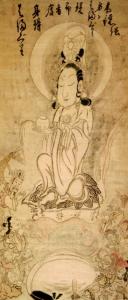
“Clam Kannon” by Hakuin: “The one who can cross over in the body of a clam reveals how the clam body also expounds the dharma.”
At the beginning of 2018, I began a year-long focus on Hakuin’s teaching, specifically, Norman Waddell’s newly translated Complete Poison Blossoms from a Thicket of Thorn: The Zen Records of Hakuin Zenji. In this blog post, I want to share the most important thing that about Hakuin’s Zen.
First, a little background. Hakuin (1686 – 1768) was a Japanese monk in the Rinzai tradition. Widely regarded as an exceptional artist, story teller, and fierce Zen master, he and his successors kept alive the Rinzai lineage in Japan, and largely through the efforts of the Sōtō monk, Harada Daiun Sogaku, are the source of much of the kōan introspection practiced outside of Japan today. For more on Hakuin, click here.
Some Cool Stuff About Hakuin That Aren’t Most Important
One of Hakuin’s outstanding gifts to us is the raw openness with which he showed up. He repeatedly took the Japanese custom of self-disparagement beyond normal limits and into fresh and sometimes hysterical extremes. For Hakuin, the bodhisattva of compassion, Kannon, as a lowly clam crossing over from the shore of suffering to the nirvana, was it. He inspires us to be exactly who we are. For more on this, see the image above and click here.
Furthermore, Hakuin penetrated the depths of the buddhadharma and shared his insights, usually through a vividly immanent expression of old Zen kōans, but also through reinvigorating the study and practice of the sutras. He also created new kōans like, “What is the sound of the single hand?” “East wall strikes west wall,” and “What is the color of the wind?” Indeed, Hakuin was a kōan master the likes of whom are seen only rarely on this little blue dumpling planet.
Hakuin also emphasized the importance of kenshō (awakening) and also the essential importance of continued post-kenshō training, vigorously moving through all the barriers and nasty briars left by our dharma ancestors. For more on this, click here.
Hakuin’s Definitive Awakening and the Most Important Thing
But none of these are his most important contribution to us. Hakuin’s most important contribution came from his own definitive awakening. For this, I’ll quote Waddell at some length:
“The religious quest that had been the single focus of his life for more than a quarter century finally came to an end one night in his forty-first year. He was in his chambers at Shōin-ji reading the Lotus Sutra, the very same chapter, the one on parables, he had dismissed years before as ‘a mere collection of simple tales about cause and effect.’
“In that chapter, the Buddha reveals to his disciple Shariputra the true nature of the Mahayana Bodhisattva, whose own enlightenment is but the first step in his career of assisting others to attain theirs. This is identical to the teaching Shōju had tried to drive home to Hakuin years before. Like Shariputra, Hakuin had erroneously regarded his original realization as full and perfect enlightenment, and he would have been unable to proceed beyond that realization without the timely assistance of a genuine teacher.
“As Hakuin read, the sound of a cricket churring at the foundation stones of the temple reached his ears; at that instant, he crossed the threshold into great enlightenment. The accumulated doubts and uncertainties of forty years suddenly ceased to exist. The reason why the Lotus Sutra was regarded as supreme among all the Buddha’s preachings was revealed to him ‘with blinding clarity.’ He found teardrops ‘cascading down his face like strings of beads—they poured out like beans from a ruptured sack.’” (1)
Simply put, the point of dharma practice, of a human life well-lived, is to awaken thoroughly enough to help others awaken. Hakuin’s open-hearted presentation, his art, his kōan offerings, his emphasis on kenshō, are all just about this – actualizing the bodhisattva vow. A quick search of the Complete Poison Blossoms finds Hakuin returning to this theme 80 times (more or less).
Spurring Forward the Wheel of the Four Great Universal Vows
Here is verse where Hakuin lays it out most clearly:
“Even if you are able to enter through the gates into nonduality,
If you lack the Bodhi-mind you’ll end up under Mara’s sway.
Anyone who wants to achieve complete mastery of the Dharma
Has to spur forward the wheel of the four great universal vows.” (2)
Yes! Cutting through all of the secondary and tertiary motivations for Zen practice (love of zazen; psychological, spiritual, physical healing; the subtlety and depth of the kōan literature; fluidity in life and death; mastering expression of the great matter; etc.), Hakuin returns, simply and finally, to Great Vehicle Awakening Truth (aka, Mahayana Buddhism), encouraging us through his example, to put our shoulders to the wheel of the four great universal vows. (3)
Hakuin’s Zen offers a path where fulfilling the four great universal vows is an actual possibility, clearly defined, not just vague buddha-dogma. I find the clarity of this focus utterly vivifying, cutting through the self-centered focus of our present culture and dharma scene.
It’s really about this great love. This great love isn’t a mushy, idealistic, romantic love, but a tough and messy love that is made alive through cultivating wholehearted verification, and then showing up in this world to help others realize this very mind is buddha.
That is it.
(1) Wild Ivy: The Spiritual Autobiography of Zen Master Hakuin, Hakuin Zenji & Norman Waddell, (Kindle Locations 410-413).
(2) Complete Poison Blossoms from a Thicket of Thorn, Hakuin Zenji & Norman Waddell, p. 138.
(3) An interpretive version: “The many beings are numberless; Vowing to carry them across.
Greed, anger, and ignorance rise endlessly; Vowing to cut off the mind road.
Dharma gates are countless; Vowing to wake to them all.
Buddha’s Way is all embracing; Vowing to follow through.”

Dōshō Port began practicing Zen in 1977 and now co-teaches with his wife, Tetsugan Zummach Sensei, with the Vine of Obstacles: Online Support for Zen Training, an internet-based Zen community. Dōshō received dharma transmission from Dainin Katagiri Rōshi and inka shōmei from James Myōun Ford Rōshi in the Harada-Yasutani lineage. Dōshō’s translation and commentary on The Record of Empty Hall: One Hundred Classic Koans, is now available (Shambhala). He is also the author of Keep Me In Your Heart a While: The Haunting Zen of Dainin Katagiri. Click here to support the teaching practice of Dōshō Rōshi at Patreon.
Previous Post

November 26, 2018
The Zen Teacher Hustle and Social Media
Next Post
January 19, 2019 Hōkyōji Memories on Katagiri Rōshi's 91st Birthday
Browse Our Archives
Select a Category Uncategorized
Select a Month August 2023 July 2023 June 2023 May 2023 April 2023 March 2023 February 2023 January 2023 December 2022 November 2022 October 2022 September 2022 August 2022 July 2022 June 2022 May 2022 April 2022 March 2022 February 2022 January 2022 December 2021 November 2021 August 2021 June 2021 April 2021 February 2021 January 2021 November 2020 September 2020 August 2020 July 2020 June 2020 May 2020 April 2020 January 2020 December 2019 November 2019 August 2019 June 2019 May 2019 April 2019 February 2019 January 2019 December 2018 November 2018 October 2018 September 2018 August 2018 July 2018 June 2018 May 2018 April 2018 March 2018 February 2018 January 2018 December 2017 November 2017 October 2017 September 2017 August 2017 July 2017 June 2017 December 2016 October 2016 June 2016 April 2016 February 2016 January 2016 December 2015 November 2015 October 2015 August 2015 June 2015 May 2015 April 2015 March 2015 February 2015 January 2015 December 2014 November 2014 October 2014 September 2014 August 2014 July 2014 June 2014 May 2014 April 2014 March 2014 February 2014 January 2014 December 2013 November 2013 October 2013 September 2013 August 2013 July 2013 June 2013 May 2013 April 2013 March 2013 February 2013 January 2013 December 2012 November 2012 October 2012 September 2012 August 2012 July 2012 June 2012 May 2012 April 2012 March 2012 February 2012 January 2012 December 2011 November 2011 October 2011 September 2011 August 2011 July 2011 June 2011 May 2011 April 2011 March 2011 February 2011 January 2011 December 2010 November 2010 October 2010 September 2010 August 2010 July 2010 June 2010 May 2010 April 2010 March 2010 February 2010 January 2010 December 2009 November 2009 October 2009 September 2009 August 2009 July 2009 June 2009 May 2009 April 2009 March 2009 February 2009 January 2009 December 2008 November 2008 October 2008 September 2008 August 2008 July 2008 June 2008 May 2008
Follow Us!
TAKE THE
Religious Wisdom Quiz
What root attitude does Paul say is the "root of all kinds of evil"?
Select your answer to see how you score.
Love of wisdom Love of music Love of money Love of animals
Related posts from Wild Fox Zen

Gnawing Through Qiánfēng’s Three Illnesses and Two Lights
Dōgen’s Instruction for Householder Zen Training

The Central Importance of Inquiring of a Teacher
Dogen: Find a Good Teacher, Ask For a...
TRENDING AT PATHEOS Buddhist

On Taking Refuge in the Dharma
(Here I continue the feature of sharing talks and essays by teachers...

(Continuing my intention to share talks and essays by other members of Empty...
The Subtle Art of Bowing: A Dharma Discourse
(This presentation was first offered by my dear friend Dharma Holder Tom...

Internal Family Systems Can Heal you Mentally &...
How IFS Helped Me Stop Fighting Myself Internal Family Systems (IFS) is...

The Bible No One Spoke About: A Family’s...
A mysterious family Bible, unspoken faith, and a journey from curiosity to...

How Uncertainty Can Transform Your Life in 2025
Embracing Uncertainty: A New Year’s Resolution for the Brave As 2025 approaches,...
view all Buddhist blogs
Ad-Free & Subscriber Log-In Subscription Support
- About Us
- 2026 Calendar
- Videos
- Podcasts
- Library of World Religions
- Faith In Media Tracker
- Advertise With Us
- Write for Us
- Privacy Policy
- Terms of Service
- Do Not Sell My Data
- Contact Us
- Radiant Digital
- Manage Newsletter Subscriptions
- Unsubscribe From Notifications
- Sitemap
Copyright 2008-2026, Patheos. All rights reserved.
Subscription Support Ad-Free & Subscriber Log-In
Follow Patheos