
BuddhistCatholicContemplativeEvangelicalGeneral ChristianHinduJewishLatter-day SaintMuslimNew VisionsProgressive Christian
Beliefs
- Buddhist
- Catholic
- Contemplative
- Evangelical
- General Christian
- Hindu
- Jewish
- Latter-day Saint
- More Voices
- Muslim
- New Visions
- Pagan
- Progressive Christian
Topics
- Religion News
- Food and Religion
- Sports and Religion
- Religious Art
- Religious Music and Entertainment
- Religious Events
- History and Religion
- Style and Religion
- Politics and Religion
- Women in Religion
- Recreation Outdoors and Religion
- Business Finance and Religion
- Careers Workplace and Religion
- Education and Religion
- Family Parenting and Religion
- Health Fitness and Religion
- Home and Religion
- Relationships and Religion
- Technology and Religion
- Travel and Religion
Columnists
- Buddhist Columnists
- Business Finance and Religion Columnists
- Careers Workplace and Religion Columnists
- Catholic Columnists
- Contemplative Columnists
- Education and Religion Columnists
- Evangelists Columnists
- Family Parenting and Religion Columnists
- General Christian Columnists
- Health Fitness and Religion Columnists
- Hindu Columnists
- History and Religion Columnists
- Home and Religion Columnists
- Jewish Columnists
- More Voices Columnists
- Latter Day Columnists
- Muslim Columnists
- New Visions Columnists
- Nonreligious Columnists
- Pagan Columnists
- Politics and Religion Columnists
- Progressive Columnists
- Recreation Outdoors and Religion Columnists
- Relationships and Religion Columnists
- Religion News Columnists
- Religious Art Columnists
- Religious Events Columnists
- Religious Music and Entertainment Columnists
- Sports and Religion Columnists
- Style and Religion Columnists
- Technology and Religion Columnists
- Travel and Religion Columnists
- Women in Religion Columnists
Resource Library
- 2026 Calendar
- Library of World Religions
- The 100 Most Holy Places on Earth
- Patheos Answers
- Podcasts
- Videos
- Faith Leaders Database
- Anglican Episcopalian
- Bahai
- Baptist
- Buddhism
- Christianity
- Confucianism
- Eastern Orthodoxy
- Hinduism
- Holiness and Pentecostal
- ISKCON
- Islam
- Judaism
- Lutheran
- Methodist
- The Church of Jesus Christ of Latter-day Saints
- New Age
- Paganism
- Presbytarian and Reformed
- Protestantism
- Religion Behind the Scenes
- Roman Catholic
- Scientology
- Shia Islam
- Sikhism
- Sufism
- Sunni Islam
- Taoism
- Zen
- See all religions
Research Tools
 Ad-Free & Subscriber Log-In Subscription Support
Ad-Free & Subscriber Log-In Subscription Support
Follow Patheos 

- Trending:
- Forgiveness
- |
- Marriage
- |
- Consciousness
- |
- Death Penalty
- |
- Election
- |
- Halloween
 Wild Fox Zen
- Home
- Buddhist
- Like Salad With Nasturtium Petals: The Delicious Way of Zen Master Yunmen
Like Salad With Nasturtium Petals: The Delicious Way of Zen Master Yunmen
Last updated on: June 18, 2018 at 12:52 pm by Dosho Port
Like Salad With Nasturtium Petals: The Delicious Way of Zen Master Yunmen 2018-06-18T12:52:00-06:00 Dosho Port
Patheos Explore the world's faith through different perspectives on religion and spirituality! Patheos has the views of the prevalent religions and spiritualities of the world.
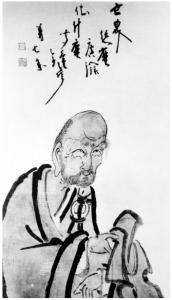
Yunmen by Hakuin
In these later days of the buddhadharma, when most of what passes off as “buddhadharma” obscures the vivid truth – the essential nature of the self – it can be useful to study and reflect on the ancient teachers. The traces of their extraordinary development in self-knowledge still flows through their breath in their recorded words.
One such inspiring resource is Urs App’s Zen Master Yunmen: His Life and Essential Sayings, recently republished by the good people at Shambhala Publications. App’s rich introductory material will help the newcomer as well as the old Zen hand appreciate the Zen tradition’s original sources, including the life and teaching of Yunmen.
Yunmen was an extraordinary teacher whose awakened mind flow through his words, even, amazingly, through translation to us today. Indeed, I haven’t spoken to anyone who has dived deeply into the Harada-Yasutani koan curriculum who doesn’t celebrate the teaching of Yunmen.
Yunmen was popular in his lifetime too, a couple hundred years later when the now-standard koan collections were created, through Hakuin’s time (72 mentions in The Complete Poison Blossoms), and, like I said, at least up until today.
Yunmen’s teaching is said to have a three-in-one quality:
1. They permeate heaven and earth.
2. They follow the waves and adapt to the currents.
3. They cut through all streams
True enough but a bit abstract for my taste. I’d say Yunmen’s teaching is like a nasturtium petal salad.
 Refreshingly, App encourages the reader to chew thoroughly and go slowly through the text. Indeed, just one passage will do. Like this koan that is popular with John Tarrant Roshi and the Pacific Zen Institute:
(15) “Someone asked: ‘What does “Sitting correctly and contemplating true reality” mean?’
Master said, ‘A coin lost in the river is found in the river.’”
What have you lost, friend, and where you going to look?
Yunmen knew what he’d lost and, like all the great teachers, had a provocative and instructive personal narrative that culminated in finding the coin. One of the first teachers he visited during his search was Muzhou, an old hermit at this point in his life, having studied with Huangbo and then returned to his native place.
App tells of their encounter like this:
(278) “[Master Muzhou’s] one room was usually shut, and it was completely empty. When he occasionally did receive people, he allowed no deliberations. When Yunmen could freely roll in and out, he went straight to Muzhou’s door and knocked.
Master Muzhou asked, ‘Who is it?’
Yunmen: ‘It is me, [Yunmen] Wenyan.’
Muzhou blocked the entrance and said, ‘Why do you keep coming?’
Yunmen replied, ‘I am not clear about myself.’
Muzhou said, ‘Absolutely useless stuff!’
Then pushed Yunmen out and shut the door. In this way Yunmen attained understanding.”
One of the strong positives in App’s text is his generous use of footnotes that help explain his translations. In this case, for example, he has Yunmen stating, “I am not clear about myself.” And Muzhou answering, “Absolutely useless stuff!”
App explains that “Absolutely useless stuff,” is “…literally: ‘stone drills from the Qin period.’ These gigantic drills were fashioned for the construction of a huge palace by the Qin emperor. Since the megalomaniac project was never realized, these tools achieved proverbial status as something that is utterly useless.”
Such footnotes add vital nuance to the utterances of Yunmen and the supporting cast. In this case, the self is not only “absolutely useless” but also a futile, megalomaniacal project.
The Record of Yunmen is not intended to stuff the readers heads full of fake knowledge, bolstering the futile, megalomaniacal selfing project, but to point to the heart of the great matter. App comments, “The problem that drives Yunmen to seek instruction is not something that bothers him but rather his own self. This is not one of a number of problems he has but rather the problem he himself is.”
“You must realize that what is at stake here,” said Yunmen, “does not reside in words and phrases: it is like sparks from struck flint, like the brilliance of flashing lightning. However you manage to deal with this, you cannot get around losing your body and life.”
Yunmen’s teaching is straight to the heart:
(271) “A monk asked, ‘What is the problem?”’
Master Yunmen replied, “’You don’t notice the stench of your own shit!’”
This is a nasturtium salad that has had it’s own shit for compost!
(139) Someone asked, ‘What is the pure immaculate Dharma body?”’
Master Yunmen replied, ‘That peony hedge!’
The monk asked, ‘Is it all right if I understand it in this way?’
The Master said, ‘A golden-haired lion!'”
The peony hedge, speaking of the pure immaculate Dharma body, formed the border on the latrine. These are the places where the lion roars.
(20) “Someone asked, ‘What is the place from whence all the buddhas come?’
Master Yunmen said, ‘The East Mountains walk on the river.’”
About this koan, Hakuin said, “If it were me, I wouldn’t say that [East Mountains walk on the river]. If someone asked me, ‘From whence come all the buddhas?’ I would say, ‘A fragrant breeze sweeps in from the south, a refreshing coolness pervades the halls and pavilions (Waddell, “Complete Poison Blossoms from a Thicket of Thorn).”
What is the place from whence off buddhas come?
Around midnight on May 10, 949, Yunmen died. A few hours before, he wrote his death poem:
“Oh! The boat of compassion having been destroyed
Samsara will not attain the shore of salvation.
The Dharma mountain having crumbled
What have flying and walking creatures left to rely upon?”

Dōshō Port began practicing Zen in 1977 and now co-teaches at the Nebraska Zen Center with his wife, Tetsugan Zummach Osho. Dōshō also teaches with the Vine of Obstacles: Online Support for Zen Training, an internet-based Zen community. Dōshō received dharma transmission from Dainin Katagiri Rōshi and inka shōmei from James Myōun Ford Rōshi in the Harada-Yasutani lineage. He is the author of Keep Me In Your Heart a While: The Haunting Zen of Dainin Katagiri.
Previous Post

June 16, 2018
The Language of Dragons: Introduction to Zen Koans
Next Post
July 7, 2018 Essential Dōgen and Hakuin Texts: Response to a Quick Question
Browse Our Archives
Select a Category Uncategorized
Select a Month August 2023 July 2023 June 2023 May 2023 April 2023 March 2023 February 2023 January 2023 December 2022 November 2022 October 2022 September 2022 August 2022 July 2022 June 2022 May 2022 April 2022 March 2022 February 2022 January 2022 December 2021 November 2021 August 2021 June 2021 April 2021 February 2021 January 2021 November 2020 September 2020 August 2020 July 2020 June 2020 May 2020 April 2020 January 2020 December 2019 November 2019 August 2019 June 2019 May 2019 April 2019 February 2019 January 2019 December 2018 November 2018 October 2018 September 2018 August 2018 July 2018 June 2018 May 2018 April 2018 March 2018 February 2018 January 2018 December 2017 November 2017 October 2017 September 2017 August 2017 July 2017 June 2017 December 2016 October 2016 June 2016 April 2016 February 2016 January 2016 December 2015 November 2015 October 2015 August 2015 June 2015 May 2015 April 2015 March 2015 February 2015 January 2015 December 2014 November 2014 October 2014 September 2014 August 2014 July 2014 June 2014 May 2014 April 2014 March 2014 February 2014 January 2014 December 2013 November 2013 October 2013 September 2013 August 2013 July 2013 June 2013 May 2013 April 2013 March 2013 February 2013 January 2013 December 2012 November 2012 October 2012 September 2012 August 2012 July 2012 June 2012 May 2012 April 2012 March 2012 February 2012 January 2012 December 2011 November 2011 October 2011 September 2011 August 2011 July 2011 June 2011 May 2011 April 2011 March 2011 February 2011 January 2011 December 2010 November 2010 October 2010 September 2010 August 2010 July 2010 June 2010 May 2010 April 2010 March 2010 February 2010 January 2010 December 2009 November 2009 October 2009 September 2009 August 2009 July 2009 June 2009 May 2009 April 2009 March 2009 February 2009 January 2009 December 2008 November 2008 October 2008 September 2008 August 2008 July 2008 June 2008 May 2008
Follow Us!
TAKE THE
Religious Wisdom Quiz
Who is the apostle to deny Jesus?
Select your answer to see how you score.
Phillip Judas Peter Andrew
Related posts from Wild Fox Zen

Gnawing Through Qiánfēng’s Three Illnesses and Two Lights

"Why, Oh Why, Is My Practice Not Progressing?"
A Black Lacquer Person Runs Through the Night:...

Intimate Friendship: "When You Sing, I Respond; When...
TRENDING AT PATHEOS Buddhist

On Taking Refuge in the Dharma
(Here I continue the feature of sharing talks and essays by teachers...

(Continuing my intention to share talks and essays by other members of Empty...
The Subtle Art of Bowing: A Dharma Discourse
(This presentation was first offered by my dear friend Dharma Holder Tom...

Internal Family Systems Can Heal you Mentally &...
How IFS Helped Me Stop Fighting Myself Internal Family Systems (IFS) is...

The Bible No One Spoke About: A Family’s...
A mysterious family Bible, unspoken faith, and a journey from curiosity to...

How Uncertainty Can Transform Your Life in 2025
Embracing Uncertainty: A New Year’s Resolution for the Brave As 2025 approaches,...
view all Buddhist blogs
Ad-Free & Subscriber Log-In Subscription Support
- About Us
- 2026 Calendar
- Videos
- Podcasts
- Library of World Religions
- Faith In Media Tracker
- Advertise With Us
- Write for Us
- Privacy Policy
- Terms of Service
- Do Not Sell My Data
- Contact Us
- Radiant Digital
- Manage Newsletter Subscriptions
- Unsubscribe From Notifications
- Sitemap
Copyright 2008-2026, Patheos. All rights reserved.
Subscription Support Ad-Free & Subscriber Log-In
Follow Patheos