
BuddhistCatholicContemplativeEvangelicalGeneral ChristianHinduJewishLatter-day SaintMuslimNew VisionsProgressive Christian
Beliefs
- Buddhist
- Catholic
- Contemplative
- Evangelical
- General Christian
- Hindu
- Jewish
- Latter-day Saint
- More Voices
- Muslim
- New Visions
- Pagan
- Progressive Christian
Topics
- Religion News
- Food and Religion
- Sports and Religion
- Religious Art
- Religious Music and Entertainment
- Religious Events
- History and Religion
- Style and Religion
- Politics and Religion
- Women in Religion
- Recreation Outdoors and Religion
- Business Finance and Religion
- Careers Workplace and Religion
- Education and Religion
- Family Parenting and Religion
- Health Fitness and Religion
- Home and Religion
- Relationships and Religion
- Technology and Religion
- Travel and Religion
Columnists
- Buddhist Columnists
- Business Finance and Religion Columnists
- Careers Workplace and Religion Columnists
- Catholic Columnists
- Contemplative Columnists
- Education and Religion Columnists
- Evangelists Columnists
- Family Parenting and Religion Columnists
- General Christian Columnists
- Health Fitness and Religion Columnists
- Hindu Columnists
- History and Religion Columnists
- Home and Religion Columnists
- Jewish Columnists
- More Voices Columnists
- Latter Day Columnists
- Muslim Columnists
- New Visions Columnists
- Nonreligious Columnists
- Pagan Columnists
- Politics and Religion Columnists
- Progressive Columnists
- Recreation Outdoors and Religion Columnists
- Relationships and Religion Columnists
- Religion News Columnists
- Religious Art Columnists
- Religious Events Columnists
- Religious Music and Entertainment Columnists
- Sports and Religion Columnists
- Style and Religion Columnists
- Technology and Religion Columnists
- Travel and Religion Columnists
- Women in Religion Columnists
Resource Library
- 2026 Calendar
- Library of World Religions
- The 100 Most Holy Places on Earth
- Patheos Answers
- Podcasts
- Videos
- Faith Leaders Database
- Anglican Episcopalian
- Bahai
- Baptist
- Buddhism
- Christianity
- Confucianism
- Eastern Orthodoxy
- Hinduism
- Holiness and Pentecostal
- ISKCON
- Islam
- Judaism
- Lutheran
- Methodist
- The Church of Jesus Christ of Latter-day Saints
- New Age
- Paganism
- Presbytarian and Reformed
- Protestantism
- Religion Behind the Scenes
- Roman Catholic
- Scientology
- Shia Islam
- Sikhism
- Sufism
- Sunni Islam
- Taoism
- Zen
- See all religions
Research Tools
 Ad-Free & Subscriber Log-In Subscription Support
Ad-Free & Subscriber Log-In Subscription Support
Follow Patheos 

- Trending:
- Forgiveness
- |
- Marriage
- |
- Consciousness
- |
- Death Penalty
- |
- Election
- |
- Halloween
 Wild Fox Zen
- Home
- Buddhist
- Acquiring the Ability to Teach Dunces of the Poorer Sort
Acquiring the Ability to Teach Dunces of the Poorer Sort
Last updated on: February 19, 2022 at 11:28 am by Dosho Port
Acquiring the Ability to Teach Dunces of the Poorer Sort 2022-02-19T11:28:00-06:00 Dosho Port
Patheos Explore the world's faith through different perspectives on religion and spirituality! Patheos has the views of the prevalent religions and spiritualities of the world.
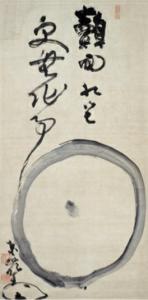
Calligraphy by Torei, another of Hakuin’s major successors.
One of the hallmarks of Hakuin’s vivid style of Zen was his emphasis on the importance of practice post-kenshō, digging into the subtlety of many subsequent kōans. This work was seen – and is still seen in our Harada-Yasutani kōan-introspection tradition for which Hakuin was one of the founders – as essential refining of the initial insight, enabling one to function freely, and serve as a guide for others intent on awakening, actualizing the Four Great Vows.
It’s also one of the things that Hakuin was pumped about in terms of his contribution to the dharma world. For example, in The Complete Plum Blossoms in a Thicket of Thorn (CPB, “Gudō’s Lingering Radiance”), Hakuin reports how he helped an old priest named Zenkai to kenshō and then continue the work. Hakuin further tells us that Zenkai would bow down daily, and mournfully weep out praise like this (I hear this with Hakuin as the ventriloquist, and Zenkai, the puppet):
“I have recently been greatly puzzled as to why none of the fine Buddhist teachers of the past has spoken of the practice that comes after satori. I searched through the [many Zen records]…. But I never found any mention of this very important matter. How wonderful it is that my teacher [Hakuin] has devoted his life to making this great truth known, to teaching people that post-satori practice invariably gives rise to the Bodhi-mind and enables people to avoid the awful fate that otherwise awaits them in the evil paths. ”
However, one of Hakuin’s main students, Daikyū, left Hakuin’s temple, Shōin-ji, soon after his initial awakening, an awakening that was said to have “penetrated deeply to the Dharma source.” Perhaps rather than living with the reportedly overbearing Hakuin, Daikyū opted to travel around and looking for a beautiful, quiet spot to settle in and devote himself to his practice. In a letter preserved in CBP 191, Hakuin tells Daikyū that if he doesn’t return and continue kōan work, “… You will never acquire the ability to teach even a dunce of the poorer sort.”
Old Hakuin was a wild man, living with his emotions pouring out, apparently, not all the “Zen master” spiritual masquerade.
Hakuin’s letter to Daikyū begins on a seemingly friendly note, though, letting him know that all of Hakuin’s other senior priests are there with him at Shōin-ji and that “…Everyone is resolutely bent on refining and polishing their attainment. They endure the bitter cold and other privations without complaint, never slackening their efforts at all.”
From what I’ve seen, though, I’d say it isn’t at all uncommon for practitioners to slacken their efforts after kenshō. “Oh, there’s sesshin this weekend? I’d love to do it, but … it’s really the only time that I have to change the storm windows.”
In addition, ignorance has a wonderful way of reasserting itself after kenshō. Practitioners sometimes sail through a whole bunch of kōan in the wake of an opening, only to find themselves stuck on one of the kōans in the Miscellaneous Collection or on some tasteless thing like No Gate Gateway, Case 4: “Why has the Western Paradise Barbarian no beard?”
One tell-tale sign that we’re going off in stuckland is that we focus time and energy on how to present the koan to the teacher, rather than accepting the likely fact that there is more to see in this kōan, then focussing on being more intimate with the koan itself, attending to the subtle aspects, which usually lay waiting in our blind spots. Worry about the presentation is a way of focussing too much on the teacher rather than our own insight.
Hakuin, also in the letter to his errant student Daikyū, explains the process of post-kenshō training:
“Genuine [ancestors] of the secret depths, in order to be able to undertake the teaching of the true Dharma, enter the training hall, mingle with the [community], sit silently at the rear of the hall, work on koans they haven’t yet passed, engage in practice sessions with their comrades, and in this way gradually accumulate Dharma assets and mature into great Dharma vessels. ”
In our Harada-Yasutani kōan curriculum, after passing through the initial kōan and checking questions, the student sets out on a journey that may well take ten years or a lifetime, working through hundreds of subsequent kōans and checking questions, just in this spirit. Not only does everyone who undertakes the journey not reach the end, but everyone who reaches the end will not become a kōan teacher. There are many ways to manifest the dharma and not everyone is karmically suited to teach. Or better, some folks are karmically suited to manifest in other ways than to take on the yoke of teaching.
However, Hakuin, thirty-years Daikyū’s senior, seems to have identified Daikyū as a potential successor and teacher, so he tried all sorts of shenanigans to tug on his heart to bring him back to Shōin-ji. “You will have plenty of time later [after I die], to hide yourself in the boondocks and investigate the matter of your self, but only limited time remains to me in which to sit in these broken-down old chambers laughing and chatting with my monks. I just wait, counting the days and nights off on my fingers, until you return.”
Ah, to sit in Hakuin’s chambers, laughing and chatting – if only there holodeck were online!
It isn’t clear from the record whether Daikyū returned or not. The wonderful translator and annotator, Norman Waddell, seems to think that he didn’t. What is clear is that Daikyū did become a powerful teacher. Waddell reports that “…Hakuin describes attending a large lecture meeting that Daikyū conducted at the great Tōfuku-ji in Kyoto. According to the Annals of Tōfuku-ji, eight hundred and thirteen priests and monks, including Tōrei and other students of Hakuin, participated in the meeting. Through assemblies such as this, Daikyū introduced Hakuin-style Zen to the large Gozan monasteries in the capital.”
So the student went the wrong way and it seems to have all worked out.
Or did it?
Daikyū died in 1774, just six years after Hakuin, so it turned out that he didn’t have much time after Hakuin died to wallow in the boondocks. The continuing line of transmission coming to us flowed through another of Hakuin’s students, Gasan Jitō (1727–1797).

Dōshō Port began practicing Zen in 1977 and now co-teaches with his wife, Tetsugan Zummach Sensei, with the Vine of Obstacles: Online Support for Zen Training, an internet-based Zen community. Dōshō received dharma transmission from Dainin Katagiri Rōshi and inka shōmei from James Myōun Ford Rōshi in the Harada-Yasutani lineage. Dōshō’s translation and commentary on The Record of Empty Hall: One Hundred Classic Koans, is now available (Shambhala). He is also the author of Keep Me In Your Heart a While: The Haunting Zen of Dainin Katagiri. Click here to support the teaching practice of Tetsugan Sensei and Dōshō Rōshi.
Harada-Yasutani kōan curriculum
Previous Post

February 23, 2018
Hakuin Helps An Old Sōtō Priest Favorlessly Meet Birth and Death
Next Post
March 12, 2018 Big Idea, Big Stupid, Big Realization
Browse Our Archives
Select a Category Uncategorized
Select a Month August 2023 July 2023 June 2023 May 2023 April 2023 March 2023 February 2023 January 2023 December 2022 November 2022 October 2022 September 2022 August 2022 July 2022 June 2022 May 2022 April 2022 March 2022 February 2022 January 2022 December 2021 November 2021 August 2021 June 2021 April 2021 February 2021 January 2021 November 2020 September 2020 August 2020 July 2020 June 2020 May 2020 April 2020 January 2020 December 2019 November 2019 August 2019 June 2019 May 2019 April 2019 February 2019 January 2019 December 2018 November 2018 October 2018 September 2018 August 2018 July 2018 June 2018 May 2018 April 2018 March 2018 February 2018 January 2018 December 2017 November 2017 October 2017 September 2017 August 2017 July 2017 June 2017 December 2016 October 2016 June 2016 April 2016 February 2016 January 2016 December 2015 November 2015 October 2015 August 2015 June 2015 May 2015 April 2015 March 2015 February 2015 January 2015 December 2014 November 2014 October 2014 September 2014 August 2014 July 2014 June 2014 May 2014 April 2014 March 2014 February 2014 January 2014 December 2013 November 2013 October 2013 September 2013 August 2013 July 2013 June 2013 May 2013 April 2013 March 2013 February 2013 January 2013 December 2012 November 2012 October 2012 September 2012 August 2012 July 2012 June 2012 May 2012 April 2012 March 2012 February 2012 January 2012 December 2011 November 2011 October 2011 September 2011 August 2011 July 2011 June 2011 May 2011 April 2011 March 2011 February 2011 January 2011 December 2010 November 2010 October 2010 September 2010 August 2010 July 2010 June 2010 May 2010 April 2010 March 2010 February 2010 January 2010 December 2009 November 2009 October 2009 September 2009 August 2009 July 2009 June 2009 May 2009 April 2009 March 2009 February 2009 January 2009 December 2008 November 2008 October 2008 September 2008 August 2008 July 2008 June 2008 May 2008
Follow Us!
TAKE THE
Religious Wisdom Quiz
What root attitude does Paul say is the "root of all kinds of evil"?
Select your answer to see how you score.
Love of wisdom Love of music Love of money Love of animals
Related posts from Wild Fox Zen

Gnawing Through Qiánfēng’s Three Illnesses and Two Lights
Dōgen’s Instruction for Householder Zen Training

The Central Importance of Inquiring of a Teacher
Dogen: Find a Good Teacher, Ask For a...
TRENDING AT PATHEOS Buddhist

On Taking Refuge in the Dharma
(Here I continue the feature of sharing talks and essays by teachers...

(Continuing my intention to share talks and essays by other members of Empty...
The Subtle Art of Bowing: A Dharma Discourse
(This presentation was first offered by my dear friend Dharma Holder Tom...

Internal Family Systems Can Heal you Mentally &...
How IFS Helped Me Stop Fighting Myself Internal Family Systems (IFS) is...

The Bible No One Spoke About: A Family’s...
A mysterious family Bible, unspoken faith, and a journey from curiosity to...

How Uncertainty Can Transform Your Life in 2025
Embracing Uncertainty: A New Year’s Resolution for the Brave As 2025 approaches,...
view all Buddhist blogs
Ad-Free & Subscriber Log-In Subscription Support
- About Us
- 2026 Calendar
- Videos
- Podcasts
- Library of World Religions
- Faith In Media Tracker
- Advertise With Us
- Write for Us
- Privacy Policy
- Terms of Service
- Do Not Sell My Data
- Contact Us
- Radiant Digital
- Manage Newsletter Subscriptions
- Unsubscribe From Notifications
- Sitemap
Copyright 2008-2026, Patheos. All rights reserved.
Subscription Support Ad-Free & Subscriber Log-In
Follow Patheos