
BuddhistCatholicContemplativeEvangelicalGeneral ChristianHinduJewishLatter-day SaintMuslimNew VisionsProgressive Christian
Beliefs
- Buddhist
- Catholic
- Contemplative
- Evangelical
- General Christian
- Hindu
- Jewish
- Latter-day Saint
- More Voices
- Muslim
- New Visions
- Pagan
- Progressive Christian
Topics
- Religion News
- Food and Religion
- Sports and Religion
- Religious Art
- Religious Music and Entertainment
- Religious Events
- History and Religion
- Style and Religion
- Politics and Religion
- Women in Religion
- Recreation Outdoors and Religion
- Business Finance and Religion
- Careers Workplace and Religion
- Education and Religion
- Family Parenting and Religion
- Health Fitness and Religion
- Home and Religion
- Relationships and Religion
- Technology and Religion
- Travel and Religion
Columnists
- Buddhist Columnists
- Business Finance and Religion Columnists
- Careers Workplace and Religion Columnists
- Catholic Columnists
- Contemplative Columnists
- Education and Religion Columnists
- Evangelists Columnists
- Family Parenting and Religion Columnists
- General Christian Columnists
- Health Fitness and Religion Columnists
- Hindu Columnists
- History and Religion Columnists
- Home and Religion Columnists
- Jewish Columnists
- More Voices Columnists
- Latter Day Columnists
- Muslim Columnists
- New Visions Columnists
- Nonreligious Columnists
- Pagan Columnists
- Politics and Religion Columnists
- Progressive Columnists
- Recreation Outdoors and Religion Columnists
- Relationships and Religion Columnists
- Religion News Columnists
- Religious Art Columnists
- Religious Events Columnists
- Religious Music and Entertainment Columnists
- Sports and Religion Columnists
- Style and Religion Columnists
- Technology and Religion Columnists
- Travel and Religion Columnists
- Women in Religion Columnists
Resource Library
- 2026 Calendar
- Library of World Religions
- The 100 Most Holy Places on Earth
- Patheos Answers
- Podcasts
- Videos
- Faith Leaders Database
- Anglican Episcopalian
- Bahai
- Baptist
- Buddhism
- Christianity
- Confucianism
- Eastern Orthodoxy
- Hinduism
- Holiness and Pentecostal
- ISKCON
- Islam
- Judaism
- Lutheran
- Methodist
- The Church of Jesus Christ of Latter-day Saints
- New Age
- Paganism
- Presbytarian and Reformed
- Protestantism
- Religion Behind the Scenes
- Roman Catholic
- Scientology
- Shia Islam
- Sikhism
- Sufism
- Sunni Islam
- Taoism
- Zen
- See all religions
Research Tools
 Ad-Free & Subscriber Log-In Subscription Support
Ad-Free & Subscriber Log-In Subscription Support
Follow Patheos 

- Trending:
- Forgiveness
- |
- Marriage
- |
- Consciousness
- |
- Death Penalty
- |
- Election
- |
- Halloween
 Wild Fox Zen
- Home
- Buddhist
- Will You Be Aware of Your Own Awakening?
Will You Be Aware of Your Own Awakening?
Last updated on: February 19, 2022 at 11:18 am by Dosho Port
Will You Be Aware of Your Own Awakening? 2022-02-19T11:18:59-06:00 Dosho Port
Patheos Explore the world's faith through different perspectives on religion and spirituality! Patheos has the views of the prevalent religions and spiritualities of the world.

This past week, I received an email from a Sōtō Zen priest who trains under the guidance of good friends. “Does kenshō need to be realized by the discriminating mind?” he asked.
I figured he was probably thinking of how practitioners ripen differently, some more prone to sudden experiences, while others seem more predisposed to the gradual process of steady cultivation. And perhaps he was thinking of Dōgen’s passage in “Genjōkōan,” “We should not think that what we have attained is conceived by ourselves and known by our discriminating mind.”
Before I share my response, a quick “kenshō” review.
The way Hakuin used the word, kenshō refers to an abrupt experience of nonduality, “as clear as the palm of your hand,” he frequently said. People often report that while kenshō-ing is startling, it also seems intimately familiar. Another important aspect, as Hakuin put it, “You will experience a joy of unprecedented depth and intensity. You will soar like the phoenix when it breaks free of the golden net, like the crane that is liberated from its pen” (1).
With kenshō, nondual embodiment, nothing is left out. That includes the discriminating/divided mind. Indeed, through the kenshō experience, the divided mind is healed and we realize that it isn’t the problem after all. The Heart Sutra supports this view from beginning to end: “Avalokiteshvara Bodhisattva, when deeply practicing prajna paramita, clearly saw that all five aggregates are empty and thus relieved all suffering.”
The Heart Sutra doesn’t say that Avalokiteshvara saw that four aggregates are empty. But one, consciousness (aka, discriminating mind) is clueless.
So in answer to the above Zen priest’s question, I responded, “Yes, the discriminating mind is realized through kensho.”
If someone were to say “No, the divided mind is not included in nondual kenshō-ing,” I’d wonder if their awakening was limited, so as not to include the self and the 10,000 dharmas. Maybe their “kenshō” was a trance state apart from our belching, farting, divided world. This is important, because if the divided mind is left out of kenshō, how you going to make it work in daily life?
Unfortunately, in modern usage, kenshō, and more frequently, “awakening,” are terms used to refer to the gradual process of the transformation of consciousness, usually before or instead of a sudden and distinctive awakening, as well as to abrupt experiences of nonduality. Although gradual cultivation before and after kenshō is a vital part of the Zen path, in my view, it doesn’t serve practitioners or the buddhadharma to conflate gradual transformation of consciousness with sudden kenshō.
The Mahayana classic, The Awakening of Faith, has something to offer here. The text is short and sweet with crisp and clear definitions. It says, “Two relationships exist between the enlightened and unenlightened states. They are ‘identity’ and ‘nonidentity'” (Hakeda translation, pp. 45-46).
So kenshō and the divided mind are the same and they are different.
The text then uses the example of pottery. In terms of identity, “Just as pieces of various kinds of pottery are of the same nature in that they are made of clay, so the various magic-like manifestations of both enlightenment and nonenlightenment are of the same essence, Suchness.”
In terms of nonidentity, The Awakening of Faith continues, “Just as various pieces of pottery differ from each other, so differences exist between the state of enlightenment and that of nonenlightenment….”
So, again, conflating kenshō and nonkenshō is one aspect – they are the same. The other aspect, though, an aspect unappreciated in too much of contemporary Sōtō discourse, is that they are different.
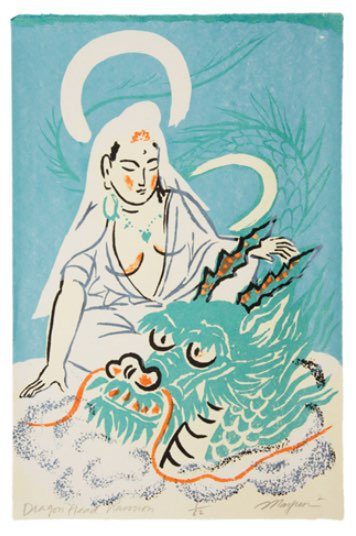
“Dragon Head Kannon” (2008) by Mayumi Oda
Back to the question in light of Dōgen’s teaching
What about the Dōgen’s passage from “Genjōkōan” quoted above? “We should not think that what we have attained is conceived by ourselves and known by our discriminating mind.”
Dōgen seems to be talking mostly here about the importance gradual cultivation. I think of another Dōgen phrase, “Walking in the mist, suddenly your coat is soaked through.” Suzuki Roshi elaborates:
“So Dōgen-zenji says our practice is like to go through the fog. It is not like to go out in thunderstorm [laughs]. If you go out in heavy rain, your clothes will be all-at-once wet. You will be soaked in water, but sudden rainstorm will not penetrate in your, you know, underwear. It will [laughs] [probably gestures to show water running off a surface]—but fog—when you walk through the thick fog for a long time, even though you don’t know—realize your clothing is wet, it is wet, and it will penetrate into your underwear. This is the true practice. You don’t think you made some progress, but [laughs] you did a remarkable progress if someone who knows what is real practice will acknowledge it” (2).
“Walking in the mist” (or fog) refers to the steady process of daily sitting, reflection, and application. “Suddenly your coat is soaked through,” is kenshō. And it’s an important thing to check with “someone who knows real practice.”
Shifting metaphor, gradual cultivation is like turning the lid on a Mason jar. Who knows where we’re at in the process? Then suddenly it pops off.
In other places in the Shōbōgenzō, “Self-Realization Samadhi (Jishō Zammai),” for instance, Dōgen insists on the importance on an abrupt nondual kenshō. He challenges his favorite nemesis, Dàhuì, for instance, for not having had a sufficiently unitary kenshō experience.
The Tanahashi translation has a key passage of Dōgen’s criticism like this: “Although [Dàhuì] often tried to open up for one phrase of enlightenment, he was lacking a single experience. He could not take hold of or drop away from this single experience” (3).
While Nishijima and Cross have it like this: “[Dàhuì] ultimately kept missing that one experience, and there is no way of compensating for that, for one cannot omit that experience…. He did not grasp that to study and train is to awaken to one’s True Self. He did not hear that to delve deeply into the writings of myriad generations is to come to realize what that Self truly is.
In conclusion, both gradual cultivation and sudden realization are vital aspects of the Zen way. And the spirit of both Dōgen Zen and Hakuin Zen is to do gradual cultivation with the spirit of sudden realization – with wholehearted effort without figuring, practicing as if our hair were on fire.
(1) Complete Poison Blossoms in a Thicket of Thorn #8
(2) Suzuki Roshi dharma talk from July 29, 1965
(3) Treasury of the True Dharma Eye: Zen Master Dogen’s Shobogenzo, “Self-Realization Samadhi,” translated by Kaz Tanahashi
(4) Shobogenzo, “Jishō-zanmai: Samādhi as Experience of the Self,” Nishijima and Cross, p. 48

Dōshō Port began practicing Zen in 1977 and now co-teaches with his wife, Tetsugan Zummach Sensei, with the Vine of Obstacles: Online Support for Zen Training, an internet-based Zen community. Dōshō received dharma transmission from Dainin Katagiri Rōshi and inka shōmei from James Myōun Ford Rōshi in the Harada-Yasutani lineage. Dōshō’s translation and commentary on The Record of Empty Hall: One Hundred Classic Koans, is now available (Shambhala). He is also the author of Keep Me In Your Heart a While: The Haunting Zen of Dainin Katagiri. Click here to support the teaching practice of Tetsugan Sensei and Dōshō Rōshi.
Previous Post

February 5, 2018
Tears of Love, Tears of Resentment
Next Post
February 23, 2018 Hakuin Helps An Old Sōtō Priest Favorlessly Meet Birth and Death
Browse Our Archives
Select a Category Uncategorized
Select a Month August 2023 July 2023 June 2023 May 2023 April 2023 March 2023 February 2023 January 2023 December 2022 November 2022 October 2022 September 2022 August 2022 July 2022 June 2022 May 2022 April 2022 March 2022 February 2022 January 2022 December 2021 November 2021 August 2021 June 2021 April 2021 February 2021 January 2021 November 2020 September 2020 August 2020 July 2020 June 2020 May 2020 April 2020 January 2020 December 2019 November 2019 August 2019 June 2019 May 2019 April 2019 February 2019 January 2019 December 2018 November 2018 October 2018 September 2018 August 2018 July 2018 June 2018 May 2018 April 2018 March 2018 February 2018 January 2018 December 2017 November 2017 October 2017 September 2017 August 2017 July 2017 June 2017 December 2016 October 2016 June 2016 April 2016 February 2016 January 2016 December 2015 November 2015 October 2015 August 2015 June 2015 May 2015 April 2015 March 2015 February 2015 January 2015 December 2014 November 2014 October 2014 September 2014 August 2014 July 2014 June 2014 May 2014 April 2014 March 2014 February 2014 January 2014 December 2013 November 2013 October 2013 September 2013 August 2013 July 2013 June 2013 May 2013 April 2013 March 2013 February 2013 January 2013 December 2012 November 2012 October 2012 September 2012 August 2012 July 2012 June 2012 May 2012 April 2012 March 2012 February 2012 January 2012 December 2011 November 2011 October 2011 September 2011 August 2011 July 2011 June 2011 May 2011 April 2011 March 2011 February 2011 January 2011 December 2010 November 2010 October 2010 September 2010 August 2010 July 2010 June 2010 May 2010 April 2010 March 2010 February 2010 January 2010 December 2009 November 2009 October 2009 September 2009 August 2009 July 2009 June 2009 May 2009 April 2009 March 2009 February 2009 January 2009 December 2008 November 2008 October 2008 September 2008 August 2008 July 2008 June 2008 May 2008
Follow Us!
TAKE THE
Religious Wisdom Quiz
What body part did Peter cut off a servant during Jesus’ arrest?
Select your answer to see how you score.
Hand Finger Ear Nose
Related posts from Wild Fox Zen

Gnawing Through Qiánfēng’s Three Illnesses and Two Lights
Messing With Yasutani Roshi Again and Again: Don't...

What is the Heart of Zen? Reflections on...
A Black Lacquer Person Runs Through the Night:...
TRENDING AT PATHEOS Buddhist

On Taking Refuge in the Dharma
(Here I continue the feature of sharing talks and essays by teachers...

(Continuing my intention to share talks and essays by other members of Empty...
The Subtle Art of Bowing: A Dharma Discourse
(This presentation was first offered by my dear friend Dharma Holder Tom...

Internal Family Systems Can Heal you Mentally &...
How IFS Helped Me Stop Fighting Myself Internal Family Systems (IFS) is...

The Bible No One Spoke About: A Family’s...
A mysterious family Bible, unspoken faith, and a journey from curiosity to...

How Uncertainty Can Transform Your Life in 2025
Embracing Uncertainty: A New Year’s Resolution for the Brave As 2025 approaches,...
view all Buddhist blogs
Ad-Free & Subscriber Log-In Subscription Support
- About Us
- 2026 Calendar
- Videos
- Podcasts
- Library of World Religions
- Faith In Media Tracker
- Advertise With Us
- Write for Us
- Privacy Policy
- Terms of Service
- Do Not Sell My Data
- Contact Us
- Radiant Digital
- Manage Newsletter Subscriptions
- Unsubscribe From Notifications
- Sitemap
Copyright 2008-2026, Patheos. All rights reserved.
Subscription Support Ad-Free & Subscriber Log-In
Follow Patheos