
BuddhistCatholicContemplativeEvangelicalGeneral ChristianHinduJewishLatter-day SaintMuslimNew VisionsProgressive Christian
Beliefs
- Buddhist
- Catholic
- Contemplative
- Evangelical
- General Christian
- Hindu
- Jewish
- Latter-day Saint
- More Voices
- Muslim
- New Visions
- Pagan
- Progressive Christian
Topics
- Religion News
- Food and Religion
- Sports and Religion
- Religious Art
- Religious Music and Entertainment
- Religious Events
- History and Religion
- Style and Religion
- Politics and Religion
- Women in Religion
- Recreation Outdoors and Religion
- Business Finance and Religion
- Careers Workplace and Religion
- Education and Religion
- Family Parenting and Religion
- Health Fitness and Religion
- Home and Religion
- Relationships and Religion
- Technology and Religion
- Travel and Religion
Columnists
- Buddhist Columnists
- Business Finance and Religion Columnists
- Careers Workplace and Religion Columnists
- Catholic Columnists
- Contemplative Columnists
- Education and Religion Columnists
- Evangelists Columnists
- Family Parenting and Religion Columnists
- General Christian Columnists
- Health Fitness and Religion Columnists
- Hindu Columnists
- History and Religion Columnists
- Home and Religion Columnists
- Jewish Columnists
- More Voices Columnists
- Latter Day Columnists
- Muslim Columnists
- New Visions Columnists
- Nonreligious Columnists
- Pagan Columnists
- Politics and Religion Columnists
- Progressive Columnists
- Recreation Outdoors and Religion Columnists
- Relationships and Religion Columnists
- Religion News Columnists
- Religious Art Columnists
- Religious Events Columnists
- Religious Music and Entertainment Columnists
- Sports and Religion Columnists
- Style and Religion Columnists
- Technology and Religion Columnists
- Travel and Religion Columnists
- Women in Religion Columnists
Resource Library
- 2026 Calendar
- Library of World Religions
- The 100 Most Holy Places on Earth
- Patheos Answers
- Podcasts
- Videos
- Faith Leaders Database
- Anglican Episcopalian
- Bahai
- Baptist
- Buddhism
- Christianity
- Confucianism
- Eastern Orthodoxy
- Hinduism
- Holiness and Pentecostal
- ISKCON
- Islam
- Judaism
- Lutheran
- Methodist
- The Church of Jesus Christ of Latter-day Saints
- New Age
- Paganism
- Presbytarian and Reformed
- Protestantism
- Religion Behind the Scenes
- Roman Catholic
- Scientology
- Shia Islam
- Sikhism
- Sufism
- Sunni Islam
- Taoism
- Zen
- See all religions
Research Tools
 Ad-Free & Subscriber Log-In Subscription Support
Ad-Free & Subscriber Log-In Subscription Support
Follow Patheos 

- Trending:
- Forgiveness
- |
- Marriage
- |
- Consciousness
- |
- Death Penalty
- |
- Election
- |
- Halloween
 Wild Fox Zen
- Home
- Buddhist
- Who Is This ‘Hakuin’ Guy?
Who Is This ‘Hakuin’ Guy?
Last updated on: February 19, 2022 at 9:01 pm by Dosho Port
Who Is This ‘Hakuin’ Guy? 2022-02-19T21:01:35-06:00 Dosho Port
Patheos Explore the world's faith through different perspectives on religion and spirituality! Patheos has the views of the prevalent religions and spiritualities of the world.
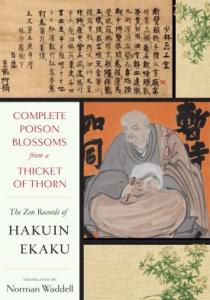
Recently, I interviewed a prospective student for the Vine of Obstacles: Online Support for Zen Training. He’d spend about a decade doing center-based Zen study with a nonkoan teacher, and another decade on his own doing Sōtō home-based practice. In our conversation, I mentioned how I’m in both the lineage streams of Dōgen (through Katagiri Roshi,1928 – 1990) and Hakuin (through Dōkutan Sōsan Rōshi, 1840 – 1917, Dai-un Sōgagku Rōshi, 1871 – 1961, and James Myōun Ford Rōshi, 1948 – ).
“Ah,” he hesitated, “who was this ‘Hakuin’ guy? Don’t think I ever heard of him.”
Hakuin is an enormously important figure in our Zen tradition, and his work deserves much more attention than it gets. So in this post, I’ll tell you a bit about him, laud Complete Poison Blossoms, an important recent translation of his work (see above cover image), and briefly share some thoughts about why Hakuin is so important for us today.
By the way, I’m planning to focus this Wild Fox Zen blog on Hakuin’s teaching, and especially Complete Poison Blossoms, through all of 2018, so if you’re a regular reader, you also might want to get the text. There is an earlier version of Poison Blossoms, also translated by Waddell, that contains about half the material in Complete Poison Blossoms. My recommendation, though, is not to hold back – buy the whole thing! It’s the only Zen study text you’ll need for at least a decade! So in that, it’s a bargain.
Emphasizing the importance of Complete Poison Blossoms, Waddell quotes Iida Tōin (1863–1937), another heretic with training in both Sōtō and Rinzai traditions:
“Anyone who wants to understand Master Hakuin must read Poison Blossoms from a Thicket of Thorn. Half-baked Zen teachers who disparage Hakuin without having read it are like blind men groping at an elephant. . . . Although as the title indicates it contains much material that is extremely difficult to grasp, how can anyone claiming to be a descendant of Hakuin really know him unless he has read this work? I have always kept my own copy close at hand. It gives me the feeling that I am living together with the old master.”
About Hakuin
Hakuin Ekaku (白隠 慧鶴, 1686 – 1768) and his eighty successors are often cited for being responsible for the revival of the Rinzai school. Hakuin was a central figure in the development of the modern kōan introspection method, including the Harada-Yasutani system, the most commonly practiced curriculum in the West today. Scholar and translator, Norman Waddell, has done us an enormous service through his numerous Hakuin translations, including the most recent Complete Poison Blossoms from a Thicket of Thorn: The Zen Records of Hakuin Ekaku, the work that I’ll turn to in a moment.
But who was this “Hakuin” guy? One of Hakuin’s most important successors, Tōrei, described Hakuin as lumbering like an ox and glaring like a tiger. Those images continue to come to mind as I study this great old teacher.
Hakuin was born to a middle-class family fairly close to Tokyo (but before it became Tokyo and when Kyoto was the center of the Rinzai Zen world) and became a monk at a young age. When he was nine, his mother had made the questionable parenting decision of taking him to a talk on the hell realms. This questionable decision was the sand in the oyster that led to the pearl of Hakuin’s Zen. At the time, however, the fragile young Hakuin was deeply impacted, tormented even, by the hell realm images and became a monk about five years later because he was still freaking out about being reborn in hell.
When he was twenty-two, following some years of rigorously throwing himself wholeheartedly in the mu kōan, Hakuin heard the sound of a distant temple bell, and had a significant kenshō. He met his heart teacher soon after that, Shōju Rōjin Roshi (1642–1721), and had several more important kenshō. After about ten years of pilgrimage, testing and refining his awakening with many different teachers, he eventually settled near his home village at Shōrinji, a small, dilapidated country temple. It was there at age forty-two that Hakuin had what he reported as his definitive awakening while reading the Lotus Sutra.
Here’s how Waddell describes it in Wild Ivy: The Spiritual Autobiography of Zen Master Hakuin:
“As Hakuin read, the sound of a cricket churring at the foundation stones of the temple reached his ears; at that instant, he crossed the threshold into great enlightenment. The accumulated doubts and uncertainties of forty years suddenly ceased to exist. The reason why the Lotus Sutra was regarded as supreme among all the Buddha’s preachings was revealed to him ‘with blinding clarity.’ He found teardrops ‘cascading down his face like strings of beads—they poured out like beans from a ruptured sack.’”
In Hakuin’s first decade after this awakening, he concentrated his bodhisattva vow energy toward the awakening of the small group of monks that gathered at Shōrinji. In the following three decades, Hakuin became an 18th Century Zen rock star, travelling and teaching widely. He was invited to explicate many texts, including the Blue Cliff Record, Lotus Sutra, Diamond Sutra, Dahui’s Arsenal, Gudō’s Lingering Radiance, and many more. Hundreds of practitioners attended these events and in some cases Hakuin’s introductory comments and verses for the occasions have been preserved and are included in Complete Poison Blossoms.
Hakuin regularly refers to the twenty-four Zen lineages transmitted to Japan, beginning in the 13th Century. Almost all of them were Rinzai lineages. And yet in the decades following Hakuin, all but two Rinzai lineages came to an end – the Obaku line and the line passing through Hsu-t’ang (Xutang Zhiyu 虚堂智愚, Japanese, Kido Chigu, 1185–1269), Nampo Jōmyō (1235–1308), and eventually through Hakuin and Gasan Jito (1727–1797).
Complete Poison Blossoms from a Thicket of Thorn: The Zen Records of Hakuin Ekaku
Complete Poison Blossoms is an extraordinary accomplishment and an enormous contribution to Zen practice. Many thanks to Norman Waddell!
Hakuin himself was very much involved in collecting and editing Complete Poison Blossoms and the text was published when he was in his early 70’s. That gave him another decade to teach from his own collected works. Waddell generously provides annotations made by some of Hakuin’s key successors, including Tōrei. Waddell also explains almost all of Hakuin’s references, bringing us more fully into the rich textures of Hakuin’s buddhadharma and secular narratives.
Hakuin’s buddhadharma narrative reveals a master of enlightening discourse while secular narrative is also strikingly rich and shows Hakuin to be engaged not only with monks and nuns but with lay people from many walks of life.
A hidden theme that doesn’t get much attention is the community that sprang up around Hakuin. It isn’t clear from the text whether it was planned or not, but when Hakuin became popular, many practitioners came to Shōrinji to train, way too many to provide for. Instead of creating a large monastic institution, Hakuin seems to have done what he could to provide simple accommodations at Shōrinji, but then sent small groups of practitioners into the local community to find food and lodging. According to Hakuin’s reports, they managed in bitter cold, living in whatever they could find, including abandoned shrines, surviving through begging and too often with very little food.
This decentralized model, catering to only the most stalwart practitioners, seems to have been a central ingredient to Hakuin’s success as a teacher.
Complete Poison Blossoms itself is equally decentralized and diverse, including, according to Waddell, “… instructions delivered on various occasions; formal and informal talks; verse and prose comments on koans; cautions on training addressed to individual students; remarks uttered at anniversaries, funeral services, and other temple observances; essays and explanations of terms from Buddhist scripture; letters, prefaces, and epilogues; painting inscriptions, a great many religious verses, and extended commentaries on the Heart Sutra and Tung-shan’s Five Ranks.”
Why Study Hakuin?
Primarily for the depth, breadth, and clarity of this message. How so?
In Complete Poison Blossoms, “78. Instructions to the Assembly at the Opening of a Lecture Meeting on the Lotus Sutra,” Hakuin wrote,
“Anyone who seeks to master the Buddha’s Way/Must begin by attaining a kenshō of total clarity.”
This is hardly the only time the primacy of kenshō for those who seek mastery of the buddhadharma is emphasized. In addition, the ongoing practice based on kenshō is a regular refrain in this and other Hakuin texts.
“Bodhisattvas of superior capacity,” Hakuin writes, “dwell in the dusty realm of differentiation, constantly carrying out their practice amid an infinite variety of distinctions.”
And he doesn’t just preach it, he practices it, and isn’t shy about sharing his own ongoing work. Writing about the Five Ranks, for example, he says, “But for more than thirty years … whether I was active or at rest, I was unable to feel truly at ease. Today, I have for the first time penetrated its secret mysteries completely. In comparison to this, everything I previously understood was no more than a shadow or an echo.”
He says similar things about a bunch of the kōan he comments on, adding an immanent subtlety that’s seldom encountered. So if even as an outstanding master, a Zen rock star, such as Hakuin continued doing the finely-drawn work of cultivating verification throughout his life, then those half-baked potatoes like me teaching Zen today should also be so inclined.
Finally, Hakuin connects kenshō and ongoing cultivation with the bodhisattva vow to carry all beings across in the most palpable and powerful way. For forty years after his definitive awakening, he worked tirelessly to help others realize the same heart-mind as the Buddha.
If you’re interested in such stuff, stay tuned.

Dōshō Port began practicing Zen in 1977 and now co-teaches with his wife, Tetsugan Zummach Sensei, with the Vine of Obstacles: Online Support for Zen Training, an internet-based Zen community. Dōshō received dharma transmission from Dainin Katagiri Rōshi and inka shōmei from James Myōun Ford Rōshi in the Harada-Yasutani lineage. Dōshō’s translation and commentary on The Record of Empty Hall: One Hundred Classic Koans, is now available (Shambhala). He is also the author of Keep Me In Your Heart a While: The Haunting Zen of Dainin Katagiri. Click here to support the teaching practice of Tetsugan Sensei and Dōshō Rōshi.
Complete Poison Blossoms from a Thicket of Thorn
Previous Post
December 30, 2017
It'll All Get Swept Away - And Happy New Year Anyway
Next Post

January 7, 2018 Hakuin on Kenshō and the Bodhisattva Vows
Browse Our Archives
Select a Category Uncategorized
Select a Month August 2023 July 2023 June 2023 May 2023 April 2023 March 2023 February 2023 January 2023 December 2022 November 2022 October 2022 September 2022 August 2022 July 2022 June 2022 May 2022 April 2022 March 2022 February 2022 January 2022 December 2021 November 2021 August 2021 June 2021 April 2021 February 2021 January 2021 November 2020 September 2020 August 2020 July 2020 June 2020 May 2020 April 2020 January 2020 December 2019 November 2019 August 2019 June 2019 May 2019 April 2019 February 2019 January 2019 December 2018 November 2018 October 2018 September 2018 August 2018 July 2018 June 2018 May 2018 April 2018 March 2018 February 2018 January 2018 December 2017 November 2017 October 2017 September 2017 August 2017 July 2017 June 2017 December 2016 October 2016 June 2016 April 2016 February 2016 January 2016 December 2015 November 2015 October 2015 August 2015 June 2015 May 2015 April 2015 March 2015 February 2015 January 2015 December 2014 November 2014 October 2014 September 2014 August 2014 July 2014 June 2014 May 2014 April 2014 March 2014 February 2014 January 2014 December 2013 November 2013 October 2013 September 2013 August 2013 July 2013 June 2013 May 2013 April 2013 March 2013 February 2013 January 2013 December 2012 November 2012 October 2012 September 2012 August 2012 July 2012 June 2012 May 2012 April 2012 March 2012 February 2012 January 2012 December 2011 November 2011 October 2011 September 2011 August 2011 July 2011 June 2011 May 2011 April 2011 March 2011 February 2011 January 2011 December 2010 November 2010 October 2010 September 2010 August 2010 July 2010 June 2010 May 2010 April 2010 March 2010 February 2010 January 2010 December 2009 November 2009 October 2009 September 2009 August 2009 July 2009 June 2009 May 2009 April 2009 March 2009 February 2009 January 2009 December 2008 November 2008 October 2008 September 2008 August 2008 July 2008 June 2008 May 2008
Follow Us!
TAKE THE
Religious Wisdom Quiz
Who wrote many letters (epistles) in the New Testament?
Select your answer to see how you score.
Jude John Paul Peter
Related posts from Wild Fox Zen

Gnawing Through Qiánfēng’s Three Illnesses and Two Lights

"Why, Oh Why, Is My Practice Not Progressing?"

What is the Heart of Zen? Reflections on...
A Black Lacquer Person Runs Through the Night:...
TRENDING AT PATHEOS Buddhist

On Taking Refuge in the Dharma
(Here I continue the feature of sharing talks and essays by teachers...

(Continuing my intention to share talks and essays by other members of Empty...
The Subtle Art of Bowing: A Dharma Discourse
(This presentation was first offered by my dear friend Dharma Holder Tom...

Internal Family Systems Can Heal you Mentally &...
How IFS Helped Me Stop Fighting Myself Internal Family Systems (IFS) is...

The Bible No One Spoke About: A Family’s...
A mysterious family Bible, unspoken faith, and a journey from curiosity to...

How Uncertainty Can Transform Your Life in 2025
Embracing Uncertainty: A New Year’s Resolution for the Brave As 2025 approaches,...
view all Buddhist blogs
Ad-Free & Subscriber Log-In Subscription Support
- About Us
- 2026 Calendar
- Videos
- Podcasts
- Library of World Religions
- Faith In Media Tracker
- Advertise With Us
- Write for Us
- Privacy Policy
- Terms of Service
- Do Not Sell My Data
- Contact Us
- Radiant Digital
- Manage Newsletter Subscriptions
- Unsubscribe From Notifications
- Sitemap
Copyright 2008-2026, Patheos. All rights reserved.
Subscription Support Ad-Free & Subscriber Log-In
Follow Patheos