
BuddhistCatholicContemplativeEvangelicalGeneral ChristianHinduJewishLatter-day SaintMuslimNew VisionsProgressive Christian
Beliefs
- Buddhist
- Catholic
- Contemplative
- Evangelical
- General Christian
- Hindu
- Jewish
- Latter-day Saint
- More Voices
- Muslim
- New Visions
- Pagan
- Progressive Christian
Topics
- Religion News
- Food and Religion
- Sports and Religion
- Religious Art
- Religious Music and Entertainment
- Religious Events
- History and Religion
- Style and Religion
- Politics and Religion
- Women in Religion
- Recreation Outdoors and Religion
- Business Finance and Religion
- Careers Workplace and Religion
- Education and Religion
- Family Parenting and Religion
- Health Fitness and Religion
- Home and Religion
- Relationships and Religion
- Technology and Religion
- Travel and Religion
Columnists
- Buddhist Columnists
- Business Finance and Religion Columnists
- Careers Workplace and Religion Columnists
- Catholic Columnists
- Contemplative Columnists
- Education and Religion Columnists
- Evangelists Columnists
- Family Parenting and Religion Columnists
- General Christian Columnists
- Health Fitness and Religion Columnists
- Hindu Columnists
- History and Religion Columnists
- Home and Religion Columnists
- Jewish Columnists
- More Voices Columnists
- Latter Day Columnists
- Muslim Columnists
- New Visions Columnists
- Nonreligious Columnists
- Pagan Columnists
- Politics and Religion Columnists
- Progressive Columnists
- Recreation Outdoors and Religion Columnists
- Relationships and Religion Columnists
- Religion News Columnists
- Religious Art Columnists
- Religious Events Columnists
- Religious Music and Entertainment Columnists
- Sports and Religion Columnists
- Style and Religion Columnists
- Technology and Religion Columnists
- Travel and Religion Columnists
- Women in Religion Columnists
Resource Library
- 2026 Calendar
- Library of World Religions
- The 100 Most Holy Places on Earth
- Patheos Answers
- Podcasts
- Videos
- Faith Leaders Database
- Anglican Episcopalian
- Bahai
- Baptist
- Buddhism
- Christianity
- Confucianism
- Eastern Orthodoxy
- Hinduism
- Holiness and Pentecostal
- ISKCON
- Islam
- Judaism
- Lutheran
- Methodist
- The Church of Jesus Christ of Latter-day Saints
- New Age
- Paganism
- Presbytarian and Reformed
- Protestantism
- Religion Behind the Scenes
- Roman Catholic
- Scientology
- Shia Islam
- Sikhism
- Sufism
- Sunni Islam
- Taoism
- Zen
- See all religions
Research Tools
 Ad-Free & Subscriber Log-In Subscription Support
Ad-Free & Subscriber Log-In Subscription Support
Follow Patheos 

- Trending:
- Forgiveness
- |
- Marriage
- |
- Consciousness
- |
- Death Penalty
- |
- Election
- |
- Halloween
 Wild Fox Zen
- Home
- Buddhist
- The Zen Priesthood: A Fold of Failures
The Zen Priesthood: A Fold of Failures
Last updated on: January 25, 2022 at 7:56 pm by Dosho Port
The Zen Priesthood: A Fold of Failures 2022-01-25T19:56:07-06:00 Dosho Port
Patheos Explore the world's faith through different perspectives on religion and spirituality! Patheos has the views of the prevalent religions and spiritualities of the world.
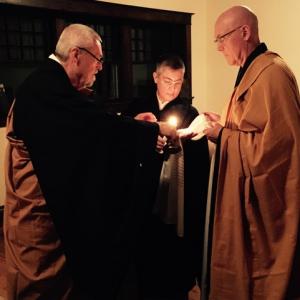
This post continues the series on the teaching of Hakuin, the 18th Century Japanese Rinzai Zen priest in all his raw, unplugged and unglued dharma from the heart. Dave Hondo has an excellent to-the-point post, “Reading Hakuin in the Age of Trump,” here. And Kurt Spellmeyer had this about Hakuin in Tricycle a few years ago: The Zen Master is Present.
By the way, I have no grand scheme for the order of posts in this series except “no rhyme or reason,” and write each week just on what is capturing my attention at the time.
One striking theme that has my attention this week is how Hakuin presents in the recently published Complete Plum Blossoms from a Thicket of Thorns (CPB), as thriving in a rich dharma ecosystem he inhabited with monks, nuns, laywomen, and laymen. And although Hakuin bemoans the sorry state of affairs in his day, well, it seems sorrier today. We in this global dharma ecosystem may just be getting going, while the Zen gardens in Hakuin’s time were in the old-growth phase: “Understory becomes well-developed and canopy opens up, but moss layer remains thin.”
Zeigan, a well-known Confucian scholar and friend of Hakuin wrote,
“The present generation of shavepates [Buddhist priests] is primarily concerned with fame and profit; they keep concubines, they eat fish, and are unscrupulous in hoodwinking lay people into respecting them. Although priests in the Sōtō and Ōbaku schools still strictly uphold the precepts against saké and tobacco, many of the Rinzai priests you see make no attempt whatever to observe them. Nonetheless, genuine Zen priests such as Daigu, Gudō, Bankei, Tenkei, Kogetsu, and Hakuin have appeared in the modern age” (CPB, p. 10).
So perhaps the old-growth forest was past its prime, the moss layer was getting thicker by the day, but still some huge trees were still present.
One of the most-sighted critters in Hakuin’s dharma ecosystem was the Zen priest. We see them today, as well, sometimes still sporting shaved heads and robes, but we have evolved a wider range of adaptive and nonadaptive behaviors.
In this post, I’ll now let go of the ecosystem metaphor and focus on Hakuin’s view of the following: who is a Zen priest?, what is the practice of a Zen priest?, and what are some of the pitfalls of priest practice?
Who is a Zen priest?
“Where our Zen school is concerned, anyone who achieves kenshō and leaves the house of birth-and-death is a ‘houseleaver’ (shukke or priest); it is not just someone who leaves the family home and gets his head shaved. Still, you find people going round crowing out unfounded claims: ‘I’ve left home. I’m a priest. I’m a priest.’ What is even worse, they proceed to pocket the charity and donations they hoodwink laypeople, the householders or ‘stay-at-homes,’ into giving them” (Wild Ivy, “Authentic Zen: The Danger of False Teaching,” pp. 3-4).
Earlier in the same work, Hakuin makes an even stronger claim, “Anyone who would call himself a member of the Zen family must first of all achieve kenshō—realization of the Buddha’s Way. If a person who has not achieved kenshō says he is a follower of Zen, he is an outrageous fraud. A swindler pure and simple.”
In the first sentence of the first citation above, Hakuin makes a radical claim – a Zen priest is someone who has kenshō-ed and so includes people living various lifestyles, home-leaving and home-dwelling. And in the second citation he’s does some name calling (i.e., fraud, swindler) for those that haven’t. This is consistent with Hakuin’s emphasis on the importance of kenshō and might have been intended more as admonitions to urge his listeners on to wholehearted practice, realizing kenshō, then as an organizational standard.
As an organizational standard, it would be tough to implement. Even in Hakuin’s day, there seems to have been a range of views on what constituted kenshō. Hakuin offered an effort toward quality control, “kenshō as clear as the palm of your hand,” but clearly this too is open to interpretation. And this lack of clarity seemed to have been true not only for Hakuin himself during his training, but for many of the Zen priests, Sōtō, Ōbaku, and Rinzai, that came to Hakuin to test a kenshō that they’d already attained.
The practice of visiting various teachers to test kenshō continues to be an important one today and is included in the formal training process in both the Kapleau and Kwan Um lineages. I’ve done a bit of it myself and can attest to its power and significance.
Hakuin’s assertion here that a Zen priest is anyone who attains kenshō, stands out in contrast to Dōgen’s view, as expressed in “Words of Praise and Admiration,” still recited as part of the ordination ceremony in Sōtō Zen:
“To roam freely in the path to liberation one needs the procedure of going forth from household life. This rite, which is the same in the way of all buddhas, is the standard for attaining liberation. This is a fact! It cannot be doubted. In bringing one’s body and mind into full accord with the way, nothing surpasses going forth from household life.”
For Dōgen, the ceremony of leaving home is conflated with liberation, and to accept it as fact as Dōgen states authoritatively, requires an esoteric, medieval-type belief in magic. And yet by a simple twist of cause and effect, this seems to be the prevailing view of priest ordination in the modern world.
A Zen priest friend, a much more generous, open-hearted fellow than myself, frames this more positively as “the transformative power of ritual.”
In my view, the best case scenario is when the experiential (aka, kenshō-ial) and the ceremonial practices come together. The worst case is over-relying on the ceremonial. “You can call a jar a bell….”
What is the practice of a Zen priest?
For Hakuin, “The priest, for [their] part, in order to lead others to salvation, kindles a great burning faith in [their] heart, opens the matchless eye of wisdom through the attainment of kenshō, and then works tirelessly to bestow the great gift of the Dharma, leading [their] fellow beings toward salvation in place of the Buddha [ancestor]s. In this way, priests and laity are like the two wheels of a cart, moving forward in unison” (Wild Ivy, “Authentic Zen: The Danger of False Teaching,” p. 4).
Hakuin offers a simple outline for priest practice here – kindle a great burning faith, realize kenshō, then go to work sharing the gift of dharma, especially kenshō, with others. Elsewhere, Hakuin stresses the process after kenshō as essential, boring through difficult-to-pass through kōans.
Hakuin expresses his sadness that there are “…priests who have not experienced kenshō, who do not engage in kōan practice, who do not read the sutras or uphold the precepts (CBT, “Gudo’s Lingering Radiance,” Supplement Two).”
Just in case we make the mistake of thinking that kenshō and character development are two different things, Hakuin conflates them. In CPB #147 “In Response to a Request from Tenryū Chōrō,” Hakuin refers to four questions posed by [Wu-tsu] Fa-yen. Waddell, offers a helpful note, quoting “Zen Master [Wu-tsu] Fa-yen’s Instructions for Students Leaving on Pilgrimage” (available in Broughton’s translation, Chan Whip Anthology: A Companion to Zen Practice, pp. 73-75).
“Once you resolve to concentrate on your training, you must constantly explore and examine yourself from hour to hour as you spur yourself forward. ‘Where was it I was able to gain spiritual strength?’ ‘Where was it I failed to gain strength?’ ‘Where was it I made mistakes?’ ‘Where was it I made no mistakes?’”
These reflections are the unpacking of the second of the Three Pure Precepts, the precept of generating power for the road through engaging in wholesome actions. According to Asanga, the heart of this precept is “…dedicating everything wholesome done with body, speech, and mind, and all that is yet to do, to supreme, right and full awakening…. The bodhisattva recognizes their own mistakes and looks at their faults; cognized and seen, they will be relinquished…. Ethics that procures, preserves, and increases wholesome factors such as these, are known as the bodhisattva’s ethics of collecting wholesome factors” (Asanga’s Chapter on Ethics, by Tatz).
What are the pitfalls to be avoided in priest practice?
Although there are many, let’s focus on two. First, getting distracted by worldly affairs. Hakuin said,
“[Temple priests’] life grows more relaxed by the day, they weaken and degenerate by the month, but eventually they become teachers charged with an assembly of their own students. As the years pass they are plagued by ever-deepening worries and fears. Thinking back, I can recall at most only five priests whose careers were satisfactory from beginning to end. I myself am one who belongs to this fraternity of failures. Becoming a temple priest is indeed a most formidable, most perilous undertaking, something you can only approach with extreme care and trepidation” (CPB #147).
What to do?
“Do not allow your quest to falter or cease because you get caught up in the endless entanglements of secular affairs. Nor should you acquire a liking for quiet spots where you can retire to sit until you shrivel away. You must apply yourself steadily and singlemindedly, whether you are walking, sitting, standing, or lying down, whether you are in a place bustling with activity or a place of great tranquility” (CPB #147).
The second pitfall is arrogance. Hakuin repeatedly returns to this theme in many of his works. In a long section with admonitions for an arrogant priest, Bonji, “Dharma Words Written for Bonji” (CPB), Hakuin gave a little background about this arrogant monk:
“Bonji, so far you have spoken and acted as you pleased. You have run roughshod over the whole world, your strong spirit refusing to yield to anyone. Your sharp tongue has enabled you to better others in argument.”
Hakuin tried to intervene, saying “…Observing your antics yesterday, I felt as though I was watching a small child toddling towards an open well.”
He then tried several strategies to get through to Bonji, telling eleven stories of arrogant priests who had nasty rebirths, and then tried identifying with Bonji, saying, “When I entered the realm of enlightenment for the first time, I myself became prideful, more arrogant than you are, Bonji. ”
I, too, have had struggles with the arrogance demon. For example, while training with Katagiri Roshi, a couple senior priests went to him and asked him to forbid me from asking questions after their talks, because I embarrassed them by besting them in dharma dialogue. Katagiri Roshi followed their advice, saying to me that although it was fine for me to ask him questions, I shouldn’t ask questions to other priests. I think he also saw me toddling towards an open well.
Indeed, I was such an arrogant upstart that instead of taking the above as important feedback, it became a badge of pride. And I regret to say that this was just the beginning of my travails with arrogance. Oh, I had a long way to go! And still….
Hakuin also tried a more directly confrontive approach with Bonji, pointing out that “…people who pride themselves on their cleverness are usually regarded by others as lacking in intelligence and common sense.”
Ouch!
Hakuin also provides an example of a nonarrogant, benevolent practitioner:
“Someone once asked the prelate Soshō Hosshi, ‘Why is it that everyone feels happy gazing at your face? Whether lay or cleric, young or old, they all feel as though they are looking at their father or mother.’ Soshō replied, ‘Whenever I look at people, deep in my heart I feel that they are to be revered and respected as Buddhas and Bodhisattvas. How could they feel enmity towards me?’”
The final antidote for arrogance is failure. In my case, it has been the most powerful antidote. Hakuin tells Bonji, “I have little wisdom that I can use to help others. No virtue for them to place their trust in. But because [an] old priest reproached me for my arrogance, I am able to doze away peacefully in this tiny temple of mine.”
Should you be so inclined, I would be delighted to welcome you too to the Zen priest fold (as defined above), a gaggle of near-total nincompoops. For a limited time, we’re offering free, full, lifetime membership in the fraternity/sorority of failures. Act now while space is available.
_________________

Previous Post

January 22, 2018
Hakuin's Advice for How To Attain Kenshō
Next Post
February 5, 2018 Tears of Love, Tears of Resentment
Browse Our Archives
Select a Category Uncategorized
Select a Month August 2023 July 2023 June 2023 May 2023 April 2023 March 2023 February 2023 January 2023 December 2022 November 2022 October 2022 September 2022 August 2022 July 2022 June 2022 May 2022 April 2022 March 2022 February 2022 January 2022 December 2021 November 2021 August 2021 June 2021 April 2021 February 2021 January 2021 November 2020 September 2020 August 2020 July 2020 June 2020 May 2020 April 2020 January 2020 December 2019 November 2019 August 2019 June 2019 May 2019 April 2019 February 2019 January 2019 December 2018 November 2018 October 2018 September 2018 August 2018 July 2018 June 2018 May 2018 April 2018 March 2018 February 2018 January 2018 December 2017 November 2017 October 2017 September 2017 August 2017 July 2017 June 2017 December 2016 October 2016 June 2016 April 2016 February 2016 January 2016 December 2015 November 2015 October 2015 August 2015 June 2015 May 2015 April 2015 March 2015 February 2015 January 2015 December 2014 November 2014 October 2014 September 2014 August 2014 July 2014 June 2014 May 2014 April 2014 March 2014 February 2014 January 2014 December 2013 November 2013 October 2013 September 2013 August 2013 July 2013 June 2013 May 2013 April 2013 March 2013 February 2013 January 2013 December 2012 November 2012 October 2012 September 2012 August 2012 July 2012 June 2012 May 2012 April 2012 March 2012 February 2012 January 2012 December 2011 November 2011 October 2011 September 2011 August 2011 July 2011 June 2011 May 2011 April 2011 March 2011 February 2011 January 2011 December 2010 November 2010 October 2010 September 2010 August 2010 July 2010 June 2010 May 2010 April 2010 March 2010 February 2010 January 2010 December 2009 November 2009 October 2009 September 2009 August 2009 July 2009 June 2009 May 2009 April 2009 March 2009 February 2009 January 2009 December 2008 November 2008 October 2008 September 2008 August 2008 July 2008 June 2008 May 2008
Follow Us!
TAKE THE
Religious Wisdom Quiz
Who said, "Come to me, all you who are weary and burdened, and I will give you rest"?
Select your answer to see how you score.
Paul David Moses Jesus
Related posts from Wild Fox Zen

Gnawing Through Qiánfēng’s Three Illnesses and Two Lights

"Why, Oh Why, Is My Practice Not Progressing?"

What is the Heart of Zen? Reflections on...

A Black Lacquer Person Runs Through the Night:...
TRENDING AT PATHEOS Buddhist

On Taking Refuge in the Dharma
(Here I continue the feature of sharing talks and essays by teachers...

(Continuing my intention to share talks and essays by other members of Empty...
The Subtle Art of Bowing: A Dharma Discourse
(This presentation was first offered by my dear friend Dharma Holder Tom...

Internal Family Systems Can Heal you Mentally &...
How IFS Helped Me Stop Fighting Myself Internal Family Systems (IFS) is...

The Bible No One Spoke About: A Family’s...
A mysterious family Bible, unspoken faith, and a journey from curiosity to...

How Uncertainty Can Transform Your Life in 2025
Embracing Uncertainty: A New Year’s Resolution for the Brave As 2025 approaches,...
view all Buddhist blogs
Ad-Free & Subscriber Log-In Subscription Support
- About Us
- 2026 Calendar
- Videos
- Podcasts
- Library of World Religions
- Faith In Media Tracker
- Advertise With Us
- Write for Us
- Privacy Policy
- Terms of Service
- Do Not Sell My Data
- Contact Us
- Radiant Digital
- Manage Newsletter Subscriptions
- Unsubscribe From Notifications
- Sitemap
Copyright 2008-2026, Patheos. All rights reserved.
Subscription Support Ad-Free & Subscriber Log-In
Follow Patheos