
BuddhistCatholicContemplativeEvangelicalGeneral ChristianHinduJewishLatter-day SaintMuslimNew VisionsProgressive Christian
Beliefs
- Buddhist
- Catholic
- Contemplative
- Evangelical
- General Christian
- Hindu
- Jewish
- Latter-day Saint
- More Voices
- Muslim
- New Visions
- Pagan
- Progressive Christian
Topics
- Religion News
- Food and Religion
- Sports and Religion
- Religious Art
- Religious Music and Entertainment
- Religious Events
- History and Religion
- Style and Religion
- Politics and Religion
- Women in Religion
- Recreation Outdoors and Religion
- Business Finance and Religion
- Careers Workplace and Religion
- Education and Religion
- Family Parenting and Religion
- Health Fitness and Religion
- Home and Religion
- Relationships and Religion
- Technology and Religion
- Travel and Religion
Columnists
- Buddhist Columnists
- Business Finance and Religion Columnists
- Careers Workplace and Religion Columnists
- Catholic Columnists
- Contemplative Columnists
- Education and Religion Columnists
- Evangelists Columnists
- Family Parenting and Religion Columnists
- General Christian Columnists
- Health Fitness and Religion Columnists
- Hindu Columnists
- History and Religion Columnists
- Home and Religion Columnists
- Jewish Columnists
- More Voices Columnists
- Latter Day Columnists
- Muslim Columnists
- New Visions Columnists
- Nonreligious Columnists
- Pagan Columnists
- Politics and Religion Columnists
- Progressive Columnists
- Recreation Outdoors and Religion Columnists
- Relationships and Religion Columnists
- Religion News Columnists
- Religious Art Columnists
- Religious Events Columnists
- Religious Music and Entertainment Columnists
- Sports and Religion Columnists
- Style and Religion Columnists
- Technology and Religion Columnists
- Travel and Religion Columnists
- Women in Religion Columnists
Resource Library
- 2026 Calendar
- Library of World Religions
- The 100 Most Holy Places on Earth
- Patheos Answers
- Podcasts
- Videos
- Faith Leaders Database
- Anglican Episcopalian
- Bahai
- Baptist
- Buddhism
- Christianity
- Confucianism
- Eastern Orthodoxy
- Hinduism
- Holiness and Pentecostal
- ISKCON
- Islam
- Judaism
- Lutheran
- Methodist
- The Church of Jesus Christ of Latter-day Saints
- New Age
- Paganism
- Presbytarian and Reformed
- Protestantism
- Religion Behind the Scenes
- Roman Catholic
- Scientology
- Shia Islam
- Sikhism
- Sufism
- Sunni Islam
- Taoism
- Zen
- See all religions
Research Tools
 Ad-Free & Subscriber Log-In Subscription Support
Ad-Free & Subscriber Log-In Subscription Support
Follow Patheos 

- Trending:
- Forgiveness
- |
- Marriage
- |
- Consciousness
- |
- Death Penalty
- |
- Election
- |
- Halloween
 Wild Fox Zen
- Home
- Buddhist
- Hakuin on Kenshō and the Bodhisattva Vows
Hakuin on Kenshō and the Bodhisattva Vows
Last updated on: November 19, 2022 at 9:39 am by Dosho Port
Hakuin on Kenshō and the Bodhisattva Vows 2022-11-19T09:39:56-06:00 Dosho Port
Patheos Explore the world's faith through different perspectives on religion and spirituality! Patheos has the views of the prevalent religions and spiritualities of the world.
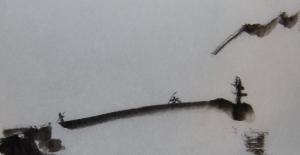
Painting, “Bridge,” by Hakuin
In my last post, Who Is This Hakuin Guy?, I gave some background for Hakuin Ekaku (白隠 慧鶴, 1686 – 1768) and the record of his teachings, the recently published Complete Poison Blossoms from a Thicket of Thorn: The Zen Records of Hakuin Ekaku, translated by Norman Waddell. Like most radical reformulators of the buddhadharma (e.g., Nagarjuna, Bodhidharma, Huineng, Dōgen, etc.), Hakuin saw himself as holding true to the essence of the Zen way, rearticulating that essence, and innovating a method for its attainment. In this post, I want to give an overview of what Hakuin taught, especially about kenshō, hopefully holding it up as a mirror for our times.
By the way, kenshō (見性) means “seeing [true] nature or essence.”
Hakuin freely and refreshingly stresses the importance of kenshō. In his long verse, “78. Instructions to the Assembly at the Opening of a Lecture Meeting on the Lotus Sutra,” the primary source for this post, Hakuin begins with these two lines:
“Anyone who seeks to master the Buddha’s Way/Must begin by attaining a kenshō of total clarity.”
The importance of kenshō
James Myōun Ford Roshi puts it this way: “As I see it first and foremost Zen is about awakening.”
It’s fair to say that not all Zen folks agree about that primacy of kenshō. For example, in a recent exchange of views, another Zen priest and teacher from one of the large Sōtō centers described the attitude of his institution as “rabidly anti-kenshō.”
Now, synonyms for kenshō include awakening, enlightenment, and satori. And the “buddh” in Buddhism means “awake,” so we Buddhists might call ourselves “Awake-ists.” If only it rolled off the tongue….
In any case, and whatever it’s called, I find it really surprising that a Buddhist group would be rabidly anti it.
As is often the case, support for contemporary predilections of Sōtō practitioners is found in the words of the thirteenth century founder of the Sōtō lineage in Japan, Dōgen. Sure enough, he had an issue with the word “kenshō.” “Seeing into mind and seeing into essence,” he wrote in his “Mountain and Rivers Sutra,” “is the activity of people outside the way.”
What Dōgen seemed to be saying here is that if you think you have some experience that reveals “mind” or “essence” as a thing, you are off to see the wizard, skipping along the yellow brick road of delusion. Of course, our Zen way is about intimacy and identity action, or as he expressed it kōanically, “Green mountains are always walking.”
Fair enough.
Now, I’d like to note that when it comes to words, Dōgen was quite a nitpicker. He also didn’t like the word “Zen,” but we still use that word widely, so why not “kenshō?” I’m wondering if those that are rabidly anti-kenshō are against the word, as Dōgen was, or against what it represents – awakening – which Dōgen wasn’t.
For me, experiences of awakening have been central to my Zen process. And so I find Hakuin’s emphasis so clear, and, yes, supportive of my predilections. In my view, the word that we use to describe the experience is not so important. How about respectfully hearing Dōgen’s concern about the possible misuse of the word “kenshō” and then moving on?
Which is what I’d like to do in this post. Although, clearly, after forty years of Dōgen study, I’m finding that challenging! Still, I’ll keep working on it during this year of Wild Fox Zen blog Hakuin focus.
Back to Hakuin
His first line opening his lecture on the Lotus Sutra Hakuin says, “Anyone who seeks to master the Buddha’s Way,” has a couple significant points. First, this Way is wide open – “Anyone.” You don’t have to be a Zen marine, really smart, or really healthy in every way. The important first point is this: “Anyone.”
Second, Hakuin implicitly recognizes that there are a variety of motivations for practice, including health, well-being, favorable rebirth, and personal effectiveness. In other passages in the Complete Poison Blossoms, Hakuin affirms and works with these and many other motivations. But here Hakuin is talking to is those who want to master the Buddha Way, the process of awakening.
If you are so motivated to master the Buddha Way, then Hakuin argues that you “…must begin by attaining a kenshō of total clarity.” How could you be a master of awakening if you’ve not experienced an awakening? But it’s not just any awakening that Hakuin recommends but a “kenshō of total clarity.”
Kenshō experiences, abrupt embodiments of nonduality, come with a wide-variety of characteristics, including special effects that can confuse and distract us from the heart of the matter – the intimate knowledge of self-and-other – and obscure the clarity that we-and-the-world itself are at once lacking in any abiding substance, and we-and-the-world are one within the great play of interaction, interdependence, and interpenetration.
Finally, also implicit in this passage is Hakuin’s predilection that kenshō is the beginning of the Buddha Way, not the end. To “… think experiencing kenshō is enough,” he writes, is “… a great fraud.”
It’s also important to note that kenshō is a part of our human inheritance and is really quite common, therefore, it makes sense to position kenshō in the beginning of the life of practice. That said, however, not everyone who diligently practices experiences kenshō, at least not in the time frame that they prefer. This also is an important topic that I’m going to kick down the road to future posts.
In future posts, I’ll also address Hakuin’s view of how to realize kenshō. For now, I’ll just note that one of the great virtues of working with a kōan teacher, is that after kenshō, there is a brilliant system for culling, clarifying, and cultivating verification.
Post kenshō practice
Hakuin continues,
“When it is as clear as a fruit lying in your hand/Crack the secret ciphers of the Eastern Mountain”
So, “a fruit lying in your hand,” gives us a sense of how clear “clear” is. It’s really obvious. “How could I have missed that I have a mango in my hand? Amazing!”
Waddell notes that “Secret ciphers or ‘passwords’ (angō-rei) originally referred to secret passwords used by soldiers in wartime; here it means potent kōans, generally.”
And it’s quite nice that, in English, “cipher” also means “zero.” And so we have here a found kōan – “quickly, crack zero!”
“Eastern Mountain” is a specific reference that Hakuin seems to mean more generally, to paraphrase Waddell, as Zen utterances of marvellous efficacy. Hakuin lists eight kōans, secret ciphers, that are fitting for post-kenshō practice, including “Huang-lung planting vegetables by the zazen seat.” I’ll return to this kōan soon.
Then after you’ve passed through these post-kensho kōan, Hakuin encourages us to take up a couple sutras as secret ciphers, specifically the Lotus and Vimalakirti sutras. This is really creative! “I have always lamented Zen’s ignorance of the sutras,” writes Hakuin, “Monks plodding ahead aimlessly like blind donkeys.”
Hakuin continues, “Unless you grasp their meaning, even with kenshō/You will fall unawares into the abyss of emptiness.” And on the other hand, “And if you read the scriptures without having kenshō/You’re only a parrot imitating someone else’s speech.”
Again, realizing emptiness, another way of languaging kenshō, is just the first step. If we get stuck there, “squatting inside attainment,” we will be sick through and through. “Bodhisattvas of superior capacity,” Hakuin writes, “dwell in the dusty realm of differentiation, constantly carrying out their practice amid an infinite variety of distinctions.”
Vowing to share kenshō with others
And now we come to the heart of Hakuin’s contribution to our Zen way.
“I want you [people] to keep the ancients’ practice in mind,” says Hakuin in his Lotus Sutra introduction, “While spurring the vow-wheel on to save living beings.”
Hakuin came this realization at age forty-two while reading the Lotus Sutra’s chapter on “Skillful Means.” As Waddell notes it in *Wild Ivy: The Spiritual Autobiography of Zen Master Hakuin, “*In that chapter, the Buddha reveals to his disciple Shariputra the true nature of the Mahayana Bodhisattva, whose own enlightenment is but the first step in [their] career of assisting others to attain theirs.”
Cracking the secret ciphers of the ancients, and then repaying our great debt of gratitude by aiding others are equal, mutually reinforcing aspects of post-kenshō training. One of Hakuin’s outstanding contributions to our practice is the visceral way he connects the heart of the way, the altruistic vow to save all beings, beginning with our first steps on the path, resolving to realize kenshō, realizing kenshō, and then working through difficult-to-pass kōans in order to share awakening with others. Thus the Bodhisattva Vows, beginning with “Beings are numberless; I vow to free them,” are made incredibly concrete.

Dōshō Port began practicing Zen in 1977 and now co-teaches with his wife, Tetsugan Zummach Sensei, with the Vine of Obstacles: Online Support for Zen Training, an internet-based Zen community. Dōshō received dharma transmission from Dainin Katagiri Rōshi and inka shōmei from James Myōun Ford Rōshi in the Harada-Yasutani lineage. Dōshō’s translation and commentary on The Record of Empty Hall: One Hundred Classic Koans, is now available (Shambhala). He is also the author of Keep Me In Your Heart a While: The Haunting Zen of Dainin Katagiri. Click here to support the teaching practice of Tetsugan Sensei and Dōshō Rōshi.
Previous Post

January 5, 2018
Who Is This 'Hakuin' Guy?
Next Post
January 15, 2018 Wump - There It Is
Browse Our Archives
Select a Category Uncategorized
Select a Month August 2023 July 2023 June 2023 May 2023 April 2023 March 2023 February 2023 January 2023 December 2022 November 2022 October 2022 September 2022 August 2022 July 2022 June 2022 May 2022 April 2022 March 2022 February 2022 January 2022 December 2021 November 2021 August 2021 June 2021 April 2021 February 2021 January 2021 November 2020 September 2020 August 2020 July 2020 June 2020 May 2020 April 2020 January 2020 December 2019 November 2019 August 2019 June 2019 May 2019 April 2019 February 2019 January 2019 December 2018 November 2018 October 2018 September 2018 August 2018 July 2018 June 2018 May 2018 April 2018 March 2018 February 2018 January 2018 December 2017 November 2017 October 2017 September 2017 August 2017 July 2017 June 2017 December 2016 October 2016 June 2016 April 2016 February 2016 January 2016 December 2015 November 2015 October 2015 August 2015 June 2015 May 2015 April 2015 March 2015 February 2015 January 2015 December 2014 November 2014 October 2014 September 2014 August 2014 July 2014 June 2014 May 2014 April 2014 March 2014 February 2014 January 2014 December 2013 November 2013 October 2013 September 2013 August 2013 July 2013 June 2013 May 2013 April 2013 March 2013 February 2013 January 2013 December 2012 November 2012 October 2012 September 2012 August 2012 July 2012 June 2012 May 2012 April 2012 March 2012 February 2012 January 2012 December 2011 November 2011 October 2011 September 2011 August 2011 July 2011 June 2011 May 2011 April 2011 March 2011 February 2011 January 2011 December 2010 November 2010 October 2010 September 2010 August 2010 July 2010 June 2010 May 2010 April 2010 March 2010 February 2010 January 2010 December 2009 November 2009 October 2009 September 2009 August 2009 July 2009 June 2009 May 2009 April 2009 March 2009 February 2009 January 2009 December 2008 November 2008 October 2008 September 2008 August 2008 July 2008 June 2008 May 2008
Follow Us!
TAKE THE
Religious Wisdom Quiz
What river did John baptize Jesus in?
Select your answer to see how you score.
Nile River Tigris River Jordan River Red Sea
Related posts from Wild Fox Zen

Gnawing Through Qiánfēng’s Three Illnesses and Two Lights
Messing With Yasutani Roshi Again and Again: Don't...

What is the Heart of Zen? Reflections on...
A Black Lacquer Person Runs Through the Night:...
TRENDING AT PATHEOS Buddhist

On Taking Refuge in the Dharma
(Here I continue the feature of sharing talks and essays by teachers...

(Continuing my intention to share talks and essays by other members of Empty...
The Subtle Art of Bowing: A Dharma Discourse
(This presentation was first offered by my dear friend Dharma Holder Tom...

Internal Family Systems Can Heal you Mentally &...
How IFS Helped Me Stop Fighting Myself Internal Family Systems (IFS) is...

The Bible No One Spoke About: A Family’s...
A mysterious family Bible, unspoken faith, and a journey from curiosity to...

How Uncertainty Can Transform Your Life in 2025
Embracing Uncertainty: A New Year’s Resolution for the Brave As 2025 approaches,...
view all Buddhist blogs
Ad-Free & Subscriber Log-In Subscription Support
- About Us
- 2026 Calendar
- Videos
- Podcasts
- Library of World Religions
- Faith In Media Tracker
- Advertise With Us
- Write for Us
- Privacy Policy
- Terms of Service
- Do Not Sell My Data
- Contact Us
- Radiant Digital
- Manage Newsletter Subscriptions
- Unsubscribe From Notifications
- Sitemap
Copyright 2008-2026, Patheos. All rights reserved.
Subscription Support Ad-Free & Subscriber Log-In
Follow Patheos