
BuddhistCatholicContemplativeEvangelicalGeneral ChristianHinduJewishLatter-day SaintMuslimNew VisionsProgressive Christian
Beliefs
- Buddhist
- Catholic
- Contemplative
- Evangelical
- General Christian
- Hindu
- Jewish
- Latter-day Saint
- More Voices
- Muslim
- New Visions
- Pagan
- Progressive Christian
Topics
- Religion News
- Food and Religion
- Sports and Religion
- Religious Art
- Religious Music and Entertainment
- Religious Events
- History and Religion
- Style and Religion
- Politics and Religion
- Women in Religion
- Recreation Outdoors and Religion
- Business Finance and Religion
- Careers Workplace and Religion
- Education and Religion
- Family Parenting and Religion
- Health Fitness and Religion
- Home and Religion
- Relationships and Religion
- Technology and Religion
- Travel and Religion
Columnists
- Buddhist Columnists
- Business Finance and Religion Columnists
- Careers Workplace and Religion Columnists
- Catholic Columnists
- Contemplative Columnists
- Education and Religion Columnists
- Evangelists Columnists
- Family Parenting and Religion Columnists
- General Christian Columnists
- Health Fitness and Religion Columnists
- Hindu Columnists
- History and Religion Columnists
- Home and Religion Columnists
- Jewish Columnists
- More Voices Columnists
- Latter Day Columnists
- Muslim Columnists
- New Visions Columnists
- Nonreligious Columnists
- Pagan Columnists
- Politics and Religion Columnists
- Progressive Columnists
- Recreation Outdoors and Religion Columnists
- Relationships and Religion Columnists
- Religion News Columnists
- Religious Art Columnists
- Religious Events Columnists
- Religious Music and Entertainment Columnists
- Sports and Religion Columnists
- Style and Religion Columnists
- Technology and Religion Columnists
- Travel and Religion Columnists
- Women in Religion Columnists
Resource Library
- 2026 Calendar
- Library of World Religions
- The 100 Most Holy Places on Earth
- Patheos Answers
- Podcasts
- Videos
- Faith Leaders Database
- Anglican Episcopalian
- Bahai
- Baptist
- Buddhism
- Christianity
- Confucianism
- Eastern Orthodoxy
- Hinduism
- Holiness and Pentecostal
- ISKCON
- Islam
- Judaism
- Lutheran
- Methodist
- The Church of Jesus Christ of Latter-day Saints
- New Age
- Paganism
- Presbytarian and Reformed
- Protestantism
- Religion Behind the Scenes
- Roman Catholic
- Scientology
- Shia Islam
- Sikhism
- Sufism
- Sunni Islam
- Taoism
- Zen
- See all religions
Research Tools
 Ad-Free & Subscriber Log-In Subscription Support
Ad-Free & Subscriber Log-In Subscription Support
Follow Patheos 

- Trending:
- Forgiveness
- |
- Marriage
- |
- Consciousness
- |
- Death Penalty
- |
- Election
- |
- Halloween
 Wild Fox Zen
- Home
- Buddhist
- Who Am I? What Is Death? What Happens After Death?
Who Am I? What Is Death? What Happens After Death?
Last updated on: November 8, 2017 at 9:36 am by Dosho Port
Who Am I? What Is Death? What Happens After Death? 2017-11-08T09:36:09-06:00 Dosho Port
Patheos Explore the world's faith through different perspectives on religion and spirituality! Patheos has the views of the prevalent religions and spiritualities of the world.
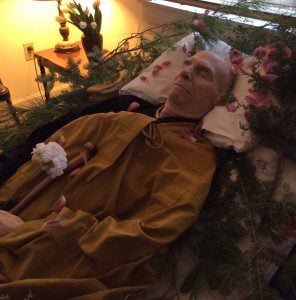
Above is Zenshin Tim Buckley, a friend and fellow traveller on this Zen way, who died on April 16, 2015. You can read more about Zenshin here.
We’re not here today, though, to memorialize Zenshin but to ask, “Who is it that dies?”
You can read the run up to this post, “Birth Death and Intimate Self Knowledge,” here and listen to a talk about it here. In this post, I’ll unpack a kōan from the *No Gate Barrier (*Wúménguān 禪宗無門關) collection, “CASE 47: Dōushuài’s Three Barriers” (my translation). In plain English, the three barriers are, Who am I? What is death? And what happens after death? All essential human questions.
Case:
The happy old monk Dōushuài, set up three barriers to ask students.
“Parting the grasses, participating in the mystery, only seeking to meet [essential] nature. Right now, honored one, where will you know this self nature?
“Just when birthdeath is shed, when vision falls away, what will you do?
“Birthdeath shed, then [you] know [your] destination. The four elements separate, where will you go?”
First a word about Dōushuài (1023-1104). He was a teacher in the Huánglóng branch of Línjì. The scholar, Steve Heine, associates this branch and the Cáodòng lineage (Japanese, Sōtō) with the entangling-vine approach to kōan introspection rather than the key-phrase method of the Línjì branch associated with Dahui. It was this Huánglóng branch that Dōgen inherited from his first teacher and esteemed sufficiently to include on his blood vein (kechimyaku). It is still transmitted today in Sōtō Zen.
Wúmén introduces Dōushuài in an unusual way with an adjective before “old monk” (Japanese, ōshō), a rare thing in the kōan collections. Dōushuài is a “happy” old monk, no less. We like him already. Dōushuài’s “happy” old monkness is not apart from resolving these three questions and having the chance to pose them for others.
Who Am I?
First*,*“parting the grasses, participating in the mystery, only seeking to meet [essential] nature. Right now, honored one, where will you know this self nature?”
“Grasses” in “Parting the grasses” refers to the wild world of delusion. And “parting” is a practice instruction for how to work with delusion – touching and letting go.
“Participating in the mystery,” could also be “participating the darkness.” Again, a practice instruction. With grasses extending to and darkening the sky, take a step.
Why? “Only seeking to meet [essential] nature.”
If you want to find freedom in this question, you’ll probably want to organize your life around your practice, rather than fit in your practice in when your life allows. Only seeking essential nature. It isn’t something for some other time but for “right now.” Show some self respect, “honored one.”
Aitken Roshi’s translation has the last phrase as “Where is your nature?” but this leaves out a sinograph or two. I read it as “Where will you know this self nature?” The kōan is a narrow gate and penetratingly specific.
What is death?
“Just when birthdeath is shed, when vision falls away, what will you do?
For “Just when birthdeath is shed,” Aitken Roshi has “When you have realized your self-nature.” His approach explains what is meant by “birthdeath shed.” I prefer to stay close to the sinographs here – just drop birthdeath. “Shed” (or “drop”) is 脱, the same character Dōgen used in “shed bodymind.” No need to paste a belief system – heaven/hell, rebirth, you name it – on top of it. All that is clinging to and swirling in birthdeath. So the practice instruction – just shed birthdeath and what death is (“what you will do when you die?”) will be crystal clear.
What happens after death?
“Birthdeath shed, then [you] know [your] destination. The four elements separate, where will you go?”
Likewise, when birthdeath is shed and you’ve realized intimate self-knowledge, when the cells of “your” body (i.e., earth, water, air, and fire) begin to decompose, you’ll know where you go. No need for idle speculation. This is why Zen has been handed on through the generations.
Enter the dark mystery completely and birthdeath will be completely dropped. Who you are, what death is, what happens after death are all clear.
When it’s already raining, no need to water the lawn.
Wúmén’s Comment:
If you can arrive at three turning words, then [you] can take responsibility everywhere, meet karma and approach the [school of the] ancestors. Before this happens, a coarse meal will easily satisfy, [but] when hungry, subtle chewing is a problem.
Wúmén’s voice, as usual, is clear and strong. The last sentence is worth a quiet sit or two. Lost in the swirl of the world, we can wolf down our food – drugs, sex, rock n roll. When we turn to practice, make only seeking self nature the central organizing principle, we begin the subtle chewing of sitting, study, and engagement. The hunger to realize and the need for subtle chewing are the two foci that rub together and heat the room on a cold morning.
Verse:
One nen is the universe seeing the immeasurable kalpa.
The immeasurable kalpa is this matter now –
Now sees the broken one nen*.*
Seeing the broken now is seeing the essential person.
I’ve left “nen” (念) untranslated because the multiple nuances of the term make it difficult to find one fitting English word. The sinograph is composed of “now” above and “heart/mind” below. It means “thought,” “memory,” “remembering (as in nenbutsu, remembering buddha),” “moment,” and is the sinograph that is translated as “mindfulness.” The closest I can come to capture aspects of all these meanings is “nowfulness” – “One nowfulness is the universe….”
Simply put, this moment, for all its broken glory, is it.
Previous Post

November 6, 2017
Birth, Death and Intimate Self Knowledge
Next Post

November 13, 2017 Dōshō the Dōgen Hater (Not): A Preemptive Blog For My Dear Critics
Browse Our Archives
Select a Category Uncategorized
Select a Month August 2023 July 2023 June 2023 May 2023 April 2023 March 2023 February 2023 January 2023 December 2022 November 2022 October 2022 September 2022 August 2022 July 2022 June 2022 May 2022 April 2022 March 2022 February 2022 January 2022 December 2021 November 2021 August 2021 June 2021 April 2021 February 2021 January 2021 November 2020 September 2020 August 2020 July 2020 June 2020 May 2020 April 2020 January 2020 December 2019 November 2019 August 2019 June 2019 May 2019 April 2019 February 2019 January 2019 December 2018 November 2018 October 2018 September 2018 August 2018 July 2018 June 2018 May 2018 April 2018 March 2018 February 2018 January 2018 December 2017 November 2017 October 2017 September 2017 August 2017 July 2017 June 2017 December 2016 October 2016 June 2016 April 2016 February 2016 January 2016 December 2015 November 2015 October 2015 August 2015 June 2015 May 2015 April 2015 March 2015 February 2015 January 2015 December 2014 November 2014 October 2014 September 2014 August 2014 July 2014 June 2014 May 2014 April 2014 March 2014 February 2014 January 2014 December 2013 November 2013 October 2013 September 2013 August 2013 July 2013 June 2013 May 2013 April 2013 March 2013 February 2013 January 2013 December 2012 November 2012 October 2012 September 2012 August 2012 July 2012 June 2012 May 2012 April 2012 March 2012 February 2012 January 2012 December 2011 November 2011 October 2011 September 2011 August 2011 July 2011 June 2011 May 2011 April 2011 March 2011 February 2011 January 2011 December 2010 November 2010 October 2010 September 2010 August 2010 July 2010 June 2010 May 2010 April 2010 March 2010 February 2010 January 2010 December 2009 November 2009 October 2009 September 2009 August 2009 July 2009 June 2009 May 2009 April 2009 March 2009 February 2009 January 2009 December 2008 November 2008 October 2008 September 2008 August 2008 July 2008 June 2008 May 2008
Follow Us!
TAKE THE
Religious Wisdom Quiz
Who said, "Faith without works is dead"?
Select your answer to see how you score.
John Paul James Peter
Related posts from Wild Fox Zen

Throw Yourself Into the House of Buddha: The...

New Vine Ghost Site for Dosho's Creative Endeavors...

Gnawing Through Qiánfēng’s Three Illnesses and Two Lights

"Why, Oh Why, Is My Practice Not Progressing?"
TRENDING AT PATHEOS Buddhist

On Taking Refuge in the Dharma
(Here I continue the feature of sharing talks and essays by teachers...

(Continuing my intention to share talks and essays by other members of Empty...
The Subtle Art of Bowing: A Dharma Discourse
(This presentation was first offered by my dear friend Dharma Holder Tom...

Internal Family Systems Can Heal you Mentally &...
How IFS Helped Me Stop Fighting Myself Internal Family Systems (IFS) is...

The Bible No One Spoke About: A Family’s...
A mysterious family Bible, unspoken faith, and a journey from curiosity to...

How Uncertainty Can Transform Your Life in 2025
Embracing Uncertainty: A New Year’s Resolution for the Brave As 2025 approaches,...
view all Buddhist blogs
Ad-Free & Subscriber Log-In Subscription Support
- About Us
- 2026 Calendar
- Videos
- Podcasts
- Library of World Religions
- Faith In Media Tracker
- Advertise With Us
- Write for Us
- Privacy Policy
- Terms of Service
- Do Not Sell My Data
- Contact Us
- Radiant Digital
- Manage Newsletter Subscriptions
- Unsubscribe From Notifications
- Sitemap
Copyright 2008-2026, Patheos. All rights reserved.
Subscription Support Ad-Free & Subscriber Log-In
Follow Patheos