
BuddhistCatholicContemplativeEvangelicalGeneral ChristianHinduJewishLatter-day SaintMuslimNew VisionsProgressive Christian
Beliefs
- Buddhist
- Catholic
- Contemplative
- Evangelical
- General Christian
- Hindu
- Jewish
- Latter-day Saint
- More Voices
- Muslim
- New Visions
- Pagan
- Progressive Christian
Topics
- Religion News
- Food and Religion
- Sports and Religion
- Religious Art
- Religious Music and Entertainment
- Religious Events
- History and Religion
- Style and Religion
- Politics and Religion
- Women in Religion
- Recreation Outdoors and Religion
- Business Finance and Religion
- Careers Workplace and Religion
- Education and Religion
- Family Parenting and Religion
- Health Fitness and Religion
- Home and Religion
- Relationships and Religion
- Technology and Religion
- Travel and Religion
Columnists
- Buddhist Columnists
- Business Finance and Religion Columnists
- Careers Workplace and Religion Columnists
- Catholic Columnists
- Contemplative Columnists
- Education and Religion Columnists
- Evangelists Columnists
- Family Parenting and Religion Columnists
- General Christian Columnists
- Health Fitness and Religion Columnists
- Hindu Columnists
- History and Religion Columnists
- Home and Religion Columnists
- Jewish Columnists
- More Voices Columnists
- Latter Day Columnists
- Muslim Columnists
- New Visions Columnists
- Nonreligious Columnists
- Pagan Columnists
- Politics and Religion Columnists
- Progressive Columnists
- Recreation Outdoors and Religion Columnists
- Relationships and Religion Columnists
- Religion News Columnists
- Religious Art Columnists
- Religious Events Columnists
- Religious Music and Entertainment Columnists
- Sports and Religion Columnists
- Style and Religion Columnists
- Technology and Religion Columnists
- Travel and Religion Columnists
- Women in Religion Columnists
Resource Library
- 2026 Calendar
- Library of World Religions
- The 100 Most Holy Places on Earth
- Patheos Answers
- Podcasts
- Videos
- Faith Leaders Database
- Anglican Episcopalian
- Bahai
- Baptist
- Buddhism
- Christianity
- Confucianism
- Eastern Orthodoxy
- Hinduism
- Holiness and Pentecostal
- ISKCON
- Islam
- Judaism
- Lutheran
- Methodist
- The Church of Jesus Christ of Latter-day Saints
- New Age
- Paganism
- Presbytarian and Reformed
- Protestantism
- Religion Behind the Scenes
- Roman Catholic
- Scientology
- Shia Islam
- Sikhism
- Sufism
- Sunni Islam
- Taoism
- Zen
- See all religions
Research Tools
 Ad-Free & Subscriber Log-In Subscription Support
Ad-Free & Subscriber Log-In Subscription Support
Follow Patheos 

- Trending:
- Forgiveness
- |
- Marriage
- |
- Consciousness
- |
- Death Penalty
- |
- Election
- |
- Halloween
 Wild Fox Zen
- Home
- Buddhist
- “It Came From Beyond Zen” and What Dōgen Did Not Teach
“It Came From Beyond Zen” and What Dōgen Did Not Teach
Last updated on: January 25, 2022 at 8:03 pm by Dosho Port
“It Came From Beyond Zen” and What Dōgen Did Not Teach 2022-01-25T20:03:17-06:00 Dosho Port
Patheos Explore the world's faith through different perspectives on religion and spirituality! Patheos has the views of the prevalent religions and spiritualities of the world.

In this look at Brad Warner’s new book, It Came From Beyond Zen: More Practical Advice from Dōgen, Japan’s Greatest Zen Master, I’m going to focus just on one issue – kōan. But for decorum sake, let’s start with this:
Brad Warner has done a lot of good for Zen in the West. Most practitioners I talk with who are under 40-years-old found their way to Zen through Warner’s books, especially Hardcore Zen*. Warner has cultivated an image of being an irreverent iconoclastic, while ironically embracing orthodox Sōtō Zen, for example, by exhibiting reverence for Dōgen’s teaching, advocating no-goal zazen, and finding kensho and koan introspection either insignificant or not a part of Sōtō practice.*
That’s what I said about Warner’s previous book, Don’t Be A Jerk: And Other Practical Advice from Dōgen, Japan’s Greatest Zen Master (A Radical but Reverent Paraphrasing of Dōgen’s Treasury of the True Dharma Eye). Read the whole review here. All that still applies.
Warner’s new book, It Came From Beyond Zen, is more of the same – a practitioner’s helpful contribution to Dōgen studies. It includes a careful review of what the old boy (Dōgen, that is, not the 53-year-old Warner) said, paraphrased with phrases like “What’s yours, bro?” thrown in, and a generous review of other translations. The chapters include commentary by Warner, as well.
As I said, Warner’s near full-on embrace of post-Meiji Sōtō orthodoxy, especially regarding kōan, is what I’ll dig into here in some detail, responding point-by-point to Warner. But he’s right, the cross talk between kōan Zen practitioners and nonkōan Zen practitioners tends not to be fruitful. People tend to take this issue as intensely personal. Click here for my recent post about my history with Dōgen and kōan Zen.
Nevertheless, as I said, Warner writes,
“There is a lot of cross talk in Zen circles, about whether Dōgen practiced and taught what folks these days call ‘kōan Zen.'”
Kōan Zen has developed a lot since Dōgen’s time, so I don’t know anyone who thinks that Dōgen practiced or taught kōan Zen like it’s practiced and taught in our post-Hakuin world (as if there was one thing that really existed now or then called “kōan Zen”). Dōgen had received transmission from a Rinzai line before he went to China, but we have even less information about what their actual practice was and if they engaged in kōan introspection.
However, it doesn’t seem that Dōgen had any set curriculum and may have had a more panoramic approach to kōan, rather than Dahui’s key phrase method, as Steven Heine (Like Cats and Dogs: Contesting the Mu Koan in Zen Buddhism – my review here) and Taigen Leighton (Just This Is It, p. 12) have argued. The panoramic approach, though, is a series of key-phrases, so in actual practice the distinction falls apart.
Stepping back and looking at the whole body of Dōgen’s work, it seems to me that what he was doing was subtle and nuanced and doesn’t fit neatly into today’s kōan or nonkōan (or panoramic and key phrase) hardening of the categories. What’s interesting to me and my ilk is the incredible kōan playfulness, creativity, and integration that Dōgen manifested in his writing, seemingly without limit. It’s really inspiring. And that’s the main reason I enter the forest of thorns here about Dōgen and kōan – he provides kōan practitioners with such inspiration that I want to point his work out rather than have it hidden under the “zazen-only” bushel basket.
Granted, Dōgen said a lot and so it is possible to pull together a poison blossoms bouquet for both kōan Zen and nonkōan Zen. But what was Dōgen’s practice and what does that say about cultivating verification today? I find myself still interested in those questions even though I’ve been researching them on and off the cushion for forty years, as well as writing about it here for almost ten years. Warner’s view provides me with an opportunity to summarize some of that (just follow the many links for more).
That said, I think we in Sōtō Zen make way too much of Dōgen. Afterall, he is long dead and wasn’t God or the lord Jesus but a person like us, a self-proclaimed broken-wooden ladle. In addition, if we’re going to make a big deal out of dead people, there have been a lot of great Zen teachers in China, Japan, and Korea (at least). And Rujing, one of Dōgen’s primary teachers, gave instruction for how to engage the mu kōan (click here), as did Dogen (click here), which would have been kinda silly if no one they were talking to was doing it. Finally, Dōgen’s immediate successors, at least through Keizan, practiced, woke up, and taught through kōan (click here and/or click here).
In my view, the kōan innovation is one of the most generous and illuminating developments in meditation practice in fifteen hundred years or so. And Hakuin and his close successors were incredible spiritual geniuses. So even if Dōgen really did teach that zazen MUST be a kōan-free zone, well, so what?
Warner continues,
“This is the kind of Zen [kōan Zen] in which your teacher gives you a tricky question like, ‘What is the sound of one hand clapping?’ or ‘If a tree falls on a mime does he make a sound?’ and you meditate on it. Then you’re supposed to go to your master and present your answer.”
Ok, “If a tree falls on a mime does he make a sound?” – I like! A wonderful found kōan!
However, Warner’s trivializing portrayal of kōan Zen exists only in Warner’s mind. I hope. Kōan Zen is not about meditating on a kōan, referred to by Warner elsewhere as that “Rinzai thinkee thing,” but about being the kōan, doing the thinking, not thinking, non thinking thing. And Warner’s notion that kōan Zen is like elementary school where the student is called to the front of the room and put on the spot for “the answer” is a feeling that people sometimes have but isn’t the actual work.
Here’s somebody (John Tarrant) who knows about kōan Zen describing what it’s about:
“The method of immersing yourself in a great question is more ancient than Buddhism and seems to arise naturally in some people when they turn to spiritual things. It is a method that faces human ignorance squarely and at the same time has faith that remedy for suffering exists, and that a sincere effort will reveal that remedy…. Over and over again, [kōan] Zen is not about having the answer but about moving in the darkness of what is unknown and uncertain and trusting both your moves and the darkness that opens as you enter it.”
Briefly put, kōan introspection is for people that are driven to investigate the essential questions of life and death in relationship with someone who is also doing that investigation.
For you visual learners, here’s Hakuin’s “Blind Men Crossing a Bridge” (thanks, Robert L.) that gives a wonderful illustration of the process:
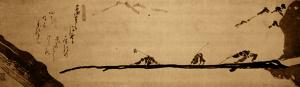
Warner continues,
“Dōgen did not teach this sort of ‘kōan Zen.’ Period. End of debate. Forever.”
On this we can agree. Nobody taught or teaches Warner’s parody of kōan introspection, including Dōgen.
Warner continues,
“Dōgen … wrote very extensively about what kind of Zen he did practice and teach. He is abundantly clear about it, especially in his essay “Fukanzazengi” … there is nothing in that or, indeed, in any of Dōgen’s writing in which he recommends that anyone sit and contemplate a kōan and then try to answer it for their teacher.”
I beg to differ. We know that Dōgen was a great kōanizer (click here), reframing monastic life from the kitchen to the toilet in terms of kōan. Did he leave zazen out? Well, no, in my view, he didn’t.
Right in the “Fukanzazengi” (“Universal Recommendations for Zazen”), despite what Warner believes, Dōgen defines zazen as the “kōan realized.” Click here. Further, when Dōgen taught what he saw as Buddha’s zazen in the “Fukanzazengi” and several other places, he used the “thinking, not-thinking, non- thinking kōan.” Remember, it’s not about meditating on something but about being it.
Still, is it the case that Dōgen never recommended working with the traditional kōans? No, it isn’t. Take this, for example:
“Good gentleman, when you meet a teacher, first ask for one case of a kōan story, and just keep it in mind and study it diligently (Eiheikoroku, Hogo 14).”
Notably, Dōgen didn’t say “…just keep it in mind EXCEPT in zazen.” He just didn’t.
In addition, Dōgen frequently used the expression “sit quietly and look into…” something. Like this:
“I only ask that students sit quietly and look into the beginning and end of this body as it truly is. The body, limbs, hair, and skin come from the two drops of father’s semen and mother’s blood; when the breath ceases, they separate and decay in the mountains and fields, eventually turning into mud and earth. What do you have to cling to as your body? (Record of Things Heard, IV, 3)”
Dōgen in this example isn’t using standard kōan from a curriculum, but instead, seeing kōan everywhere. This kind of questioning, sometimes mistaken as rhetorical, fills the Shobogenzo and Eiheikoroku. The questions function much like checking questions in the Harada-Yasutani kōan curriculum. Here’s an example that riffs with the “hanging-from-a-branch-by-your-teeth kōan from the Shobogenzo in “The Meaning of Bodhidharma’s Coming from India:”
“Now, quietly examine the words ‘What if you are hanging by your teeth from a tree branch on a one-thousand-foot cliff?’ What is you? …Let me ask you: what is the size of one thousand feet? …What are the teeth? …But is hanging in emptiness the same as hanging from a tree by your teeth?”
If you’ve got an eye for kōan, I think you’ll see what Dōgen is doing in these examples. In my experience, once questions like these are taken up in earnest, they seamlessly permeate the thinking/not thinking/non thinking play of zazen as well as everyday life. Therefore, it seems unlikely to me that when Dōgen said “sit” and “question” he meant EXCEPT when you are sitting zen in zazen – which he himself said has nothing to do with sitting or lying down (“Fukanzazengi”).
Moving along, is it consistent with the evidence to say that Dōgen never assigned a kōan or invited a dharma presentation? No, it isn’t. However, in the records that we have from Dōgen he is usually talking to a group, so he doesn’t give a lot of individual instructions or ask for individual dharma presentations. Even in Dōgen’s Eiheikoroku, unlike most Zen masters’ records, very few students appear. Kinda odd.
The many questions Dōgen asked, though, can be seen as invitations to pick up a kōan. And occasionally Dōgen does address an individual student. Here’s one example of assigning a kōan:
“‘This mind itself is Buddha.’ Student [Ryo]Nen, understand this clearly (Eiheikoroku, Hogo 9).”
In this case, it sounds like Dōgen is assigning one of his principal woman students, Ryonen, a kōan. Curiously, it is a related kōan to “not mind, not Buddha, not a thing,” that Dahui, supposedly Dōgen’s nemesis, assigned to one of his principal woman students, Miaotou (see the wonderful work of Miriam Levering on this – click here).
Again, note that Dōgen doesn’t say, “Understand this clearly. But, oh, yeah, not in zazen – I really mean it. Do not think about this kōan in zazen! Ever. Whatever you do, do NOT be the mind-is-Buddha in zazen. Just don’t do it!”
And, finally, in terms of asking for a dharma presentation, how about this?
“‘Right now, monks, is there someone who has attained it?’
At that time a monk arose and made prostrations. Dōgen said: ‘This is what it is, only it’s not yet there.’
The monk asked, ‘What is there to attain?’
Dōgen said: ‘Truly I know that you have not attained it’
Then Dōgen said: ‘How is the person who has attained?’ After a pause Dōgen said: ‘Body and mind are upright and direct, the voice is strong.’ (Eiheikoruku, 72).”
So Dōgen did call people out sometimes. And the above passage might even get you to wondering if Dōgen was really a personal-enlightenment hater as the post-Meiji Sōtō orthodoxy would lead one to believe. But I’ll leave that for another day. Or you can click here.
In sum, it seems to me that Dōgen certainly taught some kind of kōan Zen. I’d describe it as just-sitting, broken-wooden ladle, panoramic, shape-shifting, key-phrase, actualizing-the-fundamental-point kōan Zen.
And like I said in my review of Warner’s last book,
When reading Warner (or Dōgen or anybody), it is important to sort the shit from the Shinola. In other words, Warner has a platform to express his views on the meaning of Zen, kōan, zazen, rebirth, and Dōgen’s teaching. He often does that in entertaining ways. However, as Warner himself says, Zen is about inquiry, not belief, so because Warner (or Dōgen or anybody) thinks this or that, the important work is to see it for ourselves in relationship and to “…put such a unitive awareness into practice in the midst of the revaluated world” (Dōgen, Negotiating the Way).
__________
Previous Post

November 13, 2017
Dōshō the Dōgen Hater (Not): A Preemptive Blog For My Dear Critics

Browse Our Archives
Select a Category Uncategorized
Select a Month August 2023 July 2023 June 2023 May 2023 April 2023 March 2023 February 2023 January 2023 December 2022 November 2022 October 2022 September 2022 August 2022 July 2022 June 2022 May 2022 April 2022 March 2022 February 2022 January 2022 December 2021 November 2021 August 2021 June 2021 April 2021 February 2021 January 2021 November 2020 September 2020 August 2020 July 2020 June 2020 May 2020 April 2020 January 2020 December 2019 November 2019 August 2019 June 2019 May 2019 April 2019 February 2019 January 2019 December 2018 November 2018 October 2018 September 2018 August 2018 July 2018 June 2018 May 2018 April 2018 March 2018 February 2018 January 2018 December 2017 November 2017 October 2017 September 2017 August 2017 July 2017 June 2017 December 2016 October 2016 June 2016 April 2016 February 2016 January 2016 December 2015 November 2015 October 2015 August 2015 June 2015 May 2015 April 2015 March 2015 February 2015 January 2015 December 2014 November 2014 October 2014 September 2014 August 2014 July 2014 June 2014 May 2014 April 2014 March 2014 February 2014 January 2014 December 2013 November 2013 October 2013 September 2013 August 2013 July 2013 June 2013 May 2013 April 2013 March 2013 February 2013 January 2013 December 2012 November 2012 October 2012 September 2012 August 2012 July 2012 June 2012 May 2012 April 2012 March 2012 February 2012 January 2012 December 2011 November 2011 October 2011 September 2011 August 2011 July 2011 June 2011 May 2011 April 2011 March 2011 February 2011 January 2011 December 2010 November 2010 October 2010 September 2010 August 2010 July 2010 June 2010 May 2010 April 2010 March 2010 February 2010 January 2010 December 2009 November 2009 October 2009 September 2009 August 2009 July 2009 June 2009 May 2009 April 2009 March 2009 February 2009 January 2009 December 2008 November 2008 October 2008 September 2008 August 2008 July 2008 June 2008 May 2008
Follow Us!
TAKE THE
Religious Wisdom Quiz
What does Paul say we see now as in a mirror dimly, but will one day see face to face?
Select your answer to see how you score.
Christ Heaven Knowledge God
Related posts from Wild Fox Zen

The Vigorous Nature of Zen Work

Plucking a Blade of Grass: The Wondrous Dharma...
Dōgen’s Instruction for Householder Zen Training

Wandering Destitute into a Demon Pit
TRENDING AT PATHEOS Buddhist

On Taking Refuge in the Dharma
(Here I continue the feature of sharing talks and essays by teachers...

(Continuing my intention to share talks and essays by other members of Empty...
The Subtle Art of Bowing: A Dharma Discourse
(This presentation was first offered by my dear friend Dharma Holder Tom...

Internal Family Systems Can Heal you Mentally &...
How IFS Helped Me Stop Fighting Myself Internal Family Systems (IFS) is...

The Bible No One Spoke About: A Family’s...
A mysterious family Bible, unspoken faith, and a journey from curiosity to...

How Uncertainty Can Transform Your Life in 2025
Embracing Uncertainty: A New Year’s Resolution for the Brave As 2025 approaches,...
view all Buddhist blogs
Ad-Free & Subscriber Log-In Subscription Support
- About Us
- 2026 Calendar
- Videos
- Podcasts
- Library of World Religions
- Faith In Media Tracker
- Advertise With Us
- Write for Us
- Privacy Policy
- Terms of Service
- Do Not Sell My Data
- Contact Us
- Radiant Digital
- Manage Newsletter Subscriptions
- Unsubscribe From Notifications
- Sitemap
Copyright 2008-2026, Patheos. All rights reserved.
Subscription Support Ad-Free & Subscriber Log-In
Follow Patheos