
BuddhistCatholicContemplativeEvangelicalGeneral ChristianHinduJewishLatter-day SaintMuslimNew VisionsProgressive Christian
Beliefs
- Buddhist
- Catholic
- Contemplative
- Evangelical
- General Christian
- Hindu
- Jewish
- Latter-day Saint
- More Voices
- Muslim
- New Visions
- Pagan
- Progressive Christian
Topics
- Religion News
- Food and Religion
- Sports and Religion
- Religious Art
- Religious Music and Entertainment
- Religious Events
- History and Religion
- Style and Religion
- Politics and Religion
- Women in Religion
- Recreation Outdoors and Religion
- Business Finance and Religion
- Careers Workplace and Religion
- Education and Religion
- Family Parenting and Religion
- Health Fitness and Religion
- Home and Religion
- Relationships and Religion
- Technology and Religion
- Travel and Religion
Columnists
- Buddhist Columnists
- Business Finance and Religion Columnists
- Careers Workplace and Religion Columnists
- Catholic Columnists
- Contemplative Columnists
- Education and Religion Columnists
- Evangelists Columnists
- Family Parenting and Religion Columnists
- General Christian Columnists
- Health Fitness and Religion Columnists
- Hindu Columnists
- History and Religion Columnists
- Home and Religion Columnists
- Jewish Columnists
- More Voices Columnists
- Latter Day Columnists
- Muslim Columnists
- New Visions Columnists
- Nonreligious Columnists
- Pagan Columnists
- Politics and Religion Columnists
- Progressive Columnists
- Recreation Outdoors and Religion Columnists
- Relationships and Religion Columnists
- Religion News Columnists
- Religious Art Columnists
- Religious Events Columnists
- Religious Music and Entertainment Columnists
- Sports and Religion Columnists
- Style and Religion Columnists
- Technology and Religion Columnists
- Travel and Religion Columnists
- Women in Religion Columnists
Resource Library
- 2026 Calendar
- Library of World Religions
- The 100 Most Holy Places on Earth
- Patheos Answers
- Podcasts
- Videos
- Faith Leaders Database
- Anglican Episcopalian
- Bahai
- Baptist
- Buddhism
- Christianity
- Confucianism
- Eastern Orthodoxy
- Hinduism
- Holiness and Pentecostal
- ISKCON
- Islam
- Judaism
- Lutheran
- Methodist
- The Church of Jesus Christ of Latter-day Saints
- New Age
- Paganism
- Presbytarian and Reformed
- Protestantism
- Religion Behind the Scenes
- Roman Catholic
- Scientology
- Shia Islam
- Sikhism
- Sufism
- Sunni Islam
- Taoism
- Zen
- See all religions
Research Tools
 Ad-Free & Subscriber Log-In Subscription Support
Ad-Free & Subscriber Log-In Subscription Support
Follow Patheos 

- Trending:
- Forgiveness
- |
- Marriage
- |
- Consciousness
- |
- Death Penalty
- |
- Election
- |
- Halloween
 Wild Fox Zen
- Home
- Buddhist
- Why “Why Buddhism is True” Truly is an Important Book
Why “Why Buddhism is True” Truly is an Important Book
Last updated on: September 25, 2017 at 9:28 am by Dosho Port
Why “Why Buddhism is True” Truly is an Important Book 2017-09-25T09:28:04-06:00 Dosho Port
Patheos Explore the world's faith through different perspectives on religion and spirituality! Patheos has the views of the prevalent religions and spiritualities of the world.
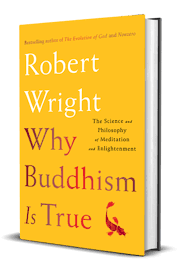 Why Buddhism is True: The Science and Philosophy of Meditation and Enlightenment by Robert Wright
One reason that this is an important book is obvious – at number 5 or 8 or 11 on the New York Times Best Sellers, depending what you’re looking at – it’s reaching a lot of people.
It could, of course, be important but not a fair or positive presentation. Fortunately, after reading Wright’s ambitious undertaking Why Buddhism is True, I can say that, in my view, it is a sound working through of some important aspects of the buddhadharma through the lens of personal experience, the traditional teaching, and evolutionary psychology.
A Summary by someone else
What does Wright have to say in a nutshell (that is, a biggish nutshell)? Antonio DaMasio in his review, “Assessing the Value of Buddhism for Individuals and the World” says it really well:
“First, the beneficial powers of meditation come from the possibility of realizing that our emotive reactions and the consequent feelings they engender — which operate in automated fashion, outside our deliberate control — are often inappropriate and even counterproductive relative to the situations that trigger them. Second, the mismatch between causes and responses is rooted in evolution. We have inherited from our nonhuman and human forerunners a complex affect apparatus suited to life circumstances very different from ours. That apparatus — which is controlled from varied sectors of our nervous systems — was created by natural selection and assisted by genetic transmission over a long period of time. It worked well for nonhuman primates and later for human hunter gatherers, but it has worked far less well as cultures became more complex. Third, meditation allows us to realize that the idea of the self as director of our decisions is an illusion, and that the degree to which we are at the mercy of a weakly controlled system places us at a considerable disadvantage. Fourth, the awareness brought on by meditation helps the construction of a truly enlightened humanity and counters the growing tribalism of contemporary societies.”
The flavor
DaMasio summarizes the content well, but, in my view, doesn’t get the flavor.
Wright is an engaging author, effectively speaking directly to the reader, while at the same time sharing his retreat experiences as a student of Vipassana/mindfulness meditation at the Insight Meditation Society in Barre, MA. No wonder this book sells! Those interested in meditation retreats will find this aspect of the book particularly compelling, getting a glimpse of what is possible from the early stages of intensive practice.
But that’s not all. This is no fluff project. Wright starts the book with the well-worn-but-worth-another-run scene from the first Matrix movie with Morpheus offering Neo the blue or the red pill. Wright would take the red pill, then walk through the door to illuminate the illusion of this life, at least by his earnest description, if not always through personal experience.
How so? Wright digs into the five aggregates (form, feeling, perception, formations, consciousness), the teaching of nonself, and emptiness while offering passages from the Pali Canon, even quoting the Buddha. I think that’s just incredible for a best seller. Has that ever happened before? And, of course, he uses psychological research and a modern paradigm, the “module” view of the self, that supports a good deal of what the Buddha and generations of practitioners have discovered in meditation.
Refreshingly and consistent with modernity, Wright also acknowledges that
“There’s roughly no chance that all the sayings attributed to [Shakyamuni Buddha] in Buddhist texts were uttered by him. In fact, some scholars will tell you that there is little or nothing in these texts that we can confidently attribute to him. Like the “historical Jesus,” the “historical Buddha” is hard to discern through the mists of history.”
What’s most engaging?
I found myself most engaged in sections where Wright shares conversations he’s had with some of his Vipassana teachers, particularly the well-known Joseph Goldstein and less well-known Rodney Smith (author of another excellent book, Awakening: A Paradigm Shift of the Heart).
Here’s an excerpt of one of Wright’s conversations with Goldstein.
“Let me see if I have this right. During meditation, you can begin to see that . . . whereas you might have thought all your life that you’re thinking thoughts—the thing you think of as ‘you’ is thinking thoughts—it’s closer to being the case that the thoughts try to capture you, the thing you think of as ‘you.’ ”
“Right.”
“They come from somewhere in your body, somewhere in your brain.”
“Yes.”
So far so good. But then I pressed the point too far for Goldstein’s taste. I said, “But whatever part of the brain or body you think of as you is more like the captive of the thoughts; the thoughts try to reach out and grab that—”
“That’s kind of an interesting way to describe it, and it certainly feels like that. But I would phrase it a little differently. It’s just that the thoughts are arising and there’s a strong habit of mind to be identified with them. So it’s not so much they have the intent to reach out and capture us, but rather there’s this very strong habitual identification. This is how we’ve lived our lives, and it takes practice to try to break this conditioning, to be mindful of the thought rather than be lost in it.”
Criticism
Wright has been criticized, along with others of his ilk (like me), for being a Modernist or Secular Buddhist. He acknowledges that he doesn’t believe in rebirth, for instance, and that he is selecting aspects of Traditional Buddhism that most resonate with him and his evolutionary psychology perspective. If that’s a negative for you, you might still read the book with bare attention just to beef up your practice of sympathetic joy.
That’s not to say that Why Buddhism is True plumbs the depths of the dharma ocean and will replace Dogen’s Treasury of the True Dharma Eye or Nagarjuna’s Discourse on the Middle Way. It is, however, an excellent introductory book, directed at a “normal” reader, and covers a lot of ground that is shared, at least, by the Vipassana and Zen lineages.
The main difference that I see between his presentation of practice and Zen is not in the analysis of illusion of a solid self and world, but about the skillful means to realize what’s true. Wright talks a lot about detachment or nonattachment. The Zen way is through intimacy and identity action.
But then Why Buddhism is True isn’t a Zen book.
I hope that it points more people, suffering in the swirl of this life, to the real possibility of awakening so (to paraphrase Albert Low) instead of using Manjushri’s sword to sharpen a pencil (blue-pill practice), wielding the flaming clarity of nondual wisdom to cut through illusion and benefit beings.
I also hope that I live to see the day that somebody writes a Zen book that reaches as many people with such intelligence and grace as Why Buddhism is True.

Next Post

October 9, 2017 Luòpǔ With One Foot in the Grave
Browse Our Archives
Select a Category Uncategorized
Select a Month August 2023 July 2023 June 2023 May 2023 April 2023 March 2023 February 2023 January 2023 December 2022 November 2022 October 2022 September 2022 August 2022 July 2022 June 2022 May 2022 April 2022 March 2022 February 2022 January 2022 December 2021 November 2021 August 2021 June 2021 April 2021 February 2021 January 2021 November 2020 September 2020 August 2020 July 2020 June 2020 May 2020 April 2020 January 2020 December 2019 November 2019 August 2019 June 2019 May 2019 April 2019 February 2019 January 2019 December 2018 November 2018 October 2018 September 2018 August 2018 July 2018 June 2018 May 2018 April 2018 March 2018 February 2018 January 2018 December 2017 November 2017 October 2017 September 2017 August 2017 July 2017 June 2017 December 2016 October 2016 June 2016 April 2016 February 2016 January 2016 December 2015 November 2015 October 2015 August 2015 June 2015 May 2015 April 2015 March 2015 February 2015 January 2015 December 2014 November 2014 October 2014 September 2014 August 2014 July 2014 June 2014 May 2014 April 2014 March 2014 February 2014 January 2014 December 2013 November 2013 October 2013 September 2013 August 2013 July 2013 June 2013 May 2013 April 2013 March 2013 February 2013 January 2013 December 2012 November 2012 October 2012 September 2012 August 2012 July 2012 June 2012 May 2012 April 2012 March 2012 February 2012 January 2012 December 2011 November 2011 October 2011 September 2011 August 2011 July 2011 June 2011 May 2011 April 2011 March 2011 February 2011 January 2011 December 2010 November 2010 October 2010 September 2010 August 2010 July 2010 June 2010 May 2010 April 2010 March 2010 February 2010 January 2010 December 2009 November 2009 October 2009 September 2009 August 2009 July 2009 June 2009 May 2009 April 2009 March 2009 February 2009 January 2009 December 2008 November 2008 October 2008 September 2008 August 2008 July 2008 June 2008 May 2008
Follow Us!
TAKE THE
Religious Wisdom Quiz
What Christian group is known for door-to-door evangelism?
Select your answer to see how you score.
Pentecostals Catholics Baptists Jehovah’s Witnesses
Related posts from Wild Fox Zen

Throw Yourself Into the House of Buddha: The...

New Vine Ghost Site for Dosho's Creative Endeavors...

Gnawing Through Qiánfēng’s Three Illnesses and Two Lights

"Why, Oh Why, Is My Practice Not Progressing?"
TRENDING AT PATHEOS Buddhist

On Taking Refuge in the Dharma
(Here I continue the feature of sharing talks and essays by teachers...

(Continuing my intention to share talks and essays by other members of Empty...
The Subtle Art of Bowing: A Dharma Discourse
(This presentation was first offered by my dear friend Dharma Holder Tom...

Internal Family Systems Can Heal you Mentally &...
How IFS Helped Me Stop Fighting Myself Internal Family Systems (IFS) is...

The Bible No One Spoke About: A Family’s...
A mysterious family Bible, unspoken faith, and a journey from curiosity to...

How Uncertainty Can Transform Your Life in 2025
Embracing Uncertainty: A New Year’s Resolution for the Brave As 2025 approaches,...
view all Buddhist blogs
Ad-Free & Subscriber Log-In Subscription Support
- About Us
- 2026 Calendar
- Videos
- Podcasts
- Library of World Religions
- Faith In Media Tracker
- Advertise With Us
- Write for Us
- Privacy Policy
- Terms of Service
- Do Not Sell My Data
- Contact Us
- Radiant Digital
- Manage Newsletter Subscriptions
- Unsubscribe From Notifications
- Sitemap
Copyright 2008-2026, Patheos. All rights reserved.
Subscription Support Ad-Free & Subscriber Log-In
Follow Patheos