
BuddhistCatholicContemplativeEvangelicalGeneral ChristianHinduJewishLatter-day SaintMuslimNew VisionsProgressive Christian
Beliefs
- Buddhist
- Catholic
- Contemplative
- Evangelical
- General Christian
- Hindu
- Jewish
- Latter-day Saint
- More Voices
- Muslim
- New Visions
- Pagan
- Progressive Christian
Topics
- Religion News
- Food and Religion
- Sports and Religion
- Religious Art
- Religious Music and Entertainment
- Religious Events
- History and Religion
- Style and Religion
- Politics and Religion
- Women in Religion
- Recreation Outdoors and Religion
- Business Finance and Religion
- Careers Workplace and Religion
- Education and Religion
- Family Parenting and Religion
- Health Fitness and Religion
- Home and Religion
- Relationships and Religion
- Technology and Religion
- Travel and Religion
Columnists
- Buddhist Columnists
- Business Finance and Religion Columnists
- Careers Workplace and Religion Columnists
- Catholic Columnists
- Contemplative Columnists
- Education and Religion Columnists
- Evangelists Columnists
- Family Parenting and Religion Columnists
- General Christian Columnists
- Health Fitness and Religion Columnists
- Hindu Columnists
- History and Religion Columnists
- Home and Religion Columnists
- Jewish Columnists
- More Voices Columnists
- Latter Day Columnists
- Muslim Columnists
- New Visions Columnists
- Nonreligious Columnists
- Pagan Columnists
- Politics and Religion Columnists
- Progressive Columnists
- Recreation Outdoors and Religion Columnists
- Relationships and Religion Columnists
- Religion News Columnists
- Religious Art Columnists
- Religious Events Columnists
- Religious Music and Entertainment Columnists
- Sports and Religion Columnists
- Style and Religion Columnists
- Technology and Religion Columnists
- Travel and Religion Columnists
- Women in Religion Columnists
Resource Library
- 2026 Calendar
- Library of World Religions
- The 100 Most Holy Places on Earth
- Patheos Answers
- Podcasts
- Videos
- Faith Leaders Database
- Anglican Episcopalian
- Bahai
- Baptist
- Buddhism
- Christianity
- Confucianism
- Eastern Orthodoxy
- Hinduism
- Holiness and Pentecostal
- ISKCON
- Islam
- Judaism
- Lutheran
- Methodist
- The Church of Jesus Christ of Latter-day Saints
- New Age
- Paganism
- Presbytarian and Reformed
- Protestantism
- Religion Behind the Scenes
- Roman Catholic
- Scientology
- Shia Islam
- Sikhism
- Sufism
- Sunni Islam
- Taoism
- Zen
- See all religions
Research Tools
 Ad-Free & Subscriber Log-In Subscription Support
Ad-Free & Subscriber Log-In Subscription Support
Follow Patheos 

- Trending:
- Forgiveness
- |
- Marriage
- |
- Consciousness
- |
- Death Penalty
- |
- Election
- |
- Halloween
 Wild Fox Zen
- Home
- Buddhist
- Communal or Private: Is Zen for Everybody or Just a Few?
Communal or Private: Is Zen for Everybody or Just a Few?
Last updated on: February 5, 2023 at 7:13 am by Dosho Port
Communal or Private: Is Zen for Everybody or Just a Few? 2023-02-05T07:13:05-06:00 Dosho Port
Patheos Explore the world's faith through different perspectives on religion and spirituality! Patheos has the views of the prevalent religions and spiritualities of the world.
 Jiryu Mark Rutschman-Byler at No Zen in the West recently raised the issue of “Private Religion, Private Engagement; Communal Religion, Communal Engagement.”
The vision Jiryu presents is compelling: “…daring to stand for something in this time of so many somethings worth standing for.”
Jiryu acknowledges that for some practitioners, Zen is a private thing and then he asks what about “…Buddhist religion as communal, Buddhist meditation as communal, and Buddhist social engagement as communal? What about Sangha?”
And hopes that “…We can work towards a moral consensus in our Buddhist communities with respect to at least some of the actual issues of our place and time.”
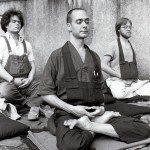
I hope so too. And since the Freeze Movement back in the early ’80’s (see photo from a protest at the UN in 1982, or so – in front is Bodhin Kjolhede, now abbot of the Rochester Zen Center, and I’m over on the right), in those freaky Reagan days, I thought that we Buddhists should not just sit but stand up for something (in the case of the protest at the UN, we stood up by sitting down). I do cringe, though, at the prospect of dharma communities devoting the time and energy necessary to arrive at a “moral consensus” about social action in our time – the crises in the world might not wait until we all agree what to do.
In addition, “…The true dharma,” Kyogen Carlson, the late abbot of Dharma Rain in Portland, OR, once said, “isn’t found by the majority vote in an election.”
In terms of moral consensus, perhaps “communal action with individual responsibility” says what I want to add to the conversation. And there’s a related issue of the communal-or-private religion issue that interests me – is Zen universal or exclusive? In other words, is the practice of Zen really open to everybody? And should it be? Is Zen for everybody or just a few brave practitioners? What about when our inquiry for the truth burns past what is acknowledged and embraced by the collective?
In the Heart of Zen: Practice without Gaining-mind, translated by Shohaku Okumura, Uchiyama Roshi takes up this issue. Uchiyama emphasizes the communal or what he calls the “universal” perspective. He writes, “I believe that in a true religion, all people must be saved without exception.”
Uchiyama argues that Sōtō Zen is one such religion because Dōgen’s zazen is universal (“Universal Recommendations for Zazen”). “…The essential characteristic of Dōgen-zenji’s zazen is that it can be recommended to anyone, anywhere and is not concerned with being wise or foolish, sharp-witted or dull-witted. This is because his zazen is the colorless practice of shikan (justness) and devoid of any particular purpose.”
Uchiyama goes on to say that because Rinzai Zen practitioners train rigorously to attain satori and because such training cannot be done by all people [author’s note: assumption alert], Rinzai Zen is an elite practice, not a universal religion. He suggests it be called “Ultimate Zen” or “Adept Zen.”
It’s a wonderful thing to vow to free all beings by realizing the great way and to focus on developing a religion that is open to everybody. The problem with that, though, is in how it can dumb the practice-enlightenment down to the lowest common sense – which isn’t universal and often isn’t such a great way. Bluntly put, when the communal is over-emphasized, our Zen Centers become community centers or social clubs. Like I said above, what about when our inquiry (and commensurate practice) for the truth burns past what is acknowledged and embraced by the collective?
Uchiyama seems to acknowledge as much when he talks about how before his teacher, Sawaki Roshi [and in fairness, there were a number of other 20th century Sōtō teachers that also emphasized zazen], if Sōtō monks wanted to focus on zazen, they went to a Rinzai monastery, because there just wasn’t much zazen being practiced in Sōtō. Harada Dai-un Roshi, who brought a modified koan curriculum back into Sōtō training, was one such person.
Uchiyama notes that the Rinzai master, Shibayama Roshi, once asked him, “In Sōtō Zen, zazen is most important. And yet, Rinzai practitioners, not Sōtō monks, are the ones who have been practicing zazen constantly. Why has this happened?”
Maybe because when we believe that the great way is always manifest in just-this-ness but shy away from proving it with our own bodies and hearts, and when all intentions except purposelessness are excluded, there isn’t much reason to undertake arduous training.
There are a couple notable points of irony in Uchiyama’s perspective. First, he championed the “Antaiji-style sesshin” – one of the most arduous forms of sesshin in Sōtō Zen. And second, it evokes the question that the young Dōgen took with him to China, “Why did the Buddhas of all ages — undoubtedly in possession of enlightenment — find it necessary to seek enlightenment and engage in spiritual practice?”
Dōgen was only able to resolve the issue through wholehearted, day-and-night zazen. It’s said that he didn’t lie down to sleep during his almost three years with his teacher, Rujing.
Dogen was not alone in sitting fixedly, pushing private practice, engaging in extreme (exclusive) dharma training – it’s deep in the Zen mythology. Buddha left his community of practitioners to sit under the bodhi tree, Bodhidharma quickly had enough of Emperor Wu and sat in a cave for nine years, and Dogen went to China. In the 20th century, Katagiri Roshi sat his first Rohatsu at Eiheiji in full lotus until he would pass out and the monks would drag him out of the zendo and throw him in the snow to revive him.
In my view, these are examples of exclusive practice and they are also universal practice. Just because a practice isn’t something that everybody wants to do, doesn’t mean it isn’t done with a universal intention, an intention to benefit all the many beings, regardless of intention. Encouraging a practice that truly works a person’s capacity to the full, does not necessarily exclude anybody – anybody who’s intention is to discover the heart of the buddhadharma.
So our practice is universal/communal but not only that. The exclusive/private is also vital.
In terms of training, unless we ourselves become what Dogen calls “zazen persons,” discover and practice intimate self-knowledge, our Zen religion is just another belief system. Instead of something universal to offer the community, “Under the beautiful flag of religion, we then fight,” as Katagiri Roshi put it. The private/exclusive and communal/universal are two foci, like a set chopsticks, where neither can function alone without being dysfunctional and looking kind of silly.
——–
Previous Post

June 13, 2017
Flipping Over and Decoding Chinese Characters for Zen Translations
Next Post
June 21, 2017 What Is Zazen? Dōgen's Koan Realized
Browse Our Archives
Select a Category Uncategorized
Select a Month August 2023 July 2023 June 2023 May 2023 April 2023 March 2023 February 2023 January 2023 December 2022 November 2022 October 2022 September 2022 August 2022 July 2022 June 2022 May 2022 April 2022 March 2022 February 2022 January 2022 December 2021 November 2021 August 2021 June 2021 April 2021 February 2021 January 2021 November 2020 September 2020 August 2020 July 2020 June 2020 May 2020 April 2020 January 2020 December 2019 November 2019 August 2019 June 2019 May 2019 April 2019 February 2019 January 2019 December 2018 November 2018 October 2018 September 2018 August 2018 July 2018 June 2018 May 2018 April 2018 March 2018 February 2018 January 2018 December 2017 November 2017 October 2017 September 2017 August 2017 July 2017 June 2017 December 2016 October 2016 June 2016 April 2016 February 2016 January 2016 December 2015 November 2015 October 2015 August 2015 June 2015 May 2015 April 2015 March 2015 February 2015 January 2015 December 2014 November 2014 October 2014 September 2014 August 2014 July 2014 June 2014 May 2014 April 2014 March 2014 February 2014 January 2014 December 2013 November 2013 October 2013 September 2013 August 2013 July 2013 June 2013 May 2013 April 2013 March 2013 February 2013 January 2013 December 2012 November 2012 October 2012 September 2012 August 2012 July 2012 June 2012 May 2012 April 2012 March 2012 February 2012 January 2012 December 2011 November 2011 October 2011 September 2011 August 2011 July 2011 June 2011 May 2011 April 2011 March 2011 February 2011 January 2011 December 2010 November 2010 October 2010 September 2010 August 2010 July 2010 June 2010 May 2010 April 2010 March 2010 February 2010 January 2010 December 2009 November 2009 October 2009 September 2009 August 2009 July 2009 June 2009 May 2009 April 2009 March 2009 February 2009 January 2009 December 2008 November 2008 October 2008 September 2008 August 2008 July 2008 June 2008 May 2008
Follow Us!
TAKE THE
Religious Wisdom Quiz
Who restored water to Jericho by throwing salt into a spring?
Select your answer to see how you score.
Elijah Naaman Elisha Jonah
Related posts from Wild Fox Zen

Throw Yourself Into the House of Buddha: The...

New Vine Ghost Site for Dosho's Creative Endeavors...

Gnawing Through Qiánfēng’s Three Illnesses and Two Lights

"Why, Oh Why, Is My Practice Not Progressing?"
TRENDING AT PATHEOS Buddhist

On Taking Refuge in the Dharma
(Here I continue the feature of sharing talks and essays by teachers...

(Continuing my intention to share talks and essays by other members of Empty...
The Subtle Art of Bowing: A Dharma Discourse
(This presentation was first offered by my dear friend Dharma Holder Tom...

Internal Family Systems Can Heal you Mentally &...
How IFS Helped Me Stop Fighting Myself Internal Family Systems (IFS) is...

The Bible No One Spoke About: A Family’s...
A mysterious family Bible, unspoken faith, and a journey from curiosity to...

How Uncertainty Can Transform Your Life in 2025
Embracing Uncertainty: A New Year’s Resolution for the Brave As 2025 approaches,...
view all Buddhist blogs
Ad-Free & Subscriber Log-In Subscription Support
- About Us
- 2026 Calendar
- Videos
- Podcasts
- Library of World Religions
- Faith In Media Tracker
- Advertise With Us
- Write for Us
- Privacy Policy
- Terms of Service
- Do Not Sell My Data
- Contact Us
- Radiant Digital
- Manage Newsletter Subscriptions
- Unsubscribe From Notifications
- Sitemap
Copyright 2008-2026, Patheos. All rights reserved.
Subscription Support Ad-Free & Subscriber Log-In
Follow Patheos