
BuddhistCatholicContemplativeEvangelicalGeneral ChristianHinduJewishLatter-day SaintMuslimNew VisionsProgressive Christian
Beliefs
- Buddhist
- Catholic
- Contemplative
- Evangelical
- General Christian
- Hindu
- Jewish
- Latter-day Saint
- More Voices
- Muslim
- New Visions
- Pagan
- Progressive Christian
Topics
- Religion News
- Food and Religion
- Sports and Religion
- Religious Art
- Religious Music and Entertainment
- Religious Events
- History and Religion
- Style and Religion
- Politics and Religion
- Women in Religion
- Recreation Outdoors and Religion
- Business Finance and Religion
- Careers Workplace and Religion
- Education and Religion
- Family Parenting and Religion
- Health Fitness and Religion
- Home and Religion
- Relationships and Religion
- Technology and Religion
- Travel and Religion
Columnists
- Buddhist Columnists
- Business Finance and Religion Columnists
- Careers Workplace and Religion Columnists
- Catholic Columnists
- Contemplative Columnists
- Education and Religion Columnists
- Evangelists Columnists
- Family Parenting and Religion Columnists
- General Christian Columnists
- Health Fitness and Religion Columnists
- Hindu Columnists
- History and Religion Columnists
- Home and Religion Columnists
- Jewish Columnists
- More Voices Columnists
- Latter Day Columnists
- Muslim Columnists
- New Visions Columnists
- Nonreligious Columnists
- Pagan Columnists
- Politics and Religion Columnists
- Progressive Columnists
- Recreation Outdoors and Religion Columnists
- Relationships and Religion Columnists
- Religion News Columnists
- Religious Art Columnists
- Religious Events Columnists
- Religious Music and Entertainment Columnists
- Sports and Religion Columnists
- Style and Religion Columnists
- Technology and Religion Columnists
- Travel and Religion Columnists
- Women in Religion Columnists
Resource Library
- 2026 Calendar
- Library of World Religions
- The 100 Most Holy Places on Earth
- Patheos Answers
- Podcasts
- Videos
- Faith Leaders Database
- Anglican Episcopalian
- Bahai
- Baptist
- Buddhism
- Christianity
- Confucianism
- Eastern Orthodoxy
- Hinduism
- Holiness and Pentecostal
- ISKCON
- Islam
- Judaism
- Lutheran
- Methodist
- The Church of Jesus Christ of Latter-day Saints
- New Age
- Paganism
- Presbytarian and Reformed
- Protestantism
- Religion Behind the Scenes
- Roman Catholic
- Scientology
- Shia Islam
- Sikhism
- Sufism
- Sunni Islam
- Taoism
- Zen
- See all religions
Research Tools
 Ad-Free & Subscriber Log-In Subscription Support
Ad-Free & Subscriber Log-In Subscription Support
Follow Patheos 

- Trending:
- Forgiveness
- |
- Marriage
- |
- Consciousness
- |
- Death Penalty
- |
- Election
- |
- Halloween
 Wild Fox Zen
- Home
- Buddhist
- After Buddhism: Embrace Life, Let Go of What Arises, See its Ceasing, Act!
After Buddhism: Embrace Life, Let Go of What Arises, See its Ceasing, Act!
Last updated on: November 30, 2015 at 1:03 pm by Dosho Port
After Buddhism: Embrace Life, Let Go of What Arises, See its Ceasing, Act! 2015-11-30T13:03:53-06:00 Dosho Port
Patheos Explore the world's faith through different perspectives on religion and spirituality! Patheos has the views of the prevalent religions and spiritualities of the world.
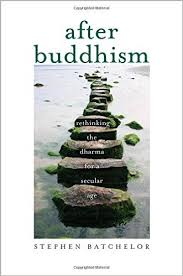 When I mentioned to a friend that I was reading Stephen Batchelor’s new book, After Buddhism: Rethinking the Dharma for a Secular Age, he asked, “Is it as acerbic as his last book?”
Ouch!
Now, I’ve been reading Batchelor for a long time. Way back in 1983, Batchelor’s Alone with Others: An Existential Approach to Buddhism, was a powerful and important book for me. Living with the Devil (2005) is still a personal favorite. And perhaps because of my own acerbic proclivity, I haven’t found any of his works to be primarily such. I don’t necessarily resonate with all the atheist and secular threads, but always find his work to be coming from a like-minded practitioner who earnestly follows his line of inquiry wherever it might lead.
Sometimes it leads to a critical examination of dharma training and beliefs, especially those in the Tibetan Gelug tradition where he was ordained and practiced for nearly a decade. Batchelor’s background has led him, in a series of books, to examine Buddhist orthodoxy and to find much of it wanting.
If you’re going to criticize, you risk being thought of as being acerbic from time to time. I’ve been there and have been accused of that.
In any case, I told my friend, “No, I don’t find it acerbic … but then you know me.”
To be clear, I found After Buddhism to be a smart and delightful read and am grateful to Batchelor for the decade-long process that resulted in this book.
For starters, Batchelor’s narrative voice is evocatively sincere and probing. Like many intent on offering a new expression of the buddhadharma, Batchelor returns to the source – for him, the collection of works now referred to as the Pali Canon, previously thought of as the “original teachings” of the Buddha, but now, thanks to the work of modern scholars, we know that this collection contains texts with a wide-range of themes and perspectives (repetitive, overlapping, and sometimes contradictory) that developed during the centuries following the Buddha’s death. Sorting out what might be Gautama Buddha’s voice from all of what was added is an impossible task. Still, Batchelor offers some careful speculation.
In addition, Batchelor adroitly pulls off a risky thematic structure with the odd-numbered chapters rearticulating the dharma for the modern practitioner (“After Buddhism,” “A Fourfold Task,” “Letting Go of Truth,” “Experience,” “The Everyday Sublime,” and “A Culture of Awakening”) and the even-numbered chapters offering a detailed synthesis of a handful of marginal characters whose stories are spread through the Pali Canon (“Mahanama: The Convert,” “Pasenadi: The King,” “Sunakkhatta: The Traitor,” “Jivaka: The Doctor,” and “Ananda: The Attendant”). Batchelor skillfully connects his rearticulation of the dharma in the odd chapters to the ancient (freshly emphasized) tradition in the even chapters. This entangling vine organization creates two foci in intimate conversation.
As a person who has spent some time working through the Pali Canon (I studied it for a couple years with Katagiri Roshi), I’m awed by the sections of the book that offer a detailed examination of the marginal figures cited above, fleshing out the contexts in which the Buddha taught so much more fully than I had understood in my own cursory study. Especially powerful is how Batchelor shows how the Buddha was a person, immersed in time and place with joys and tragedies like any of us. Batchelor notes, for example, that the Buddha said, “Now I mainly dwell by dwelling in emptiness.”
“Mainly” – what the heck? Even the Buddha only “mainly” dwells in emptiness. And there are plenty of examples with the old guy getting reactive (like when his former attendant Sunakkhatta quits, or Devadata turns against him) that more than support the “mainly.”
For me, the most striking aspect of this part of the book lay in how it shows the last months of the Buddha’s life. We learn that the Buddha died at a time that his community was in chaos and his dharma career was limping along. Some of his key allies had either died or turned away, his native people (the Sakiyans) had been nearly annihilated, his most senior, trusted disciples had died, and others (especially the conservative meanie Mahakassapa who Batchelor calls a “prig”) vied to lead the order.
Although these sections were always engaging for me, I sometimes wondered if the less dharma geekee would find them as compelling.
Batchelor summarizes some of the essential dharma points of the book (expressly developed the odd-numbered chapters) like this:
“An understanding of conditionality as the context for a fourfold task: to comprehend suffering, to let go of the arising of reactivity, to behold the ceasing of reactivity, and to cultivate an eightfold path that is grounded in the perspective of mindful awareness and leads one to become self-reliant in the practice of the dharma.”
“Task” is used consciously rather than “truth.” Batchelor, refreshingly, directs dharma practice away from abstract truths to doing, so what are generally called the Four Truths (here the four tasks) are expressed like this: “Embrace life, Let go of what arises, See its ceasing, Act!”
This perspective is certainly right up the Zen alley of practicing enlightenment where it isn’t so much about what you believe but what you do. And there’s not much to argue about – rebirth, karma, enlightenment, religion, secular, yadda, yadda, yadda. The message is clear – get off your dharma soap box and get to work.
“The purpose of the Buddha’s teaching,” says Batchelor, “is not to resolve doubts about the nature of ‘reality’ by providing answers to such conundrums but to offer a practice that will remove the ‘arrow’ of reactivity, thereby restoring practitioners’ health and enabling them to flourish here on earth.”
I especially appreciate Batchelor’s argument against the two truths doctrine (the absolute and relative truths) that quickly became pervasive across schools, but was never mentioned in the Pali Canon (see Chapter 5, “Letting Go of Truth”). For more on my view of the pernicious two truths doctrine, see this previous post – “The No of No No.” Batchelor calls the adoption of the two truths, “…a fatal fork in the road for the Buddhist tradition.” This fatal fork, among other things, is a “… dualism [that] led to a recurrent emphasis on the innate purity of mind as opposed to the defiled, unclean nature of the body.”
Rather than an absolute truth that is divorced from this very body and mind, Batchelor presents the Buddha’s awakening and practice as being right here: “’It is just in this fathom-high mortal frame endowed with perception and mind,’ says Gotama, ‘that I make known the world.’”
And in Batchelor’s words,
“Emptiness thus seems to be a perspective, a sensibility, a way of being in this poignant, contingent world. The ‘great person’ would be one who has cultivated such a sensibility until it has become entirely natural. Rather than being the negation of ‘self,’ emptiness discloses the dignity of a person who has realized what it means to be fully human.”
Another strong section begins with an introduction of embodied meditation and moves into the vital role of questioning and doubt. Batchelor frames the role of meditation like this:
“Meditation is an integral part of a caring/care-full relationship to oneself and the world. As such, it forms a crucial dimension of each aspect of the fourfold task. It is involved in the cultivation of the eightfold path, which requires fully embracing the conditions of one’s life, letting go of habitual reactivity, and beholding the ceasing of that reactivity. Such a meditative sensibility allows one to flourish by leading a life of ethical commitment, contemplative attention, philosophical reflection, and aesthetic appreciation.”
About Great Doubt, Batchelor writes, “The kind of doubt spoken of in Sŏn [Zen] … should be thought of as a psychosomatic condition of astonishment and bafflement rather than as a discursive mental process.”
A couple limitations of the book are worth a brief mention. First, Batchelor diminishes the role of kensho (i.e., breakthrough or turnaround) and misses the chance to fully unpack the significance of that experience in light of ongoing practice. Second, his emphasis on the secular vs. religious has the (reactive?) ring of lumping all the good stuff in one pile (e.g., doubt and inquiry) and calling it “secular” and all the not-so-good stuff (dogmatism, belief in rebirth, and rigid orthodoxy) into another pile and calling it “religious.” I don’t find this distinction to have much utility. I consider myself religious, for example, but agree with all of his “Ten Theses for a Secular Dharma.”
Nevertheless, in After Buddhism, Batchelor makes another strong contribution to the ongoing exploration of the buddhadharma for modern, global practitioners like us. I strongly recommend it.
Here’s an interview with Batchelor that gives some of the back story to the book – click.
Comments welcome, especially if you’ve read the book.
After Buddhism: Rethinking the Dharma for a Secular Age
Previous Post

October 29, 2015
Shaking Up the Buddhadharma With Online Practice
Next Post
December 2, 2015 Buddha's Enlightenment: The Root of Zen
Browse Our Archives
Select a Category Uncategorized
Select a Month August 2023 July 2023 June 2023 May 2023 April 2023 March 2023 February 2023 January 2023 December 2022 November 2022 October 2022 September 2022 August 2022 July 2022 June 2022 May 2022 April 2022 March 2022 February 2022 January 2022 December 2021 November 2021 August 2021 June 2021 April 2021 February 2021 January 2021 November 2020 September 2020 August 2020 July 2020 June 2020 May 2020 April 2020 January 2020 December 2019 November 2019 August 2019 June 2019 May 2019 April 2019 February 2019 January 2019 December 2018 November 2018 October 2018 September 2018 August 2018 July 2018 June 2018 May 2018 April 2018 March 2018 February 2018 January 2018 December 2017 November 2017 October 2017 September 2017 August 2017 July 2017 June 2017 December 2016 October 2016 June 2016 April 2016 February 2016 January 2016 December 2015 November 2015 October 2015 August 2015 June 2015 May 2015 April 2015 March 2015 February 2015 January 2015 December 2014 November 2014 October 2014 September 2014 August 2014 July 2014 June 2014 May 2014 April 2014 March 2014 February 2014 January 2014 December 2013 November 2013 October 2013 September 2013 August 2013 July 2013 June 2013 May 2013 April 2013 March 2013 February 2013 January 2013 December 2012 November 2012 October 2012 September 2012 August 2012 July 2012 June 2012 May 2012 April 2012 March 2012 February 2012 January 2012 December 2011 November 2011 October 2011 September 2011 August 2011 July 2011 June 2011 May 2011 April 2011 March 2011 February 2011 January 2011 December 2010 November 2010 October 2010 September 2010 August 2010 July 2010 June 2010 May 2010 April 2010 March 2010 February 2010 January 2010 December 2009 November 2009 October 2009 September 2009 August 2009 July 2009 June 2009 May 2009 April 2009 March 2009 February 2009 January 2009 December 2008 November 2008 October 2008 September 2008 August 2008 July 2008 June 2008 May 2008
Follow Us!
TAKE THE
Religious Wisdom Quiz
What does Revelation say about anyone who adds to the words of the prophecy?
Select your answer to see how you score.
They will lose their salvation They will be judged God will add to them the plagues described in this scroll They will be cursed
Related posts from Wild Fox Zen

Throw Yourself Into the House of Buddha: The...

New Vine Ghost Site for Dosho's Creative Endeavors...

Gnawing Through Qiánfēng’s Three Illnesses and Two Lights

"Why, Oh Why, Is My Practice Not Progressing?"
TRENDING AT PATHEOS Buddhist

On Taking Refuge in the Dharma
(Here I continue the feature of sharing talks and essays by teachers...

(Continuing my intention to share talks and essays by other members of Empty...
The Subtle Art of Bowing: A Dharma Discourse
(This presentation was first offered by my dear friend Dharma Holder Tom...

Internal Family Systems Can Heal you Mentally &...
How IFS Helped Me Stop Fighting Myself Internal Family Systems (IFS) is...

The Bible No One Spoke About: A Family’s...
A mysterious family Bible, unspoken faith, and a journey from curiosity to...

How Uncertainty Can Transform Your Life in 2025
Embracing Uncertainty: A New Year’s Resolution for the Brave As 2025 approaches,...
view all Buddhist blogs
Ad-Free & Subscriber Log-In Subscription Support
- About Us
- 2026 Calendar
- Videos
- Podcasts
- Library of World Religions
- Faith In Media Tracker
- Advertise With Us
- Write for Us
- Privacy Policy
- Terms of Service
- Do Not Sell My Data
- Contact Us
- Radiant Digital
- Manage Newsletter Subscriptions
- Unsubscribe From Notifications
- Sitemap
Copyright 2008-2026, Patheos. All rights reserved.
Subscription Support Ad-Free & Subscriber Log-In
Follow Patheos