
BuddhistCatholicContemplativeEvangelicalGeneral ChristianHinduJewishLatter-day SaintMuslimNew VisionsProgressive Christian
Beliefs
- Buddhist
- Catholic
- Contemplative
- Evangelical
- General Christian
- Hindu
- Jewish
- Latter-day Saint
- More Voices
- Muslim
- New Visions
- Pagan
- Progressive Christian
Topics
- Religion News
- Food and Religion
- Sports and Religion
- Religious Art
- Religious Music and Entertainment
- Religious Events
- History and Religion
- Style and Religion
- Politics and Religion
- Women in Religion
- Recreation Outdoors and Religion
- Business Finance and Religion
- Careers Workplace and Religion
- Education and Religion
- Family Parenting and Religion
- Health Fitness and Religion
- Home and Religion
- Relationships and Religion
- Technology and Religion
- Travel and Religion
Columnists
- Buddhist Columnists
- Business Finance and Religion Columnists
- Careers Workplace and Religion Columnists
- Catholic Columnists
- Contemplative Columnists
- Education and Religion Columnists
- Evangelists Columnists
- Family Parenting and Religion Columnists
- General Christian Columnists
- Health Fitness and Religion Columnists
- Hindu Columnists
- History and Religion Columnists
- Home and Religion Columnists
- Jewish Columnists
- More Voices Columnists
- Latter Day Columnists
- Muslim Columnists
- New Visions Columnists
- Nonreligious Columnists
- Pagan Columnists
- Politics and Religion Columnists
- Progressive Columnists
- Recreation Outdoors and Religion Columnists
- Relationships and Religion Columnists
- Religion News Columnists
- Religious Art Columnists
- Religious Events Columnists
- Religious Music and Entertainment Columnists
- Sports and Religion Columnists
- Style and Religion Columnists
- Technology and Religion Columnists
- Travel and Religion Columnists
- Women in Religion Columnists
Resource Library
- 2026 Calendar
- Library of World Religions
- The 100 Most Holy Places on Earth
- Patheos Answers
- Podcasts
- Videos
- Faith Leaders Database
- Anglican Episcopalian
- Bahai
- Baptist
- Buddhism
- Christianity
- Confucianism
- Eastern Orthodoxy
- Hinduism
- Holiness and Pentecostal
- ISKCON
- Islam
- Judaism
- Lutheran
- Methodist
- The Church of Jesus Christ of Latter-day Saints
- New Age
- Paganism
- Presbytarian and Reformed
- Protestantism
- Religion Behind the Scenes
- Roman Catholic
- Scientology
- Shia Islam
- Sikhism
- Sufism
- Sunni Islam
- Taoism
- Zen
- See all religions
Research Tools
 Ad-Free & Subscriber Log-In Subscription Support
Ad-Free & Subscriber Log-In Subscription Support
Follow Patheos 

- Trending:
- Forgiveness
- |
- Marriage
- |
- Consciousness
- |
- Death Penalty
- |
- Election
- |
- Halloween
 Wild Fox Zen
- Home
- Buddhist
- Zen: The Authentic Gate
Zen: The Authentic Gate
Last updated on: August 30, 2015 at 3:30 pm by Dosho Port
Zen: The Authentic Gate 2015-08-30T15:30:34-06:00 Dosho Port
Patheos Explore the world's faith through different perspectives on religion and spirituality! Patheos has the views of the prevalent religions and spiritualities of the world.
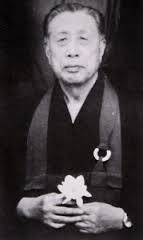
Zen: The Authentic Gate, by Koun Yamada Roshi (1907—1989; pictured above), is an essential text for any student of Zen interested in a clear expression from the source of the Zen reformation that unfolded in the 20th Century and continues to shape Zen practice today.
Yamada Roshi is a towering figure in 20th century Zen. His great enlightenment was first presented in a cloaked manner in Three Pillars of Zen. Here’s David Loy from the Foreward of Zen: The Authentic Path framing Yamada Roshi kensho and quoting from Three Pillars of Zen:
“Most interesting, however, were the ‘Contemporary Enlightenment Experiences’ toward the back of the book. The first account was by ‘Mr. K. Y., a Japanese businessman.’ He was reading on a train when he came across something Dōgen wrote after his own awakening (quoting an early Chinese text): ‘I came to realize clearly that mind is nothing other than rivers and mountains and the great wide earth, the sun and the moon and the stars.’ Sleeping later that night, Mr. K. Y. suddenly awoke and that quotation flashed into his mind:
‘Then all at once I was struck as though by lightning, and the next instant heaven and earth crumbled and disappeared. Instantaneously, like surging waves, a tremendous delight welled up in me, a veritable hurricane of delight, as I laughed loudly and wildly: “Ha, ha, ha, ha, ha, ha! There’s no reasoning here, no reasoning at all! Ha, ha, ha!’ The empty sky split into two, then opened its enormous mouth and began to laugh uproariously: “Ha, ha, ha!'”
Yamada Roshi, along with his teacher Yasutani Roshi, and his teacher’s teacher, Sogaku Harada Roshi, brought enlightenment to the center of Zen practice. As many reformers in the past, including Dogen Zenji, Yamada Roshi frames his Zen as authentic – as opposed to what? Here’s Yamada Roshi:
“Both [Sogaku] Harada Roshi and Yasutani Roshi deplored how, in modern Zen, the Rinzai sect tends to cling to the aspect of stages in practice and forget the solemnity of ‘no stages,’ and the Sōtō sect is content with the ‘no stages’ Zen of little consequence and neglects the arduous stages of practice (p. 142).”
Stages and attainment or no stages and no attainment? Yamada Roshi’s Zen is all about these two foci in intimate conversation. However, he is often criticized in Soto Zen circles for teaching a one-sided, desperate for kensho, hungry ghost Zen – stages and attainment Zen – and dismissed as a Rinzai wanna-be.
A careful reading by an open-hearted reader of Zen: The Authentic Gate will dispel that characterization. Indeed, Yamada Roshi seems to see himself primarily in the tradition of Dogen Zenji as we can see from the references he utilizes in Zen: The Authentic Gate: Dogen Zenji (35), Sogaku Harada Roshi (9), Yasutani Roshi (8), Hakuin Zenji (7).
Indeed, although Yamada Roshi quotes and comments on Dogen Zenji more frequently, one of the valuable contributions of Zen: The Authentic Path, lies in those nine first-time-in-English references from the seminal Sogaku Harada Roshi.
Yamada Roshi’s Zen is about the perfection of character, not an ego Zen of either “my enlightenment’s so pure I’ve never had kensho,” or “my kensho’s bigger than your’s:”
“Although in Zen training we must all pass through the stage where ‘there are no beings to save,’ if we remain stuck in that emptiness, enjoying solitary bliss, then the desire to save all beings will never arise. We may end up as self-authorized egotists who have cut ties with other sentient beings (p. 37).”
and
“Another aspect of delusion after seeing into one’s own nature is found in statements like, ‘Life is equally empty whether rich or poor, so it’s enough to become one with your poverty and live with it if you are poor.’ Someone who sees only the side of emptiness and overlooks the benefits of sowing good fortune may look askance at anyone with wealth. Or someone might say, ‘If you are suffering from illness, just become suffering; when suffering, you become one with the whole universe, and then there is no more suffering.’ For one caught up in this one side of reality, the heart of compassion that seeks to relieve a sick person of their suffering closes. Such a person is a prisoner of one-sided enlightenment. The ancients warned against this, calling it ‘the deep abyss of liberation (p. 131).’”
Yamada Roshi’s themes also reflect a groundedness in the actual conditions of our human predicament. Here’s a selection of chapter titles: “Suffering and Modern-Day Humanity,” “Depth of Enlightenment,” “Deceptive Phenomena,” “Belief, Understanding, Practice, Realization, and Personalization,” and “Zen Practice for People of Other Religions.”
In addition to his great enlightenment and teaching, Yamada Roshi is also an important figure in our contemporary Zen world because he is one of the few lay people in all of Zen history that not only received full dharma transmission, proving definitively that this work can be accomplished while fully engaged in the world, but also in that his lineage has continued to flourish several generations down the line with Sanbo Zen and the Diamond Sangha, and various wild flowers like Pacific Zen Institute, Boundless Way, Empty Sky Sangha, Great Heartland Buddhist Temple of Toledo, and our own little projects, Great Tides Zen and Vine of Obstacles: Online Support for Zen Training.
The Sanbo Kyodan website lists five generations and about 132 teachers in his line.
What’s the essence of his teaching?
“By awakening to our self-nature, by awakening to both emptiness and form, we come to peace. This is true Buddhist salvation. However, we must wipe away all traces of enlightenment as well, and then forget that we have wiped them away. And that practice continues endlessly. This is the Buddha Way (p. 37).”
Previous Post

June 26, 2015
Ducking the Quacking Koan: Soto Zen, Koan, and Kensho
Next Post
October 29, 2015 Shaking Up the Buddhadharma With Online Practice
Browse Our Archives
Select a Category Uncategorized
Select a Month August 2023 July 2023 June 2023 May 2023 April 2023 March 2023 February 2023 January 2023 December 2022 November 2022 October 2022 September 2022 August 2022 July 2022 June 2022 May 2022 April 2022 March 2022 February 2022 January 2022 December 2021 November 2021 August 2021 June 2021 April 2021 February 2021 January 2021 November 2020 September 2020 August 2020 July 2020 June 2020 May 2020 April 2020 January 2020 December 2019 November 2019 August 2019 June 2019 May 2019 April 2019 February 2019 January 2019 December 2018 November 2018 October 2018 September 2018 August 2018 July 2018 June 2018 May 2018 April 2018 March 2018 February 2018 January 2018 December 2017 November 2017 October 2017 September 2017 August 2017 July 2017 June 2017 December 2016 October 2016 June 2016 April 2016 February 2016 January 2016 December 2015 November 2015 October 2015 August 2015 June 2015 May 2015 April 2015 March 2015 February 2015 January 2015 December 2014 November 2014 October 2014 September 2014 August 2014 July 2014 June 2014 May 2014 April 2014 March 2014 February 2014 January 2014 December 2013 November 2013 October 2013 September 2013 August 2013 July 2013 June 2013 May 2013 April 2013 March 2013 February 2013 January 2013 December 2012 November 2012 October 2012 September 2012 August 2012 July 2012 June 2012 May 2012 April 2012 March 2012 February 2012 January 2012 December 2011 November 2011 October 2011 September 2011 August 2011 July 2011 June 2011 May 2011 April 2011 March 2011 February 2011 January 2011 December 2010 November 2010 October 2010 September 2010 August 2010 July 2010 June 2010 May 2010 April 2010 March 2010 February 2010 January 2010 December 2009 November 2009 October 2009 September 2009 August 2009 July 2009 June 2009 May 2009 April 2009 March 2009 February 2009 January 2009 December 2008 November 2008 October 2008 September 2008 August 2008 July 2008 June 2008 May 2008
Follow Us!
TAKE THE
Religious Wisdom Quiz
Who was Boaz's mother?
Select your answer to see how you score.
Naomi Ruth Sarah Rahab
Related posts from Wild Fox Zen

Throw Yourself Into the House of Buddha: The...

New Vine Ghost Site for Dosho's Creative Endeavors...

Gnawing Through Qiánfēng’s Three Illnesses and Two Lights

"Why, Oh Why, Is My Practice Not Progressing?"
TRENDING AT PATHEOS Buddhist

On Taking Refuge in the Dharma
(Here I continue the feature of sharing talks and essays by teachers...

(Continuing my intention to share talks and essays by other members of Empty...
The Subtle Art of Bowing: A Dharma Discourse
(This presentation was first offered by my dear friend Dharma Holder Tom...

Internal Family Systems Can Heal you Mentally &...
How IFS Helped Me Stop Fighting Myself Internal Family Systems (IFS) is...

The Bible No One Spoke About: A Family’s...
A mysterious family Bible, unspoken faith, and a journey from curiosity to...

How Uncertainty Can Transform Your Life in 2025
Embracing Uncertainty: A New Year’s Resolution for the Brave As 2025 approaches,...
view all Buddhist blogs
Ad-Free & Subscriber Log-In Subscription Support
- About Us
- 2026 Calendar
- Videos
- Podcasts
- Library of World Religions
- Faith In Media Tracker
- Advertise With Us
- Write for Us
- Privacy Policy
- Terms of Service
- Do Not Sell My Data
- Contact Us
- Radiant Digital
- Manage Newsletter Subscriptions
- Unsubscribe From Notifications
- Sitemap
Copyright 2008-2026, Patheos. All rights reserved.
Subscription Support Ad-Free & Subscriber Log-In
Follow Patheos