
BuddhistCatholicContemplativeEvangelicalGeneral ChristianHinduJewishLatter-day SaintMuslimNew VisionsProgressive Christian
Beliefs
- Buddhist
- Catholic
- Contemplative
- Evangelical
- General Christian
- Hindu
- Jewish
- Latter-day Saint
- More Voices
- Muslim
- New Visions
- Pagan
- Progressive Christian
Topics
- Religion News
- Food and Religion
- Sports and Religion
- Religious Art
- Religious Music and Entertainment
- Religious Events
- History and Religion
- Style and Religion
- Politics and Religion
- Women in Religion
- Recreation Outdoors and Religion
- Business Finance and Religion
- Careers Workplace and Religion
- Education and Religion
- Family Parenting and Religion
- Health Fitness and Religion
- Home and Religion
- Relationships and Religion
- Technology and Religion
- Travel and Religion
Columnists
- Buddhist Columnists
- Business Finance and Religion Columnists
- Careers Workplace and Religion Columnists
- Catholic Columnists
- Contemplative Columnists
- Education and Religion Columnists
- Evangelists Columnists
- Family Parenting and Religion Columnists
- General Christian Columnists
- Health Fitness and Religion Columnists
- Hindu Columnists
- History and Religion Columnists
- Home and Religion Columnists
- Jewish Columnists
- More Voices Columnists
- Latter Day Columnists
- Muslim Columnists
- New Visions Columnists
- Nonreligious Columnists
- Pagan Columnists
- Politics and Religion Columnists
- Progressive Columnists
- Recreation Outdoors and Religion Columnists
- Relationships and Religion Columnists
- Religion News Columnists
- Religious Art Columnists
- Religious Events Columnists
- Religious Music and Entertainment Columnists
- Sports and Religion Columnists
- Style and Religion Columnists
- Technology and Religion Columnists
- Travel and Religion Columnists
- Women in Religion Columnists
Resource Library
- 2026 Calendar
- Library of World Religions
- The 100 Most Holy Places on Earth
- Patheos Answers
- Podcasts
- Videos
- Faith Leaders Database
- Anglican Episcopalian
- Bahai
- Baptist
- Buddhism
- Christianity
- Confucianism
- Eastern Orthodoxy
- Hinduism
- Holiness and Pentecostal
- ISKCON
- Islam
- Judaism
- Lutheran
- Methodist
- The Church of Jesus Christ of Latter-day Saints
- New Age
- Paganism
- Presbytarian and Reformed
- Protestantism
- Religion Behind the Scenes
- Roman Catholic
- Scientology
- Shia Islam
- Sikhism
- Sufism
- Sunni Islam
- Taoism
- Zen
- See all religions
Research Tools
 Ad-Free & Subscriber Log-In Subscription Support
Ad-Free & Subscriber Log-In Subscription Support
Follow Patheos 

- Trending:
- Forgiveness
- |
- Marriage
- |
- Consciousness
- |
- Death Penalty
- |
- Election
- |
- Halloween
 Wild Fox Zen
- Home
- Buddhist
- Radical Vulnerability: The Three Sicknesses and Two Lights
Radical Vulnerability: The Three Sicknesses and Two Lights
Last updated on: December 29, 2014 at 1:44 pm by Dosho Port
Radical Vulnerability: The Three Sicknesses and Two Lights 2014-12-29T13:44:11-06:00 Dosho Port
Patheos Explore the world's faith through different perspectives on religion and spirituality! Patheos has the views of the prevalent religions and spiritualities of the world.
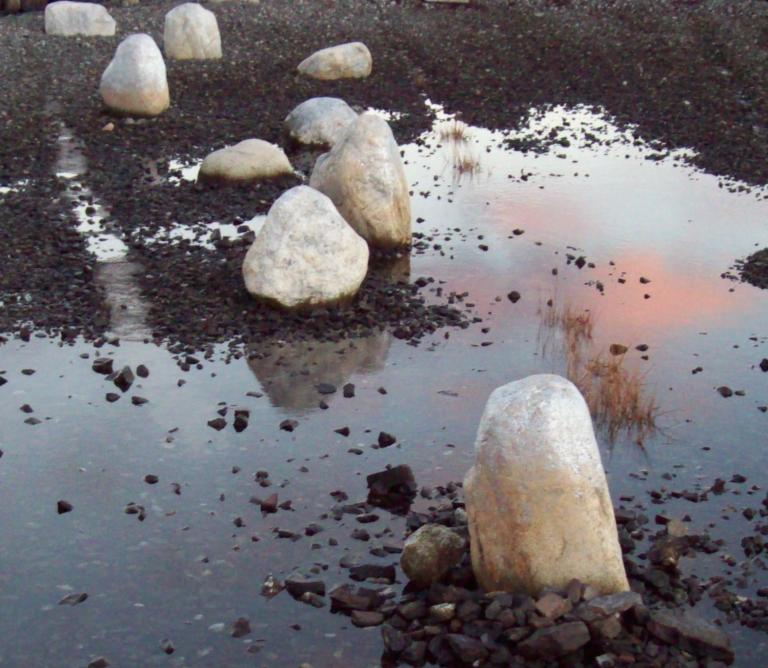
Moon Garden, Portland, ME, photo by Low Tide
In a recent New York Times’ opinion piece, Against Invulnerability, Todd May takes a stand against philosophies that advocate that we develop an invulnerable stance in the face of the vicissitudes of this life. “Invulnerabilism,” he writes,”recommends that we secrete a distance between ourselves and the world so that ultimately it cannot touch us.”
And he includes Buddhism as one of these secreting approaches.
Like most rich religious traditions, Buddhism is a category in which many different teachings and approaches to life are included. So a critic might find grounds to wrap us up with the Stoics, for example, by selectively reading the original teachings of the Buddha.
The Zen way, though, is emphatically not a way of cultivating the delusion of invulnerability – quite the contrary, the Zen way is about radical vulnerability. Let me cite a couple cases from one old master, Ch’ien–feng, to make the point.
Ch’ien–feng was a direct successor of Dongshan Liangjie (Japanese, Tozan Ryokai), a bright light in the Cao-dong/Soto lineage. Indeed, Dongshan/Tozan put the “dong” and the “to” in Cao-dong and Soto. But little is known of Ch’ien–feng, although he appears a few times in the koan literature.
And according to Morten Schlutter in How Zen Became Zen (p.93), in the oldest records, Ch’ien–feng is one of the teachers through whom the later Cao-dong/Soto lineage flowed. But because he was not well known, the 12th Century reconstructionists of the Cao-dong/Soto lineage selected Ch’ien–feng out and the more well-known Yunju in. Be that as it may….
I’m rather fond of Ch’ien–feng and his straight-edged way of making the radical-vulnerability point. For example: A monk once asked Ch’ien–feng, “How does one escape the three realms?”
The three realms are either past, present and future or the spheres of desire, form, and formlessness (click here for more detail). To reframe the monk’s question, then, in light of May’s piece, “How does one escape the world and become invulnerable?”
Ch’ien–feng said, “Call the temple director and have him chase this monk out of here!”
Apparently, Ch’ien–feng was not feeling the monk’s other-worldly question and didn’t even take time to write him a referral. One can only imagine the reception Mr. May might have received from Ch’ien–feng.
Here’s another, more complex working of the issue (for a full rendering, see Waddell’s The Essential Teaching of Zen Master Hakuin, p. 19, Ferguson’s Zen’s Chinese Heritage, p. 219, or Cleary’s Book of Serenity, p. 47):
Priest Ch’ien–feng addressed his assembly: “The dharmakaya has three kinds of sickness and two kinds of light. Can any of you clarify that?”
The dharmakaya is the truth-body of the buddha, the fundamental, absolute truth, usually grouped with the sambogakya (the bliss-body of the buddha) and the nirmanakaya (the form-body of the buddha). Click here for more detail.
Ch’ien–feng says something radical here – the truth-body of the buddha has three kinds of sicknesses.
From a standard buddhalogical perspective, you might think that the form-body of the buddha might have sicknesses – it is a form body, after all, like this body. Or you might think that even the form-body of the buddha would be a perfected, not-sick body. In either case, the absolute, beyond duality, dharmakaya, truth body, would be free from sickness and light.
So Ch’ien–feng utterance is biting in much the same way as the “No” that Zhaozhou declares the dog’s buddha nature to be.
“The dharmakaya (aka, truth body) has three kinds of sickness and two kinds of light.”
Wow. Ch’ien-feng makes the world shake and shudder.
By the way, the three kinds of sicknesses vary by commentary but are along the lines of thinking that there’s something to get from practice, thinking that you’ve got it, and thinking that you’re free of getting and not getting. Or if you prefer beast-of-burden metaphors, then the three sicknesses are searching for a donkey while riding on a donkey; after getting on the donkey, being unwilling to get off; and getting off the donkey and dancing freely. Any position, in other words is a position of sickness.
The two kinds of light vary even more by commentary. Being a simple person, I like to think of them as the light of samadhi and the light of realization.
To reiterate, Ch’ien–feng asserts that the highest truth is sickness and light. No invulnerable position is advocated here.
Then Ch’ien-feng asks, “Can any of you clarify that?”
Yün-men came forward and said, “Why doesn’t the fellow inside the hermitage know what’s going on outside?”
There is always some blindness. “When one side is illumined,” said Dogen, “the other side is dark.”
This too is the truth-body buddha.
Leave it to Yün-men to show it so clearly.
Ch’ien–feng roared with laughter.
Ch’ien–feng laughs the laugh of the liberated in this very vulnerable body.
Next Post

December 31, 2014 Happy New Year and May All Conditions Be Favorable
Browse Our Archives
Select a Category Uncategorized
Select a Month August 2023 July 2023 June 2023 May 2023 April 2023 March 2023 February 2023 January 2023 December 2022 November 2022 October 2022 September 2022 August 2022 July 2022 June 2022 May 2022 April 2022 March 2022 February 2022 January 2022 December 2021 November 2021 August 2021 June 2021 April 2021 February 2021 January 2021 November 2020 September 2020 August 2020 July 2020 June 2020 May 2020 April 2020 January 2020 December 2019 November 2019 August 2019 June 2019 May 2019 April 2019 February 2019 January 2019 December 2018 November 2018 October 2018 September 2018 August 2018 July 2018 June 2018 May 2018 April 2018 March 2018 February 2018 January 2018 December 2017 November 2017 October 2017 September 2017 August 2017 July 2017 June 2017 December 2016 October 2016 June 2016 April 2016 February 2016 January 2016 December 2015 November 2015 October 2015 August 2015 June 2015 May 2015 April 2015 March 2015 February 2015 January 2015 December 2014 November 2014 October 2014 September 2014 August 2014 July 2014 June 2014 May 2014 April 2014 March 2014 February 2014 January 2014 December 2013 November 2013 October 2013 September 2013 August 2013 July 2013 June 2013 May 2013 April 2013 March 2013 February 2013 January 2013 December 2012 November 2012 October 2012 September 2012 August 2012 July 2012 June 2012 May 2012 April 2012 March 2012 February 2012 January 2012 December 2011 November 2011 October 2011 September 2011 August 2011 July 2011 June 2011 May 2011 April 2011 March 2011 February 2011 January 2011 December 2010 November 2010 October 2010 September 2010 August 2010 July 2010 June 2010 May 2010 April 2010 March 2010 February 2010 January 2010 December 2009 November 2009 October 2009 September 2009 August 2009 July 2009 June 2009 May 2009 April 2009 March 2009 February 2009 January 2009 December 2008 November 2008 October 2008 September 2008 August 2008 July 2008 June 2008 May 2008
Follow Us!
TAKE THE
Religious Wisdom Quiz
What is the main Christian church in Greece?
Select your answer to see how you score.
Pentecostal Lutheran Greek Orthodox Catholic
Related posts from Wild Fox Zen

Throw Yourself Into the House of Buddha: The...

New Vine Ghost Site for Dosho's Creative Endeavors...

Gnawing Through Qiánfēng’s Three Illnesses and Two Lights

"Why, Oh Why, Is My Practice Not Progressing?"
TRENDING AT PATHEOS Buddhist

On Taking Refuge in the Dharma
(Here I continue the feature of sharing talks and essays by teachers...

(Continuing my intention to share talks and essays by other members of Empty...
The Subtle Art of Bowing: A Dharma Discourse
(This presentation was first offered by my dear friend Dharma Holder Tom...

Internal Family Systems Can Heal you Mentally &...
How IFS Helped Me Stop Fighting Myself Internal Family Systems (IFS) is...

The Bible No One Spoke About: A Family’s...
A mysterious family Bible, unspoken faith, and a journey from curiosity to...

How Uncertainty Can Transform Your Life in 2025
Embracing Uncertainty: A New Year’s Resolution for the Brave As 2025 approaches,...
view all Buddhist blogs
Ad-Free & Subscriber Log-In Subscription Support
- About Us
- 2026 Calendar
- Videos
- Podcasts
- Library of World Religions
- Faith In Media Tracker
- Advertise With Us
- Write for Us
- Privacy Policy
- Terms of Service
- Do Not Sell My Data
- Contact Us
- Radiant Digital
- Manage Newsletter Subscriptions
- Unsubscribe From Notifications
- Sitemap
Copyright 2008-2026, Patheos. All rights reserved.
Subscription Support Ad-Free & Subscriber Log-In
Follow Patheos