
BuddhistCatholicContemplativeEvangelicalGeneral ChristianHinduJewishLatter-day SaintMuslimNew VisionsProgressive Christian
Beliefs
- Buddhist
- Catholic
- Contemplative
- Evangelical
- General Christian
- Hindu
- Jewish
- Latter-day Saint
- More Voices
- Muslim
- New Visions
- Pagan
- Progressive Christian
Topics
- Religion News
- Food and Religion
- Sports and Religion
- Religious Art
- Religious Music and Entertainment
- Religious Events
- History and Religion
- Style and Religion
- Politics and Religion
- Women in Religion
- Recreation Outdoors and Religion
- Business Finance and Religion
- Careers Workplace and Religion
- Education and Religion
- Family Parenting and Religion
- Health Fitness and Religion
- Home and Religion
- Relationships and Religion
- Technology and Religion
- Travel and Religion
Columnists
- Buddhist Columnists
- Business Finance and Religion Columnists
- Careers Workplace and Religion Columnists
- Catholic Columnists
- Contemplative Columnists
- Education and Religion Columnists
- Evangelists Columnists
- Family Parenting and Religion Columnists
- General Christian Columnists
- Health Fitness and Religion Columnists
- Hindu Columnists
- History and Religion Columnists
- Home and Religion Columnists
- Jewish Columnists
- More Voices Columnists
- Latter Day Columnists
- Muslim Columnists
- New Visions Columnists
- Nonreligious Columnists
- Pagan Columnists
- Politics and Religion Columnists
- Progressive Columnists
- Recreation Outdoors and Religion Columnists
- Relationships and Religion Columnists
- Religion News Columnists
- Religious Art Columnists
- Religious Events Columnists
- Religious Music and Entertainment Columnists
- Sports and Religion Columnists
- Style and Religion Columnists
- Technology and Religion Columnists
- Travel and Religion Columnists
- Women in Religion Columnists
Resource Library
- 2026 Calendar
- Library of World Religions
- The 100 Most Holy Places on Earth
- Patheos Answers
- Podcasts
- Videos
- Faith Leaders Database
- Anglican Episcopalian
- Bahai
- Baptist
- Buddhism
- Christianity
- Confucianism
- Eastern Orthodoxy
- Hinduism
- Holiness and Pentecostal
- ISKCON
- Islam
- Judaism
- Lutheran
- Methodist
- The Church of Jesus Christ of Latter-day Saints
- New Age
- Paganism
- Presbytarian and Reformed
- Protestantism
- Religion Behind the Scenes
- Roman Catholic
- Scientology
- Shia Islam
- Sikhism
- Sufism
- Sunni Islam
- Taoism
- Zen
- See all religions
Research Tools
 Ad-Free & Subscriber Log-In Subscription Support
Ad-Free & Subscriber Log-In Subscription Support
Follow Patheos 

- Trending:
- Forgiveness
- |
- Marriage
- |
- Consciousness
- |
- Death Penalty
- |
- Election
- |
- Halloween
 Wild Fox Zen
- Home
- Buddhist
- Do Words Have Buddha Nature? Fighting Over and Gnawing at Rotting Bones – Crunch! Snap! Howl! Bark!
Do Words Have Buddha Nature? Fighting Over and Gnawing at Rotting Bones – Crunch! Snap! Howl! Bark!
Last updated on: November 11, 2013 at 6:48 pm by Dosho Port
Do Words Have Buddha Nature? Fighting Over and Gnawing at Rotting Bones – Crunch! Snap! Howl! Bark! 2013-11-11T18:48:40-06:00 Dosho Port
Patheos Explore the world's faith through different perspectives on religion and spirituality! Patheos has the views of the prevalent religions and spiritualities of the world.
 What is the role of words in Zen practice?
It has become a cliche in American Zen that “words can’t reach it.” For example, when asked, “What is mu?” beginning mu students will often utter such a defense.
So I sometimes continue, “Do words have buddha nature? Or is buddha nature somewhere above and beyond stinky, lowly words? Are words even further from the buddha nature than the mu dog?”
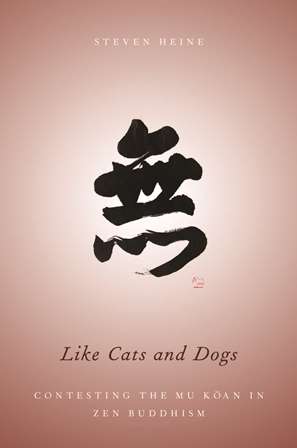
Enter Dr. Steven Heine’s new book, Like Cats and Dogs: Contesting the Mu Koan in Zen Buddhism.
My short-cut review is that he’s done it again – produced a fine piece of scholarship on a really important topic for Zen practice, provided many juicy historical tidbits and context, a fine sampling of original sources (this time including some material from the Korean tradition – often overlooked in Zen studies, it seems to me) some translated here for the first time, and advanced a provocative revisionist theory of the history of Zen while also rolling some inspired Dogen study into the mix.
But if you’re working on the mu koan and concerned that you might get the answer by reading this book, no worries. In terms of koan work, Heine, like Buddhist scholars generally, ain’t nothing but a hound dog barking up the wrong tree. The whole bunch is good at providing context for koan work but have no buddha nature (my first draft title was “Do Buddhist Scholars Have Buddha Nature?”) and are lacking when it comes to pointing to the koan point. That isn’t, after all, their specialty. The koan bone can only be seen through what Dogen calls “identity action” – becoming the koan (“be the bone”) itself through one-pointed introspection.
I’ve gnawed that rotting bone before (see “Satisfying Hunger with Koan: A Critical Review of Foulk’s Scholarly Perspective”), so I’ll leave it at that.
How does Heine’s work here support dharma inquiry?
The main point of the book seems to be that for the last 1,000 years, there have been two main styles of Zen practice and teaching – wato (key phrase) and katto (entangling vines).
The wato approach (sometimes translated as “head word”), “…captures in a single word [mu] the heart of Zen functioning as an ineffable transmission that eliminates cogitation and rhetoric at the root by not relying on any particular manner of deliberation or phrasing.” This is also called a bilateral approach because it presents itself as distinct from katto.
The katto (entangling vines) approach is to fully enter the play of words as the expression of the ineffable. In this approach there’s also multiple layers of rich meaning, thick interpretation, and creativity. That’s Dogen’s approach and a bunch of other important teachers like Daito, Hongzhi, and Yuanwu. This is called a multilateral approach because it throws everything into the mix. It’s also referred to as panoramic.
For example, “How is your hand like a Buddha’s hand?” In the wato method, the focus is just on this question. Dogen, in his katto-ish way, brings up this koan and then says he also asks, “How is your hand like your hand?” And “How is Buddha’s hand like Buddha’s hand?”
Wato was invented by Dahui (1089–1163), Yuanwu’s successor. It seems that Zen had become entangled in beautiful, powerful, panoramic word play – katto – and Dahui, even though his own teacher, Yuanwu, was fantastic at it (or perhaps because his teacher was fantastic at it), reacted against the entangling vine way, even to the point of burning the wood blocks for the Blue Cliff Record – his master’s master work.
My explanation for Dahui’s flip is that he was, in my professional opinion, an asshole. Really. Certifiable. That’s my theory, anyway. And an enlightened asshole at that who wantonly spoke his mind. So he was exiled from the big posh monasteries for being an asshole and he had to find a way to work with lay people, mostly really well educated lay people who were already attached to fine verbal expression (anything here sound familiar?).
Because excessive verbal erudition didn’t seem to help people break through, Dahui invented the wato method. He found that by focusing on just the key word, mostly mu, many more people realized what is to be realized than through study of multiple levels of commentary and counter commentary.
Dahui’s key-word innovation swept through the Zen world and was carried to Korea and Japan so that mu realization is the essence of practice 1,000 years later. Well, except for that ragged, erudite bunch who call themselves Soto Zen practitioners of the last couple hundred years or so.
“The shift took place so quickly,” says Heine, “and was then affirmed so radically that historiographical accounts of the period easily get blurred or distorted.”
Heine puts a lot of emphasis to make his point on what he calls the Emphatic Mu (wato) presentation of the Gateless Barrier, where Zhaozhou is asked if a dog has buddha nature and he says, “No” (or “wu” in Chinese; “mu” in Japanese; and “bu” in Korean). This is contrasted with the so-called Dual Version (katto) of the Book of Serenity which has Zhaozhou saying both no and yes or yes and no, depending on the version. By the way, “Fighting Over and Gnawing at Rotting Bones – Crunch! Snap! Howl! Bark!” is Heine’s translation of Wanson’s comment to the poem by Hongzhi on Zhaozhou’s dual dog in the Book of Serenity (see how it can get kinda exhausting?).
Heine also presents a convincing case that if anybody ever had the mu dialogue about the buddha nature, it wasn’t Zhaozhou. The whole mess in either version wasn’t attributed to him for a couple hundred years, doesn’t appear in the earliest records of Zhaozhou, etc. This is an interesting historical point that to credential the mu koan, somebody put it in Zhaozhou’s mouth, but for koan work it totally doesn’t matter.
The monk could have been asking Daffy Duck and Daffy could have said “No” or “Yes” or “Huh?” Although it might not have sparked the mu explosion in quite the same way because people would be giggling too much to focus.
Now like most “there’s two types of people” theories, Heine goes too far with wato and katto. Maybe it was once a telling difference but as time has past, each approach has eaten the other. That seems to happen a lot.
In the koan curriculum, for example, the student starts with mu as a key word. It is important to shut up for once. Then in subsequent koans – hundreds of them – the mu realization is applied in multiple settings, across time and space, including dealing with the Dual Version. There are also checking questions for almost all the koans that tease out a multitude of perspectives and presentations. Now that’s pretty darn much like multilateral entanglement.
On the other hand, Dogen, a katto type, also uses the key word approach. He just uses lots of them. In the example above, for double example, Dogen isn’t done playing when he hears how your hand is like a Buddha’s hand. He wants to know how your hand is like your hand, etc.
What about me? In the work I do with people, I pull in that ol’ dog Dogen both in the Gateless Barrier as a source for additional checking questions and also by teasing out the koans in Genjokoan and other Shobogenzo fascicles and working with them in a wato-katto way.
Like Heine says, “…the wato and katto standpoints in the end tend to agree on the need to maintain a lofty silence or – more crudely put – to shut their yaps for a change. Otherwise, that ol’ dog of a special transmission outside the scriptures just won’t hunt.”
Like Cats and Dogs: Contesting the Mu Koan in Zen Buddhism
Previous Post

November 2, 2013
In the Teacher-Student Relationship, Who Gets Who?
Next Post
November 24, 2013 A Happy Life: Precept Practice
Browse Our Archives
Select a Category Uncategorized
Select a Month August 2023 July 2023 June 2023 May 2023 April 2023 March 2023 February 2023 January 2023 December 2022 November 2022 October 2022 September 2022 August 2022 July 2022 June 2022 May 2022 April 2022 March 2022 February 2022 January 2022 December 2021 November 2021 August 2021 June 2021 April 2021 February 2021 January 2021 November 2020 September 2020 August 2020 July 2020 June 2020 May 2020 April 2020 January 2020 December 2019 November 2019 August 2019 June 2019 May 2019 April 2019 February 2019 January 2019 December 2018 November 2018 October 2018 September 2018 August 2018 July 2018 June 2018 May 2018 April 2018 March 2018 February 2018 January 2018 December 2017 November 2017 October 2017 September 2017 August 2017 July 2017 June 2017 December 2016 October 2016 June 2016 April 2016 February 2016 January 2016 December 2015 November 2015 October 2015 August 2015 June 2015 May 2015 April 2015 March 2015 February 2015 January 2015 December 2014 November 2014 October 2014 September 2014 August 2014 July 2014 June 2014 May 2014 April 2014 March 2014 February 2014 January 2014 December 2013 November 2013 October 2013 September 2013 August 2013 July 2013 June 2013 May 2013 April 2013 March 2013 February 2013 January 2013 December 2012 November 2012 October 2012 September 2012 August 2012 July 2012 June 2012 May 2012 April 2012 March 2012 February 2012 January 2012 December 2011 November 2011 October 2011 September 2011 August 2011 July 2011 June 2011 May 2011 April 2011 March 2011 February 2011 January 2011 December 2010 November 2010 October 2010 September 2010 August 2010 July 2010 June 2010 May 2010 April 2010 March 2010 February 2010 January 2010 December 2009 November 2009 October 2009 September 2009 August 2009 July 2009 June 2009 May 2009 April 2009 March 2009 February 2009 January 2009 December 2008 November 2008 October 2008 September 2008 August 2008 July 2008 June 2008 May 2008
Follow Us!
TAKE THE
Religious Wisdom Quiz
How did Jesus heal the mute and deaf man in Decapolis?
Select your answer to see how you score.
Gave bread Anointed his head Put fingers in ears and touched tongue Said "Go in peace"
Related posts from Wild Fox Zen
Flowers Blooming on a Withered Tree: Incredible!

Throw Yourself Into the House of Buddha: The...

New Vine Ghost Site for Dosho's Creative Endeavors...

Gnawing Through Qiánfēng’s Three Illnesses and Two Lights
TRENDING AT PATHEOS Buddhist

On Taking Refuge in the Dharma
(Here I continue the feature of sharing talks and essays by teachers...

(Continuing my intention to share talks and essays by other members of Empty...
The Subtle Art of Bowing: A Dharma Discourse
(This presentation was first offered by my dear friend Dharma Holder Tom...

Internal Family Systems Can Heal you Mentally &...
How IFS Helped Me Stop Fighting Myself Internal Family Systems (IFS) is...

The Bible No One Spoke About: A Family’s...
A mysterious family Bible, unspoken faith, and a journey from curiosity to...

How Uncertainty Can Transform Your Life in 2025
Embracing Uncertainty: A New Year’s Resolution for the Brave As 2025 approaches,...
view all Buddhist blogs
Ad-Free & Subscriber Log-In Subscription Support
- About Us
- 2026 Calendar
- Videos
- Podcasts
- Library of World Religions
- Faith In Media Tracker
- Advertise With Us
- Write for Us
- Privacy Policy
- Terms of Service
- Do Not Sell My Data
- Contact Us
- Radiant Digital
- Manage Newsletter Subscriptions
- Unsubscribe From Notifications
- Sitemap
Copyright 2008-2026, Patheos. All rights reserved.
Subscription Support Ad-Free & Subscriber Log-In
Follow Patheos