
BuddhistCatholicContemplativeEvangelicalGeneral ChristianHinduJewishLatter-day SaintMuslimNew VisionsProgressive Christian
Beliefs
- Buddhist
- Catholic
- Contemplative
- Evangelical
- General Christian
- Hindu
- Jewish
- Latter-day Saint
- More Voices
- Muslim
- New Visions
- Pagan
- Progressive Christian
Topics
- Religion News
- Food and Religion
- Sports and Religion
- Religious Art
- Religious Music and Entertainment
- Religious Events
- History and Religion
- Style and Religion
- Politics and Religion
- Women in Religion
- Recreation Outdoors and Religion
- Business Finance and Religion
- Careers Workplace and Religion
- Education and Religion
- Family Parenting and Religion
- Health Fitness and Religion
- Home and Religion
- Relationships and Religion
- Technology and Religion
- Travel and Religion
Columnists
- Buddhist Columnists
- Business Finance and Religion Columnists
- Careers Workplace and Religion Columnists
- Catholic Columnists
- Contemplative Columnists
- Education and Religion Columnists
- Evangelists Columnists
- Family Parenting and Religion Columnists
- General Christian Columnists
- Health Fitness and Religion Columnists
- Hindu Columnists
- History and Religion Columnists
- Home and Religion Columnists
- Jewish Columnists
- More Voices Columnists
- Latter Day Columnists
- Muslim Columnists
- New Visions Columnists
- Nonreligious Columnists
- Pagan Columnists
- Politics and Religion Columnists
- Progressive Columnists
- Recreation Outdoors and Religion Columnists
- Relationships and Religion Columnists
- Religion News Columnists
- Religious Art Columnists
- Religious Events Columnists
- Religious Music and Entertainment Columnists
- Sports and Religion Columnists
- Style and Religion Columnists
- Technology and Religion Columnists
- Travel and Religion Columnists
- Women in Religion Columnists
Resource Library
- 2026 Calendar
- Library of World Religions
- The 100 Most Holy Places on Earth
- Patheos Answers
- Podcasts
- Videos
- Faith Leaders Database
- Anglican Episcopalian
- Bahai
- Baptist
- Buddhism
- Christianity
- Confucianism
- Eastern Orthodoxy
- Hinduism
- Holiness and Pentecostal
- ISKCON
- Islam
- Judaism
- Lutheran
- Methodist
- The Church of Jesus Christ of Latter-day Saints
- New Age
- Paganism
- Presbytarian and Reformed
- Protestantism
- Religion Behind the Scenes
- Roman Catholic
- Scientology
- Shia Islam
- Sikhism
- Sufism
- Sunni Islam
- Taoism
- Zen
- See all religions
Research Tools
 Ad-Free & Subscriber Log-In Subscription Support
Ad-Free & Subscriber Log-In Subscription Support
Follow Patheos 

- Trending:
- Forgiveness
- |
- Marriage
- |
- Consciousness
- |
- Death Penalty
- |
- Election
- |
- Halloween
 Wild Fox Zen
- Home
- Buddhist
- Flapping with Vitality: What’s the Point of Dogen Study?
Flapping with Vitality: What’s the Point of Dogen Study?
Last updated on: August 26, 2013 at 6:22 pm by Dosho Port
Flapping with Vitality: What’s the Point of Dogen Study? 2013-08-26T18:22:41-06:00 Dosho Port
Patheos Explore the world's faith through different perspectives on religion and spirituality! Patheos has the views of the prevalent religions and spiritualities of the world.
 What’s the point of study in Dogen Zen?
Given my Dogenophile disposition, I’m asked this question from time to time, and especially now that I’m developing an online study program, Vine of Obstacles: Online Support for Zen Training (which is full, btw, so if you’re interested in doing this work, stayed tuned for openings or contact me in a couple months).
The point, of course, is practicing enlightenment.
You might wonder, “How the heck does reading some illogical stuff contribute to practicing enlightenment?”
Likewise, some shave pates suggest that the point of Dogen Zen is to not make sense.
In the Mountains and Rivers Sutra, Dogen says about those who hold this view, “The illogical stories mentioned by you bald-headed fellows are only illogical for you, not for Buddha ancestors. Even though you do not understand, you should not neglect studying the Buddha ancestors’ path of understanding. Even if it is beyond understanding in the end, your present understanding is off the mark.”
He also says that those who hold the view that the buddhadharma is illogical are immature, foolish, have never truly studied, and are really, really stupid. So there.
Dogen says this in regard to the views of monks he met in China regarding Nanchuan’s sickle, Huangpo’s staff, and Linchi’s shout. Presumably, shorthand for the koan tradition.
If there is an understanding that is understandable to Buddha ancestors, how does it unfold? What is the inner path of this undertaking?
An old friend, a black-belt in Shotokan Karate, told me in that tradition there are three stages – birth, mastery, and breaking. That fits Dogen Zen work quite well – and I’d add a fourth stage: flapping with vitality.
When most of us are born in this Zen work, it’s like coming home. We find in the buddhadharma an expression of what we’ve always intuitively felt about this life. And because it’s so damn ungraspable, we try to figure it out with our intellect while we while away the time in zazen. Fortunately, from time to time, we follow the instructions and let go of our thinking. In letting go of thinking, we discover a more and more subtle quality of thought.
Through perseverance, increasing intimacy and grace, we suddenly find ourselves pivoting mysteriously. We bridge the gap and are no longer looking at the buddhadharma from the outside. This is mastery.
And then to our surprise we find that in order to live the buddhadharma, what we have mastered must be broken, or rather, we find that we and it, we-as-it, have always been broken. And in the perfection of brokenness, we are no longer bound by the tradition so it can be expressed freely.
What’s left but to flap along with vitality, cursing the gods and buddhas, howling with the coyotes and the far-off train whistle on a hot summer night?
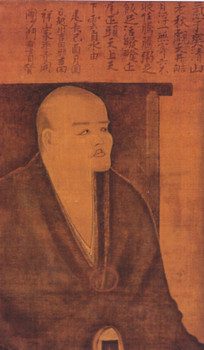
Speaking of howling, the picture above is a self-portrait by Dogen, probably from 1249, just a few years before his death. He painted it on the night of the harvest moon and wrote a poem for it while he was feeling good (the calligraphy at the top of the painting). Okumura and Leighton (Dogen’s Extensive Record, p. 602) translate it like this:
Autumn is spirited and refreshing as this mountain ages.
A donkey observes the sky in the well, white moon floating.
One is not dependent;
One does not contain.
Letting go, vigorous with plenty of gruel and rice,
Flapping with vitality, right from head to tail,
Above and below the heavens, clouds and water are free.
May we all go on practicing enlightenment just like this.
Previous Post

August 19, 2013
Practice Meeting Notes Hastily Scribbled
Next Post
September 14, 2013 The Future's Uncertain and the End is Always Near
Browse Our Archives
Select a Category Uncategorized
Select a Month August 2023 July 2023 June 2023 May 2023 April 2023 March 2023 February 2023 January 2023 December 2022 November 2022 October 2022 September 2022 August 2022 July 2022 June 2022 May 2022 April 2022 March 2022 February 2022 January 2022 December 2021 November 2021 August 2021 June 2021 April 2021 February 2021 January 2021 November 2020 September 2020 August 2020 July 2020 June 2020 May 2020 April 2020 January 2020 December 2019 November 2019 August 2019 June 2019 May 2019 April 2019 February 2019 January 2019 December 2018 November 2018 October 2018 September 2018 August 2018 July 2018 June 2018 May 2018 April 2018 March 2018 February 2018 January 2018 December 2017 November 2017 October 2017 September 2017 August 2017 July 2017 June 2017 December 2016 October 2016 June 2016 April 2016 February 2016 January 2016 December 2015 November 2015 October 2015 August 2015 June 2015 May 2015 April 2015 March 2015 February 2015 January 2015 December 2014 November 2014 October 2014 September 2014 August 2014 July 2014 June 2014 May 2014 April 2014 March 2014 February 2014 January 2014 December 2013 November 2013 October 2013 September 2013 August 2013 July 2013 June 2013 May 2013 April 2013 March 2013 February 2013 January 2013 December 2012 November 2012 October 2012 September 2012 August 2012 July 2012 June 2012 May 2012 April 2012 March 2012 February 2012 January 2012 December 2011 November 2011 October 2011 September 2011 August 2011 July 2011 June 2011 May 2011 April 2011 March 2011 February 2011 January 2011 December 2010 November 2010 October 2010 September 2010 August 2010 July 2010 June 2010 May 2010 April 2010 March 2010 February 2010 January 2010 December 2009 November 2009 October 2009 September 2009 August 2009 July 2009 June 2009 May 2009 April 2009 March 2009 February 2009 January 2009 December 2008 November 2008 October 2008 September 2008 August 2008 July 2008 June 2008 May 2008
Follow Us!
TAKE THE
Religious Wisdom Quiz
Who said, "The Lord said to my Lord, ‘Sit at my right hand’"?
Select your answer to see how you score.
Isaiah Moses David Solomon
Related posts from Wild Fox Zen

Throw Yourself Into the House of Buddha: The...

New Vine Ghost Site for Dosho's Creative Endeavors...

Gnawing Through Qiánfēng’s Three Illnesses and Two Lights

"Why, Oh Why, Is My Practice Not Progressing?"
TRENDING AT PATHEOS Buddhist

On Taking Refuge in the Dharma
(Here I continue the feature of sharing talks and essays by teachers...

(Continuing my intention to share talks and essays by other members of Empty...
The Subtle Art of Bowing: A Dharma Discourse
(This presentation was first offered by my dear friend Dharma Holder Tom...

Internal Family Systems Can Heal you Mentally &...
How IFS Helped Me Stop Fighting Myself Internal Family Systems (IFS) is...

The Bible No One Spoke About: A Family’s...
A mysterious family Bible, unspoken faith, and a journey from curiosity to...

How Uncertainty Can Transform Your Life in 2025
Embracing Uncertainty: A New Year’s Resolution for the Brave As 2025 approaches,...
view all Buddhist blogs
Ad-Free & Subscriber Log-In Subscription Support
- About Us
- 2026 Calendar
- Videos
- Podcasts
- Library of World Religions
- Faith In Media Tracker
- Advertise With Us
- Write for Us
- Privacy Policy
- Terms of Service
- Do Not Sell My Data
- Contact Us
- Radiant Digital
- Manage Newsletter Subscriptions
- Unsubscribe From Notifications
- Sitemap
Copyright 2008-2026, Patheos. All rights reserved.
Subscription Support Ad-Free & Subscriber Log-In
Follow Patheos