
BuddhistCatholicContemplativeEvangelicalGeneral ChristianHinduJewishLatter-day SaintMuslimNew VisionsProgressive Christian
Beliefs
- Buddhist
- Catholic
- Contemplative
- Evangelical
- General Christian
- Hindu
- Jewish
- Latter-day Saint
- More Voices
- Muslim
- New Visions
- Pagan
- Progressive Christian
Topics
- Religion News
- Food and Religion
- Sports and Religion
- Religious Art
- Religious Music and Entertainment
- Religious Events
- History and Religion
- Style and Religion
- Politics and Religion
- Women in Religion
- Recreation Outdoors and Religion
- Business Finance and Religion
- Careers Workplace and Religion
- Education and Religion
- Family Parenting and Religion
- Health Fitness and Religion
- Home and Religion
- Relationships and Religion
- Technology and Religion
- Travel and Religion
Columnists
- Buddhist Columnists
- Business Finance and Religion Columnists
- Careers Workplace and Religion Columnists
- Catholic Columnists
- Contemplative Columnists
- Education and Religion Columnists
- Evangelists Columnists
- Family Parenting and Religion Columnists
- General Christian Columnists
- Health Fitness and Religion Columnists
- Hindu Columnists
- History and Religion Columnists
- Home and Religion Columnists
- Jewish Columnists
- More Voices Columnists
- Latter Day Columnists
- Muslim Columnists
- New Visions Columnists
- Nonreligious Columnists
- Pagan Columnists
- Politics and Religion Columnists
- Progressive Columnists
- Recreation Outdoors and Religion Columnists
- Relationships and Religion Columnists
- Religion News Columnists
- Religious Art Columnists
- Religious Events Columnists
- Religious Music and Entertainment Columnists
- Sports and Religion Columnists
- Style and Religion Columnists
- Technology and Religion Columnists
- Travel and Religion Columnists
- Women in Religion Columnists
Resource Library
- 2026 Calendar
- Library of World Religions
- The 100 Most Holy Places on Earth
- Patheos Answers
- Podcasts
- Videos
- Faith Leaders Database
- Anglican Episcopalian
- Bahai
- Baptist
- Buddhism
- Christianity
- Confucianism
- Eastern Orthodoxy
- Hinduism
- Holiness and Pentecostal
- ISKCON
- Islam
- Judaism
- Lutheran
- Methodist
- The Church of Jesus Christ of Latter-day Saints
- New Age
- Paganism
- Presbytarian and Reformed
- Protestantism
- Religion Behind the Scenes
- Roman Catholic
- Scientology
- Shia Islam
- Sikhism
- Sufism
- Sunni Islam
- Taoism
- Zen
- See all religions
Research Tools
 Ad-Free & Subscriber Log-In Subscription Support
Ad-Free & Subscriber Log-In Subscription Support
Follow Patheos 

- Trending:
- Forgiveness
- |
- Marriage
- |
- Consciousness
- |
- Death Penalty
- |
- Election
- |
- Halloween
 Wild Fox Zen
- Home
- Buddhist
- Do Not Waste Your Time Admiring a Painted Rice Cake: Kukai and Dogen on the Art of Enlightenment
Do Not Waste Your Time Admiring a Painted Rice Cake: Kukai and Dogen on the Art of Enlightenment
Last updated on: July 28, 2013 at 11:53 am by Dosho Port
Do Not Waste Your Time Admiring a Painted Rice Cake: Kukai and Dogen on the Art of Enlightenment 2013-07-28T11:53:36-06:00 Dosho Port
Patheos Explore the world's faith through different perspectives on religion and spirituality! Patheos has the views of the prevalent religions and spiritualities of the world.
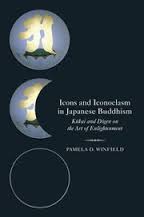 Pamela D. Winfield has undertaken a wonderfully detailed and intelligent study, Icons and Iconoclasm in Japanese Buddhism: Kukai and Dogen on the Art of Enlightenment, suitable for hopeless Dogen geeks (or Kukai geeks if there be such people) like myself and Buddhist scholars, of course, but maybe not the masses.
This morning, Amazon has the book at #680,626 – so, okay, for sure not the masses.
However, there is much here that informs the practice of Zen. And some that doesn’t. In this post, I’ll try to give you a little of each.
Winfield aims at answering three big questions: “Do images help or hinder the realization of Buddhahood? Does the experience of awakening involve the imagination or not? Can art ever represent the experience of enlightenment itself?”
One thing is immediately clear – Winfield is coming at this study as a Buddhist. Her questions presuppose the possibility of enlightenment as does her methodology, digging deeply into the works of two of Japan’s enlightened masters.
First a little bit about Kukai (774-835). He was a master of esoteric Buddhism and an advocate of realizing Buddhahood with this very body by just glancing at mandalas “Buddha enters me, I enter Buddha.” Winfield has a lot to say about Kukai and his elaborate practices, depictions of enlightenment, and the power of such.
Notably, someone said of Kukai, “He studied abroad [in China] to seek the Way; he went empty-handed and returned fully-equipped.”
That might sound familiar, especially to Dogenophiles.
“Not having visited many monasteries but having only studied under Master Rujing and plainly realizing that the eyes are horizontal and the nose vertical, without being deceived by anyone, I came home empty-handed,” said Dogen (1200-1253) about his own visit to China.
Turns out that Dogen’s empty-handed statement and quite a lot that he had to say was in response to Kukai, Mr. Fully Equipped.
Now it is well known that Mr. Empty Handed did indeed have a few items with him when he returned from China, including his shisho transmission certificate from Rujing (see my previous post for Katagiri Roshi on shisho). Winfield uses Dogen’s shisho as a demonstration of what she sees as Dogen’s holochronic view, time simultaneously ranging from past to present, present to past, future to present, etc.
The shisho is a blood line of succession, a dharma genealogy, that goes back to the seven primordial Buddhas. On this document, instead of lining up from past to present like most genealogies, the names are presented in a circle. That the generations are standing “…side by side and shoulder to shoulder with one another helps one to understand how their minds can transhistorically ‘see’ one another across the circle of time. It helps to explain how their minds can ‘meet’ in a momentary nikon (individual just-now being time) that is simultaneously nondual with the ranging circle of kyoryaku (dynamic range or extension of being time) holochrony” (p. 51-52).
We’re fortunate to have scholars like Winfield, Heine, Kim, Foulk, Bielefeldt, Wright, Bodiford, etc., who are helping enormously with the translation of dharma to the global culture by not only providing detailed historical analysis, contextualizing the tradition, but also developing a language for concisely presenting it. I think of Kim’s notion of “foci” and now Winfield’s “holochronic” as just a couple examples of how the fields of study and practice entangle.
Winfield also does practitioners a great service by destroying the simplistic understanding of dharma that words (and/or images) are apart from it. Kukai saw the things of world as letters constantly spelling out and preaching the dharma. Dogen said that “all buddhas are picture-buddhas and all picture-buddhas are buddhas.”
If words and images were NOT the buddhadharma, then we would have a dualistic path where silence and samadhi are privileged over expression and insight.
Despite this and other contributions, when the fields of study and practice collide, it’s usually about practicing dharma. Let me cite just one example briefly, hopefully giving you a feel for what I’m talking about.
Winfield, in pursuit of her question about art depicting enlightenment, takes up the section of Dogen’s Buddha Nature where he tells of being at a monastery in China and seeing a portrait of Nagarjuna, portrayed with a full-moon halo.
“…The body manifesting the shape of the round moon has never yet been painted,” Dogen says, demonstrating for Winfield that Dogen opposed this artistic presentation.
Winfield further quotes Dogen,
…Not to paint the body manifesting, not to paint the round moon, not to paint the full moon shape, not to trace the body of Buddhas, not to be thereby expressing,* not to trace the preaching Dharma, and to trace in vain the picture of rice cake – what can possibly come of that?*
For Winfield, when Dogen says “thereby expressing” he is only referring to the form of zazen as a liturgical reenactment of awakening (for more, see this series of posts). In my view, this is not correct practice enlightenment. Winfield forgets that the zazen Dogen is talking about simultaneously is not “…limited to sitting or lying down,” as Dogen expresses in the Universal Recommendations for Zazen, but is holochronically manifesting buddha.
And in not to paint the body manifesting, she also misses an application of Dogen’s “logic of ‘not.'” “Not” is not necessarily “not” as usually understood.
So what? It makes an enormous difference for practice if zazen is the only expression of enlightenment, that’s what.
Another view would be to see Dogen urging us all as Winfield quotes, “Old Buddhas! New Buddhas! Encounter the real manifesting body! Do not waste your time admiring a painted rice cake!”
How can we encounter the real manifesting body and express it in a way that is not limited to sitting or lying down?
One way is to enter the painting of Nagarjuna manifesting the round moon in the spirit of Kukai, “Buddha enters me, I enter Buddha.”
Then the don’t-tell-me-show-me koans become, “What did Nagarjuna realize such that he manifested his body of freedom like the disk of the full moon?”
And “Paint a full moon with your body.”
And “Do not waste your time admiring a painted rice cake!”
Next Post

August 6, 2013 What is the Minimum Amount of Asceticism Required?
Browse Our Archives
Select a Category Uncategorized
Select a Month August 2023 July 2023 June 2023 May 2023 April 2023 March 2023 February 2023 January 2023 December 2022 November 2022 October 2022 September 2022 August 2022 July 2022 June 2022 May 2022 April 2022 March 2022 February 2022 January 2022 December 2021 November 2021 August 2021 June 2021 April 2021 February 2021 January 2021 November 2020 September 2020 August 2020 July 2020 June 2020 May 2020 April 2020 January 2020 December 2019 November 2019 August 2019 June 2019 May 2019 April 2019 February 2019 January 2019 December 2018 November 2018 October 2018 September 2018 August 2018 July 2018 June 2018 May 2018 April 2018 March 2018 February 2018 January 2018 December 2017 November 2017 October 2017 September 2017 August 2017 July 2017 June 2017 December 2016 October 2016 June 2016 April 2016 February 2016 January 2016 December 2015 November 2015 October 2015 August 2015 June 2015 May 2015 April 2015 March 2015 February 2015 January 2015 December 2014 November 2014 October 2014 September 2014 August 2014 July 2014 June 2014 May 2014 April 2014 March 2014 February 2014 January 2014 December 2013 November 2013 October 2013 September 2013 August 2013 July 2013 June 2013 May 2013 April 2013 March 2013 February 2013 January 2013 December 2012 November 2012 October 2012 September 2012 August 2012 July 2012 June 2012 May 2012 April 2012 March 2012 February 2012 January 2012 December 2011 November 2011 October 2011 September 2011 August 2011 July 2011 June 2011 May 2011 April 2011 March 2011 February 2011 January 2011 December 2010 November 2010 October 2010 September 2010 August 2010 July 2010 June 2010 May 2010 April 2010 March 2010 February 2010 January 2010 December 2009 November 2009 October 2009 September 2009 August 2009 July 2009 June 2009 May 2009 April 2009 March 2009 February 2009 January 2009 December 2008 November 2008 October 2008 September 2008 August 2008 July 2008 June 2008 May 2008
Follow Us!
TAKE THE
Religious Wisdom Quiz
Which book contains the story of the Valley of Dry Bones?
Select your answer to see how you score.
Jeremiah Ezekiel Daniel Isaiah
Related posts from Wild Fox Zen
Plucking a Blade of Grass: The Wondrous Dharma...
Dōgen’s Instruction for Householder Zen Training

Wandering Destitute into a Demon Pit

The Central Importance of Inquiring of a Teacher
TRENDING AT PATHEOS Buddhist

On Taking Refuge in the Dharma
(Here I continue the feature of sharing talks and essays by teachers...

(Continuing my intention to share talks and essays by other members of Empty...
The Subtle Art of Bowing: A Dharma Discourse
(This presentation was first offered by my dear friend Dharma Holder Tom...

Internal Family Systems Can Heal you Mentally &...
How IFS Helped Me Stop Fighting Myself Internal Family Systems (IFS) is...

The Bible No One Spoke About: A Family’s...
A mysterious family Bible, unspoken faith, and a journey from curiosity to...

How Uncertainty Can Transform Your Life in 2025
Embracing Uncertainty: A New Year’s Resolution for the Brave As 2025 approaches,...
view all Buddhist blogs
Ad-Free & Subscriber Log-In Subscription Support
- About Us
- 2026 Calendar
- Videos
- Podcasts
- Library of World Religions
- Faith In Media Tracker
- Advertise With Us
- Write for Us
- Privacy Policy
- Terms of Service
- Do Not Sell My Data
- Contact Us
- Radiant Digital
- Manage Newsletter Subscriptions
- Unsubscribe From Notifications
- Sitemap
Copyright 2008-2026, Patheos. All rights reserved.
Subscription Support Ad-Free & Subscriber Log-In
Follow Patheos