
BuddhistCatholicContemplativeEvangelicalGeneral ChristianHinduJewishLatter-day SaintMuslimNew VisionsProgressive Christian
Beliefs
- Buddhist
- Catholic
- Contemplative
- Evangelical
- General Christian
- Hindu
- Jewish
- Latter-day Saint
- More Voices
- Muslim
- New Visions
- Pagan
- Progressive Christian
Topics
- Religion News
- Food and Religion
- Sports and Religion
- Religious Art
- Religious Music and Entertainment
- Religious Events
- History and Religion
- Style and Religion
- Politics and Religion
- Women in Religion
- Recreation Outdoors and Religion
- Business Finance and Religion
- Careers Workplace and Religion
- Education and Religion
- Family Parenting and Religion
- Health Fitness and Religion
- Home and Religion
- Relationships and Religion
- Technology and Religion
- Travel and Religion
Columnists
- Buddhist Columnists
- Business Finance and Religion Columnists
- Careers Workplace and Religion Columnists
- Catholic Columnists
- Contemplative Columnists
- Education and Religion Columnists
- Evangelists Columnists
- Family Parenting and Religion Columnists
- General Christian Columnists
- Health Fitness and Religion Columnists
- Hindu Columnists
- History and Religion Columnists
- Home and Religion Columnists
- Jewish Columnists
- More Voices Columnists
- Latter Day Columnists
- Muslim Columnists
- New Visions Columnists
- Nonreligious Columnists
- Pagan Columnists
- Politics and Religion Columnists
- Progressive Columnists
- Recreation Outdoors and Religion Columnists
- Relationships and Religion Columnists
- Religion News Columnists
- Religious Art Columnists
- Religious Events Columnists
- Religious Music and Entertainment Columnists
- Sports and Religion Columnists
- Style and Religion Columnists
- Technology and Religion Columnists
- Travel and Religion Columnists
- Women in Religion Columnists
Resource Library
- 2026 Calendar
- Library of World Religions
- The 100 Most Holy Places on Earth
- Patheos Answers
- Podcasts
- Videos
- Faith Leaders Database
- Anglican Episcopalian
- Bahai
- Baptist
- Buddhism
- Christianity
- Confucianism
- Eastern Orthodoxy
- Hinduism
- Holiness and Pentecostal
- ISKCON
- Islam
- Judaism
- Lutheran
- Methodist
- The Church of Jesus Christ of Latter-day Saints
- New Age
- Paganism
- Presbytarian and Reformed
- Protestantism
- Religion Behind the Scenes
- Roman Catholic
- Scientology
- Shia Islam
- Sikhism
- Sufism
- Sunni Islam
- Taoism
- Zen
- See all religions
Research Tools
 Ad-Free & Subscriber Log-In Subscription Support
Ad-Free & Subscriber Log-In Subscription Support
Follow Patheos 

- Trending:
- Forgiveness
- |
- Marriage
- |
- Consciousness
- |
- Death Penalty
- |
- Election
- |
- Halloween
 Wild Fox Zen
- Home
- Buddhist
- On Taking Refuge in Evil Buddhas
On Taking Refuge in Evil Buddhas
Last updated on: March 17, 2013 at 5:23 pm by Dosho Port
On Taking Refuge in Evil Buddhas 2013-03-17T17:23:26-06:00 Dosho Port
Patheos Explore the world's faith through different perspectives on religion and spirituality! Patheos has the views of the prevalent religions and spiritualities of the world.
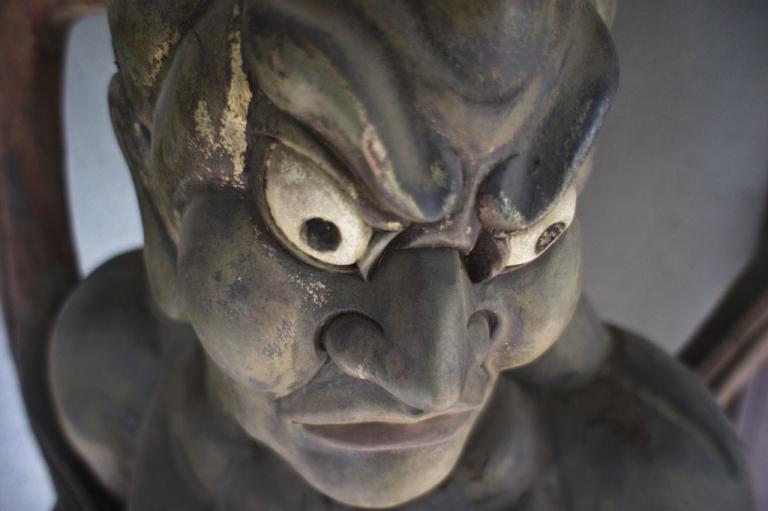 In a recent fine talk, Absolute Refuge, Jiryu Mark Rutschman Byler shares the practice of taking refuge in evil Buddhas. We had a lively conversation about this during our last Monday night Dogen study here. Turns out it’s a theme that riles some folks up.
Gentle Jiryu’s riling talk, by the way, is one of the audio dharma talks that we’ll use in the Vine of Obstacles: Online Support for Zen Training.
Jiryu has studied an old Buddhist school in China, the Three Stages Sect, who seem to have been interested in how to live in peace and harmony. And they noticed how attachment to our views creates conflict and discord. They came to the opinion that all opinions are false, as a practice for cutting through attachment to our own limited perspectives.
But if all views are false, where can we go for refuge? What is a reliable source of stability, strength, and sanity? The Three Stages Sect identified the teachings of the historical Buddha, the universal Buddha, and evil Buddhas as fitting sources for refuge.
The first two, the historical and universal Buddhas, go well with what we usually think of as objects of refuge but taking refuge in evil Buddhas just might sound rather messed up. As one person said, “‘Evil Buddhas’ is an oxymoron. And refuge, to me, indicates a place of safety and security… as in a circle of protection. Why would I let evil Buddhas into my circle of protection?”
In the same vein, during Catholic confirmation, if memory serves, the bishop asks, “Do you renounce Satan and all his works?”
If anybody in my confirmation cohort had been a member of the Three Stages Sect, they’d have hollered, “No way, dude! I take refuge in Satan, too.”
So this is a teaching that is intended, I believe, to rile us up, to disclose our one-sidedness and free us from being Buddhist fundamentalists – imv, really important for our times.
If “evil Buddha” is too provocative, consider opening up that category so that evil includes delusion and death and difficulty. Consider that the evil Buddha isn’t out there somewhere but right here. Just this person. And even when the so-called other is before us, who is seeing this “evil Buddha”?
See, for example (I hope), my recent post about what to do when life is disrupted (click here) for a practical, personal way that this perspective can be practiced.
This refuge-in-evil-Buddhas teaching in various forms recurs throughout the Buddhist tradition, including in Dogen, Shinran, and the Vimalakirti Sutra (see the end of the this post for a few excerpts of what they had to say). You might sit calmly and reflect deeply about this. After all, as I said, it’s a recurring theme, so just maybe there is something important for us here, too.
It is my unreliable opinion that there is.
One of the evil sides of refuge in evil Buddhas, (otherwise known as entering fully into Mara, or the way as going the wrong way, or being an evil person – see below for the excerpts I’m referencing here), is that we might use these teachings to justify our own harmful actions of body, speech, and thought, and to condone the negative actions of others.
That’s really not the point, although, in a way it supports the Three Stage’s contention – all perspectives are unreliable.
Jiryu says about the Three Stages Sect, “It’s not that they liked evil Buddhas. [The Three Stages Sect] were a great source for good, they really helped people, and they lived by all the rules that Buddhists have always lived by to be most kind and most compassionate…. They realized that the only place to find real reliable refuge is right here, so if there is an evil buddha in front of me, that is my refuge…. If I’m not finding refuge in what’s here, then how will I find it anywhere?”
Jiryu also mentions a really hinky test that the founder of this school advocated for determining whether a donor should give gifts to a community. S/he should ask, “Is there anyone among the assembly who breaks their vows?”
If the answer is “No sir! We are a pure community of righteous practitioners,” then you shouldn’t give to that group because the group is “…excluding from the embrace of refuge those who break their vows,” as Jiryu put it.
As a breaker of vows, sinner, and broken-down old guy, I think that’s so tender.
Comments welcome and okay. Here are the excerpts:
1. Dogen, Thirty-seven Conditions Contributing to Bodhisattva Practice:
When a demon becomes a buddha, it exerts its demon-ness, breaks it, and actualizes a buddha. When a buddha becomes a buddha, he/she exerts his/her buddhahood, strives for it, and actualizes a buddha. When a human being becomes a buddha, he/she exerts his/her human nature, trains it, and actualizes a buddha. You should thoroughly understand the truth that possibilities lie precisely in the ways various beings exert their respective natures.
2. Vimalakirti Sutra, Chapter 8, The Family of the Tathagathas
Then, the crown prince Manjusri said to the Licchavi Vimalakirti, “Noble sir, how does the bodhisattva follow the way to attain the qualities of the Buddha?”
Vimalakirti replied, “Manjusri, when the bodhisattva follows the wrong way, he follows the way to attain the qualities of the Buddha.”
Manjusri continued, “How does the bodhisattva follow the wrong way?”
Vimalakirti replied, “Even should he enact the five deadly sins, he feels no malice, violence, or hate. Even should he go into the hells, he remains free of all taint of passions. Even should he go into the states of the animals, he remains free of darkness and ignorance. When he goes into the states of the asuras, he remains free of pride, conceit, and arrogance. When he goes into the realm of the lord of death, he accumulates the stores of merit and wisdom. When he goes into the states of motionlessness and immateriality, he does not dissolve therein.
“He may follow the ways of desire, yet he stays free of attachment to the enjoyments of desire. He may follow the ways of hatred, yet he feels no anger to any living being. He may follow the ways of folly, yet he is ever conscious with the wisdom of firm understanding.
3. Shinran’s Tannisho: Even the good person attains birth in the Pure Land, how much more so the evil person.
But the people of the world constantly say, even the evil person attains birth, how much more so the good person. Although this appears to be sound at first glance, it goes against the intention of the Primal Vow of Other Power. The reason is that since the person of self power, being conscious of doing good, lacks the thought of entrusting the self completely to Other Power, he or she is not the focus of the Primal Vow of Amida. But when self-power is turned over and entrusting to Other Power occurs, the person attains birth in the land of True Fulfillment.
The Primal Vow was established out of deep compassion for us who cannot become freed from the bondage of birth-and-death through any religious practice, due to the abundance of blind passion. Since its basic intention is to effect the enlightenment of such an evil one, the evil person who is led to true entrusting by Other Power is the person who attains birth in the Pure Land. Thus, even the good person attains birth, how much more so the evil person!
Previous Post

March 15, 2013
Arousing the Way Seeking Heart
Next Post
March 21, 2013 What is Refuge?
Browse Our Archives
Select a Category Uncategorized
Select a Month August 2023 July 2023 June 2023 May 2023 April 2023 March 2023 February 2023 January 2023 December 2022 November 2022 October 2022 September 2022 August 2022 July 2022 June 2022 May 2022 April 2022 March 2022 February 2022 January 2022 December 2021 November 2021 August 2021 June 2021 April 2021 February 2021 January 2021 November 2020 September 2020 August 2020 July 2020 June 2020 May 2020 April 2020 January 2020 December 2019 November 2019 August 2019 June 2019 May 2019 April 2019 February 2019 January 2019 December 2018 November 2018 October 2018 September 2018 August 2018 July 2018 June 2018 May 2018 April 2018 March 2018 February 2018 January 2018 December 2017 November 2017 October 2017 September 2017 August 2017 July 2017 June 2017 December 2016 October 2016 June 2016 April 2016 February 2016 January 2016 December 2015 November 2015 October 2015 August 2015 June 2015 May 2015 April 2015 March 2015 February 2015 January 2015 December 2014 November 2014 October 2014 September 2014 August 2014 July 2014 June 2014 May 2014 April 2014 March 2014 February 2014 January 2014 December 2013 November 2013 October 2013 September 2013 August 2013 July 2013 June 2013 May 2013 April 2013 March 2013 February 2013 January 2013 December 2012 November 2012 October 2012 September 2012 August 2012 July 2012 June 2012 May 2012 April 2012 March 2012 February 2012 January 2012 December 2011 November 2011 October 2011 September 2011 August 2011 July 2011 June 2011 May 2011 April 2011 March 2011 February 2011 January 2011 December 2010 November 2010 October 2010 September 2010 August 2010 July 2010 June 2010 May 2010 April 2010 March 2010 February 2010 January 2010 December 2009 November 2009 October 2009 September 2009 August 2009 July 2009 June 2009 May 2009 April 2009 March 2009 February 2009 January 2009 December 2008 November 2008 October 2008 September 2008 August 2008 July 2008 June 2008 May 2008
Follow Us!
TAKE THE
Religious Wisdom Quiz
Who said, "The joy of the Lord is your strength"?
Select your answer to see how you score.
Paul David Nehemiah Solomon
Related posts from Wild Fox Zen

Plucking a Blade of Grass: The Wondrous Dharma...
Dōgen’s Instruction for Householder Zen Training

Wandering Destitute into a Demon Pit

The Central Importance of Inquiring of a Teacher
TRENDING AT PATHEOS Buddhist

On Taking Refuge in the Dharma
(Here I continue the feature of sharing talks and essays by teachers...

(Continuing my intention to share talks and essays by other members of Empty...
The Subtle Art of Bowing: A Dharma Discourse
(This presentation was first offered by my dear friend Dharma Holder Tom...

Internal Family Systems Can Heal you Mentally &...
How IFS Helped Me Stop Fighting Myself Internal Family Systems (IFS) is...

The Bible No One Spoke About: A Family’s...
A mysterious family Bible, unspoken faith, and a journey from curiosity to...

How Uncertainty Can Transform Your Life in 2025
Embracing Uncertainty: A New Year’s Resolution for the Brave As 2025 approaches,...
view all Buddhist blogs
Ad-Free & Subscriber Log-In Subscription Support
- About Us
- 2026 Calendar
- Videos
- Podcasts
- Library of World Religions
- Faith In Media Tracker
- Advertise With Us
- Write for Us
- Privacy Policy
- Terms of Service
- Do Not Sell My Data
- Contact Us
- Radiant Digital
- Manage Newsletter Subscriptions
- Unsubscribe From Notifications
- Sitemap
Copyright 2008-2026, Patheos. All rights reserved.
Subscription Support Ad-Free & Subscriber Log-In
Follow Patheos