
BuddhistCatholicContemplativeEvangelicalGeneral ChristianHinduJewishLatter-day SaintMuslimNew VisionsProgressive Christian
Beliefs
- Buddhist
- Catholic
- Contemplative
- Evangelical
- General Christian
- Hindu
- Jewish
- Latter-day Saint
- More Voices
- Muslim
- New Visions
- Pagan
- Progressive Christian
Topics
- Religion News
- Food and Religion
- Sports and Religion
- Religious Art
- Religious Music and Entertainment
- Religious Events
- History and Religion
- Style and Religion
- Politics and Religion
- Women in Religion
- Recreation Outdoors and Religion
- Business Finance and Religion
- Careers Workplace and Religion
- Education and Religion
- Family Parenting and Religion
- Health Fitness and Religion
- Home and Religion
- Relationships and Religion
- Technology and Religion
- Travel and Religion
Columnists
- Buddhist Columnists
- Business Finance and Religion Columnists
- Careers Workplace and Religion Columnists
- Catholic Columnists
- Contemplative Columnists
- Education and Religion Columnists
- Evangelists Columnists
- Family Parenting and Religion Columnists
- General Christian Columnists
- Health Fitness and Religion Columnists
- Hindu Columnists
- History and Religion Columnists
- Home and Religion Columnists
- Jewish Columnists
- More Voices Columnists
- Latter Day Columnists
- Muslim Columnists
- New Visions Columnists
- Nonreligious Columnists
- Pagan Columnists
- Politics and Religion Columnists
- Progressive Columnists
- Recreation Outdoors and Religion Columnists
- Relationships and Religion Columnists
- Religion News Columnists
- Religious Art Columnists
- Religious Events Columnists
- Religious Music and Entertainment Columnists
- Sports and Religion Columnists
- Style and Religion Columnists
- Technology and Religion Columnists
- Travel and Religion Columnists
- Women in Religion Columnists
Resource Library
- 2026 Calendar
- Library of World Religions
- The 100 Most Holy Places on Earth
- Patheos Answers
- Podcasts
- Videos
- Faith Leaders Database
- Anglican Episcopalian
- Bahai
- Baptist
- Buddhism
- Christianity
- Confucianism
- Eastern Orthodoxy
- Hinduism
- Holiness and Pentecostal
- ISKCON
- Islam
- Judaism
- Lutheran
- Methodist
- The Church of Jesus Christ of Latter-day Saints
- New Age
- Paganism
- Presbytarian and Reformed
- Protestantism
- Religion Behind the Scenes
- Roman Catholic
- Scientology
- Shia Islam
- Sikhism
- Sufism
- Sunni Islam
- Taoism
- Zen
- See all religions
Research Tools
 Ad-Free & Subscriber Log-In Subscription Support
Ad-Free & Subscriber Log-In Subscription Support
Follow Patheos 

- Trending:
- Forgiveness
- |
- Marriage
- |
- Consciousness
- |
- Death Penalty
- |
- Election
- |
- Halloween
 Wild Fox Zen
- Home
- Buddhist
- Dogen: the Patron Saint of Passive Zen?
Dogen: the Patron Saint of Passive Zen?
Last updated on: September 17, 2022 at 9:26 am by Dosho Port
Dogen: the Patron Saint of Passive Zen? 2022-09-17T09:26:26-06:00 Dosho Port
Patheos Explore the world's faith through different perspectives on religion and spirituality! Patheos has the views of the prevalent religions and spiritualities of the world.
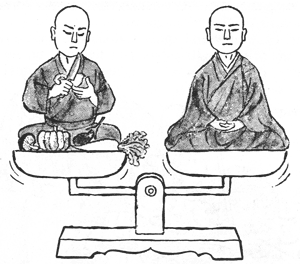 I was pleased this morning as I reviewed the comments to my recent posts about Soto Zen going to hell. Seems like as real a cyber conversation as we’ve had in these parts. Not everyone agrees, of course, and sometimes feelings flare.
One way to frame the disagreement is as a debate between inherent stability and full aliveness. As is often the case these days, Dogen is brought up as a proponent of inherent buddha nature with a slight twist – there is no enlightenment apart from practice and its corollary, practice is itself enlightenment.
Was Dogen, then, the patron saint of passive Zen, as one tongue-in-cheek commentator says?
The above drawing (not mine), represents the active and passive aspects of what Dogen taught (e.g., “Instructions for the Cook” vs. “Zazenshin”) and reflects the actual practice of Soto Zen. Obviously, there are the active (work) and passive (zazen) sides of training. However, for Zen activity to be fully alive, the activity must spring from stillness. For the practice of stillness to be fully alive, interiority must be dynamically hopping along.
I like the drawing above, but from the view I’m expressing here, I’d like the two monks to be much closer. It isn’t about balancing two things but about the two aspects entwined and hopping along together, sometimes dangerously close to falling down, sometimes falling down. And then, pushing off the great earth, getting up and getting going again.
The form of zazen and the precepts, for example, are the containers for full aliveness, the ground rules for full-out boogie, optimally unfolding full aliveness. Without the intimate engagement of both aspects, practice is either boring and repressive or crazy and dangerous. The beauty of Dogen’s expression is how he points to full aliveness in stillness, still within full aliveness.
This is akin to Suzuki Roshi’s pre-politically correct “Hinayana practice with Mahayana spirit – rigid formal practice with informal mind.”
So this conversation isn’t about authority, but about what Dogen wrote 750 years ago that can inform our practice-enlightenment now and especially for the next generation and beyond. The important point, then, is to take up the teaching and experiment with it … enjoying a good rant from time to time too. The old bugger certainly did.
Different people will come up with different results as they use the body-mind to test the teaching. No problem. At the same time, that doesn’t mean that they’re all equal in power to illuminate one little corner of the world, as they say.
If it could be definitively demonstrated that Dogen totally favored one side or the other … well, ho hum. And that does seem to be the drift in contemporary Soto Zen – a rush to institutionalize, regulate, and normalize – making Zen safe and dull and utterly devoid of challenge and freedom.
A Zen teacher friend recently mentioned to me that when he read through the survey results of Soto Zen teachers that I’ve been groaning about, he found that when there was 60-70% agreement on some point, that he too almost always agreed. After our conversation, it occurred to me that I wished I said to him, “Yes, exactly the point. Ask safe questions tending to the norm and that’s the answers that you get.”
After 30-some years of study and practice, it’s my provisional view that Dogen was not advocating silent illumination or passivity. He was a creative. In fact, that Dogen did not advocate quietism makes him relevant today and is what keeps me coming back to his vivid expression of practice where the active and passive elements are in intimate conversation, with neither aspect dominating the other.
Even in his early years, when he was about 30, Dogen junked the “silent illumination” framing of zazen for the much more active “self-enjoyment samadhi.” Later it became “the acupuncture needle of zazen” as well, of course, as “dropping body and mind” and “earnest, vivid sitting.”
In the early period, as I was saying, it seems to me that he hadn’t fully resolved the nasty moral and practice implications of the original enlightenment teaching (“It’s all good” and “whatever” and “just sit”) that were vogue in his day. Here’s a passage from the “Self Enjoyment Samadhi” section of “Bendowa” with my comments inserted:
There is a path
(emphasizing the relative world with a beginning, middle and end)
through which the unsurpassed, complete, perfect enlightenment of all things
(emphasizing the fundamental, giving possession of perfection to each of the myriad things with or without path)
returns
(the 10,000 dharmas advancing to confirm the self)
to the person in zazen, and the person and the enlightenment of all things intimately and imperceptibly assist each other.
(the practitioner boogieing with the buddha).
Therefore, this zazen person
(this person who has become a zazen person, but not necessarily the person who does not practice, intimately entwines with buddha)
without fail
(stay with it practitioners, you are doing it!)
drops off body and mind, cuts away previous tainted views and thoughts, awakens genuine buddha-dharma, universally helps the buddha work in each place, as numerous as atoms, where buddha-tathagatas teach and practice, and widely influences practitioners who are going beyond buddha, thereby vigorously
(the bold highlight that this dance is not passive)
exalting the dharma that goes beyond buddha
(ordinary being and buddha together go beyond buddha).
Dogen’s creative burst of dharmic, koanic fluency during his early 40’s in Shobogenzo fascicle after fascicle goes beyond his early work in intensely wrestling practice-enlightenment, active-still, sacred-profane. More about that in future posts. I use the above because it is often cited to support the all-zazen-is-enlightenment view while the meaning is considerably more nuanced.
Dogen this and Dogen that. How will I live? How will you live?
Myotai Treace once said, “You can’t live a bunny life and write tiger poems.”
What is the self?
Next Post

October 28, 2012 It's Not So Easy: The Apprenticeship Model for Zen Training
Browse Our Archives
Select a Category Uncategorized
Select a Month August 2023 July 2023 June 2023 May 2023 April 2023 March 2023 February 2023 January 2023 December 2022 November 2022 October 2022 September 2022 August 2022 July 2022 June 2022 May 2022 April 2022 March 2022 February 2022 January 2022 December 2021 November 2021 August 2021 June 2021 April 2021 February 2021 January 2021 November 2020 September 2020 August 2020 July 2020 June 2020 May 2020 April 2020 January 2020 December 2019 November 2019 August 2019 June 2019 May 2019 April 2019 February 2019 January 2019 December 2018 November 2018 October 2018 September 2018 August 2018 July 2018 June 2018 May 2018 April 2018 March 2018 February 2018 January 2018 December 2017 November 2017 October 2017 September 2017 August 2017 July 2017 June 2017 December 2016 October 2016 June 2016 April 2016 February 2016 January 2016 December 2015 November 2015 October 2015 August 2015 June 2015 May 2015 April 2015 March 2015 February 2015 January 2015 December 2014 November 2014 October 2014 September 2014 August 2014 July 2014 June 2014 May 2014 April 2014 March 2014 February 2014 January 2014 December 2013 November 2013 October 2013 September 2013 August 2013 July 2013 June 2013 May 2013 April 2013 March 2013 February 2013 January 2013 December 2012 November 2012 October 2012 September 2012 August 2012 July 2012 June 2012 May 2012 April 2012 March 2012 February 2012 January 2012 December 2011 November 2011 October 2011 September 2011 August 2011 July 2011 June 2011 May 2011 April 2011 March 2011 February 2011 January 2011 December 2010 November 2010 October 2010 September 2010 August 2010 July 2010 June 2010 May 2010 April 2010 March 2010 February 2010 January 2010 December 2009 November 2009 October 2009 September 2009 August 2009 July 2009 June 2009 May 2009 April 2009 March 2009 February 2009 January 2009 December 2008 November 2008 October 2008 September 2008 August 2008 July 2008 June 2008 May 2008
Follow Us!
TAKE THE
Religious Wisdom Quiz
Who was the father of John the Baptist?
Select your answer to see how you score.
Joseph Simeon Nathan Zechariah
Related posts from Wild Fox Zen

Plucking a Blade of Grass: The Wondrous Dharma...
Dōgen’s Instruction for Householder Zen Training

Wandering Destitute into a Demon Pit

The Central Importance of Inquiring of a Teacher
TRENDING AT PATHEOS Buddhist

On Taking Refuge in the Dharma
(Here I continue the feature of sharing talks and essays by teachers...

(Continuing my intention to share talks and essays by other members of Empty...
The Subtle Art of Bowing: A Dharma Discourse
(This presentation was first offered by my dear friend Dharma Holder Tom...

Internal Family Systems Can Heal you Mentally &...
How IFS Helped Me Stop Fighting Myself Internal Family Systems (IFS) is...

The Bible No One Spoke About: A Family’s...
A mysterious family Bible, unspoken faith, and a journey from curiosity to...

How Uncertainty Can Transform Your Life in 2025
Embracing Uncertainty: A New Year’s Resolution for the Brave As 2025 approaches,...
view all Buddhist blogs
Ad-Free & Subscriber Log-In Subscription Support
- About Us
- 2026 Calendar
- Videos
- Podcasts
- Library of World Religions
- Faith In Media Tracker
- Advertise With Us
- Write for Us
- Privacy Policy
- Terms of Service
- Do Not Sell My Data
- Contact Us
- Radiant Digital
- Manage Newsletter Subscriptions
- Unsubscribe From Notifications
- Sitemap
Copyright 2008-2026, Patheos. All rights reserved.
Subscription Support Ad-Free & Subscriber Log-In
Follow Patheos