
BuddhistCatholicContemplativeEvangelicalGeneral ChristianHinduJewishLatter-day SaintMuslimNew VisionsProgressive Christian
Beliefs
- Buddhist
- Catholic
- Contemplative
- Evangelical
- General Christian
- Hindu
- Jewish
- Latter-day Saint
- More Voices
- Muslim
- New Visions
- Pagan
- Progressive Christian
Topics
- Religion News
- Food and Religion
- Sports and Religion
- Religious Art
- Religious Music and Entertainment
- Religious Events
- History and Religion
- Style and Religion
- Politics and Religion
- Women in Religion
- Recreation Outdoors and Religion
- Business Finance and Religion
- Careers Workplace and Religion
- Education and Religion
- Family Parenting and Religion
- Health Fitness and Religion
- Home and Religion
- Relationships and Religion
- Technology and Religion
- Travel and Religion
Columnists
- Buddhist Columnists
- Business Finance and Religion Columnists
- Careers Workplace and Religion Columnists
- Catholic Columnists
- Contemplative Columnists
- Education and Religion Columnists
- Evangelists Columnists
- Family Parenting and Religion Columnists
- General Christian Columnists
- Health Fitness and Religion Columnists
- Hindu Columnists
- History and Religion Columnists
- Home and Religion Columnists
- Jewish Columnists
- More Voices Columnists
- Latter Day Columnists
- Muslim Columnists
- New Visions Columnists
- Nonreligious Columnists
- Pagan Columnists
- Politics and Religion Columnists
- Progressive Columnists
- Recreation Outdoors and Religion Columnists
- Relationships and Religion Columnists
- Religion News Columnists
- Religious Art Columnists
- Religious Events Columnists
- Religious Music and Entertainment Columnists
- Sports and Religion Columnists
- Style and Religion Columnists
- Technology and Religion Columnists
- Travel and Religion Columnists
- Women in Religion Columnists
Resource Library
- 2026 Calendar
- Library of World Religions
- The 100 Most Holy Places on Earth
- Patheos Answers
- Podcasts
- Videos
- Faith Leaders Database
- Anglican Episcopalian
- Bahai
- Baptist
- Buddhism
- Christianity
- Confucianism
- Eastern Orthodoxy
- Hinduism
- Holiness and Pentecostal
- ISKCON
- Islam
- Judaism
- Lutheran
- Methodist
- The Church of Jesus Christ of Latter-day Saints
- New Age
- Paganism
- Presbytarian and Reformed
- Protestantism
- Religion Behind the Scenes
- Roman Catholic
- Scientology
- Shia Islam
- Sikhism
- Sufism
- Sunni Islam
- Taoism
- Zen
- See all religions
Research Tools
 Ad-Free & Subscriber Log-In Subscription Support
Ad-Free & Subscriber Log-In Subscription Support
Follow Patheos 

- Trending:
- Forgiveness
- |
- Marriage
- |
- Consciousness
- |
- Death Penalty
- |
- Election
- |
- Halloween
 The White Hindu
-
Hinduism Basics
-
More
- Home
- Hindu
- Meditation Is Waiting
Meditation Is Waiting
Last updated on: December 19, 2022 at 2:15 pm by Ambaa Choate
Meditation Is Waiting 2022-12-19T14:15:47-05:00 Ambaa Choate
Patheos Explore the world's faith through different perspectives on religion and spirituality! Patheos has the views of the prevalent religions and spiritualities of the world.
If you’ve been around here for any length of time you probably know that I have a fraught relationship with meditation. It is often given as the balm to all ailments and troubles by Hindus and non-Hindus alike. Perhaps that is true, but it makes me squirm when I hear people recommend it. Formal meditation is hard. Really hard. It requires a discipline and fortitude. Your mind is very likely going to fight it with everything it can. The “monkey mind” does not appreciate attempts to train it.
I grew up with formal TM-style meditation, a mantra-based system. I’ve never fully understood what it was “supposed” to do or if it was working. That’s not the point, I was told. You’re not meant to be looking for results. Despite my fighting doing it, I must admit that I think it did give me some valuable mental skills. I think meditation practice, however inconsistent, has allowed me to be able to have a pause between stimulus and reaction. I’m pretty good at observing the information coming in and seeing my emotional reaction rising to the surface. I gather that this is an unusual skill and I think it is due to my meditation.
I haven’t meditated with any kind of regularity in years. In fact, I’ve probably gone at least a year in between attempts at meditation!
Every time I visit my parents they invite me to meditate with them. (They don’t like when I brag about them but they’re dedication to meditation over the last 40-some years is inspiring). I always refuse the invitation.
But this last visit my father told me about something he was reading from Sadhguru. Now, I am often cynical about holy people and take things with a grain of salt. There are far too many charlatans out there in this kali yuga. But if something resonates as truth for me then I don’t care who said it.
This description of meditation is so different from anything I’ve heard before and I love it. It makes so much sense.
On Nandi, waiting, & meditation
Sadhguru Jaggi Vasudeva and Shekhar Kapur discuss the significance and symbolism of Nandi, Shiva’s vehicle.
Shekhar Kapur: I understand Nandi is Shiva’s vehicle. Is he waiting for Shiva to come out and say… what? Tell me more about the Nandi.
Sadhguru: He is not waiting for him to come out and say something. He is in waiting. Nandi is a symbolism of eternal waiting, because waiting is considered the greatest virtue in Indian culture. One who knows how to simply sit and wait is naturally meditative. He is not expecting Shiva to come out tomorrow. He will wait forever. That quality is the essence of receptivity.
Nandi is Shiva’s closest accomplice because he is the essence of receptivity. Before you go into a temple, you must have the quality of Nandi – to simply sit. You are not trying to go to heaven, you are not trying to get this or that – you go inside and simply sit. So, just by sitting here, he is telling you, “When you go in, don’t do your fanciful things. Don’t ask for this or that. Just go and sit like me.”
Shekhar Kapur: And waiting and anticipation are two different things, I assume, right?
Sadhguru: He is not waiting in anticipation or expectation. He is just waiting. That’s meditation – just sitting. That’s his message for you. Simply go inside and sit. Alert, not sleepy.
Shekhar Kapur: So, the bull is sitting in what we would call meditation?
Sadhguru: People have always misunderstood meditation as some kind of activity. No, it is a quality. That is a fundamental difference. Prayer means you are trying to talk to God. You are trying to tell him your vows, your expectations, or whatever else. Meditation means you are willing to just listen to existence, to the ultimate nature of creation. You have nothing to say, you simply listen. That is the quality of Nandi – he just sits, alert. This is very important: he is alert. He is not sleepy or sitting in a passive way. He is sitting very active, full of alertness and life, but no expectation or anticipation. That is meditation. Just waiting, not for anything in particular.
If you just wait without doing your own thing, the existence will do its thing. Meditation essentially means the individual person is not doing his own thing. He is just there. Once you are simply there, you become aware of the larger dimension of the existence, which is always in action. You become aware that you are a part of it. Even now, you are a part of it. But becoming aware that “I am a part of it” is meditativeness. Nandi is the symbolism of that. He reminds everyone, “You must sit like me.”
Now that is a kind of meditation that I can relate to. Peaceful waiting with stillness in the quiet moments in life. That is something that I am doing regularly. This description resonated with me so incredibly hard. It was like decades of frustration just fell away and all the pieces came together as they were supposed to. Just waiting. It is simple, it is straightforward, and it cuts to the heart of what meditation should feel like.
I love when someone is able to articulate something in a way that makes a lightbulb go off in your brain. Many Hindu wisemen are great at this! So many wonderful metaphors, descriptions, and analogies. And I appreciate it so much!
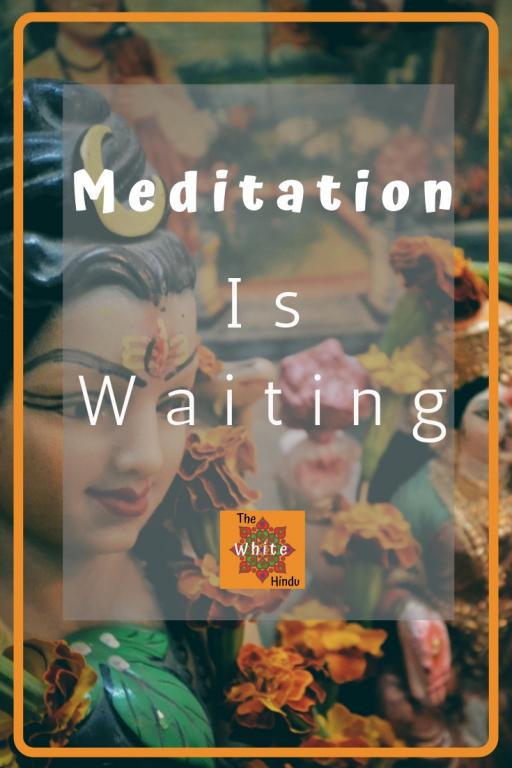
Thank you for reading! I would love to discuss more Hindu philosophy with you in my Facebook Group: Hindus In Pursuit Of Truth
New to this blog? Check out these posts:
Why Am I Called “The White Hindu”?
New to Hinduism? Learn more here:
Hinduism 101: What Do Hindus Believe?
Your First Visit To A Hindu Temple
(views expressed here are mine alone and do not reflect opinions of my supporters. Links within the text may be affiliate links, meaning that if you purchase something I get a small commission for recommending it. I only recommend things I truly believe in)
Click below to get my ebook for beginner Hindus…

Learn more about Hindusim in Patheos’ library.
Read from top Hindu writers on Patheos.
How Am I Being a Hindu This Week?
Previous Post

May 7, 2019
The Truth About Bhakti Yoga
Next Post
May 16, 2019 Cult or Religion -- What's the Difference?
Browse Our Archives
Select a Category Book Club Hindu Holiday How Am I Being a Hindu This Week? Inside the Life Meet a God Meet a Guru Movie Club Philosophy Corner Resources Scripture Uncategorized Wild Card
Select a Month February 2020 September 2019 May 2019 January 2019 December 2018 November 2018 October 2018 September 2018 August 2018 June 2018 May 2018 April 2018 March 2018 February 2018 January 2018 December 2017 November 2017 October 2017 September 2017 August 2017 July 2017 June 2017 May 2017 April 2017 March 2017 February 2017 January 2017 December 2016 November 2016 October 2016 September 2016 August 2016 July 2016 June 2016 May 2016 April 2016 March 2016 February 2016 January 2016 December 2015 November 2015 October 2015 September 2015 August 2015 July 2015 June 2015 May 2015 April 2015 March 2015 February 2015 January 2015 December 2014 November 2014 October 2014 September 2014 August 2014 July 2014 June 2014 May 2014 April 2014 March 2014 February 2014 January 2014 December 2013 November 2013 October 2013 September 2013 August 2013 July 2013 June 2013 May 2013 April 2013 March 2013 February 2013 January 2013 December 2012
Follow Us!
TAKE THE
Religious Wisdom Quiz
In the Parable of the Mustard Seed, what does the seed represent?
Select your answer to see how you score.
Sin The kingdom of God The Pharisees Wealth
Related posts from The White Hindu

Show Your Hindu Pride in New Gear!

By the Book: Meditation for Fidgity Skeptics

Mental Health in the Hindu Community

TRENDING AT PATHEOS Hindu

Indian Hindu pilot’s valor in line of duty...
There is a hoary maritime tradition that the captain of the...

Movie on Neem Karoli Baba’s life is a...
Neem Karoli Baba’s life (1900-1973) is associated with miracles he made in...

20 Questions to Ask Before an Interfaith Marriage,...
Four questions every interfaith couple should discuss before marriage: Conversion. Will either...

Avadhānam: The Art of Concentration and Intellectual Mastery
What is Avadhānam? In the summer of 2015, during a three-day Sanskrit...

Jesus in the Dharma: Where Christ Fits in...
Where Does Jesus Fit in Hinduism? That’s a question I get often...

Hormuz: A Shared Hindu and Zoroastrian Heritage
Every evening, somewhere in the world, a newsreader utters the words: "The...
view all Hindu blogs
Ad-Free & Subscriber Log-In Subscription Support
- About Us
- 2026 Calendar
- Videos
- Podcasts
- Library of World Religions
- Faith In Media Tracker
- Advertise With Us
- Write for Us
- Privacy Policy
- Terms of Service
- Do Not Sell My Data
- Contact Us
- Radiant Digital
- Manage Newsletter Subscriptions
- Unsubscribe From Notifications
- Sitemap
Copyright 2008-2026, Patheos. All rights reserved.
Subscription Support Ad-Free & Subscriber Log-In
Follow Patheos