
BuddhistCatholicContemplativeEvangelicalGeneral ChristianHinduJewishLatter-day SaintMuslimNew VisionsProgressive Christian
Beliefs
- Buddhist
- Catholic
- Contemplative
- Evangelical
- General Christian
- Hindu
- Jewish
- Latter-day Saint
- More Voices
- Muslim
- New Visions
- Pagan
- Progressive Christian
Topics
- Religion News
- Food and Religion
- Sports and Religion
- Religious Art
- Religious Music and Entertainment
- Religious Events
- History and Religion
- Style and Religion
- Politics and Religion
- Women in Religion
- Recreation Outdoors and Religion
- Business Finance and Religion
- Careers Workplace and Religion
- Education and Religion
- Family Parenting and Religion
- Health Fitness and Religion
- Home and Religion
- Relationships and Religion
- Technology and Religion
- Travel and Religion
Columnists
- Buddhist Columnists
- Business Finance and Religion Columnists
- Careers Workplace and Religion Columnists
- Catholic Columnists
- Contemplative Columnists
- Education and Religion Columnists
- Evangelists Columnists
- Family Parenting and Religion Columnists
- General Christian Columnists
- Health Fitness and Religion Columnists
- Hindu Columnists
- History and Religion Columnists
- Home and Religion Columnists
- Jewish Columnists
- More Voices Columnists
- Latter Day Columnists
- Muslim Columnists
- New Visions Columnists
- Nonreligious Columnists
- Pagan Columnists
- Politics and Religion Columnists
- Progressive Columnists
- Recreation Outdoors and Religion Columnists
- Relationships and Religion Columnists
- Religion News Columnists
- Religious Art Columnists
- Religious Events Columnists
- Religious Music and Entertainment Columnists
- Sports and Religion Columnists
- Style and Religion Columnists
- Technology and Religion Columnists
- Travel and Religion Columnists
- Women in Religion Columnists
Resource Library
- 2026 Calendar
- Library of World Religions
- The 100 Most Holy Places on Earth
- Patheos Answers
- Podcasts
- Videos
- Faith Leaders Database
- Anglican Episcopalian
- Bahai
- Baptist
- Buddhism
- Christianity
- Confucianism
- Eastern Orthodoxy
- Hinduism
- Holiness and Pentecostal
- ISKCON
- Islam
- Judaism
- Lutheran
- Methodist
- The Church of Jesus Christ of Latter-day Saints
- New Age
- Paganism
- Presbytarian and Reformed
- Protestantism
- Religion Behind the Scenes
- Roman Catholic
- Scientology
- Shia Islam
- Sikhism
- Sufism
- Sunni Islam
- Taoism
- Zen
- See all religions
Research Tools
 Ad-Free & Subscriber Log-In Subscription Support
Ad-Free & Subscriber Log-In Subscription Support
Follow Patheos 

- Trending:
- Forgiveness
- |
- Marriage
- |
- Consciousness
- |
- Death Penalty
- |
- Election
- |
- Halloween
 The White Hindu
-
Hinduism Basics
-
More
- Home
- Hindu
- What Is Manusmriti (Laws of Manu)?
What Is Manusmriti (Laws of Manu)?
Last updated on: February 2, 2017 at 9:19 am by Ambaa Choate
What Is Manusmriti (Laws of Manu)? 2017-02-02T09:19:40-05:00 Ambaa Choate
Patheos Explore the world's faith through different perspectives on religion and spirituality! Patheos has the views of the prevalent religions and spiritualities of the world.
When I was growing up I knew Manu as a book of weird sayings and rules supposedly written by the first man in existence. It was something I was aware of and we read it sometimes but I never got the impression it was something to put much stock in. I didn’t realize until I began blogging how much Manusmriti is used to try to discredit Hinduism.
Those who want to paint Hinduism as backward or strange create memes with quotes exclusively from Manu. Which is frustrating because many, I would even say most, Hindus aren’t guided by Manu. He sets out a lot of cultural guidelines and I know there are Hindus who believe we should follow them. And some people follow it “just in case.” Sure, maybe there’s a good reason why you should never share when you see a rainbow or why a woman must always part her hair in the center.
But as we’ve established, I don’t do things because I’m told to. I trust the divinity within myself highly. I believe in understanding what I’m doing and why. I think it’s dangerous not to question and not to find out the reason behind traditions. I see no reason to trust or believe in Manu. As I look into it more for this article I see that he is respected by many and seen as a sage by some. I am surprised to see him referred to in the same sentence with the sage Yajnavalkya, for whom I do have a lot of respect.
You can still believe Manu was the first man without thinking he was all that bright. Is this sacrilegious? No. He’s not an enlightened being and his writings are not scripture. They are more like the Kama Sutra, a guide to life and society. A poor one at that, if you ask me.
When it comes to Manusmriti I would pick and choose what makes sense to follow. There may be some good ideas in there but there’s a lot of crazy too, in my opinion. It’s like with posting quotes on my Facebook page: I post quotes that I agree with regardless of who said them. So if I find something nice in Manusmriti then okay I’ll use that quote, but I still don’t trust most of what he says.
A big problem with Manu is his attitude about women. He definitely talks about us like we aren’t human and we’re just here to distract and harm men. There’s also a lot of stuff about caste rules. Another big problem is that many of the verses are contradictory within the text (this author even says that it contradicts the Vedas). This work more than any other can be used by Hindus to justify whatever one wants and used by non-Hindus to claim all kinds of wild things about what Hindus believe.
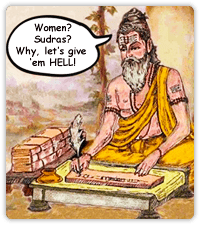
https://miraprabhu.wordpress.com/tag/burning-of-manusmriti/
I’m not the only one who puts no faith in the Law of Manu. Here is a quote from native Hindu Neelotpal Mukhopadhyay:
Now, there are indeed some slokas in versions of Manusmriti that contain
verses that speak ill of shudras or women. How can a rigid follower of Manusmriti reconcile the two types of verses that are polar opposites? Was such a book laden with major contradictions respected all along history? In that case which parts were followed or rejected?It is claimed that a large number of the anti-shudra/anti-women shlokas, are fake that were inserted later (at what times?, by whom? for what purpose? no one knows)
To me, Manusmriti is merely a compilation of one man’s view about society and his recommendations. That’s all. I haven’t seen any proof that it was used as formal “law/constitution” in Indian kingdoms, and so to assume that whole of Indian society was run based on this one book (like Abrahamic religions!) seems to be utter hogwash.
The claim that the “bad” parts were added by non-Hindus is a little far fetched. I mean, I’m all for blaming colonialism on a lot of the problems in Indian society today, but it feels too convenient to say “All the good parts were us and all the bad parts are from the British.” It’s the “no true Scotsman” logical fallacy, trying to distance one’s self and one’s beloved religion from people who don’t show it in its best light.
So if you’re looking for Hindu philosophy to read, don’t bother with Manu. Go for the Vedas, the Upanishads, and the Gita.
Previous Post

January 31, 2017
Do Moments of Happiness Matter?
Next Post

February 6, 2017 In-Between Not Alive and Alive (the abortion debate)
Browse Our Archives
Select a Category Book Club Hindu Holiday How Am I Being a Hindu This Week? Inside the Life Meet a God Meet a Guru Movie Club Philosophy Corner Resources Scripture Uncategorized Wild Card
Select a Month February 2020 September 2019 May 2019 January 2019 December 2018 November 2018 October 2018 September 2018 August 2018 June 2018 May 2018 April 2018 March 2018 February 2018 January 2018 December 2017 November 2017 October 2017 September 2017 August 2017 July 2017 June 2017 May 2017 April 2017 March 2017 February 2017 January 2017 December 2016 November 2016 October 2016 September 2016 August 2016 July 2016 June 2016 May 2016 April 2016 March 2016 February 2016 January 2016 December 2015 November 2015 October 2015 September 2015 August 2015 July 2015 June 2015 May 2015 April 2015 March 2015 February 2015 January 2015 December 2014 November 2014 October 2014 September 2014 August 2014 July 2014 June 2014 May 2014 April 2014 March 2014 February 2014 January 2014 December 2013 November 2013 October 2013 September 2013 August 2013 July 2013 June 2013 May 2013 April 2013 March 2013 February 2013 January 2013 December 2012
Follow Us!
TAKE THE
Religious Wisdom Quiz
Which Gospel records the birth of John the Baptist?
Select your answer to see how you score.
Luke Matthew Mark John
Related posts from The White Hindu


Thoughts About Kashmir And Beyond— A Hindu Perspective

Show Your Hindu Pride in New Gear!

TRENDING AT PATHEOS Hindu

Indian Hindu pilot’s valor in line of duty...
There is a hoary maritime tradition that the captain of the...

Movie on Neem Karoli Baba’s life is a...
Neem Karoli Baba’s life (1900-1973) is associated with miracles he made in...

20 Questions to Ask Before an Interfaith Marriage,...
Four questions every interfaith couple should discuss before marriage: Conversion. Will either...

Avadhānam: The Art of Concentration and Intellectual Mastery
What is Avadhānam? In the summer of 2015, during a three-day Sanskrit...

Jesus in the Dharma: Where Christ Fits in...
Where Does Jesus Fit in Hinduism? That’s a question I get often...

Hormuz: A Shared Hindu and Zoroastrian Heritage
Every evening, somewhere in the world, a newsreader utters the words: "The...
view all Hindu blogs
Ad-Free & Subscriber Log-In Subscription Support
- About Us
- 2026 Calendar
- Videos
- Podcasts
- Library of World Religions
- Faith In Media Tracker
- Advertise With Us
- Write for Us
- Privacy Policy
- Terms of Service
- Do Not Sell My Data
- Contact Us
- Radiant Digital
- Manage Newsletter Subscriptions
- Unsubscribe From Notifications
- Sitemap
Copyright 2008-2026, Patheos. All rights reserved.
Subscription Support Ad-Free & Subscriber Log-In
Follow Patheos