
BuddhistCatholicContemplativeEvangelicalGeneral ChristianHinduJewishLatter-day SaintMuslimNew VisionsProgressive Christian
Beliefs
- Buddhist
- Catholic
- Contemplative
- Evangelical
- General Christian
- Hindu
- Jewish
- Latter-day Saint
- More Voices
- Muslim
- New Visions
- Pagan
- Progressive Christian
Topics
- Religion News
- Food and Religion
- Sports and Religion
- Religious Art
- Religious Music and Entertainment
- Religious Events
- History and Religion
- Style and Religion
- Politics and Religion
- Women in Religion
- Recreation Outdoors and Religion
- Business Finance and Religion
- Careers Workplace and Religion
- Education and Religion
- Family Parenting and Religion
- Health Fitness and Religion
- Home and Religion
- Relationships and Religion
- Technology and Religion
- Travel and Religion
Columnists
- Buddhist Columnists
- Business Finance and Religion Columnists
- Careers Workplace and Religion Columnists
- Catholic Columnists
- Contemplative Columnists
- Education and Religion Columnists
- Evangelists Columnists
- Family Parenting and Religion Columnists
- General Christian Columnists
- Health Fitness and Religion Columnists
- Hindu Columnists
- History and Religion Columnists
- Home and Religion Columnists
- Jewish Columnists
- More Voices Columnists
- Latter Day Columnists
- Muslim Columnists
- New Visions Columnists
- Nonreligious Columnists
- Pagan Columnists
- Politics and Religion Columnists
- Progressive Columnists
- Recreation Outdoors and Religion Columnists
- Relationships and Religion Columnists
- Religion News Columnists
- Religious Art Columnists
- Religious Events Columnists
- Religious Music and Entertainment Columnists
- Sports and Religion Columnists
- Style and Religion Columnists
- Technology and Religion Columnists
- Travel and Religion Columnists
- Women in Religion Columnists
Resource Library
- 2026 Calendar
- Library of World Religions
- The 100 Most Holy Places on Earth
- Patheos Answers
- Podcasts
- Videos
- Faith Leaders Database
- Anglican Episcopalian
- Bahai
- Baptist
- Buddhism
- Christianity
- Confucianism
- Eastern Orthodoxy
- Hinduism
- Holiness and Pentecostal
- ISKCON
- Islam
- Judaism
- Lutheran
- Methodist
- The Church of Jesus Christ of Latter-day Saints
- New Age
- Paganism
- Presbytarian and Reformed
- Protestantism
- Religion Behind the Scenes
- Roman Catholic
- Scientology
- Shia Islam
- Sikhism
- Sufism
- Sunni Islam
- Taoism
- Zen
- See all religions
Research Tools
 Ad-Free & Subscriber Log-In Subscription Support
Follow Patheos 

- Trending:
- Advent
- |
- Forgiveness
- |
- Thanksgiving
- |
- Election
- |
- Seasonal Holidays
- |
- Marriage
 The White Hindu
-
Hinduism Basics
-
More
- Home
- Hindu
- Ishta Devata: A Personal God
Ishta Devata: A Personal God
Last updated on: February 17, 2017 at 6:30 am by Ambaa Choate
Ishta Devata: A Personal God 2017-02-12T22:31:57-05:00 Ambaa Choate
Patheos Explore the world's faith through different perspectives on religion and spirituality! Patheos has the views of the prevalent religions and spiritualities of the world.
The last time I spoke about the concept of an Ishta Devata was actually on my former blog and in 2010! I didn’t realize it had been so long ago. Here is what I posted then and I will update with any new thoughts I have seven years later in italics…
Dhurga recently mentioned Ishta-Devata in the comments. Simply put, this would be one’s personal God.
There are many, many, many Gods in Hinduism. Each has different qualities and different personalities. The idea is that out of all those, there will be one that will speak to you and seem well suited to your spiritual growth. Often that is also based somewhat on family or regional traditions and maybe your birth chart.
For my branch, it is traditional to pick from the “five forms” that Shankara picked as the principle forms, uniting all branches. One of these forms is selected for main worship, but the other four are still worshiped also and all are seen as manifestations of the same Ultimate Reality, Brahman. The five are Ganesha, Vishnu, Shiva, Devī, and Sūrya. (I did not get this information from my guru. I think it came from the Himalayan Academy)
A murti (statue, idol) is used for worship. It is believed that the mind needs a physical form to focus on. Sometimes in Smartism (advaita), the five forms are represented by five stones. For more dualistic branches, the worship of the murti is more like the Catholic communion. The God has actually come and inhabited the statue. (Actually, I think that’s always true of a murti. It is God by nature of its materials, as all things are God, but it also has the spirit of God more fully enlivening it. Not sure how to explain that right)
Sometimes if a great sage is thought to be an avatar of God, he or she might also be worshiped as one’s Ishta-Devata. I mentioned before that some believe Jesus to be an avatar of Vishnu and I came across an interesting article articulating some about why and how Jesus is chosen as an Ishta-Devata at times. I know we had one person comment to say that this is impossible, but I am not in the habit of dismissing the beliefs of others and I am unwilling to say that it wouldn’t be possible for Jesus to have been an avatar. (As comments on the original post mention, though, I am nervous and concerned about…encouraging…this practice as it does seem to open the door to the Christian missionaries who want to destroy Hinduism)
I’ve heard about this phenomenon of Indians adding Jesus to their altars from both perspectives. I knew of a girl in college who loved India and was also an evangelical Christian. She frequently went to India to work on converting people (which completely horrified me, but I didn’t know her personally). I was told that a problem she often had was that Indians seemed to have a hard time understanding that they couldn’t just add Jesus in. Jesus had to replace ALL Gods and only he could be worshiped. The article above sees this as possibly just a survival technique, to keep Hinduism alive while compromising with Christianity. I’m much closer to the perspective of seeing Christianity trying to destroy Hinduism.
Some believe that it doesn’t matter which God you choose, all lead to moksha. However, some branches believe that only particular Gods will. For Vaishnavites, only a form of Vishnu will work (Rama, Krishna…).
To find one’s Ishta-Devata some believe that you must go by astrology. Others just find that one in particular speaks to him. It can be something chosen oneself or chosen for you by a guru. This form of God will stay with you all your life.
So, what is my Ishta-Devata?
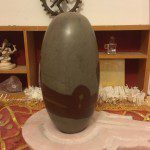
Shiva, in the form of the nata raja. (Actually, Shiva period. The Nataraja form is not usually worshipped, from what I understand. But as you read on you’ll see why it is on my altar. I now also have a Shivaling to use for worship as well).
It wasn’t always clear to me. When I was a kid I was fascinated by Krishna. I loved how different he was at different points in his life. I liked the teenage Krishna best, with the gopis worshiping him.
I was initiated into mantra-based meditation when I was 13. Ideally, one’s mantra would be connected to one’s Ishta-Devata, it would be a way of calling on that God. The organization I grew up in does not believe in Ishta-Devatas. A mantra was chosen for the entire organization to use and given to us through a Shankaracharya in India. It is a sound connected to Rama.
Despite these moments with other forms, the little bronze nata raja statue that I bought at the new age shop in my town clicked with me in a way that the others hadn’t. I spent long periods of time just staring into his tiny face, and entranced by the grace of his arms.
I started dance five years later.
Nata raja still sits in the central place on my altar. A couple years ago my mother gave me a Krishna statue, remembering how much I loved Krishna as a child. That image just never had the same effect on me.
As soon as I look at my nata raja, I feel calmed and centered and I feel as though there is fire in his eyes.
No one gave me that form to worship, I chose it (or it chose me).
I’ve had more experiences connected to Shiva since this post. I started using a Shiva mantra for meditation and found the whole experience transformed and became much lighter and easier. I also started seeing a guru and it coincidentally (or not so coincidentally!) turned out that Shiva is the main God that he worships.
Previous Post

February 16, 2017
Islamic Terrorism: How I Plan To Counter It
Next Post
February 20, 2017 Mahashivratri 2017 (Hindu Holiday)
Browse Our Archives
Select a Category Book Club Hindu Holiday How Am I Being a Hindu This Week? Inside the Life Meet a God Meet a Guru Movie Club Philosophy Corner Resources Scripture Uncategorized Wild Card
Select a Month February 2020 September 2019 May 2019 January 2019 December 2018 November 2018 October 2018 September 2018 August 2018 June 2018 May 2018 April 2018 March 2018 February 2018 January 2018 December 2017 November 2017 October 2017 September 2017 August 2017 July 2017 June 2017 May 2017 April 2017 March 2017 February 2017 January 2017 December 2016 November 2016 October 2016 September 2016 August 2016 July 2016 June 2016 May 2016 April 2016 March 2016 February 2016 January 2016 December 2015 November 2015 October 2015 September 2015 August 2015 July 2015 June 2015 May 2015 April 2015 March 2015 February 2015 January 2015 December 2014 November 2014 October 2014 September 2014 August 2014 July 2014 June 2014 May 2014 April 2014 March 2014 February 2014 January 2014 December 2013 November 2013 October 2013 September 2013 August 2013 July 2013 June 2013 May 2013 April 2013 March 2013 February 2013 January 2013 December 2012
Follow Us!
TAKE THE
Religious Wisdom Quiz
According to 1 Peter, what does love do?
Select your answer to see how you score.
Casts out fear Covers over a multitude of sins Bears all things Never fails
Related posts from The White Hindu

Show Your Hindu Pride in New Gear!
TRENDING AT PATHEOS Hindu
‘Ramayana’ Gives India’s Epic a Hollywood-Scale Makeover
For centuries, the Ramayana has been far more than an ancient...

Does One of Us Have to Change Religions...
Twenty Years of Listening to Interfaith Couples A couple can spend years...

10% or 38%? Counting Hindu - American Interfaith...
Are 10% or 38% of American Hindus Marrying Outside Faith? What two...

Indian Hindu pilot’s valor in line of duty...
There is a hoary maritime tradition that the captain of the...

Movie on Neem Karoli Baba’s life is a...
Neem Karoli Baba’s life (1900-1973) is associated with miracles he made in...

20 Questions to Ask Before an Interfaith Marriage,...
Four questions every interfaith couple should discuss before marriage: Conversion. Will either...
view all Hindu blogs
Ad-Free & Subscriber Log-In Subscription Support
- About Us
- 2026 Calendar
- Videos
- Podcasts
- Library of World Religions
- Faith In Media Tracker
- Advertise With Us
- Write for Us
- Privacy Policy
- Terms of Service
- Do Not Sell My Data
- Contact Us
- Radiant Digital
- Manage Newsletter Subscriptions
- Unsubscribe From Notifications
- Sitemap
Copyright 2008-2026, Patheos, part of the Radiant Digital network of media brands. All rights reserved.
Subscription Support Ad-Free & Subscriber Log-In
Follow Patheos