
BuddhistCatholicContemplativeEvangelicalGeneral ChristianHinduJewishLatter-day SaintMuslimNew VisionsProgressive Christian
Beliefs
- Buddhist
- Catholic
- Contemplative
- Evangelical
- General Christian
- Hindu
- Jewish
- Latter-day Saint
- More Voices
- Muslim
- New Visions
- Pagan
- Progressive Christian
Topics
- Religion News
- Food and Religion
- Sports and Religion
- Religious Art
- Religious Music and Entertainment
- Religious Events
- History and Religion
- Style and Religion
- Politics and Religion
- Women in Religion
- Recreation Outdoors and Religion
- Business Finance and Religion
- Careers Workplace and Religion
- Education and Religion
- Family Parenting and Religion
- Health Fitness and Religion
- Home and Religion
- Relationships and Religion
- Technology and Religion
- Travel and Religion
Columnists
- Buddhist Columnists
- Business Finance and Religion Columnists
- Careers Workplace and Religion Columnists
- Catholic Columnists
- Contemplative Columnists
- Education and Religion Columnists
- Evangelists Columnists
- Family Parenting and Religion Columnists
- General Christian Columnists
- Health Fitness and Religion Columnists
- Hindu Columnists
- History and Religion Columnists
- Home and Religion Columnists
- Jewish Columnists
- More Voices Columnists
- Latter Day Columnists
- Muslim Columnists
- New Visions Columnists
- Nonreligious Columnists
- Pagan Columnists
- Politics and Religion Columnists
- Progressive Columnists
- Recreation Outdoors and Religion Columnists
- Relationships and Religion Columnists
- Religion News Columnists
- Religious Art Columnists
- Religious Events Columnists
- Religious Music and Entertainment Columnists
- Sports and Religion Columnists
- Style and Religion Columnists
- Technology and Religion Columnists
- Travel and Religion Columnists
- Women in Religion Columnists
Resource Library
- 2026 Calendar
- Library of World Religions
- The 100 Most Holy Places on Earth
- Patheos Answers
- Podcasts
- Videos
- Faith Leaders Database
- Anglican Episcopalian
- Bahai
- Baptist
- Buddhism
- Christianity
- Confucianism
- Eastern Orthodoxy
- Hinduism
- Holiness and Pentecostal
- ISKCON
- Islam
- Judaism
- Lutheran
- Methodist
- The Church of Jesus Christ of Latter-day Saints
- New Age
- Paganism
- Presbytarian and Reformed
- Protestantism
- Religion Behind the Scenes
- Roman Catholic
- Scientology
- Shia Islam
- Sikhism
- Sufism
- Sunni Islam
- Taoism
- Zen
- See all religions
Research Tools
 Ad-Free & Subscriber Log-In Subscription Support
Ad-Free & Subscriber Log-In Subscription Support
Follow Patheos 

- Trending:
- Forgiveness
- |
- Marriage
- |
- Consciousness
- |
- Death Penalty
- |
- Election
- |
- Halloween
 The White Hindu
-
Hinduism Basics
-
More
- Home
- Hindu
- Philosophical Differences
Philosophical Differences
Last updated on: October 11, 2015 at 11:01 pm by Ambaa Choate
Philosophical Differences 2015-10-11T23:01:37-04:00 Ambaa Choate
Patheos Explore the world's faith through different perspectives on religion and spirituality! Patheos has the views of the prevalent religions and spiritualities of the world.
Last week Brad and I had the pleasure of visiting an ISKCON center and enjoying some bhajans, chanting, and Gita discussion. It was a wonderful atmosphere and very uplifting to be among fellow spiritual seekers.
It’s not often, I find, that as a Hindu I’m presented with a fundamental philosophical difference between branches. Usually you can just go to any Hindu function, event, or location and know what to expect. There’s a great deal of similarity of practice among various Hindu branches.
But last week we really came face to face with one of the things that makes Vaishnavism different from Advaita.
The Gita discussion led to talking about the ultimate reality beyond this world. For me as an Advaitan that means complete unity with God. Merging with God and becoming one. After all, the word Advaita means non-duality.
For our new friends moksha means joining God but not becoming the same as God.
I will do my best to explain both points of view, though forgive and correct me for any mistakes as only one of these is my belief and it can be challenging to look at it from someone else’s perspective.
They spoke of us as individuals joining God in the reality beyond Maya and being loved by him. But they spoke of us being God’s fingers, or hands, or feet. Not the brain. Only Krishna is the brain. We are part of him but not equal to him.
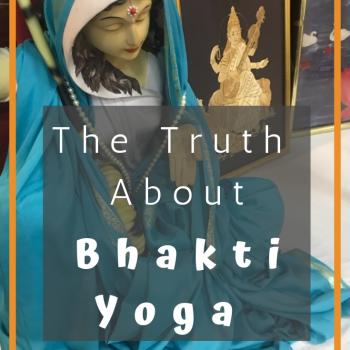
It is true that once one becomes unified with God there would be no need for bhakti. You wouldn’t worship yourself. When there are not two there is no worshiper and worshipee. So what is the point of bhakti?
I’ve always seen bhakti as being a wonderful step along the way towards enlightenment. Really all yogas to me are stepping stones until we reach the full understanding of our true Selves.
The way it has been explained to me is that we start out seeing God as a distant king. And then we begin to relate to him like a stern father. And then eventually as a loving father. Eventually we relate to him as a dear friend. And then at the end we realize there is no difference between us, our limits and boundaries drop away and we go back to being part of the brain of God.
One of the questions that comes up is how much of our individuality we maintain in that transition. As I’ve talked about recently, I’m not really sure what the core and unchanging part of me is. But whatever is constant and unchanging, that is the part that is God in disguise.
I do believe we are parts in a whole but that we are equal to all the other parts. There are no parts larger or smaller than any other part. It is all God. It is all all of God.
They described it as being as though the world we live in now is the reflection on a clear lake. It has every detail of the real world but it is not as dynamic or full. The real tree is better than the tree reflected in the water. In that way the world beyond this one would look and act almost exactly the same as this one but everything would feel a little more real, I guess?
The example I’ve always liked is that of an ocean. God is the vast ocean and we are tiny droplets. We contain all that is God within us but we are smaller. Yet, and here is where our new friends stopped the metaphor, when those drops are brought back to the ocean they disappear into it and become part of the whole again with no boundaries to distinguish them from any other part of the ocean. It still has all the qualities it had before just with no limitations.
I respect bhakti very much and strive to be better at it myself. However I still think it is a vehicle bringing us along a path that will eventually lead to no longer needing it.
hindu philosophical differences
Previous Post

October 7, 2015
Get Ready for Navratri!
Next Post

October 13, 2015 My Navratri Golu 2015
Browse Our Archives
Select a Category Book Club Hindu Holiday How Am I Being a Hindu This Week? Inside the Life Meet a God Meet a Guru Movie Club Philosophy Corner Resources Scripture Uncategorized Wild Card
Select a Month February 2020 September 2019 May 2019 January 2019 December 2018 November 2018 October 2018 September 2018 August 2018 June 2018 May 2018 April 2018 March 2018 February 2018 January 2018 December 2017 November 2017 October 2017 September 2017 August 2017 July 2017 June 2017 May 2017 April 2017 March 2017 February 2017 January 2017 December 2016 November 2016 October 2016 September 2016 August 2016 July 2016 June 2016 May 2016 April 2016 March 2016 February 2016 January 2016 December 2015 November 2015 October 2015 September 2015 August 2015 July 2015 June 2015 May 2015 April 2015 March 2015 February 2015 January 2015 December 2014 November 2014 October 2014 September 2014 August 2014 July 2014 June 2014 May 2014 April 2014 March 2014 February 2014 January 2014 December 2013 November 2013 October 2013 September 2013 August 2013 July 2013 June 2013 May 2013 April 2013 March 2013 February 2013 January 2013 December 2012
Follow Us!
TAKE THE
Religious Wisdom Quiz
I brought musicians and singers to serve before the ark, establishing worship in Israel. Who am I?
Select your answer to see how you score.
David Heman Asaph Solomon
Related posts from The White Hindu


Show Your Hindu Pride in New Gear!

Mental Health in the Hindu Community
TRENDING AT PATHEOS Hindu

Indian Hindu pilot’s valor in line of duty...
There is a hoary maritime tradition that the captain of the...

Movie on Neem Karoli Baba’s life is a...
Neem Karoli Baba’s life (1900-1973) is associated with miracles he made in...

20 Questions to Ask Before an Interfaith Marriage,...
Four questions every interfaith couple should discuss before marriage: Conversion. Will either...

Avadhānam: The Art of Concentration and Intellectual Mastery
What is Avadhānam? In the summer of 2015, during a three-day Sanskrit...

Jesus in the Dharma: Where Christ Fits in...
Where Does Jesus Fit in Hinduism? That’s a question I get often...

Hormuz: A Shared Hindu and Zoroastrian Heritage
Every evening, somewhere in the world, a newsreader utters the words: "The...
view all Hindu blogs
Ad-Free & Subscriber Log-In Subscription Support
- About Us
- 2026 Calendar
- Videos
- Podcasts
- Library of World Religions
- Faith In Media Tracker
- Advertise With Us
- Write for Us
- Privacy Policy
- Terms of Service
- Do Not Sell My Data
- Contact Us
- Radiant Digital
- Manage Newsletter Subscriptions
- Unsubscribe From Notifications
- Sitemap
Copyright 2008-2026, Patheos. All rights reserved.
Subscription Support Ad-Free & Subscriber Log-In
Follow Patheos