
BuddhistCatholicContemplativeEvangelicalGeneral ChristianHinduJewishLatter-day SaintMuslimNew VisionsProgressive Christian
Beliefs
- Buddhist
- Catholic
- Contemplative
- Evangelical
- General Christian
- Hindu
- Jewish
- Latter-day Saint
- More Voices
- Muslim
- New Visions
- Pagan
- Progressive Christian
Topics
- Religion News
- Food and Religion
- Sports and Religion
- Religious Art
- Religious Music and Entertainment
- Religious Events
- History and Religion
- Style and Religion
- Politics and Religion
- Women in Religion
- Recreation Outdoors and Religion
- Business Finance and Religion
- Careers Workplace and Religion
- Education and Religion
- Family Parenting and Religion
- Health Fitness and Religion
- Home and Religion
- Relationships and Religion
- Technology and Religion
- Travel and Religion
Columnists
- Buddhist Columnists
- Business Finance and Religion Columnists
- Careers Workplace and Religion Columnists
- Catholic Columnists
- Contemplative Columnists
- Education and Religion Columnists
- Evangelists Columnists
- Family Parenting and Religion Columnists
- General Christian Columnists
- Health Fitness and Religion Columnists
- Hindu Columnists
- History and Religion Columnists
- Home and Religion Columnists
- Jewish Columnists
- More Voices Columnists
- Latter Day Columnists
- Muslim Columnists
- New Visions Columnists
- Nonreligious Columnists
- Pagan Columnists
- Politics and Religion Columnists
- Progressive Columnists
- Recreation Outdoors and Religion Columnists
- Relationships and Religion Columnists
- Religion News Columnists
- Religious Art Columnists
- Religious Events Columnists
- Religious Music and Entertainment Columnists
- Sports and Religion Columnists
- Style and Religion Columnists
- Technology and Religion Columnists
- Travel and Religion Columnists
- Women in Religion Columnists
Resource Library
- 2026 Calendar
- Library of World Religions
- The 100 Most Holy Places on Earth
- Patheos Answers
- Podcasts
- Videos
- Faith Leaders Database
- Anglican Episcopalian
- Bahai
- Baptist
- Buddhism
- Christianity
- Confucianism
- Eastern Orthodoxy
- Hinduism
- Holiness and Pentecostal
- ISKCON
- Islam
- Judaism
- Lutheran
- Methodist
- The Church of Jesus Christ of Latter-day Saints
- New Age
- Paganism
- Presbytarian and Reformed
- Protestantism
- Religion Behind the Scenes
- Roman Catholic
- Scientology
- Shia Islam
- Sikhism
- Sufism
- Sunni Islam
- Taoism
- Zen
- See all religions
Research Tools
 Ad-Free & Subscriber Log-In Subscription Support
Ad-Free & Subscriber Log-In Subscription Support
Follow Patheos 

- Trending:
- Forgiveness
- |
- Marriage
- |
- Consciousness
- |
- Death Penalty
- |
- Election
- |
- Halloween
 The White Hindu
-
Hinduism Basics
-
More
- Home
- Hindu
- Diwali Time!
Diwali Time!
Last updated on: November 10, 2015 at 6:51 pm by Ambaa Choate
Diwali Time! 2015-11-10T18:51:37-05:00 Ambaa Choate
Patheos Explore the world's faith through different perspectives on religion and spirituality! Patheos has the views of the prevalent religions and spiritualities of the world.
For many Hindus, this is the biggest celebration of the year! It is known to some as the “festival of lights” and to others as the “Hindu new year” (actually, when the new year is depends a lot on your sect and the region of India you’re from, etc.)
In America Diwali is probably the biggest celebration among the Hindu diaspora and it gets the honor of being the “Christmas equivalent.” In America Christmas is huge (whether folks are religious or not) and each minority religion gets a holiday that is thought of as their Christmas. For the Jewish people that’s Hanukah, even though I’ve heard that Hanukah wasn’t a major religion before it took off in America as a Christmas equivalent. For us it’s Diwali. Even Americans who know little about Hinduism are likely to have heard of Diwali if they’ve heard anything at all.
This year we have a house and so I’m getting ready to string it with lights and have all the neighbors wondering “Why is she putting up Christmas light so early?”
Why We Celebrate
Many different branches of Hindus celebrate Diwali and all for different reasons. Here are a few of them:
- It’s the day Sri Lakshmi emerged from the ocean of milk
- It’s the day Rama returned home to Ayodhya
- It’s the day Ma Kali was stopped in her destruction by Lord Shiva
- It’s the day Sri Krishna defeated the demon Naraksura
- It symbolizes the triumph of the light of knowledge over the darkness of ignorance
Last year I created a very detailed post, so I’ll go ahead and repost that information updating the dates for 2014…
Greeting
“Shubh Diwali/Divali” means “Happy Diwali!”
You may also hear “Shubh Deepavali.” The word “Diwali” is a shortening of “Deepavali” which means “row of lights.”
How To Celebrate
Prior to Diwali, the whole house should be thoroughly cleaned. Entrances should be clear of shoes and junk, allowing Lakshmi free entrance into the home. Rangoli patterns can be created and small footprints of Lakshmi drawn (see “Decoration”) Remember that traditions vary by region and not every Hindu does every ritual on this list.
Day One: Dhanteras
It is auspicious on this day to purchase gold or silver items, particularly utensils. This is a good day for making investments. It is also the time to buy Diwali gifts.
Also decorate any businesses and clean out all the business supplies.
Some people do a puja to the God of medicine Dhanvantari. (Procedure for this puja here: http://hindupad.com/dhanvantari-puja-vidhi-or-procedure-with-mantras-slokas/)
There are two different stories associated with this day. In some regions the story is of a young king who was cursed to die by a snake bite four days after his wedding. His new wife, knowing this, made a pile of silver and gold coins and her own jewelry and lit lamps all around the room. She kept her husband awake telling stories and singing songs. Yama, the God of death, came in the form of a snake, but he was dazzled by the bright metals and stayed the night on the pile of gold and silver listening to the stories. In the morning he left and the young wife saved her husband’s life.
The other story is that of the churning of the ocean. Some believe that Dhanvantari, the God of medicine, came out of the ocean with the jar of elixir on this day.
Lamps are lit in the evening and kept burning all night (personally I won’t be using real flame for this!) and bhajans sung for Lakshmi. Cows are decorated and shown particular reverence on this day as representations of Lakshmi and as sources of income.

Day Two: Chhoti Diwali / Narak Chaturdasi
“Choti Diwali” means “small Diwali” and basically means Diwali Eve.
The legend for this day is about the demon king Narakasur, who had imprisoned 16,000 young women, daughters of Gods and saints. A woman named Satyabhama was horrified by the treatment of the women and asked for Krishna’s help to take down the demon. (Narakasur was cursed that he would be killed by a woman). Krishna empowered Satyabhama to fight Narakasur and drove her chariot. After the demon king was defeated, Krishna symbolically married all 16,000 of the captives to save their virtue. When Krishna returned home he was covered in dirt and demon blood and was bathed.
Before sunrise on this day a ritual bath is taken in some regions. In Maharashtra it is called Abhyanga Snan.
1. Scented oil
2. Utane: This is a powder mainly containing 5 ingredients. (Can be purchased at Indian grocery stores)
3. Fragrant perfumed soap (some people use only the utane and do not use soap at all)
You can use sandalwood or rose-scented soap
- Apply the scented oil and let the skin absorb the oil for about 15-20 minutes
- Apply the utane
- Rinse off with water
- Bathe with a perfumed soap
- Dry off
- Dress in new clothes
In South India people mix kumkum with oil to create a paste that looks like blood and break a bitter fruit. They apply these to their foreheads and then bathe in oil and sandalwood paste.
In the evening Lakshmi and also Rama are celebrated.
Day Three (Diwali Proper): Lakshmi Puja
Here is a simple Lakshmi Puja.
First of all, make sure that your home is completely clean. (Some people sprinkle gomutra, which is cow’s urine. Can be purchased here http://www.rudraksha-ratna.com/gomutra_2087.php4 shipping available to U.S.)
1) Light a lamp outside your home and open the door to the house, leaving it open
2) Prepare the puja space:
- Have a raised platform
- Cover it with a red cloth
- Put a handful of grains in the center
- Place the kalash (pot/vase) in the middle (fill it with 75% water, one marigold flower, one supari [betal nut], a coin, and some rice grains). Put five mango leaves around the neck of the kalash
- Put a small puja thali (plate) over the kalash and make a small flat mound of grains
- Draw a lotus with turmeric and place the Lakshmi image or idol in the center
- Place coins in front of it
- On the right side of the kalash, place Sri Ganesha. Apply a tilak mark of turmeric and kumkum and put some rice grains on the image. Do a simple puja to Ganesha with Ganesh aarti (YouTube).
- Fill a small lota (brass pot) with water and gather bel leaves, dhoop, and a garland of cotton beads
- Place books, check balance sheets, and anything related to your business in front
- Draw simple rangoli patterns in front of the platform
3) Prepare a panchamitra (mixture of milk, curd/yogurt, ghee, sugar and honey)
4) Light five clay diyas and some incense sticks.
5) Light another diya and put it on a thali along with turmeric (haldi), kumkum, and rice grains (optional: sandalwood paste, saffron paste, abeer and gulal), some flowers, and some sweets
6) Apply a tilak to the kalash and place flowers around its base. Apply a tilak to the lota of water
7) Take some flowers and rice into your hands and fold them into a prayer pose then recite a Lakshmi mantra (or just chant her name)
Namosthesthu Maha Maye,
Shree padee, sura poojithe,
Shanka, Chakra, Gadha hasthe,
Maha Lakshmi Namosthuthe
Offer the flowers and rice grain to the goddess after the prayer
8) Bathe Lakshmi by placing her in a separate thali and pouring the panchamitra over her. Then rinse with the water from the lota. Wipe the murti and replace her.
9) Apply turmeric and kumkum to the idol. Burn dhoop and offer marigold flowers and bel leaves.
10) Offer sweets, fruits, money or gold ornaments in front of the murtis. (This money is not spent, but will be gathered later and offered to the nearest temple’s collection box)
11) Perform aarti to finish the puja
12) Distribute prasadam and give teaspoon of the panchamitra into everyone’s right hand to be drunk.
Some people also do a Chopdi Puja, which is specifically for success in business. If you have put account books down in front of the Goddess, add flowers and mango leaves on top during the puja to get Lakshmi’s blessing. On the inside of the book draw a swastika and write “Shubh Labh” on either side (“Good benefit”) Traditionally account books are created especially for this ritual and are to be picked up early in the morning at an auspicious time and the first notations in the book are made with a pen given or sold by a young girl (representing the Goddess).
Day Four: Kartik Shuddh Padwa (New Year)
Sometimes also called just Padwa, there are different types of celebrations in different parts of India.
In the North, cow dung hills are created and decorated with flowers to represent Mount Govardhan, which young Krishna lifted with his finger to provide shelter for everyone in his village.
This is a day when brothers used to go and fetch their married sisters to come home for the occasion.
Another tradition is “annakoot” which is “mountain of food.” People stay up all night cooking 56 or 108 different kinds of food to be piled together and then pieces are lifted to the Gods. Later people can take the food as prasadam.
Day Five: Bhau Bheej
This is a day celebrating brothers and sisters. Brothers visit their sisters and are given aarti in thanks for their protection (very similar to Raksha Bandhan). The sisters prepare their favorite sweets. If a lady has no brother, she can perform aarti to Chandra/Darpanagayesha, God of the moon.
The story to go with this day is that Yama, the God of death, visited his sister Yami and she was so delighted to see him that she put tilak on his forehead and prepared his favorite foods. Yama was so pleased that he decreed that every anniversary of this day if a sister put a tilak on her brother, he would come to no harm.
In Maharashtra Shrikhand Poori is made.
Step 1: Prepare a thali containing a diya, some rice grains, a few ladoos or mithai, and a little red vermillion powder mixed with haldi (turmeric).
Step 2: Light the diya in the thali.
Step 3: Put a tika of the red-and-turmeric powder on the brother’s forehead (in an upwards motion as a straight line between the eyebrows just where the nose line begins).
Step 4: Throw a few rice grains on the top of the brother’s head if he is younger to you and at his feet if he is an older brother.
Step 5: Do aarti with the thali (make sure the diya is lit).
Step 6: Put a piece of the ladoo or mithai in your brother’s mouth.
Step 7: Your brother will likely give you some cash or a gift. If your brother is older than you, touch his feet and take his blessings. If the brother is younger than you, you have to place your hand (palm down) on his head and give him your blessings.
Decoration
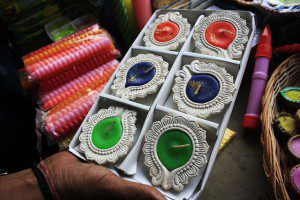
The most important decoration of the festival of lights is the lights themselves. Called diya, they can be bought in packs or you can make your own with heat-safe clay and put a tea-light candle in each.
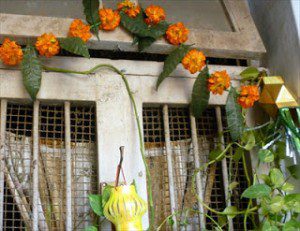
Marigolds are a big part of the decoration for Diwali. You’ll want to tie a marigold flower around the water taps in your home (sink, bathtub, shower, kitchen sink). If you can, draw a simple chalk flower design on your bathtubs or showers.
Small footprints are drawn with rice flour and vermilion powder all over the house to show Lakshmi being present in the home.
Over the main entrance to your home, hang a toran (door garland) made of marigolds and mango leaves.
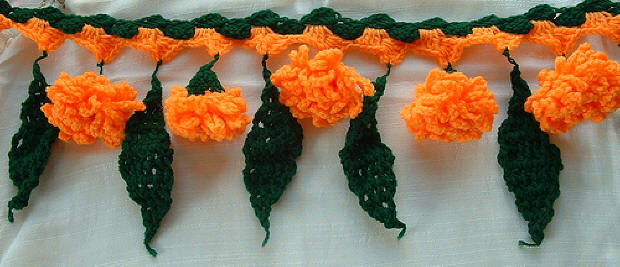
Here’s one crocheted to look like marigold and mango leaves!
In fact, I was so inspired by seeing this crocheted version, that I made my own!

It turned out so nice, I started selling these! https://www.etsy.com/listing/167851926/hindu-festival-door-hanging
Rangoli How-To
Rangoli is a geometric pattern created with colored sand, chalk, or rice and is used to decorate during festivals, particularly at Diwali. It is often used to decorate the entrance to the home, making it inviting and welcoming to Goddess Lakshmi.
You can get stencils to help you with your design or you can get patterns from books. Here are four different methods for doing rangoli, varying in difficulty: http://www.wikihow.com/Make-Rangoli
Make sure when you’re creating these patterns that there aren’t any breaks in the lines of the pattern, lest evil spirits have the opportunity to enter.
You can get rangoli stencils lots of places, even Amazon.com!


Here is another blog with Rangoli decoration advice.
Diwali Sweets
Kheer (Avoid the mistake I made the first time with kheer, use UNCOOKED rice!)
By Request: Kaju Katli
Diwali Gift Ideas
Decorated boxes of dried fruits and nuts are traditional. Try looking for “hampers” of gift basket food like this: Decorated Christmas/Diwali Gift Hamper With Chocolates, Dry Fruit And Nut Medley And Turkish Delight

Lakshmi and Ganesha statues are a great choice.
Decorative Diyas. You can never have too many, right? (Or decorative and scented candles)
About.com recommends a Lakshmi Card Holder & Wallet
For kids, maybe a book like Lighting a Lamp: A Diwali Story 

Perhaps a Ganesh Silver Coin like this one (or something else silver)


Lots of great gifts available here at IndianGiftsPortal
Songs
There are lots of Diwali songs! Here are some…
Bollywood Songs
Rajasthani Folk Dance
Lakshmi Bhajans
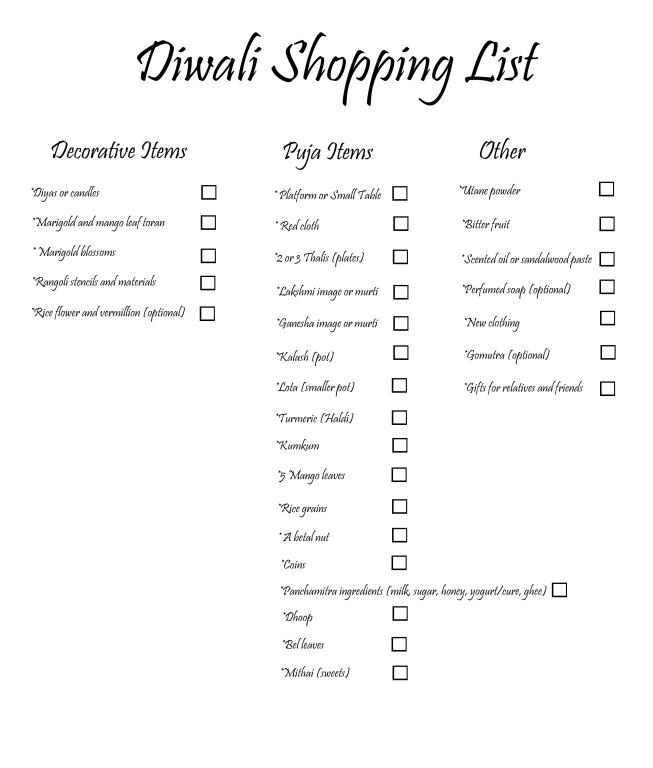
EVERYTHING YOU WILL NEED
To celebrate this year, here is all the ingredients you should make sure to have on hand on a printable shopping list. Just click on the image to get the full size and print it out to take with you to your local Indian grocery store…
Here are several places where “complete” Diwali Puja Kits can be purchased!
- Indian Gifts Portal And this one(I SO want one of these!)
- The India Bazaar
- Godsmantra.com (Laxmi Puja Kit)
- TradeIndia.com
- SpiritualSolutions.com
- IndiaMart
- Alibaba.com
what to get someone for diwali
Previous Post

October 12, 2014
Book Club: Eat, Pray, Love: 5-7
Next Post
October 15, 2014 Going Back to India!
Browse Our Archives
Select a Category Book Club Hindu Holiday How Am I Being a Hindu This Week? Inside the Life Meet a God Meet a Guru Movie Club Philosophy Corner Resources Scripture Uncategorized Wild Card
Select a Month February 2020 September 2019 May 2019 January 2019 December 2018 November 2018 October 2018 September 2018 August 2018 June 2018 May 2018 April 2018 March 2018 February 2018 January 2018 December 2017 November 2017 October 2017 September 2017 August 2017 July 2017 June 2017 May 2017 April 2017 March 2017 February 2017 January 2017 December 2016 November 2016 October 2016 September 2016 August 2016 July 2016 June 2016 May 2016 April 2016 March 2016 February 2016 January 2016 December 2015 November 2015 October 2015 September 2015 August 2015 July 2015 June 2015 May 2015 April 2015 March 2015 February 2015 January 2015 December 2014 November 2014 October 2014 September 2014 August 2014 July 2014 June 2014 May 2014 April 2014 March 2014 February 2014 January 2014 December 2013 November 2013 October 2013 September 2013 August 2013 July 2013 June 2013 May 2013 April 2013 March 2013 February 2013 January 2013 December 2012
Follow Us!
TAKE THE
Religious Wisdom Quiz
In 1 Peter, what did the prophets search intently and with great care about?
Select your answer to see how you score.
The day of the Lord The salvation of Israel The sufferings of the Messiah and the glories that would follow The end times
Related posts from The White Hindu


Show Your Hindu Pride in New Gear!

Mental Health in the Hindu Community
Karwa Chauth for Nursing Mothers
TRENDING AT PATHEOS Hindu

Indian Hindu pilot’s valor in line of duty...
There is a hoary maritime tradition that the captain of the...

Movie on Neem Karoli Baba’s life is a...
Neem Karoli Baba’s life (1900-1973) is associated with miracles he made in...

20 Questions to Ask Before an Interfaith Marriage,...
Four questions every interfaith couple should discuss before marriage: Conversion. Will either...

Avadhānam: The Art of Concentration and Intellectual Mastery
What is Avadhānam? In the summer of 2015, during a three-day Sanskrit...

Jesus in the Dharma: Where Christ Fits in...
Where Does Jesus Fit in Hinduism? That’s a question I get often...

Hormuz: A Shared Hindu and Zoroastrian Heritage
Every evening, somewhere in the world, a newsreader utters the words: "The...
view all Hindu blogs
Ad-Free & Subscriber Log-In Subscription Support
- About Us
- 2026 Calendar
- Videos
- Podcasts
- Library of World Religions
- Faith In Media Tracker
- Advertise With Us
- Write for Us
- Privacy Policy
- Terms of Service
- Do Not Sell My Data
- Contact Us
- Radiant Digital
- Manage Newsletter Subscriptions
- Unsubscribe From Notifications
- Sitemap
Copyright 2008-2026, Patheos. All rights reserved.
Subscription Support Ad-Free & Subscriber Log-In
Follow Patheos