
BuddhistCatholicContemplativeEvangelicalGeneral ChristianHinduJewishLatter-day SaintMuslimNew VisionsProgressive Christian
Beliefs
- Buddhist
- Catholic
- Contemplative
- Evangelical
- General Christian
- Hindu
- Jewish
- Latter-day Saint
- More Voices
- Muslim
- New Visions
- Pagan
- Progressive Christian
Topics
- Religion News
- Food and Religion
- Sports and Religion
- Religious Art
- Religious Music and Entertainment
- Religious Events
- History and Religion
- Style and Religion
- Politics and Religion
- Women in Religion
- Recreation Outdoors and Religion
- Business Finance and Religion
- Careers Workplace and Religion
- Education and Religion
- Family Parenting and Religion
- Health Fitness and Religion
- Home and Religion
- Relationships and Religion
- Technology and Religion
- Travel and Religion
Columnists
- Buddhist Columnists
- Business Finance and Religion Columnists
- Careers Workplace and Religion Columnists
- Catholic Columnists
- Contemplative Columnists
- Education and Religion Columnists
- Evangelists Columnists
- Family Parenting and Religion Columnists
- General Christian Columnists
- Health Fitness and Religion Columnists
- Hindu Columnists
- History and Religion Columnists
- Home and Religion Columnists
- Jewish Columnists
- More Voices Columnists
- Latter Day Columnists
- Muslim Columnists
- New Visions Columnists
- Nonreligious Columnists
- Pagan Columnists
- Politics and Religion Columnists
- Progressive Columnists
- Recreation Outdoors and Religion Columnists
- Relationships and Religion Columnists
- Religion News Columnists
- Religious Art Columnists
- Religious Events Columnists
- Religious Music and Entertainment Columnists
- Sports and Religion Columnists
- Style and Religion Columnists
- Technology and Religion Columnists
- Travel and Religion Columnists
- Women in Religion Columnists
Resource Library
- 2026 Calendar
- Library of World Religions
- The 100 Most Holy Places on Earth
- Patheos Answers
- Podcasts
- Videos
- Faith Leaders Database
- Anglican Episcopalian
- Bahai
- Baptist
- Buddhism
- Christianity
- Confucianism
- Eastern Orthodoxy
- Hinduism
- Holiness and Pentecostal
- ISKCON
- Islam
- Judaism
- Lutheran
- Methodist
- The Church of Jesus Christ of Latter-day Saints
- New Age
- Paganism
- Presbytarian and Reformed
- Protestantism
- Religion Behind the Scenes
- Roman Catholic
- Scientology
- Shia Islam
- Sikhism
- Sufism
- Sunni Islam
- Taoism
- Zen
- See all religions
Research Tools
 Ad-Free & Subscriber Log-In Subscription Support
Ad-Free & Subscriber Log-In Subscription Support
Follow Patheos 

- Trending:
- Forgiveness
- |
- Marriage
- |
- Consciousness
- |
- Death Penalty
- |
- Election
- |
- Halloween
 The White Hindu
-
Hinduism Basics
-
More
- Home
- Hindu
- Saraswati: Everything You Need to Know
Saraswati: Everything You Need to Know
Last updated on: March 13, 2015 at 10:30 pm by Ambaa Choate
Saraswati: Everything You Need to Know 2015-03-13T22:30:34-04:00 Ambaa Choate
Patheos Explore the world's faith through different perspectives on religion and spirituality! Patheos has the views of the prevalent religions and spiritualities of the world.
For Navratri this year (2014), October 2nd is the day to worship Saraswati…
Saraswati (Saara-swa-ti) is the Goddess of art, music, philosophy, creativity, wisdom and learning. She is the consort of Brahma. 
Why Worship Saraswati* Stories * Symbolism * Holidays * How She Is Worshiped * Mantras and Bhajans
Why Worship Saraswati
It is good to pray to Saraswati before tests or when seeking to become knowledgeable about something new. She gives blessings to people in pursuit of knowledge or creative pursuits. She can free one from lethargy and ignorance.
Stories
There are many origin legends for Saraswati. They all seem to involve her coming from Brahma in some way. As his clone (he split himself in two), or from his forehead, or from his mouth, or from his thigh, or from his rib. (Interesting to note parallels with other myths such as Athena born from a forehead and Eve born from a rib).
Once Shiva saw the world filled with evil. He decided to clean it and opened his third eye from which came a great fire. Saraswati took the form of a river and absorbed the fire. She took it into the sea where it formed a fire-spitting creature called Badavagni. Saraswati declared, “As long as man is wise, the animal will remain here, but if man becomes corrupt, this beast will destroy the world.”
– http://www.kidsgen.com/fables_and_fairytales/indian_mythology_stories/sati.htm#mWpXY3yjmdUixVdO.99
Here is one version of a story in which Saraswati enrages her husband and is replaced by Gayatri: http://mustardbrain.wordpress.com/2010/01/23/the-story-of-saraswati/
The “Shatarupa” in Brahma’s story is said to be Saraswati, who can take many forms.
Some more stories here: http://shaktisadhana.50megs.com/Newhomepage/Resource/essays/saraswatidevi2.html
Symbolism

-She is associated with the Vedas and with Brahma (who is also associated with the Vedas).
Two swans are depicted on the left side of the Goddess. A swan is said to have a sensitive beak that enables it to distinguish pure milk from a mixture of milk and water. A swan, therefore, symbolizes the power of discrimination, or the ability to discriminate between right and wrong or good and bad. Saraswati uses the swan as Her carrier. This indicates that one must acquire and apply knowledge with discrimination for the good of mankind. Knowledge that is dominated by ego can destroy the world. –http://www.koausa.org/Gods/God10.html
-The flowing water often around her shows the flow of knowledge
-Her beauty shows the appeal of wisdom
-Meaning of her name: “The essence of Self” or “Sara means an ocean. Swa means one’s own. Ti means the personification or embodiment. Saraswati is the embodiment of one’s own ocean of experience.” http://www.shreemaa.org/saraswati-puja-for-children-book/
Holidays
Vasant Panchami (Fifth day of spring) also called Basant Panchami
Saraswati’s birthday is the time to begin new studies. Traditionally children begin to learn reading and writing formally on this day. It happens around late January/February and is seen as a spring ritual (though where I live in America, snow is likely still on the ground!)
Depending on the region, it is traditional to dress one’s self and the murtis of the Goddess in either white or yellow. Yellow is an important color on this day and often yellow food and yellow flowers and yellow sweets are offered.
A Saraswati puja (see below) should be done within “Panchami Tithi” which is an astrological timing. (This site has a ritual that it says is the Panchami Tithi: http://timesofhindu.com/panchami-tithi-shraddh-5th-day-of-pitru-paksha/)
Some people do rangoli decorations in front of the Goddess, which is intricate patterns made of colored sand or rice powder (I’ve been known to do it with sidewalk chalk). Images of fish are considered auspicious.
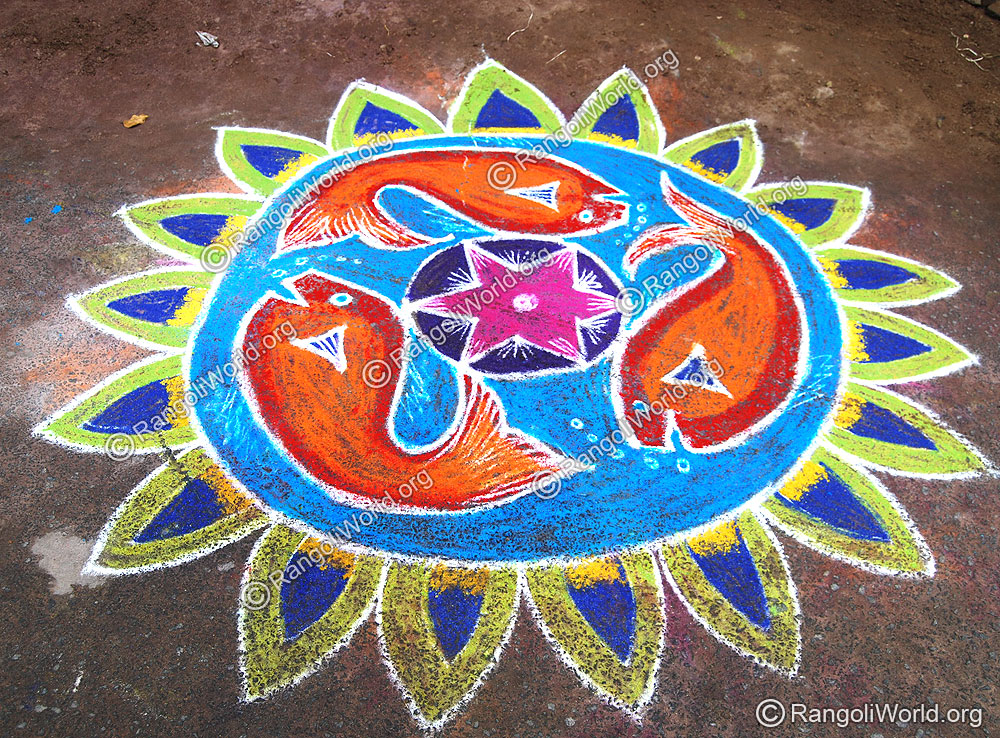
In some areas Pitr-tarpan is performed, which is ancestor worship.
In some areas it is known as the festival of kites and people crowd the skies with colorful kites!
Vasant Panchami starts the 40 day count down to Holi, another spring festival.
Navratri
Navratri is a nine-night festival in the fall to celebrate the female divine energy in various forms. See http://www.patheos.com/blogs/whitehindu/2013/09/welcome-goddesses-happy-navratri/
The Sri Chakra Puja is appropriate to use during Navratri to worship Saraswati particularly on the seventh day, which is an auspicious number to her.
How She Is Worshiped
Sri Chakra Puja
You Will Need:
- White clothes in silk or cotton (a gold border is preferred)
- Picture of Ma Saraswati
- A Sri Chakra (see below. Either purchase a metal one or print this out and laminate)
- A silver or brass plate (avoid steel or plastic)
- Ghee Lamp with five or seven lights
- Incense sticks
- Food (such as rice pudding with milk and sugar, plain milk, or other milk sweets)
- White rice
- White silk or cotton cloth
- Japa beads (optional)
- Milk or panchamruta (a mixture of milk, yogurt, cow ghee, honey, and sugar)
- Pure water
- White sandalwood powder, white rice grains, silver flowers, white flowers and/or white pearls or crystal beads (optional)
1) Bathe and dress in clean white clothes (the gold border is said to retain the energy of the puja in the subtle body) 2) In the altar room sit facing east. Place the image of Ma Saraswati in front of you and the Sri Chakra in front of that on the metal plate

http://en.wikipedia.org/wiki/Sri_Chakra
3) Light the lamp and keep it lit through out. Offer two or three sticks of incense by lighting them and waving them in a clockwise direction in front of the image.
4) Offer food by placing it in front of the altar
5) Chant Samputita Sri Suktam while pouring the milk or panchamruta over the Sri Chakra (Interestingly, this chant is addressed to Lakshmi, but the instructions say to use it). Here is a good video of the chant with transliteration and translation: http://www.youtube.com/watch?v=0Vd6xbQDTYs
Hiraņya varnám hariņīm suvarna-rajata-srajám Chandrám hiranmayīm lakshmīm jatavedo ma avaha|(1)
Tám ma ávaha játavedo lakśhmīm anapa gáminīm Yasyám hiraņyam vindeyam gám aśvam puruśhán aham|| (2)
Aśhwa-pūrvám ratha-madhyám hasti náda prabódhiním Śhriyam devím upahvaye śhrír ma devír jushatám| (3)
Kám sósmitám hiranya prákárám árdrám jvalantím triptám tarpayantím Padme sthitám padma-varnám támihópahvaye śhriyam|| (4)
Chandrám prabhásám yaśhasá jvalantím śhriyam lóke deva justám udárám Tám padminim-ím saranam aham prapadye’ alakshmír me naśyatám tvám vrne| (5)
Ǎditya varne tapasó dhijátó vanaspatis tava vrikshó’ tha bilvah Tasya phalani tapsá nudantu mayántaráyás cha báhya alakshmíh|| (6)
Upaitu mám deva-sakah kírtis cha maniná saha Prádūr bhūtó’ smi rashtre’ smin kírtim riddhim dadátu me| (7)
Kshut pipásá-amalám jyesthám alakshmím náshayámy aham Abhūtim asamriddhim cha sarván nirnuda me grihat|| (8)
Gandha dvárám durá dharşhám nitya-pushtám karíshiním Iśhvarígm sarva bhūtánám tám ihó pahvaye śhriyam| (9)
Manasah kámam ákūtím vácah satyam ashímahi Paśhūnágm rūpam annasya mayi śríh shrayatám yaśhah|| (10)
Kardamená praja-bhūtá mayi sambhava kardama Śriyam vásaya me kule mátaram padma-máliním| (11)
Ǎpah srijantu snigdháni chiklíta vasa me grihe Nicha devím mátaram śhriyam vásaya me kule|| (12)
Ardám pushkariním pushtim pingalám padma máliním Chandrám hiran-mayím lakshmím játavedó ma ávaha| (13)
Ǎrdhám yah kariním yashtim suvarnám hema-máliním Sūryám hiran-mayím lakshmím játavedó ma ávaha|| (14)
Tám ma ávaha játevedó lakshmím anapa gáminím yasyám Hiranyam prabhūtam gávó dásyó aśván vindeyam purushan aham|| (15)
Ǒm mahá-devyai cha vidmahe, vishnu-patnaiya cha dhímahi Tanno Lakshmíh prachódayát || (16)
Ǒm Shántih, Shántih, Shántih.
6) Wash the Sri Chakra with pure water and set aside for a moment.
7) Fill the metal plate with white rice and cover with the white cloth to create a seat to lay the Sri Chakra on.
8) Chant the Sri Maha Saraswati Mantra 108 times (use the japa beads to count)
Om aim shriim hriim sarasvati devyai nam-ah. Sarva jnana siddhim kuru kuru sva-ha (Variations here: http://www.youtube.com/watch?v=H4AbqzSbBZE and http://www.youtube.com/watch?v=G9gNfn2vzuA)
9) While doing this chanting, offer the other white items, such as sandalwood powder, rice grains, and flowers.
10) Wave the lamp (with five or seven ghee flames) in a clockwise direction in front of the Sri Chakra.
11) Consume the prasadam food (any that cannot be eaten should be disposed of naturally outdoors and not thrown in the garbage)
Make sure you complete this puja without interruption and keeping the mind focused on Saraswati.
-Modified from http://www.karunamayi.org/News/documents/NavaratriSaraswatiPuja.pdf
General Saraswati Puja
You Will Need:
- Image or idol of Goddess Saraswati
- A white cloth (vastram)
- Flowers – louts, lilies or jasmine.
- Mango leaves or other decorations
- Turmeric
- Kumkum
- Uncooked rice mixed with turmeric (akshata)
- Fruits
- Books or tools to be blessed
1) Decorate the Goddess image with flowers, garlands, and cover with a white cloth (if you are using a picture, place the white cloth on a tray near the image)
2) Pray to Sri Ganesha first with a quick and simple prayer
3) Light a lamp
4) Offer flowers, light incense, and chant mantras to the Goddess
5) Put the books, tools, or other objects out before the idol
6) Sprinkle some flowers on the objects and you can apply a small dot of turmeric and kumkum, but it does stain
7) Offer flowers and akshata to the deity
8) Offer any food that you have for prasadam (fruits, etc.)
9) Meditate or chant for a few moments.
-Modified from http://www.hindu-blog.com/2008/09/how-to-do-or-perform-saraswati-puja.html
Vasant Puja Ritual
- The idol is in white, symbolizing purity. The sari of the Deity is white or yellow dyed in the natural dye made from “Shiuli” flowers.
- The place where Saraswati is seated is all decorated with fresh flowers and rangoli and the design of a fish is considered auspicious.
- A flat low stool made of wood is covered with yellow cloth and the idol is placed on it, facing towards the east.
- The face of the idol remains covered till the priest begins chanting of mantras at the commencement of puja.
- A green coconut is placed in an earthen pot with a red checked cotton cloth called “Gamocha”.
- Besides the actual puja flowers there are also the most significant flower called Palash that is used in the ceremony.
- Students place their books and pen in front of the goddess to seek blessings on this auspicious day.
- The offerings made to the goddess consist of fruits- most significant are berries from the wild plum tree. Other fruits include tapioca. Sweets must include puffed rice, jaggery and yogurt.
- Family members bathe early and dress in yellow attire before assembling in front of the Goddess.
- The earthen pot is tied with a string which is untied on the next day by the priest before visarjan or the immersion ceremony.
- A havan is done by the priest using special wood, ghee, joss sticks and incense. A diya or lamp is lit beside the prasad.
- Aarti is performed by the priest twice in day, in the morning and then again in the evening.
- Nobody touches books on that day as it is believed that the goddess is blessing the books.
– See more at: http://www.festivalsofindia.in/vasantpanchami/Puja.aspx
It is auspicious to offer honey to Saraswati, as it represents the purity of learning and the sweetness of perfect knowledge.
Mantras and Bhajans
Yaa Kundendu tushaara haaradhavalaa, Yaa shubhravastraavritha|
Yaa veenavara dandamanditakara, Yaa shwetha padmaasana||
Yaa brahmaachyutha shankara prabhritibhir Devaisadaa Vanditha|
Saa Maam Paatu Saraswatee Bhagavatee Nihshesha jaadyaapahaa||
Pranam Mantra
Om Saraswati Mahabhagey, Vidye Kamala Lochaney |
Viswarupey Vishalakshmi, Vidyam Dehi Namohastutey ||
Jaya Jaya Devi, Charachara Sharey, Kuchayuga Shobhita, Mukta Haarey |
Vina Ranjita, Pustaka Hastey, Bhagavati Bharati Devi Namohastutey ||
Saraswati Vandana Mantra
Yaa Kundendu tushaara haara-dhavalaa, Yaa shubhra-vastra’avritaa
Yaa veena-vara-danda-manditakara, Yaa shweta padma’asana
Yaa brahma’achyuta shankara prabhritibhir Devai-sadaa Vanditaa
Saa Maam Paatu Saraswati Bhagavatee Nihshesha jaadya’apahaa.
Shuklaam Brahmavichaara Saara paramaam Aadhyaam Jagadvyapinim,
Veena Pustaka Dhaarineem Abhayadaam Jaadya’andhakaara’apahaam
Haste Sphaatika Maalikam Vidadhateem Padmasane Sansthitaam
Vande taam Parmeshwareem Bhagavateem Buddhipradaam Shardam.
Mata Saraswati Mantra
Saraswati namastubhyam
Varade kamaroopini l
Vidyarambham karishyami,
Siddhirbhavatu me sada
More Saraswati mantras here: http://www.prophet666.com/2011/03/saraswati-worship.html
Previous Post
September 29, 2014
How to Have a Hindu Housewarming
Next Post

October 1, 2014 The American Health Care System Has Issues
Browse Our Archives
Select a Category Book Club Hindu Holiday How Am I Being a Hindu This Week? Inside the Life Meet a God Meet a Guru Movie Club Philosophy Corner Resources Scripture Uncategorized Wild Card
Select a Month February 2020 September 2019 May 2019 January 2019 December 2018 November 2018 October 2018 September 2018 August 2018 June 2018 May 2018 April 2018 March 2018 February 2018 January 2018 December 2017 November 2017 October 2017 September 2017 August 2017 July 2017 June 2017 May 2017 April 2017 March 2017 February 2017 January 2017 December 2016 November 2016 October 2016 September 2016 August 2016 July 2016 June 2016 May 2016 April 2016 March 2016 February 2016 January 2016 December 2015 November 2015 October 2015 September 2015 August 2015 July 2015 June 2015 May 2015 April 2015 March 2015 February 2015 January 2015 December 2014 November 2014 October 2014 September 2014 August 2014 July 2014 June 2014 May 2014 April 2014 March 2014 February 2014 January 2014 December 2013 November 2013 October 2013 September 2013 August 2013 July 2013 June 2013 May 2013 April 2013 March 2013 February 2013 January 2013 December 2012
Follow Us!
TAKE THE
Religious Wisdom Quiz
Which battle did Jonathan, Saul's son, win using faith instead of army size?
Select your answer to see how you score.
Battle of Gilboa Battle of Ramah Siege of Jerusalem Garrison of the Philistines
Related posts from The White Hindu


Show Your Hindu Pride in New Gear!

Mental Health in the Hindu Community

TRENDING AT PATHEOS Hindu

Indian Hindu pilot’s valor in line of duty...
There is a hoary maritime tradition that the captain of the...

Movie on Neem Karoli Baba’s life is a...
Neem Karoli Baba’s life (1900-1973) is associated with miracles he made in...

20 Questions to Ask Before an Interfaith Marriage,...
Four questions every interfaith couple should discuss before marriage: Conversion. Will either...

Avadhānam: The Art of Concentration and Intellectual Mastery
What is Avadhānam? In the summer of 2015, during a three-day Sanskrit...

Jesus in the Dharma: Where Christ Fits in...
Where Does Jesus Fit in Hinduism? That’s a question I get often...

Hormuz: A Shared Hindu and Zoroastrian Heritage
Every evening, somewhere in the world, a newsreader utters the words: "The...
view all Hindu blogs
Ad-Free & Subscriber Log-In Subscription Support
- About Us
- 2026 Calendar
- Videos
- Podcasts
- Library of World Religions
- Faith In Media Tracker
- Advertise With Us
- Write for Us
- Privacy Policy
- Terms of Service
- Do Not Sell My Data
- Contact Us
- Radiant Digital
- Manage Newsletter Subscriptions
- Unsubscribe From Notifications
- Sitemap
Copyright 2008-2026, Patheos. All rights reserved.
Subscription Support Ad-Free & Subscriber Log-In
Follow Patheos