
BuddhistCatholicContemplativeEvangelicalGeneral ChristianHinduJewishLatter-day SaintMuslimNew VisionsProgressive Christian
Beliefs
- Buddhist
- Catholic
- Contemplative
- Evangelical
- General Christian
- Hindu
- Jewish
- Latter-day Saint
- More Voices
- Muslim
- New Visions
- Pagan
- Progressive Christian
Topics
- Religion News
- Food and Religion
- Sports and Religion
- Religious Art
- Religious Music and Entertainment
- Religious Events
- History and Religion
- Style and Religion
- Politics and Religion
- Women in Religion
- Recreation Outdoors and Religion
- Business Finance and Religion
- Careers Workplace and Religion
- Education and Religion
- Family Parenting and Religion
- Health Fitness and Religion
- Home and Religion
- Relationships and Religion
- Technology and Religion
- Travel and Religion
Columnists
- Buddhist Columnists
- Business Finance and Religion Columnists
- Careers Workplace and Religion Columnists
- Catholic Columnists
- Contemplative Columnists
- Education and Religion Columnists
- Evangelists Columnists
- Family Parenting and Religion Columnists
- General Christian Columnists
- Health Fitness and Religion Columnists
- Hindu Columnists
- History and Religion Columnists
- Home and Religion Columnists
- Jewish Columnists
- More Voices Columnists
- Latter Day Columnists
- Muslim Columnists
- New Visions Columnists
- Nonreligious Columnists
- Pagan Columnists
- Politics and Religion Columnists
- Progressive Columnists
- Recreation Outdoors and Religion Columnists
- Relationships and Religion Columnists
- Religion News Columnists
- Religious Art Columnists
- Religious Events Columnists
- Religious Music and Entertainment Columnists
- Sports and Religion Columnists
- Style and Religion Columnists
- Technology and Religion Columnists
- Travel and Religion Columnists
- Women in Religion Columnists
Resource Library
- 2026 Calendar
- Library of World Religions
- The 100 Most Holy Places on Earth
- Patheos Answers
- Podcasts
- Videos
- Faith Leaders Database
- Anglican Episcopalian
- Bahai
- Baptist
- Buddhism
- Christianity
- Confucianism
- Eastern Orthodoxy
- Hinduism
- Holiness and Pentecostal
- ISKCON
- Islam
- Judaism
- Lutheran
- Methodist
- The Church of Jesus Christ of Latter-day Saints
- New Age
- Paganism
- Presbytarian and Reformed
- Protestantism
- Religion Behind the Scenes
- Roman Catholic
- Scientology
- Shia Islam
- Sikhism
- Sufism
- Sunni Islam
- Taoism
- Zen
- See all religions
Research Tools
 Ad-Free & Subscriber Log-In Subscription Support
Follow Patheos 

- Trending:
- Advent
- |
- Forgiveness
- |
- Thanksgiving
- |
- Election
- |
- Seasonal Holidays
- |
- Marriage
 The White Hindu
-
Hinduism Basics
-
More
- Home
- Hindu
- More Myths About Reincarnation
More Myths About Reincarnation
Last updated on: March 13, 2015 at 10:31 pm by Ambaa Choate
More Myths About Reincarnation 2015-03-13T22:31:40-04:00 Ambaa Choate
Patheos Explore the world's faith through different perspectives on religion and spirituality! Patheos has the views of the prevalent religions and spiritualities of the world.
A friend on Facebook sent me an article apparently written by the founder of the Baha’i faith that is meant to take down reincarnation. I had no idea the Baha’i don’t believe in reincarnation, so that was educational. The article itself, however, just reminded me again of how much misunderstanding there is around the theory of reincarnation. Those who don’t believe in it tend to have some very strange ideas about what those of us who do believe in it think it means!
So I wanted to address some of the arguments that he makes against reincarnation. (I have previously spoken about reincarnation myths here: Reincarnation, The Truth About Past Lives)
But first, just to be clear, no one knows what happens to us when we die. No one. It is not possible for us to know. There are people who literally die and get revived, but the reports from that vary widely. I’ve read accounts by people who say they did not experience anything: no white light, no comforting presence, nothing. Then there’s Heaven Is For Real about a very Christian heaven and then there’s books by people who say they saw past lives, etc. So those accounts don’t tell us much.
All we can do is observe the world, look at death, and see what theory best fits the actual behavior of the world. In my observation, reincarnation makes the most sense. To me it certainly makes more sense than the idea that there’s a heaven somewhere where billions of people keep piling up as more and more die and that they live there in physical bodies (where is this magical place that we’ve never been able to find it?) that are the ideal version of what they looked like on earth (whose ideal, I have to wonder!) and what do they do there all day for eternity? They don’t get “lazy and inactive” as this author talks about as you’ll see below?
How we observe life and death is still going to have a bias because it’s nearly impossible for humans to see past all their biases. For example, most atheists don’t believe that we have a soul. They think that our consciousness is an effect of the complexity of our brains, so when our brain ceases to function, so does our consciousness. Those of us who are religious tend to believe in a soul. If our consciousness is a separate part called a soul, then that can’t cease to exist when we die because energy can’t leave the system. We know from physics that all matter and energy is conserved and when something falls apart, its component parts don’t vanish, they transform.
Reincarnation is a theory. Of all the theories out there, it’s the one that makes the most sense to me and fits the evidence best for my observation.
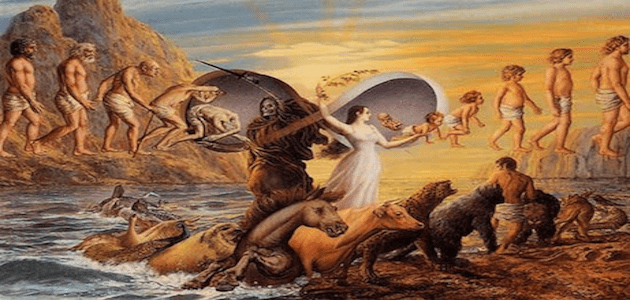
Link to: Reincarnation Part 1, the historical context (Does anyone know the original artist of this? It’s so lovely!)
So, on to the article…
It starts with a rather obnoxious: people can believe what they want, but here is the reality. Already I feel like there’s a real agenda here, since as I’ve pointed out, no one can know the reality of death.
The author speaks about a few different types of beliefs within the theory of reincarnation, which he’s right about except for the heavily judgmental langauge.
“One division thinks that man sometimes returns to this world in the form of an animal in order to undergo severe punishment and that, after enduring this painful torment, he will be released from the animal world and will come again into the human world.”
As someone who believes that we can be reborn as animals, I have to say that the purpose is not “severe punishment” nor is it “painful torment” to live an animal’s life. As an animal, you don’t have the same conscious awareness as a human and you are able to live more in the moment. The trade-off is that you are more of a slave to your instincts and can’t make real choices. Sometimes an animal form is simply the natural consequence of the way you’ve lived your human life. And then it ends, as all lives do, and you go to the next form that will help your soul develop.
When he speaks of the division of people who believe that we are always reborn human until we achieve perfection, he claims that we believe that it is a physical perfection that is being striven for, a perfection of matter.
“In other words, that men are composed of matter and force: matter in the beginning—that is to say, in the first cycle—is imperfect, but on coming repeatedly to this world it progresses and acquires refinement and delicacy, until it becomes like a polished mirror.”
Personally, I know of no one who believes that. Yes, we believe that the purpose of living many lives is to become polished and perfected over time, but it’s the spirit, the soul, being perfected. The body is mostly irrelevant except as its challenges teach us something. Beliveing that we are our bodies or our physical expressions is one of the things we are working on unlearning!
“Now observe that in the sensible world appearances are not repeated, for no being in any respect is identical with, nor the same as, another being. The sign of singleness is visible and apparent in all things. If all the granaries of the world were full of grain, you would not find two grains absolutely alike, the same and identical without any distinction. It is certain that there will be differences and distinctions between them. As the proof of uniqueness exists in all things, and the Oneness and Unity of God is apparent in the reality of all things, the repetition of the same appearance is absolutely impossible. Therefore, reincarnation, which is the repeated appearance of the same spirit with its former essence and condition in this same world of appearance, is impossible and unrealizable.”
Wait, is he saying that the soul returns to an identical body every time? Of course that’s not true and ridiculous. But that isn’t what reincarnation says at all! This is a false comparison. To say that becuase the repetition of appearances in the world is impossible, therefore reincarnation is impossible is false becuase the idea that things would repeat in an identical appearance doesn’t have anything to do with reincarnation.
Our bodies are not our selves. The soul is not connected to one paritcular appearance. Why would it be? Attachment to a body or belief that who we are is our physical appearance is one of the issues that we must overcome to acheive perfection. What we look like changes even within one lifetime! It is not eternal and True.
“It is the same with the human body, which after decomposition becomes disintegrated, and the elements which composed it are dispersed. If, in like manner, this body should again return from the mineral or vegetable world, it would not have exactly the same composition of elements as the former man. Those elements have been decomposed and dispersed; they are dissipated in this vast space. Afterward, other particles of elements have been combined, and a second body has been formed.”
This is true, but again does not in any way disprove reincarnation. The author is fixated on this idea that people who believe in reincarnation believe that when someone dies they come back again in the same body. He seems very attached to his body and identifies his Self with his body. This is something that any Hindu guru would tell you is a problem.
“The essence of imperfection, by returning, does not become the reality of perfection; complete darkness, by returning, does not become the source of light; the essence of weakness is not transformed into power and might by returning, and an earthly nature does not become a heavenly reality.”
Now he has moved to a more valid point. Does returning to the world cause us transformation over time? He says no. I say yes.
Do people change, learn, grow? They can. Throughout the process of a single life one can observe people refining their understanding and growing spiritually. It is the act of living that makes that happen, not the act of returning. Simply returning to earth to live another life isn’t what causes transformation, it’s the process of living those lives themselves. As we spend time in the world, we learn things. The longer we spend here, the more we learn in general. Some people may be resistent to growth, but they’ll have a chance to start over somewhat fresh again.
(He seems to be basing his arguments on the beliefs of the Theosophists rather than Hindus. I am not a Theosophist, so perhaps his arguments make more sense in connection with their teachings.)
“Moreover, this material world has not such value or such excellence that man, after having escaped from this cage, will desire a second time to fall into this snare. No, through the Eternal Bounty the worth and true ability of man becomes apparent and visible by traversing the degrees of existence, and not by returning. When the shell is once opened, it will be apparent and evident whether it contains a pearl or worthless matter. When once the plant has grown it will bring forth either thorns or flowers; there is no need for it to grow up again.”
Clearly this is someone who sees the world in a linear way. Whether one sees the world as linear or cyclical depends a lot on some very ingrained beliefs set early in life. While he does not see value in repeating a lesson until it is learned, Hindus do. Is this someone who was able to pass all his exams in school without studying, hearing the material only once? Not everyone has that level of brilliance. Most of us need to try things a few times and study things a few times to really “get it.”
“Besides, advancing and moving in the worlds in a direct order according to the natural law is the cause of existence, and a movement contrary to the system and law of nature is the cause of nonexistence. The return of the soul after death is contrary to the natural movement, and opposed to the divine system.”
I’m not sure what the basis of this statement is. Who says that return is opposed to the divine system?
The author’s observation is that things do not repeat and so at least there he is looking at the evidence. We just interpret what we have observed in different ways. I say that yes, advancement is natural and moving forward is natural. A soul returning to earth doesn’t mean regressing. Once a lesson is learned, then the soul is moving on to the next lesson and has advanced in terms of the type of life he is living.
I don’t think that’s contradictory to the “divine system” at all. I think it’s built right into it. But we cannot observe the progress of one soul and see how it moves, so the author is still stuck on the idea that what we’re observing is physical matter and not souls.
“…it would be better if God prolonged the life of the spirit in the material world until it had acquired perfections and graces; it then would not be necessary for it to taste of the cup of death, or to acquire a second life.”
How nice for him that he knows the best way for God to do things. He certainly sees himself as very advanced!
The question here is, why don’t we just live one extremely long life until we learn everything?
The way I’ve always looked at it as, that would get awfully complicated. I have a hard enough time remembering what happened ten years ago, how would I keep in my head all the learning of hundreds and hundreds of years?
How would I experience all the different circumstances that would help me grow if I am connected only to this body and this experience of life? I can’t expand to understand that I am everything if all I’ve ever expeirenced is being female and white and American. How could I learn that I am not my body and I am not my mind if this body and this mind were the only ones I ever knew?
It helps a lot to start somewhat clean and clear with a new life so the “blackboard” of our soul doesn’t get extremely crowded. The lessons we’ve already learned in previous lives are ingrained within us and we don’t have to consciously remember something all the time once it is ingrained within our soul.
The result of these endless beings, which is the noble existence of man, would come and go for a few days in this perishable dwelling, and after receiving punishments and rewards, at last all would become perfect. The divine creation and the infinite existing beings would be perfected and completed, and then the Divinity of the Lord, and the names and qualities of God, on behalf of these spiritual beings, would, as regards their effect, result in laziness and inaction!
No, once everything comes back to perfection (as it started), then the world itself ends, becomes unmanifest and rests, and then is reborn again itself. Because time is cyclical. This is part of the theory for those of us who believe in reincarnation. We experience time in a linear way as limited beings within a body and mind, but the reality is much more complicated than that. Time is not a simple straight line, as even science has begun to discover.
The story of going away and returning is older than time and the whole universe plays it out over and over. We start perfect, we go away from perfection to experience variety, and then we eventually return.
I don’t know that that’s reality or truth, but I think that it is.
Look, I don’t claim to know everything about everything. I am not a perfected soul as of yet. I am wary of those who claim to be, and this author clearly thinks that he knows better than anyone else the truth about everything.
In conclusion, I know there are plenty of people who don’t believe in reincarntion and that’s fine. It’s one theory, it’s one belief. A lot of people believe it and thinks it makes a lot of sense. But if you’re going to argue against it, at least be respectful that you don’t know everything about everything. The langauge in this article is incredibly insulting and condesending.
There’s a strong agenda here, a need to find reincarnation untrue. But one cannot find the truth by going into the observation with a conclusion in mind. One must be able to let go of the assumptions and the desired outcome to see what is really there. This author is unable to do so and so taints all his objections to reincarnation with gross misunderstandings of the beliefs.
***
By the way, if you want to bring your children up with reincarnation, there’s a lovely book that’s great for kids called The Mountains of Tibet. I had this book as a kid and I loved it. It’s simple and beautiful and profound.


Previous Post

May 21, 2014
Why Not Just Adopt?
Next Post
May 23, 2014 Indian Buzzfeed
Browse Our Archives
Select a Category Book Club Hindu Holiday How Am I Being a Hindu This Week? Inside the Life Meet a God Meet a Guru Movie Club Philosophy Corner Resources Scripture Uncategorized Wild Card
Select a Month February 2020 September 2019 May 2019 January 2019 December 2018 November 2018 October 2018 September 2018 August 2018 June 2018 May 2018 April 2018 March 2018 February 2018 January 2018 December 2017 November 2017 October 2017 September 2017 August 2017 July 2017 June 2017 May 2017 April 2017 March 2017 February 2017 January 2017 December 2016 November 2016 October 2016 September 2016 August 2016 July 2016 June 2016 May 2016 April 2016 March 2016 February 2016 January 2016 December 2015 November 2015 October 2015 September 2015 August 2015 July 2015 June 2015 May 2015 April 2015 March 2015 February 2015 January 2015 December 2014 November 2014 October 2014 September 2014 August 2014 July 2014 June 2014 May 2014 April 2014 March 2014 February 2014 January 2014 December 2013 November 2013 October 2013 September 2013 August 2013 July 2013 June 2013 May 2013 April 2013 March 2013 February 2013 January 2013 December 2012
Follow Us!
TAKE THE
Religious Wisdom Quiz
How many days and nights did it rain during the flood?
Select your answer to see how you score.
12 7 40 10
Related posts from The White Hindu
Cult or Religion -- What's the Difference?


Science and Hinduism Do Not Require Faith
TRENDING AT PATHEOS Hindu
‘Ramayana’ Gives India’s Epic a Hollywood-Scale Makeover
For centuries, the Ramayana has been far more than an ancient...

Does One of Us Have to Change Religions...
Twenty Years of Listening to Interfaith Couples A couple can spend years...

10% or 38%? Counting Hindu - American Interfaith...
Are 10% or 38% of American Hindus Marrying Outside Faith? What two...

Indian Hindu pilot’s valor in line of duty...
There is a hoary maritime tradition that the captain of the...

Movie on Neem Karoli Baba’s life is a...
Neem Karoli Baba’s life (1900-1973) is associated with miracles he made in...

20 Questions to Ask Before an Interfaith Marriage,...
Four questions every interfaith couple should discuss before marriage: Conversion. Will either...
view all Hindu blogs
Ad-Free & Subscriber Log-In Subscription Support
- About Us
- 2026 Calendar
- Videos
- Podcasts
- Library of World Religions
- Faith In Media Tracker
- Advertise With Us
- Write for Us
- Privacy Policy
- Terms of Service
- Do Not Sell My Data
- Contact Us
- Radiant Digital
- Manage Newsletter Subscriptions
- Unsubscribe From Notifications
- Sitemap
Copyright 2008-2026, Patheos, part of the Radiant Digital network of media brands. All rights reserved.
Subscription Support Ad-Free & Subscriber Log-In
Follow Patheos