
BuddhistCatholicContemplativeEvangelicalGeneral ChristianHinduJewishLatter-day SaintMuslimNew VisionsProgressive Christian
Beliefs
- Buddhist
- Catholic
- Contemplative
- Evangelical
- General Christian
- Hindu
- Jewish
- Latter-day Saint
- More Voices
- Muslim
- New Visions
- Pagan
- Progressive Christian
Topics
- Religion News
- Food and Religion
- Sports and Religion
- Religious Art
- Religious Music and Entertainment
- Religious Events
- History and Religion
- Style and Religion
- Politics and Religion
- Women in Religion
- Recreation Outdoors and Religion
- Business Finance and Religion
- Careers Workplace and Religion
- Education and Religion
- Family Parenting and Religion
- Health Fitness and Religion
- Home and Religion
- Relationships and Religion
- Technology and Religion
- Travel and Religion
Columnists
- Buddhist Columnists
- Business Finance and Religion Columnists
- Careers Workplace and Religion Columnists
- Catholic Columnists
- Contemplative Columnists
- Education and Religion Columnists
- Evangelists Columnists
- Family Parenting and Religion Columnists
- General Christian Columnists
- Health Fitness and Religion Columnists
- Hindu Columnists
- History and Religion Columnists
- Home and Religion Columnists
- Jewish Columnists
- More Voices Columnists
- Latter Day Columnists
- Muslim Columnists
- New Visions Columnists
- Nonreligious Columnists
- Pagan Columnists
- Politics and Religion Columnists
- Progressive Columnists
- Recreation Outdoors and Religion Columnists
- Relationships and Religion Columnists
- Religion News Columnists
- Religious Art Columnists
- Religious Events Columnists
- Religious Music and Entertainment Columnists
- Sports and Religion Columnists
- Style and Religion Columnists
- Technology and Religion Columnists
- Travel and Religion Columnists
- Women in Religion Columnists
Resource Library
- 2026 Calendar
- Library of World Religions
- The 100 Most Holy Places on Earth
- Patheos Answers
- Podcasts
- Videos
- Faith Leaders Database
- Anglican Episcopalian
- Bahai
- Baptist
- Buddhism
- Christianity
- Confucianism
- Eastern Orthodoxy
- Hinduism
- Holiness and Pentecostal
- ISKCON
- Islam
- Judaism
- Lutheran
- Methodist
- The Church of Jesus Christ of Latter-day Saints
- New Age
- Paganism
- Presbytarian and Reformed
- Protestantism
- Religion Behind the Scenes
- Roman Catholic
- Scientology
- Shia Islam
- Sikhism
- Sufism
- Sunni Islam
- Taoism
- Zen
- See all religions
Research Tools
 Ad-Free & Subscriber Log-In Subscription Support
Ad-Free & Subscriber Log-In Subscription Support
Follow Patheos 

- Trending:
- Forgiveness
- |
- Marriage
- |
- Consciousness
- |
- Death Penalty
- |
- Election
- |
- Halloween
 The White Hindu
-
Hinduism Basics
-
More
- Home
- Hindu
- The Three Gunas
The Three Gunas
Last updated on: March 13, 2015 at 10:32 pm by Ambaa Choate
The Three Gunas 2015-03-13T22:32:14-04:00 Ambaa Choate
Patheos Explore the world's faith through different perspectives on religion and spirituality! Patheos has the views of the prevalent religions and spiritualities of the world.
(Note: I am on my honeymoon this week, so if your comment doesn’t show up right away, give me a day or two!)
I promised you a post about the gunas!
So the word “guna” (Goooona) is usually translated as “quality” as in the types of qualities that things are made of.
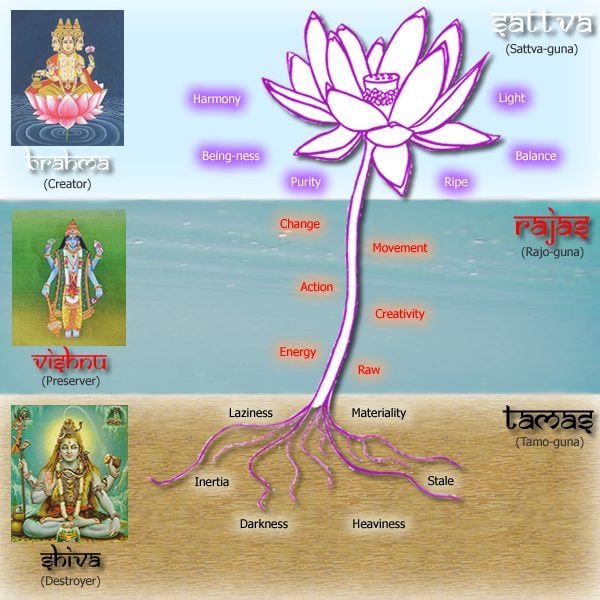
It is said that everything in creation has some combination of the three qualities in differing amounts.
Rajas
This one is energy, passion, anger, movement
Tamas
This one is inertia, dullness, laziness
Sattva
This one is peace, serenity, calm
One of the goals in human life is to try to increase our sattva and decrease the other two.
Some people believe that the food we eat has an effect and that we should eat sattvic food and avoid rajasic and tamasic foods (this is the reason why some groups of Hindus avoid spicy food, onions, and garlic). This is also why leftovers are not a part of a traditional diet. That’s tricky because on the one hand, leftover food is tamasic but on the other hand using leftovers is efficient and saves money.
I had a professor in college (in a class on The Mahabharata, can you believe how lucky I was?!) who had an unusual perspective on it. He believes that there are really only two guna: rajas and tamas and that sattva is created by having the right balance of the other two.
I’ve said more than once that I feel like I have a higher amount of tamas than most people. I tend to see more rajas in the average person. More passion and dedication than I tend to be able to muster. (Now, part of that could be dealing with intermitent depression.) My parents don’t like when I say this, but I don’t mean it as an excuse. I mean it as I know what I need to work on! Being aware of my tendency towards tamas, I can correct for it.
One great way of understanding the world through the gunas is in the example of love. When I learned about this, it really stuck with me. We tend to think of love as a single emotion, but it can manifest in very different ways, actually. Love as an emotion can also have a guna quality.
Pure, selfless, true love is sattvic love. Giving to that person only increases your own joy and peace. Even if they are with someone else, you want above all for them to be truely happy and you don’t feel like you have to posess them.
Rajasic love is possessive and jealous. You must have the other person and you feel easily threatened. This is the crazy mindset of “If I can’t have you, no one can, so I’ll kill you.”
Tamasic love is emotionally needy. It is requiring the other person to fix you.
There are even guna qualities to different times of day. This is why it is encouraged to get up by dawn and meditate or pray at the first light of day. That is a very sattvic time.
This website points out that gurus have guna qualities too:
Unfortunately guru as everything in material world can be in all three gunas. True, sattvic guru represents a chain of teacher-diciple relations and follows ancient scriptures not only in words but also in his every day life. He doesn’t criticize other religions nor he promises an easy and rapid way. Rajasic teachers are prone to criticism and separatism, often invent their own ways or “improve” already existing old practices. Tamasic leaders are violent and extreme.
But, as Krishna says in The Gita, in enlightenment, a person is not under the sway of any of the gunas:
“They are unmoved by the harmony of sattva, the activity of rajas, or the delusion of tamas. They feel no aversion when these forces are active, nor do they crave for them when these forces subside.”
Check out this gorgeous guna diagram from http://svasti.wordpress.com/
Previous Post

April 12, 2014
Movie Discussion: Sathyagraha
Next Post

April 16, 2014 A Day In The Life of a Religious Minority
Browse Our Archives
Select a Category Book Club Hindu Holiday How Am I Being a Hindu This Week? Inside the Life Meet a God Meet a Guru Movie Club Philosophy Corner Resources Scripture Uncategorized Wild Card
Select a Month February 2020 September 2019 May 2019 January 2019 December 2018 November 2018 October 2018 September 2018 August 2018 June 2018 May 2018 April 2018 March 2018 February 2018 January 2018 December 2017 November 2017 October 2017 September 2017 August 2017 July 2017 June 2017 May 2017 April 2017 March 2017 February 2017 January 2017 December 2016 November 2016 October 2016 September 2016 August 2016 July 2016 June 2016 May 2016 April 2016 March 2016 February 2016 January 2016 December 2015 November 2015 October 2015 September 2015 August 2015 July 2015 June 2015 May 2015 April 2015 March 2015 February 2015 January 2015 December 2014 November 2014 October 2014 September 2014 August 2014 July 2014 June 2014 May 2014 April 2014 March 2014 February 2014 January 2014 December 2013 November 2013 October 2013 September 2013 August 2013 July 2013 June 2013 May 2013 April 2013 March 2013 February 2013 January 2013 December 2012
Follow Us!
TAKE THE
Religious Wisdom Quiz
How did Jesus die?
Select your answer to see how you score.
Stoning Hanging Spearing Crucifixion
Related posts from The White Hindu


Thoughts About Kashmir And Beyond— A Hindu Perspective

Show Your Hindu Pride in New Gear!

Mental Health in the Hindu Community
TRENDING AT PATHEOS Hindu

Indian Hindu pilot’s valor in line of duty...
There is a hoary maritime tradition that the captain of the...

Movie on Neem Karoli Baba’s life is a...
Neem Karoli Baba’s life (1900-1973) is associated with miracles he made in...

20 Questions to Ask Before an Interfaith Marriage,...
Four questions every interfaith couple should discuss before marriage: Conversion. Will either...

Avadhānam: The Art of Concentration and Intellectual Mastery
What is Avadhānam? In the summer of 2015, during a three-day Sanskrit...

Jesus in the Dharma: Where Christ Fits in...
Where Does Jesus Fit in Hinduism? That’s a question I get often...

Hormuz: A Shared Hindu and Zoroastrian Heritage
Every evening, somewhere in the world, a newsreader utters the words: "The...
view all Hindu blogs
Ad-Free & Subscriber Log-In Subscription Support
- About Us
- 2026 Calendar
- Videos
- Podcasts
- Library of World Religions
- Faith In Media Tracker
- Advertise With Us
- Write for Us
- Privacy Policy
- Terms of Service
- Do Not Sell My Data
- Contact Us
- Radiant Digital
- Manage Newsletter Subscriptions
- Unsubscribe From Notifications
- Sitemap
Copyright 2008-2026, Patheos. All rights reserved.
Subscription Support Ad-Free & Subscriber Log-In
Follow Patheos