
BuddhistCatholicContemplativeEvangelicalGeneral ChristianHinduJewishLatter-day SaintMuslimNew VisionsProgressive Christian
Beliefs
- Buddhist
- Catholic
- Contemplative
- Evangelical
- General Christian
- Hindu
- Jewish
- Latter-day Saint
- More Voices
- Muslim
- New Visions
- Pagan
- Progressive Christian
Topics
- Religion News
- Food and Religion
- Sports and Religion
- Religious Art
- Religious Music and Entertainment
- Religious Events
- History and Religion
- Style and Religion
- Politics and Religion
- Women in Religion
- Recreation Outdoors and Religion
- Business Finance and Religion
- Careers Workplace and Religion
- Education and Religion
- Family Parenting and Religion
- Health Fitness and Religion
- Home and Religion
- Relationships and Religion
- Technology and Religion
- Travel and Religion
Columnists
- Buddhist Columnists
- Business Finance and Religion Columnists
- Careers Workplace and Religion Columnists
- Catholic Columnists
- Contemplative Columnists
- Education and Religion Columnists
- Evangelists Columnists
- Family Parenting and Religion Columnists
- General Christian Columnists
- Health Fitness and Religion Columnists
- Hindu Columnists
- History and Religion Columnists
- Home and Religion Columnists
- Jewish Columnists
- More Voices Columnists
- Latter Day Columnists
- Muslim Columnists
- New Visions Columnists
- Nonreligious Columnists
- Pagan Columnists
- Politics and Religion Columnists
- Progressive Columnists
- Recreation Outdoors and Religion Columnists
- Relationships and Religion Columnists
- Religion News Columnists
- Religious Art Columnists
- Religious Events Columnists
- Religious Music and Entertainment Columnists
- Sports and Religion Columnists
- Style and Religion Columnists
- Technology and Religion Columnists
- Travel and Religion Columnists
- Women in Religion Columnists
Resource Library
- 2026 Calendar
- Library of World Religions
- The 100 Most Holy Places on Earth
- Patheos Answers
- Podcasts
- Videos
- Faith Leaders Database
- Anglican Episcopalian
- Bahai
- Baptist
- Buddhism
- Christianity
- Confucianism
- Eastern Orthodoxy
- Hinduism
- Holiness and Pentecostal
- ISKCON
- Islam
- Judaism
- Lutheran
- Methodist
- The Church of Jesus Christ of Latter-day Saints
- New Age
- Paganism
- Presbytarian and Reformed
- Protestantism
- Religion Behind the Scenes
- Roman Catholic
- Scientology
- Shia Islam
- Sikhism
- Sufism
- Sunni Islam
- Taoism
- Zen
- See all religions
Research Tools
 Ad-Free & Subscriber Log-In Subscription Support
Ad-Free & Subscriber Log-In Subscription Support
Follow Patheos 

- Trending:
- Forgiveness
- |
- Marriage
- |
- Consciousness
- |
- Death Penalty
- |
- Election
- |
- Halloween
 The White Hindu
-
Hinduism Basics
-
More
- Home
- Hindu
- Reading the Upanishads: Katha part six
Reading the Upanishads: Katha part six
Last updated on: March 13, 2015 at 10:32 pm by Ambaa Choate
Reading the Upanishads: Katha part six 2015-03-13T22:32:11-04:00 Ambaa Choate
Patheos Explore the world's faith through different perspectives on religion and spirituality! Patheos has the views of the prevalent religions and spiritualities of the world.
We are doing a scripture study together: reading along through some scriptures and discussing the passages. Today is the sixth post of my favorite Upanishad: The Katha. This is the story of a boy who chatted with the God of death.
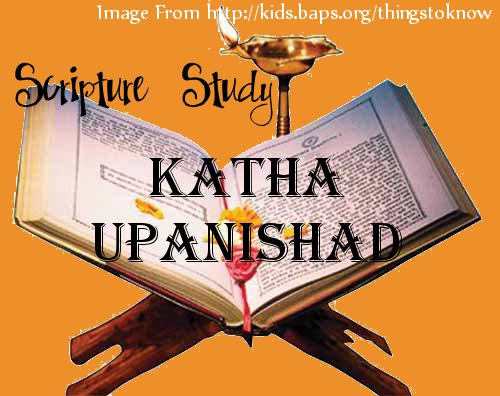
Chapter III http://www.angelfire.com/electronic/awakening101/upani_katha.html
10—11
Beyond the senses are the objects; beyond the objects is the mind; beyond the mind, the intellect; beyond the intellect, the Great Atman; beyond the Great Atman, the Unmanifest; beyond the Unmanifest, the Purusha. Beyond the Purusha there is nothing: this is the end, the Supreme Goal.
12
That Self hidden in all beings does not shine forth; but It is seen by subtle seers through their one—pointed and subtle intellects.
13
The wise man should merge his speech in his mind and his mind in his intellect. He should merge his intellect in the Cosmic Mind and the Cosmic Mind in the Tranquil Self.
14
Arise! Awake! Approach the great and learn. Like the sharp edge of a razor is that path, so the wise say—hard to tread and difficult to cross.
15
Having realised Atman, which is soundless, intangible, formless, undecaying and likewise tasteless, eternal and odourless; having realised That which is without beginning and end, beyond the Great and unchanging—one is freed from the jaws of death.
16
The wise man who has heard and related the eternal story of Nachiketa, told by Death, is adored in the world of Brahman.
17
And he who, practising self—control, recites the supreme secret in an assembly of Brahmins or at a after—death ceremony obtains thereby infinite rewards. Yea, he obtains infinite rewards.
Chapter-III http://www.vedarahasya.net/katha-3.htm
“This purusha remains hidden in all beings and creatures; he is not visible (to the naked eye). He is seen only by those wise seers who are able to do so by concentrated efforts and focused meditation.”“The wise man with subtle intelligence shall restrain the speech in his mind, the mind in the intellect, the intellect in the great soul, and the great soul in the Supreme Divine (from where there is no return to this materialistic world).”“Arise! Awake! Attain the pure knowledge by following the intelligent teachers who practice what they preach. The experienced sages say that the path (leading to self-knowledge) is a risky one since it is sharp as the edge of a knife and also difficult to tread upon or cross over.”
“Having known that which is beyond the aspects of sound, feel, vision, taste and smell, which is unchanged and eternal, which has neither a beginning nor an end, which is beyond even the greatest, which is stable and consistent, one frees himself from the mouth (hungry claws) of death.”
“The intelligent one will become the praised in Brahma loka (the world of Brahma) for the reason of having recited and heard the Naciketa – Upaagyaana (the Naciketas Story) which is ancient and taught directly by Yama, the Lord of Death.”
“That one who propounds this great secret amidst the wise ones who are interested in self-realization or who teaches it with great interest and dedication during the performance of rituals for the dead (by another), will be greatly benefited and blessed. He will be greatly benefited and blessed.”
Commentary (Swami Krishnananda)
How are you to subdue the senses? How is the charioteer to control the horses? They are mad for objects! What steps are we to take? This difficult effort on the part of the soul is called indriya-samyama or manonigraha.
What do we see? The world of objects. The senses see objects and move towards them. They see only the forms which are called objects and do not understand that there is something behind them. So they are running towards them, thinking that there is something in the object which they themselves lack. Looked at in this way, objects are superior to the senses. But we do not want objects; we want to enjoy their colour, taste, touch etc. Thus, a distinction has to be drawn between objects and their qualities or essence, or substance. These subtle essences, hidden in the objects, are superior to them. The senses want not the objects, but the characteristics hidden in them. The objects are not really the centre of desire. They are only a vehicle which holds the counterpart to our interest. We therefore want to utilise objects as agents for our satisfaction.
…Whatever be the state in which we are, we are going from one change to another. This indicates that there is something seriously wrong in this world. We are like a person walking on one leg, or riding a cycle with one wheel. It can stand as long as it moves, and when it does not move, it falls. There is only ‘becoming’ everywhere, and there is no ‘being’. Our whole life is activity, not existence.
…Beyond the drop is the stream; beyond the stream is the rivulet; beyond the rivulet is the river; and beyond the river is the ocean. There is nothing beyond the ocean. This is what these mantras say. Beyond the senses is the essence of the tanmatras; beyond them is the mind; beyond it is the intellect; beyond it is the virat; beyond It ishiranyagarbha; beyond It is ishvara or avyakta; beyond which is the purusha, and beyond the purusha there is nothing.
…The ocean of the world is limited, but this Ocean is not only outside the things that flow, but also within. While the ocean is at one end of the river, this Ocean is everywhere. God calls us at all places in the world, not merely in the temples and churches. His presence is not only at one end of the world, in heaven. He is everywhere.
(There is much more at the website where I got this material, I highly recommend going over there and reading through it!)
My Thoughts
The imagery of the sharp edge of the razor, difficult to walk across, reminds me a lot of the Biblical image of “narrow is the gate and few are those who enter.” Maintaining our balance in life and remaining focused on the goal is incredibly tricky!
The concept of our desire for objects really being a desire for the qualities hidden within them reminds me of Plato’s concept of the idea object.
Previous Post

April 28, 2014
Why Do I Have to Walk on Eggshells?
Next Post

April 30, 2014 Should Children Meditate?
Browse Our Archives
Select a Category Book Club Hindu Holiday How Am I Being a Hindu This Week? Inside the Life Meet a God Meet a Guru Movie Club Philosophy Corner Resources Scripture Uncategorized Wild Card
Select a Month February 2020 September 2019 May 2019 January 2019 December 2018 November 2018 October 2018 September 2018 August 2018 June 2018 May 2018 April 2018 March 2018 February 2018 January 2018 December 2017 November 2017 October 2017 September 2017 August 2017 July 2017 June 2017 May 2017 April 2017 March 2017 February 2017 January 2017 December 2016 November 2016 October 2016 September 2016 August 2016 July 2016 June 2016 May 2016 April 2016 March 2016 February 2016 January 2016 December 2015 November 2015 October 2015 September 2015 August 2015 July 2015 June 2015 May 2015 April 2015 March 2015 February 2015 January 2015 December 2014 November 2014 October 2014 September 2014 August 2014 July 2014 June 2014 May 2014 April 2014 March 2014 February 2014 January 2014 December 2013 November 2013 October 2013 September 2013 August 2013 July 2013 June 2013 May 2013 April 2013 March 2013 February 2013 January 2013 December 2012
Follow Us!
TAKE THE
Religious Wisdom Quiz
What is the longest verse in the Bible?
Select your answer to see how you score.
Psalm 119:105 Romans 8:28 John 3:16 Esther 8:9
Related posts from The White Hindu
Scripture Study: Bhagavad Gita, book four, verses 16-18
Scripture Study: Bhagavad Gita, book four, verses 12-15
Scripture Study: Bhagavad Gita, book four, verses 8-11
Best Bhagavad Gita Quotes #Krishna
TRENDING AT PATHEOS Hindu

Indian Hindu pilot’s valor in line of duty...
There is a hoary maritime tradition that the captain of the...

Movie on Neem Karoli Baba’s life is a...
Neem Karoli Baba’s life (1900-1973) is associated with miracles he made in...

20 Questions to Ask Before an Interfaith Marriage,...
Four questions every interfaith couple should discuss before marriage: Conversion. Will either...

Avadhānam: The Art of Concentration and Intellectual Mastery
What is Avadhānam? In the summer of 2015, during a three-day Sanskrit...

Jesus in the Dharma: Where Christ Fits in...
Where Does Jesus Fit in Hinduism? That’s a question I get often...

Hormuz: A Shared Hindu and Zoroastrian Heritage
Every evening, somewhere in the world, a newsreader utters the words: "The...
view all Hindu blogs
Ad-Free & Subscriber Log-In Subscription Support
- About Us
- 2026 Calendar
- Videos
- Podcasts
- Library of World Religions
- Faith In Media Tracker
- Advertise With Us
- Write for Us
- Privacy Policy
- Terms of Service
- Do Not Sell My Data
- Contact Us
- Radiant Digital
- Manage Newsletter Subscriptions
- Unsubscribe From Notifications
- Sitemap
Copyright 2008-2026, Patheos. All rights reserved.
Subscription Support Ad-Free & Subscriber Log-In
Follow Patheos