
BuddhistCatholicContemplativeEvangelicalGeneral ChristianHinduJewishLatter-day SaintMuslimNew VisionsProgressive Christian
Beliefs
- Buddhist
- Catholic
- Contemplative
- Evangelical
- General Christian
- Hindu
- Jewish
- Latter-day Saint
- More Voices
- Muslim
- New Visions
- Pagan
- Progressive Christian
Topics
- Religion News
- Food and Religion
- Sports and Religion
- Religious Art
- Religious Music and Entertainment
- Religious Events
- History and Religion
- Style and Religion
- Politics and Religion
- Women in Religion
- Recreation Outdoors and Religion
- Business Finance and Religion
- Careers Workplace and Religion
- Education and Religion
- Family Parenting and Religion
- Health Fitness and Religion
- Home and Religion
- Relationships and Religion
- Technology and Religion
- Travel and Religion
Columnists
- Buddhist Columnists
- Business Finance and Religion Columnists
- Careers Workplace and Religion Columnists
- Catholic Columnists
- Contemplative Columnists
- Education and Religion Columnists
- Evangelists Columnists
- Family Parenting and Religion Columnists
- General Christian Columnists
- Health Fitness and Religion Columnists
- Hindu Columnists
- History and Religion Columnists
- Home and Religion Columnists
- Jewish Columnists
- More Voices Columnists
- Latter Day Columnists
- Muslim Columnists
- New Visions Columnists
- Nonreligious Columnists
- Pagan Columnists
- Politics and Religion Columnists
- Progressive Columnists
- Recreation Outdoors and Religion Columnists
- Relationships and Religion Columnists
- Religion News Columnists
- Religious Art Columnists
- Religious Events Columnists
- Religious Music and Entertainment Columnists
- Sports and Religion Columnists
- Style and Religion Columnists
- Technology and Religion Columnists
- Travel and Religion Columnists
- Women in Religion Columnists
Resource Library
- 2026 Calendar
- Library of World Religions
- The 100 Most Holy Places on Earth
- Patheos Answers
- Podcasts
- Videos
- Faith Leaders Database
- Anglican Episcopalian
- Bahai
- Baptist
- Buddhism
- Christianity
- Confucianism
- Eastern Orthodoxy
- Hinduism
- Holiness and Pentecostal
- ISKCON
- Islam
- Judaism
- Lutheran
- Methodist
- The Church of Jesus Christ of Latter-day Saints
- New Age
- Paganism
- Presbytarian and Reformed
- Protestantism
- Religion Behind the Scenes
- Roman Catholic
- Scientology
- Shia Islam
- Sikhism
- Sufism
- Sunni Islam
- Taoism
- Zen
- See all religions
Research Tools
 Ad-Free & Subscriber Log-In Subscription Support
Ad-Free & Subscriber Log-In Subscription Support
Follow Patheos 

- Trending:
- Forgiveness
- |
- Marriage
- |
- Consciousness
- |
- Death Penalty
- |
- Election
- |
- Halloween
 The White Hindu
-
Hinduism Basics
-
More
- Home
- Hindu
- Reading the Upanishads: Katha part four
Reading the Upanishads: Katha part four
Last updated on: March 13, 2015 at 10:32 pm by Ambaa Choate
Reading the Upanishads: Katha part four 2015-03-13T22:32:18-04:00 Ambaa Choate
Patheos Explore the world's faith through different perspectives on religion and spirituality! Patheos has the views of the prevalent religions and spiritualities of the world.
We are doing a scripture study together: reading along through some scriptures and discussing the passages. Today is the fourth post of my favorite Upanishad: The Katha. This is the story of a boy who chatted with the God of death.
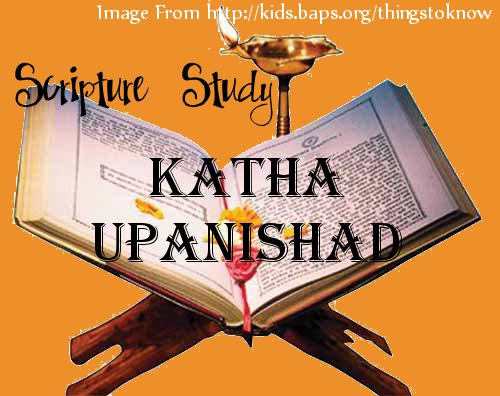
Part Two http://www.angelfire.com/electronic/awakening101/upani_katha.html
10
Yama said: I know that the treasure resulting from action is not eternal; for what is eternal cannot be obtained by the non—eternal. Yet I have performed the Nachiketa sacrifice with the help of non—eternal things and attained this position which is only relatively eternal.
11
The fulfilment of desires, the foundation of the universe, the rewards of sacrifices, the shore where there is no fear, that which adorable and great, the wide abode and the goal—all this you have seen; and being wise, you have with firm resolve discarded everything.
12
The wise man who, by means of concentration on the Self, realises that ancient, effulgent One, who is hard to be seen, unmanifest, hidden and who dwells in the buddhi and rests in the body—he, indeed, leaves joy and sorrow far behind.
13
The mortal who has heard this and comprehended it well, who has separated that Atman, the very soul of dharma, from all physical objects and has realised the subtle essence, rejoices because he has obtained that which is the cause of rejoicing. The Abode of Brahman, I believe, is open for Nachiketa.
14
Nachiketa said: That which you see as other than righteousness and unrighteousness, other than all this cause and effect, other than what has been and what is to be—tell me That.
15
Yama said: The goal which all the Vedas declare, which all austerities aim at and which men desire when they lead the life of continence, I will tell you briefly: it is Om.
16
This syllable Om is indeed Brahman. This syllable is the Highest. Whosoever knows this syllable obtains all that he desires.
17
This is the best support; this is the highest support. Whosoever knows this support is adored in the world of Brahma.
18
The knowing Self is not born; It does not die. It has not sprung from anything; nothing has sprung from It. Birthless, eternal, everlasting and ancient, It is not killed when the body is killed.
19
If the killer thinks he kills and if the killed man thinks he is killed, neither of these apprehends aright. The Self kills not, nor is It killed.
20
Atman, smaller than the small, greater than the great, is hidden in the hearts of all living creatures. A man who is free from desires beholds the majesty of the Self through tranquillity of the senses and the mind and becomes free from grief.
21
Though sitting still, It travels far; though lying down, It goes everywhere. Who but myself can know that luminous Atman who rejoices and rejoices not?
22
The wise man, having realised Atman as dwelling within impermanent bodies but Itself bodiless, vast and all—pervading, does not grieve.
23
This Atman cannot be attained by the study of the Vedas, or by intelligence, or by much hearing of sacred books. It is attained by him alone whom It chooses. To such a one Atman reveals Its own form.
24
He who has not first turn away from wickedness, who is not tranquil and subdued and whose mind is not at peace, cannot attain Atman. It is realised only through the Knowledge of Reality.
25
Who, then, knows where He is—He to whom Brahmins and kshattriyas are mere food and death itself a condiment?
Chapter-II http://www.vedarahasya.net/katha-2.htm
“I know that the wealth saved and protected is illusory. One cannot attain the ever-existent, permanent wealth of Self-Knowledge through and by the use of temporary, illusory objects that you see in the daily life of the materialistic world. Still, I have taught you the technique of Naciketa-agni which can be performed with the worldly objects and which can take you to the ultimate knowledge path. Since I have done this, I will also be eligible for being in this position (of Yama and also of the knowledgeable one) for infinite years to come.”
“O Naciketas! Thou hath attained this state of Knowledge which is at the end border of the satiation of all desires, the reside of the whole world, the end-result of all deeds, the place of no fear in which everything else is centered, that which is praised by all, the limitless one, the all-pervading and the one which is the life of the life (breath) through sheer will power and strong mind! O the Brave one! You have crossed all those things that are of illusory nature.”
“The brave one who, by continuous practice of meditation on the self, identifies and understands the Self (the classic, bright force of power) which is hard to be seen but that which is present within all things, which is the hidden thing and remains in the brain-cave of every being and the oldest of all things, he immediately leaves behind himself all sorts of happiness as well as sorrows. He remains unaffected by either of these.”
“The man who has understood it as it is and who has segregated the root of dharma using his intelligence and sense and having attained the smallest atom of the Atma will obtain that which is deeply enjoyable and remains ever-joyous. I think the house of salvation is kept open for thou, O Naciketas”.
Naciketas: “That thing which you see as beyond both Dharma and Adharma, and that which is beyond activity and cause, and that which is beyond the produced and the one to be produced, kindly tell me about that”.
Yama: “That is the one which is praised by all the Vedas; the same is the object of end-result of all penances; desire of attaining the same is the reason for practice of celibacy. I shall tell you that thing in short. It is the syllable ‘OM’ (also written as AUM).”
“This syllable (OM) is the (lower aspect of) Brahman; this is the highest aspects of Brahman as well. If one understands this, he gets all his desires fulfilled. Whatever he desires for becomes his immediately.”
“This support is the best; this support is the highest as well. The one who understands this support becomes the blessed one in the Brahma Loka.”
“One who has understood this truth beyond doubt – he is not born again; nor does he die. This Atma is not given birth to or produced by something. Nothing else is produced from this Atma also. This (the Atma) is birth less, ever existent and immortal. It precedes everything else and it is not destroyed even when the physical body (where it resides) is destroyed.”
“A killer, who thinks that he has killed (the Atma) and the killed, who thinks that he (the Atma) has been killed are both wrong. Both of them do not understand the Atma. This (Atma) does not kill nor can it be killed.”
“This Atma, which is smaller than the smallest atom and which is larger than the largest one, resides in the heart of the Jivan. That one who has completely renounced his desires, he can see the Atma. (Having thus relinquished his desires,) he understands the greatness of the Atma through the clarity of the mind and an attitude that is not stained by sorrows.”
“Sitting at just one place, it (the Atma) travels long; laying down at a place, it goes everywhere. Who else can understand that Supreme Soul, which resides in me in the forms of both pleasure and sorrow except me (since it is inside me that it resides)?”
“The wise one who understands the Atma, which resides in the bodies without a body and which is a stable thing residing in instable forms and which is very large and all pervading, as himself (the feeling of: ‘I am He’) does not get affected by any sorrow.”
“This Atma cannot be attained (or understood) by an aspirant simply by learning the Vedas or by brilliant brain or by elaborate questioning sessions or debates. It is only when the aspirant mediates exclusively on the Atma (by the Atma), it is attainable by him. Then the Atma illumines its true form to him.”
“That one who has not come out of his bad habits, the one who has no control over his sense organs, the one who is not able to control and direct his mind in attaining peace – all of these cannot attain the Atma just by reason of possessing greater knowledge or awareness.”
“The Atma to which the four kinds of people (viz the Brahmanas, the Kshatriyas, the Vysyas and the Sudras) are like basic food and to which me, the Yama (the one who has the entire world as his basic food) is like a pickle – who can understand what it is in reality?”
Commentary (Swami Krishnananda)
There is a transition of instruction between the lower and the higher, vaishvanara–agniand hiranyagarbha. “I know that all the treasures of the world are perishable, and that the perishable cannot be a means to the imperishable. Yet, as a candidate of the celestial realm, I performed the vaishvanara sacrifice. I have reached the everlasting by impermanent means.”
This is a difficult mantra to understand, and various commentators have different opinions about it. Some think it is spoken by Yama; some others, by Nachiketas. There is no ‘uvacha’ in the Upanishad like in the Bhagavadgita. However, it cannot be Nachiketas saying it for at least one reason. The speaker says, ‘I have performed thenachiketas-agni’, so they must be Yama’s words. Because Nachiketas has only heard about it but has not yet performed it.
Anandagiri’s comment, which has been accepted by many, says that this is the teaching of Yama to Nachiketas, revealing the former’s own personal condition. “Do you know how I have become Yama, the Lord of Death? It is by performing the vaishvanara–agni. I know it does not by itself lead to the absolute Truth. It is anitya and through it one cannot reach the nitya.” This means that nothing of this world can lead you to the imperishable; even the higher realms are, like this world, for the senses even though objects come closer in these higher realms because of their subtlety. The residents ofbrahma-loka do not have a physical or even subtle body, but have only a causal one, merely one step below the Absolute where it makes no difference as to where things are; everything is everywhere. But there is something higher than these levels: the subject of the third boon, which Yama refuses to teach.
All desires are due to a sense of separation from the beloved object. The longing to unite oneself with that from which one is separated is desire. The urge to come together is desire. So, when you come into union with an object, you seem to be in a state of fulfillment. But, says the Upanishad, this is not really fulfilling wants, because they rise again, like a creditor coming again and again until his dues are cleared. If they had really been fulfilled, why should desires rise again? They are not satisfied with what you give, because in a so-called enjoyment, you do not unite. The whole world cannot make you happy because you never can come into union with it, and because you fail in this, you take another birth. Yet, you do not learn the lesson. Your understanding cannot arise, precisely due to the desires. Satisfaction comes only in the ocean of hiranyagarbha. Here, you reach a state of perpetual balance. You do not stand opposed to the object of desire, as you do now. You are able to move freely into the very soul of it. There is no isolation of subject-object, and hence there is perpetual happiness.
The chant of Om is in itself a great sadhana. It puts the whole system into spiritual balance. “This is the supreme mantra,” says Yama, “the supreme Brahman, akshara.”Akshara means a letter, a word, a phrase. It also means imperishable. So it is all this. If at all you can reach Brahman by any means, it is by Om. It is the Supreme, beyond which there is nothing.
This is a very famous, often quoted verse: “Not by speech can He be known; not by the intellect, not even by hearing.” Speech returns baffled. Who expresses speech? The Atman! Who can express the Atman? Even rationality, His partial expression through the buddhi which is a modification of prakriti, cannot express Him. Frail is the intellect when it tries to stretch itself beyond its limits. As a person who cuts the branch on which he sits will fall down, he who tries to know the Atman through the intellect will break. All the faculties of the human mind break down when they try to turn towards the Atman. “He is known only by him whom He chooses.” If God chooses, you may know; otherwise not. This is the interpretation of the Bhakti School. It is God’s grace that He gives youdarshan. By a miracle taking place, you can see God; not by ordinary effort.
But Sankara’s interpretation is unique: It is not that someone chooses, because, for Sankara, that someone does not exist to choose. His understanding of this part of the mantra is: “He is beheld only by That which is the seeker himself.” That which you behold is within yourself, is the meaning. Who is the seeker? Is he outside the Atman? God is the prompter even behind the seeker. Sadhana is not possible without Him. Rather than from without, the choice has to come from within. The seeker and the sought are one.
My Thoughts
These lines are, without a doubt, my favorite in the world:
The knowing Self is not born; It does not die. It has not sprung from anything; nothing has sprung from It. Birthless, eternal, everlasting and ancient, It is not killed when the body is killed.
If the killer thinks he kills and if the killed man thinks he is killed, neither of these apprehends aright. The Self kills not, nor is It killed.
The similarity here with the message of the Gita is pretty stunning. This, it seems to me, is a consistent teaching in Hinduism.
Another great line is: “The wise man, having realised Atman as dwelling within impermanent bodies but Itself bodiless, vast and all—pervading, does not grieve.”
It is certainly most difficult to wrap our minds around how the Atman can be both permanent and part of an impermanent body. That might be why we need more than our minds to comprehend Truth fully, as the next sentence suggests.
Previous Post

March 31, 2014
Ayurveda For General Health
Next Post
April 2, 2014 We Must Love Above All
Browse Our Archives
Select a Category Book Club Hindu Holiday How Am I Being a Hindu This Week? Inside the Life Meet a God Meet a Guru Movie Club Philosophy Corner Resources Scripture Uncategorized Wild Card
Select a Month February 2020 September 2019 May 2019 January 2019 December 2018 November 2018 October 2018 September 2018 August 2018 June 2018 May 2018 April 2018 March 2018 February 2018 January 2018 December 2017 November 2017 October 2017 September 2017 August 2017 July 2017 June 2017 May 2017 April 2017 March 2017 February 2017 January 2017 December 2016 November 2016 October 2016 September 2016 August 2016 July 2016 June 2016 May 2016 April 2016 March 2016 February 2016 January 2016 December 2015 November 2015 October 2015 September 2015 August 2015 July 2015 June 2015 May 2015 April 2015 March 2015 February 2015 January 2015 December 2014 November 2014 October 2014 September 2014 August 2014 July 2014 June 2014 May 2014 April 2014 March 2014 February 2014 January 2014 December 2013 November 2013 October 2013 September 2013 August 2013 July 2013 June 2013 May 2013 April 2013 March 2013 February 2013 January 2013 December 2012
Follow Us!
TAKE THE
Religious Wisdom Quiz
How many books are in the major prophets section of the Old Testament?
Select your answer to see how you score.
3 5 7 4
Related posts from The White Hindu


Show Your Hindu Pride in New Gear!

Mental Health in the Hindu Community

TRENDING AT PATHEOS Hindu

Indian Hindu pilot’s valor in line of duty...
There is a hoary maritime tradition that the captain of the...

Movie on Neem Karoli Baba’s life is a...
Neem Karoli Baba’s life (1900-1973) is associated with miracles he made in...

20 Questions to Ask Before an Interfaith Marriage,...
Four questions every interfaith couple should discuss before marriage: Conversion. Will either...

Avadhānam: The Art of Concentration and Intellectual Mastery
What is Avadhānam? In the summer of 2015, during a three-day Sanskrit...

Jesus in the Dharma: Where Christ Fits in...
Where Does Jesus Fit in Hinduism? That’s a question I get often...

Hormuz: A Shared Hindu and Zoroastrian Heritage
Every evening, somewhere in the world, a newsreader utters the words: "The...
view all Hindu blogs
Ad-Free & Subscriber Log-In Subscription Support
- About Us
- 2026 Calendar
- Videos
- Podcasts
- Library of World Religions
- Faith In Media Tracker
- Advertise With Us
- Write for Us
- Privacy Policy
- Terms of Service
- Do Not Sell My Data
- Contact Us
- Radiant Digital
- Manage Newsletter Subscriptions
- Unsubscribe From Notifications
- Sitemap
Copyright 2008-2026, Patheos. All rights reserved.
Subscription Support Ad-Free & Subscriber Log-In
Follow Patheos