
BuddhistCatholicContemplativeEvangelicalGeneral ChristianHinduJewishLatter-day SaintMuslimNew VisionsProgressive Christian
Beliefs
- Buddhist
- Catholic
- Contemplative
- Evangelical
- General Christian
- Hindu
- Jewish
- Latter-day Saint
- More Voices
- Muslim
- New Visions
- Pagan
- Progressive Christian
Topics
- Religion News
- Food and Religion
- Sports and Religion
- Religious Art
- Religious Music and Entertainment
- Religious Events
- History and Religion
- Style and Religion
- Politics and Religion
- Women in Religion
- Recreation Outdoors and Religion
- Business Finance and Religion
- Careers Workplace and Religion
- Education and Religion
- Family Parenting and Religion
- Health Fitness and Religion
- Home and Religion
- Relationships and Religion
- Technology and Religion
- Travel and Religion
Columnists
- Buddhist Columnists
- Business Finance and Religion Columnists
- Careers Workplace and Religion Columnists
- Catholic Columnists
- Contemplative Columnists
- Education and Religion Columnists
- Evangelists Columnists
- Family Parenting and Religion Columnists
- General Christian Columnists
- Health Fitness and Religion Columnists
- Hindu Columnists
- History and Religion Columnists
- Home and Religion Columnists
- Jewish Columnists
- More Voices Columnists
- Latter Day Columnists
- Muslim Columnists
- New Visions Columnists
- Nonreligious Columnists
- Pagan Columnists
- Politics and Religion Columnists
- Progressive Columnists
- Recreation Outdoors and Religion Columnists
- Relationships and Religion Columnists
- Religion News Columnists
- Religious Art Columnists
- Religious Events Columnists
- Religious Music and Entertainment Columnists
- Sports and Religion Columnists
- Style and Religion Columnists
- Technology and Religion Columnists
- Travel and Religion Columnists
- Women in Religion Columnists
Resource Library
- 2026 Calendar
- Library of World Religions
- The 100 Most Holy Places on Earth
- Patheos Answers
- Podcasts
- Videos
- Faith Leaders Database
- Anglican Episcopalian
- Bahai
- Baptist
- Buddhism
- Christianity
- Confucianism
- Eastern Orthodoxy
- Hinduism
- Holiness and Pentecostal
- ISKCON
- Islam
- Judaism
- Lutheran
- Methodist
- The Church of Jesus Christ of Latter-day Saints
- New Age
- Paganism
- Presbytarian and Reformed
- Protestantism
- Religion Behind the Scenes
- Roman Catholic
- Scientology
- Shia Islam
- Sikhism
- Sufism
- Sunni Islam
- Taoism
- Zen
- See all religions
Research Tools
 Ad-Free & Subscriber Log-In Subscription Support
Ad-Free & Subscriber Log-In Subscription Support
Follow Patheos 

- Trending:
- Forgiveness
- |
- Marriage
- |
- Consciousness
- |
- Death Penalty
- |
- Election
- |
- Halloween
 The White Hindu
-
Hinduism Basics
-
More
- Home
- Hindu
- Reading the Upanishads: Katha part two
Reading the Upanishads: Katha part two
Last updated on: March 13, 2015 at 10:32 pm by Ambaa Choate
Reading the Upanishads: Katha part two 2015-03-13T22:32:24-04:00 Ambaa Choate
Patheos Explore the world's faith through different perspectives on religion and spirituality! Patheos has the views of the prevalent religions and spiritualities of the world.
Sorry there wasn’t a post yesterday, I’ve been sick all weekend 🙁 But I’m back on track now! Today is another Hindi practice day on Twitter, so come on over if you’d like to participate!
***
We are doing a scripture study together: reading along through some scriptures and discussing the passages. Today is the third post of my favorite Upanishad: The Katha. This is the story of a boy who chatted with the God of death.
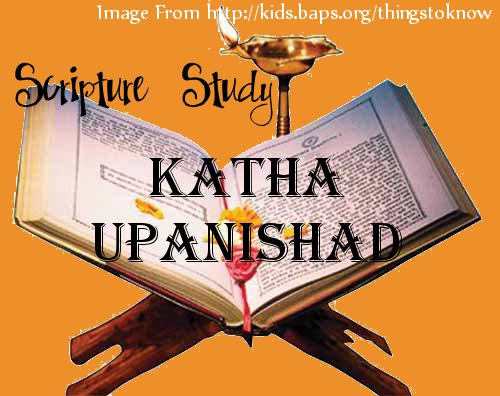
Chapter One (part two) http://www.vedarahasya.net/katha-1.htm
Naciketas replies: “ O Yama! My father, Gowthama, is very upset and filled with sorrow on thinking about me. He is deeply disturbed about my coming here. Let him forget all his anger, sorrow and confusion and let him become quite happy and contented. Let him receive me (when released by you again) with pleasure and bless me. I request thou to grant me this as the first boon.”
Yama: “ Your father (by reason of my grant) will get rid of all his anger and sorrow and will receive you with great pleasure. He will be able to sleep peacefully all nights and will also take care of you quite well.”
Naciketas: “There is no fear in the Heaven. You are also not there. There is no fear of agedness. Nor do we have the problems of hunger and thirst. Thus, the man who has attained Heaven remains there with all happiness.”
“You know the fire-related Homa practice that can lead one to Heaven. O Yama! I request you to kindly teach me that art and I assure that I will attend to it with all sincerity. As the second boon, I request you to grant me that knowledge which those who have attained the Heaven possess.”
Yama: “O Naciketas! As I know that Homa practice fully well, I shall also teach you that art which takes leads one to the path of Heaven. Understand this clearly and carefully. This instrument, which is ideal to attaining Heaven, is hidden in the cave of intelligence (buddhih) in the man. Identify and understand this.”
Yama then taught Naciketas this agni vidya (Homa Practice), which is the means for attaining Heaven and also about the structure of the Homa place, the components to be used, the stones to be used in constructing the sacrificial stage etc. Naciketas immediately grasped it and repeated it (for confirmation) to Yama. Yama was very happy with his sincerity and understanding power. Hence, as a satisfied Guru, he granted another boon to Naciketas and told him: “ Let this agni vidyaa become known to the world by your name itself. And I also present you with this necklace which consists of beautiful beads and precious stones (including diamonds) of various colors.”
“That one who has performed the Naciketas Sacrifice (the agni vidyaa will now be known by this name) thrice (after having learnt it, understood and followed) will be linked to Vedas, Smrutis and the sishtaacharam. He becomes eligible to perform the three duties of Homa or Yajna, Adhyayana and Daana (ritual sacrifice, study of the Vedas and the act of gifting or giving) and crosses the sea of births and deaths. He gets to identify Agni (the Fire-God who was born of the Supreme Being, the knower of all and the respectable one) as the Atma or the Soul. By this, he also attains immeasurable peace.”
“That one who knows these three-fold aspect of Naciketa agni and abides by these three things and properly performs the worship of Naciketa agni will destroy all the bindings placed on him by Yama in the form of adharma (doing those things that are not legal as per the Vedas or are strictly prohibited from being done), ignorance, anger and other inhuman behavior and related tendencies, even before his death and lives his life in Heaven with infinite joy and without a grain of sorrow.”
“O Naciketas! As the second boon, you have been taught what you wanted to learn – the agni vidyaa that leads one to Heaven. This practice of worship shall hereafter be known to the world by your name. O Naciketas! Go ahead and request your third boon now.”
Naciketas speaks: “When a man dies, his Atma or the Jivan leaves the physical body and starts out on an entourage. The questions as to where the Jivan goes, where is its destination, what is its status till the destination is reached etc (about death and the thereafter) remain the subject of great debate and interpretation. Some people (wise men) explain this in one way and others interpret the same subject in other ways that seem to be totally unrelated. Now as the third boon, I hereby request thou to explain to me the truth and clear explanatory answers to the above questions.”
To this Yama replies: “This has been the subject of great doubt and debate even among the Devas. This is not something that can be known very easily. This is a very complex, weird, uncanny and yet quite secretive subject. Ask me something else. Don’t pressurize me for this one.”
Naciketas: “O Yama! You have now accepted that this has been the subject of great doubt even among the Devas and also that this cannot be understood very easily. This being the case, there can be no other person who can explain and elaborate on this subject than you (who is the authority on this). There is no equal for this to be asked as the third boon.”
Yama: “You can request for sons and grandsons who will live for a long time (hundred years), for a massive herd of cattle, for elephants or horses, for pots of gold etc. I am ready to offer you all of these. You can even ask for a great portion of the earth to be under your ruling and control. Ask for a longer life for yourself. I can grant you all of these.”
“In line with the above, ask for anything else that can equal this much of wealth and life, if you desire that. O Naciketas! You can rule a huge portion of the world. I can materialize all of your desires.”
“Whatever other things are there in the world to be enjoyed by a human, ask for that from me and I shall grant you that. These women (now with me) are always found with only the Devas and with the court musicians. They (their beauty) cannot be even dreamt of by human beings. I shall send them with you for doing service to you. O Naciketas! I can grant you all of the above things. (Please) Do not ask me about death and the thereafter.”
Naciketas (addressing Yama): “O blind one! All those things that you have offered to grant me are subject to decay, if not today, by tomorrow at least. And all these things are directed at depriving and depreciating man of all his virility and strength of his limbs. Even if you grant me a longer life, that again is of no use (since I am going to die someday). At the end, all the vehicles, music, dance (all those offered by you to me) will again become yours (after death)”.
“Man can never be satisfied with material things. (Even if he is satisfied with worldly objects, it will last only for a short while. The next desire will start at the immediate moment.) Once I have had a vision of thou, we will certainly attain all the things that we desire. I need not even request for that as a boon. We will also live until such time you decide to come and take us back. Hence, the third boon that I requested for remains unaltered.”
“Having met with (and interacted with) wise men who are not subject to aging and death and still having to live the life on earth as a slave to both of them, which man of reasonable sense would like to live here for a long time having known the transitory and momentary nature of all the things that allow him to enjoy and please the sense organs.”
“O God of Death! Thou shall explain to us that heavenly matter about which all the people are having great doubts and which is not easily understandable and which is hidden beyond the reach of the normal human. Naciketas, (I) does not desire any other grant apart from this one.”
http://www.yoga-age.com/upanishads/katha.html
X
- Nachiketas said: May Gautama, my father, be free from anxious thought (about me). May he lose all anger (towards me) and be pacified in heart. May he know and welcome me when I am sent back by thee. This, O Death, is the first of the three boons I choose.
XI
- Yama replied: Through my will Auddalaki Aruni (thy father) will know thee, and be again towards thee as before. He will sleep in peace at night. He will be free from wrath when he sees thee released from the mouth of death.
XII
- Nachiketas said: In the realm of heaven there is no fear, thou (Death) art not there; nor is there fear of old age. Having crossed beyond both hunger and thirst and being above grief, (they) rejoice in heaven.
XIII
- Thou knowest, O Death, the fire–sacrifice that leads to heaven. Tell this to me, who am full of Shraddha (faith and yearning). They who live in the realm of heaven enjoy freedom from death. This I beg as my second boon.
XIV
- Yama replied: I know well that fire which leads to the realm of heaven. I shall tell it to thee. Listen to me. Know, O Nachiketas, that this is the means of attaining endless worlds and their support. It is hidden in the heart of all beings.
XV
- Yama then told him that fire–sacrifice, the beginning of all the worlds; what bricks, how many and how laid for the altar. Nachiketas repeated all as it was told to him. Then Death, being pleased with him, again said:
XVI
- The great–soured Yama, being well pleased, said to him (Nachiketas): I give thee now another boon. This fire (sacrifice) shall be named after thee. Take also this garland of many colours.
XVII
- He who performs this Nachiketa fire–sacrifice three times, being united with the three (mother, father and teacher), and who fulfills the three–fold duty (study of the Vedas, sacrifice and alms–giving) crosses over birth and death. Knowing this worshipful shining fire, born of Brahman, and realizing Him, he attains eternal peace.
XVIII
- He who knows the three–fold Nachiketa fire and performs the Nachiketa fire–sacrifice with three–fold knowledge, having cast off the fetters of death and being beyond grief, he rejoices in the realm of heaven.
XIX
- O Nachiketas, this is thy fire that leads to heaven, which thou hast chosen as thy second boon. People will call this fire after thy name. Ask the third boon, Nachiketas. Fire is regarded as “the foundation of all the worlds,” because it is the revealer of creation. If there were no fire or light, no manifested form would be visible. We read in the Semitic Scriptures, “In the beginning the Lord said, ‘Let there be light.”‘ Therefore, that which stands in the external universe as one of the purest symbols of the Divine, also dwells in subtle form in the heart of every living being as the vital energy, the life–force or cause of existence.
- Yama now tells Nachiketas how, by performing sacrifice with the three–fold knowledge, he may transcend grief and death and reach heaven. The three–fold knowledge referred to is regarding the preparation of the altar and fire. Nachiketas being eager to learn, listened with wholehearted attention and was able to repeat all that was told him. This so pleased Yama that he granted him the extra boon of naming the fire–sacrifice after him and gave him a garland set with precious stones.
XX
- Nachiketas said: There is this doubt regarding what becomes of a man after death. Some say he exists, others that he does not exist. This knowledge I desire, being instructed by thee. Of the boons this is the third boon.
XXI
- Yama replied: Even the Devas (Bright Ones) of old doubted regarding this. It is not easy to know; subtle indeed is this subject. O Nachiketas, choose another boon. Do not press me. Ask not this boon of me.
XXII
- Nachiketas said: O Death, thou sayest that even the Devas had doubts about this, and that it is not easy to know. Another teacher like unto thee is not to be found. Therefore no other boon can be equal to this one.
XXIII
- Yama said: Ask for sons and grandsons who shall live a hundred years, many cattle, elephants, gold and horses. Ask for lands of vast extent and live thyself as many autumns as thou desirest.
XXIV
- If thou thinkest of any other boon equal to this, ask for wealth and long life; be ruler over the wide earth. O Nachiketas, I shall make thee enjoyer of all desires.
XXV
- Whatsoever objects of desire are difficult to obtain in the realm of mortals, ask them all as thou desirest; these lovely maidens with their chariots and musical instruments, such as are not obtainable by mortals–be served by these whom I give to thee. O Nachiketas, do not ask regarding death.
- The third boon asked by Nachiketas concerning the great Hereafter was one which could be granted only to those who were freed from all mortal desires and limitations, therefore Yama first tested Nachiketas to see whether he was ready to receive such knowledge. “Do not press me regarding this secret,” he said. “Even wise men cannot understand it and thou art a mere lad. Take, rather, long life, wealth, whatever will give thee happiness on the mortal plane.” But the boy proved his strength and worthiness by remaining firm in his resolution to know the great secret of life and death.
XXVI
- Nachiketas said: O Death, these are fleeting; they weaken the vigour of all the senses in man. Even the longest life is short. Keep thou thy chariots, dance and music.
XXVII
- Man cannot be satisfied by wealth. Shall we possess wealth when we see thee (Death)? Shall we continue to live as long as thou rulest? Therefore that boon alone is to be chosen by me.
XXVIII
- What man dwelling on the decaying mortal plane, having approached the undecaying immortal one, and having reflected upon the nature of enjoyment through beauty and sense pleasure, would delight in long life?
XXIX
- O Death, that regarding which there is doubt, of the great Hereafter, tell us. Nachiketas asks for no other boon than that which penetrates this hidden secret.
Summary
Here begin the three requests that Nachiketas makes. Movingly, his first request is that his father’s distress be eased. Naturally, his father is pretty upset that his son has gone off to Death!
As a second request, Nachiketas asks for the ritual by which he can go to heaven. However, the Hindu concept of heaven is not eternal. As pleasant as it may be, it doesn’t last and eventually one does have to return to earth and the cycle of death and rebirth.
The third question is to know the truth about the soul and what happens to it after death.
Yama begs Nachiketas to choose any other boon. Yama has happily given the other two things, but this he does not want to give! One of the translations suggests that this is Yama’s test to make sure Nachiketas is really serious, trying to put him off by offering him temptations.
Nachiketas realizes that the other things Yama offers– like great wealth, power, land– don’t last. He is resolute in finding out the greatest secret of the universe because everyone who does not know this secret is a “slave” to death.
Commentaries
Swami Krishnananda has a fascinating take on the first boon.
“This implies that Nachiketas must return, and when returned, should be recognised. He wants normal circumstances to prevail when he returns. This is the result of fasting for one night: one becomes normal in a spiritual sense, and the world from which the soul rose accepts it truly. Many believe this verse to mean that by the power of fasting, austerity etc., a seeker can gain world-renown; you will wield a power which the world will recognise. This is a boon, but also a temptation of which one has to be cautious. A person, who was just a part of the world, now becomes a world figure. Every seeker will have to pass through this stage, and to each one it will come in a different shape.”
Every seeker will start with a stage of world renown to get through? I haven’t heard that before. I guess I could see how some spiritual seekers get derailed once their efforts begin to pay off and people take notice!
“… Mara said to him: “You have attained the highest! Go and preach to the world!” If one yields to this, he returns before reaching the topmost level, feeling a satisfaction that the world recognises him, and spiritual pride takes over. It is difficult to truly transcend this stage; and it is doubtful if there is anyone now who has done it. It would be a rise to universal renown and universal knowledge.”
Of the second boon the Swami says that the Agni Homa being spoken of is one in which the sacrifice takes place entirely in the mind without the actual physical objects: “the actual sacrifice is contemplated in the mind, without material objects.”
The gift of a necklace is explained by the Swami in this way: “In mystical texts, the spiritual experience in this condition is compared to a garland of different colours that adorns the seeker, indicating manifold experiences and not only a single one.”
In the third boon, the question Nachiketas asks “…is not the death people normally undergo but the other one, when the soul crosses all phenomena. Does it exist there, or does it get extinguished?” The Swami points out that both Yajnavalkya (a great sage) and Buddha were also asked this question.
Of the things Yama offers instead:
These are temptations in the path of sadhana, to which Nachiketas gave a prompt and befitting reply. All objects Yama offered come under the eshanas. There are three of them: vitteshana, putreshana and lokeshana, also called kanchana, kamini, and kirti; the desire for gold, the desire for sex and the desire for fame; these three bind the soul and prevent its further progress. Yama offered everything except God, with the intention to trick Nachiketas; but his ruse is met with equal strength of viveka andvairagya: the power of renunciation backed up by understanding.
…who can ask for a long life? It is full of pain, and a long life is only extending the misery. No one who knows of That which perishes not, would want what you are offering.”
Once Nachiketas rejects temptation, the Swami says:
The student has proved his worth. The glamour has not tempted him, and he has stood the test successfully. This is the transitional process which is necessary between the first two boons and the experience of immortality. The temptation of the Buddha is relevant here: everything was offered to him. The difficulty is that one cannot know them as temptations, because they come as realities and it requires a superior intelligence to detect them and find out from where they have come, and why they have come. The condensed essence of all delights of all the worlds will come before us as a bar against our progress. But when viveka helps us, Truth shall reveal itself.
The world, through its laws, wants to prevent us from straying away; like sheep in a herd should we keep doing. Thus, the laws of the world to which we are tied take these forms, and the more we try to go away from them, the more they try to pull us towards them, and our attempts will be useless if they are inadequate. These are inconceivable ordeals. We cannot even imagine them now, and when we are really placed in such a condition, we will weep, not knowing where we are standing. Nachiketas is the representative of human character passing through a crisis.
Previous Post
March 15, 2014
Movie Club: OMG discussion
Next Post

March 19, 2014 Phases of the Convert
Browse Our Archives
Select a Category Book Club Hindu Holiday How Am I Being a Hindu This Week? Inside the Life Meet a God Meet a Guru Movie Club Philosophy Corner Resources Scripture Uncategorized Wild Card
Select a Month February 2020 September 2019 May 2019 January 2019 December 2018 November 2018 October 2018 September 2018 August 2018 June 2018 May 2018 April 2018 March 2018 February 2018 January 2018 December 2017 November 2017 October 2017 September 2017 August 2017 July 2017 June 2017 May 2017 April 2017 March 2017 February 2017 January 2017 December 2016 November 2016 October 2016 September 2016 August 2016 July 2016 June 2016 May 2016 April 2016 March 2016 February 2016 January 2016 December 2015 November 2015 October 2015 September 2015 August 2015 July 2015 June 2015 May 2015 April 2015 March 2015 February 2015 January 2015 December 2014 November 2014 October 2014 September 2014 August 2014 July 2014 June 2014 May 2014 April 2014 March 2014 February 2014 January 2014 December 2013 November 2013 October 2013 September 2013 August 2013 July 2013 June 2013 May 2013 April 2013 March 2013 February 2013 January 2013 December 2012
Follow Us!
TAKE THE
Religious Wisdom Quiz
Which minor prophet foretells the coming of Elijah before the day of the Lord?
Select your answer to see how you score.
Malachi Obadiah Joel Haggai
Related posts from The White Hindu


Show Your Hindu Pride in New Gear!

Mental Health in the Hindu Community
TRENDING AT PATHEOS Hindu

Indian Hindu pilot’s valor in line of duty...
There is a hoary maritime tradition that the captain of the...

Movie on Neem Karoli Baba’s life is a...
Neem Karoli Baba’s life (1900-1973) is associated with miracles he made in...

20 Questions to Ask Before an Interfaith Marriage,...
Four questions every interfaith couple should discuss before marriage: Conversion. Will either...

Avadhānam: The Art of Concentration and Intellectual Mastery
What is Avadhānam? In the summer of 2015, during a three-day Sanskrit...

Jesus in the Dharma: Where Christ Fits in...
Where Does Jesus Fit in Hinduism? That’s a question I get often...

Hormuz: A Shared Hindu and Zoroastrian Heritage
Every evening, somewhere in the world, a newsreader utters the words: "The...
view all Hindu blogs
Ad-Free & Subscriber Log-In Subscription Support
- About Us
- 2026 Calendar
- Videos
- Podcasts
- Library of World Religions
- Faith In Media Tracker
- Advertise With Us
- Write for Us
- Privacy Policy
- Terms of Service
- Do Not Sell My Data
- Contact Us
- Radiant Digital
- Manage Newsletter Subscriptions
- Unsubscribe From Notifications
- Sitemap
Copyright 2008-2026, Patheos. All rights reserved.
Subscription Support Ad-Free & Subscriber Log-In
Follow Patheos