
BuddhistCatholicContemplativeEvangelicalGeneral ChristianHinduJewishLatter-day SaintMuslimNew VisionsProgressive Christian
Beliefs
- Buddhist
- Catholic
- Contemplative
- Evangelical
- General Christian
- Hindu
- Jewish
- Latter-day Saint
- More Voices
- Muslim
- New Visions
- Pagan
- Progressive Christian
Topics
- Religion News
- Food and Religion
- Sports and Religion
- Religious Art
- Religious Music and Entertainment
- Religious Events
- History and Religion
- Style and Religion
- Politics and Religion
- Women in Religion
- Recreation Outdoors and Religion
- Business Finance and Religion
- Careers Workplace and Religion
- Education and Religion
- Family Parenting and Religion
- Health Fitness and Religion
- Home and Religion
- Relationships and Religion
- Technology and Religion
- Travel and Religion
Columnists
- Buddhist Columnists
- Business Finance and Religion Columnists
- Careers Workplace and Religion Columnists
- Catholic Columnists
- Contemplative Columnists
- Education and Religion Columnists
- Evangelists Columnists
- Family Parenting and Religion Columnists
- General Christian Columnists
- Health Fitness and Religion Columnists
- Hindu Columnists
- History and Religion Columnists
- Home and Religion Columnists
- Jewish Columnists
- More Voices Columnists
- Latter Day Columnists
- Muslim Columnists
- New Visions Columnists
- Nonreligious Columnists
- Pagan Columnists
- Politics and Religion Columnists
- Progressive Columnists
- Recreation Outdoors and Religion Columnists
- Relationships and Religion Columnists
- Religion News Columnists
- Religious Art Columnists
- Religious Events Columnists
- Religious Music and Entertainment Columnists
- Sports and Religion Columnists
- Style and Religion Columnists
- Technology and Religion Columnists
- Travel and Religion Columnists
- Women in Religion Columnists
Resource Library
- 2026 Calendar
- Library of World Religions
- The 100 Most Holy Places on Earth
- Patheos Answers
- Podcasts
- Videos
- Faith Leaders Database
- Anglican Episcopalian
- Bahai
- Baptist
- Buddhism
- Christianity
- Confucianism
- Eastern Orthodoxy
- Hinduism
- Holiness and Pentecostal
- ISKCON
- Islam
- Judaism
- Lutheran
- Methodist
- The Church of Jesus Christ of Latter-day Saints
- New Age
- Paganism
- Presbytarian and Reformed
- Protestantism
- Religion Behind the Scenes
- Roman Catholic
- Scientology
- Shia Islam
- Sikhism
- Sufism
- Sunni Islam
- Taoism
- Zen
- See all religions
Research Tools
 Ad-Free & Subscriber Log-In Subscription Support
Ad-Free & Subscriber Log-In Subscription Support
Follow Patheos 

- Trending:
- Forgiveness
- |
- Marriage
- |
- Consciousness
- |
- Death Penalty
- |
- Election
- |
- Halloween
 The White Hindu
-
Hinduism Basics
-
More
- Home
- Hindu
- Reading the Upanishads: Katha part one
Reading the Upanishads: Katha part one
Last updated on: March 13, 2015 at 10:32 pm by Ambaa Choate
Reading the Upanishads: Katha part one 2015-03-13T22:32:26-04:00 Ambaa Choate
Patheos Explore the world's faith through different perspectives on religion and spirituality! Patheos has the views of the prevalent religions and spiritualities of the world.
First off, I have to say that last week’s Hindi on Twitter was a great success. I got over my fear to try writing and producing sentences in Hindi and people on Twitter were very supportive and gave me helpful tips. They corrected my grammar and most importantly, explained why what I was doing was wrong! So I’m trying it again today. Join me on Twitter if you’d like to check out my Hindi skills (or lack thereof! lol).
***
We are doing a scripture study together: reading along through some scriptures and discussing the passages. Today is the first post of my favorite Upanishad: The Katha. This is the story of a boy who chatted with the God of death.
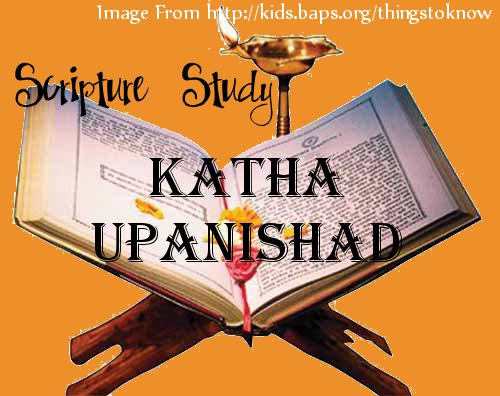
Part One http://www.angelfire.com/electronic/awakening101/upani_katha.html
Chapter I
1
Vajasravasa, desiring rewards, performed the Visvajit sacrifice, in which he gave away all his property. He had a son named Nachiketa.
2—3
When the gifts were being distributed, faith entered into the heart of Nachiketa, who was still a boy. He said to himself: Joyless, surely, are the worlds to which he goes who gives away cows no longer able to drink, to eat, to give milk, or to calve.
4
He said to his father: Father! To whom will you give me? He said this a second and a third time. Then his father replied: Unto death I will give you.
5
Among many I am the first; or among many I am the middlemost. But certainly I am never the last. What purpose of the King of Death will my father serve today by thus giving me away to him?
6
Nachiketa said: Look back and see how it was with those who came before us and observe how it is with those who are now with us. A mortal ripens like corn and like corn he springs up again.
7
Verily, like fire a brahmin guest enters a house; the householder pacifies him by giving him water and a seat. Bring him water. O King of Death!
8
The brahmin who dwells in a house, fasting, destroys that foolish householder’s hopes and expectations, the reward of his intercourse with pious people, the merit of his kindly speech, the good results of his sacrifices and beneficial deeds and his cattle and children as well.
9
Yama said: O Brahmin, salutations to you! You are a venerable guest and have dwelt in my house three nights without eating; therefore choose now three boons, one for each night, O Brahmin! May all be well with me!
Part First: http://www.yoga-age.com/upanishads/katha.html
I
- Vahasrava, being desirous of heavenly rewards (at the Viswajit sacrifice), made a gift of all that he possessed. He had a son by the name of Nachiketas.
II
- When the offerings were being distributed, faith (Shraddha) entered (the heart of)Nachiketas, who, though young, yet resected:
III
- These cows have drunk water, eaten grass and given milk for the last time, and their senses have lost all vigour. He who gives these undoubtedly goes to joyless realms. In India the idea of sacrifice has always been to give freely for the joy of giving, without asking anything in return; and the whole purpose and merit of the sacrifice is lost, if the giver entertains the least thought of name, fame or individual benefit. The special Viswajit sacrifice which Vajasrava was making required of him to give away all that he possessed. When, however, the gifts were brought forward to be offered, his son Nachiketas, although probably a lad about twelve years of age, observed how worthless were the animals which his father was offering. His heart at once became filled with Shraddha. There is no one English word which can convey the meaning of this Sanskrit term. It is more than mere faith. It also implies self–reliance, an independent sense of right and wrong, and the courage of one’s own conviction. As a boy of tender age, Nachiketas had no right to question his father’s action; yet, impelled by the sudden awakening of his higher nature, he could not but reflect: “By merely giving these useless cows, my father cannot gain any merit. If he has vowed to give all his possessions, then he must also give me. Otherwise his sacrifice will not be complete and fruitful.” Therefore, anxious for his father’s welfare, he approached him gently and reverently.
IV
- He said to his father: Dear father, to whom wilt thou give me? He said it a second time, then a third time. The father replied: I shall give thee unto Death. Nachiketas, being a dutiful son and eager to atone for his father’s inadequate sacrifice, tried to remind him thus indirectly that he had not fulfilled his promise to give away all his possessions, since he had not yet offered his own son, who would be a worthier gift than useless cattle. His father, conscious that he was not making a true sacrifice, tried to ignore the boy’s questions; but irritated by his persistence, he at last impatiently made answer: “I give thee to Yama, the Lord of Death.” The fact that anger could so quickly rise in his heart proved that he had not the proper attitude of a sacrificer, who must always be tranquil, uplifted and free from egoism.
V
- Nachiketas thought: Among many (of my father’s pupils) I stand first; among many (others) I stand in the middle (but never last). What will be accomplished for my father by my going this day to Yama?
- It was not conceit which led Nachiketas to consider his own standing and importance. He was weighing his value as a son and pupil in order to be able to judge whether or not he had merit enough to prove a worthy gift. Although he realized that his father’s harsh reply was only the expression of a momentary outburst of anger; yet he believed that greater harm might befall his father, if his word was not kept. Therefore he sought to strengthen his father’s resolution by reminding him of the transitory condition of life. He said:
VI
- Look back to those who lived before and look to those who live now. Like grain the mortal decays and like grain again springs up (is reborn).
- All things perish, Truth alone remains. Why then fear to sacrifice me also; Thus Nachiketas convinced his father that he should remain true to his word and send him to Yama, the Ruler of Death. Then Nachiketas went to the abode of Death, but Yama was absent and the boy waited without food or drink for three days. On Yama’s return one of his household said to him:
VII
- Like fire a Brahmana guest enters into houses. That fire is quenched by an offering. (Therefore) O Vaivaswata, bring water.
VIII
- The foolish man in whose house a Brahmana guest remains without food, all his hopes and expectations, all the merit gained by his association with the holy, by his good words and deeds, all his sons and cattle, are destroyed. According to the ancient Vedic ideal a guest is the representative of God and should be received with due reverence and honor. Especially is this the case with a Brahmana or a Sannyasin whose life is wholly consecrated to God. Any one who fails to give proper care to a holy guest brings misfortune on himself and his household. When Yama returned, therefore, one of the members of his household anxiously informed him of Nachiketas’ presence and begged him to bring water to wash his feet, this being always the first service to an arriving guest.
IX
- Yama said: O Brahmana! Revered guest! My salutations to thee. As thou hast remained three nights in my house without food, therefore choose three boons, O Brahmana.
Chapter-I : http://www.vedarahasya.net/katha-1.htm
Having desired to attain the highest results (of spiritual enlightenment), (the man by name) Vaajasravas conducted a yaaga (a Hindu ritual where oblations are made to different forms of God through sacrifices to the fire and by gifting certain specified things to others) called “Viswajith” as specified in the Veda Saastras. This was a very well known fact. He had a son by the name of “Naciketas”.
During the conduct of the yaaga, the young boy Naciketas, by reason of his sincerity (in the ritual and other dharmaas), seeing the ritual being performed, got anxious. He thought as under:
“These cows (which were being gifted to others as part of the rite) have drunk the water, have eaten the grass, have been milked and have lost all their vigil and virility. Whoever gifts these (old, by all means of no use to the receiver or the donee) cows will certainly go to those worlds (after his death) which are in blinding dark and which are deprived of joy and happiness”.
Having thought of this, he went to his father and asked him this: “O father! To whom are you going to gift me?” (The father did not answer since he was fully busy in the performance of the rituals. However, Naciketas continuously disturbed him with the same question for another two times.) Becoming flustered with his son, he said “I shall gift thee to Yama (the Controller / God of Death)”.
Naciketas thought: “Among the disciples, I will either go first; or in the middle; what is there that I can do to Yama; what would have my father planned for me to do to Yama?”
“One has to consider the way of life which his forefathers had adopted and understand the guiding principles; and should try to follow them in his life. Man dies like a shrub and comes back to the earth like the shrub again.”
Naciketas told his father the above and obtained his approval to leave for the world of Yama. He eventually reached there only to find that Yama was not available in his residence. So he waited outside Yama’s House for three full days without a grain of food. When Yama came back, he was shocked to see Naciketas waiting for him for three days without consuming any food. In olden days, it was considered a crime to make a guest wait in someone’s place without giving him adequate food and shelter. More so for a Brahmin and for a young Brahmachari (celibates, established in the pursuit of Dharma).
Yama was advised by his people as under: “A Brahmin Guest enters your house as the Fire (representing the Fire-God) itself. He is pacified by the wise who provide him with all sorts of respects and treating him with enough food and water. O Yama! Go immediately and bring some water (to perform some respect to the Guest)”.
“That fool who allows a Brahmin to stay in his house without taking any food will suffer from heavy loss since all his desires, determination, association with wise men, good deeds, good words, penance, service to the society, servants, cattle etc are all destroyed by him (the Brahmin) who is in the form of Fire (representing the Fire God).
Yama, on hearing all this, appeals to Naciketas: “ O Brahmana! Since you, my respectable guest, have stayed at my home without consuming anything for three long days, I hereby pray to you to have that sin removed. I should be completely cleansed of this sin and continue getting good results. For these to happen, I hereby agree to grant you three boons. (One for each day of his stay). Tell me what do you want now.”
Summary
So, a man named Vajasravasa has a son, Nachiketas. The man is performing a Vedic ritual that will make him look holy and charitable by giving away lots of things, such as his cows. His son observes that the father seems to be cheating by giving away cows that are already old and not useful anyway. What kind of a reward is that going to give? This is no sacrifice at all.
Seeing how his father is giving away all his possessions, Nachiketas wonders if he too is a possession to be given away. He keeps asking his father, as children do, until the dad snaps and gives his smart-ass answer: “I give you to Death.”
I’ve heard Nachiketas’s response translated as “Whether I go now or later makes no difference” and so he sets off for the house of Yama, the God of Death.
Yama isn’t home and so Nachiketas sits outside his home for three days. This is a disgrace for Yama as host and so he is obligated to offer something to make up for the wait. He offers three favors for the three days.
Commentaries
We should take the word “Brahmin” here in the sense given to it by the Gita: a Brahmin is one who is devoted to Brahman, the highest Reality, he is a seeker of the Spirit and serves It. A particular duty laid on the society of that age was to support and give due respect to this topmost class; for the true prestige and worth of a society depend not on its visible power or prosperity but on the richness of its inner growth. –Nolinin Kanta Gupta
Desiring did he perform the sacrifice. The intention behind it was to gain heavenly pleasure. This represents the purely exoteric aspect of religion, the outward form of devotion and faith as different from the internal spirit or the esoteric significance of practice. While [Vajasravasa] represents the outer form of religion, Nachiketas symbolises the inner spirit**. The former attitude expects something from every religious act: ‘What shall I get from my pilgrimage, from a sacred bath, etc.?’ These are the questions of this mind. ‘If I will not get something, I will not be religious’.** This attitude exhibits a commercial attitude leading to bigotry. While the outer form is necessary—like the legs of a person who can walk with them but needs a head to think with—it is inadequate by itself. The spirit should go hand in hand with the form. So, religion is different from spirituality, though it is very necessary. The outer form of worship should be an expression of inner surrender, and not a mere symbol. This is what [Vajasravasa’s] sacrifice lacked. Desiring something he performed the sacrifice, but did not part with everything he had, as was required by its spirit. –Swami Krishnananda
[Machiketas] was a great spiritual example for all times to come, though his question was impertinent. –Swami Krishnananda
Three times asked Nachiketas this question. The answer was, “Unto death I offer you.” Though this was the answer to the son, it mystically means the death of the soul. Three times asked the boy, implying the ‘I’ has to be given up in three stages, not at once. The first one is the physical offering, followed by the subtle and the causal, because we are this threefold being; we can also call it conscious, subconscious and unconscious. –Swami Krishnananda
Previous Post

March 10, 2014
Volunteering When White
Next Post

March 12, 2014 Holi Hai! [Hindu Holiday]
Browse Our Archives
Select a Category Book Club Hindu Holiday How Am I Being a Hindu This Week? Inside the Life Meet a God Meet a Guru Movie Club Philosophy Corner Resources Scripture Uncategorized Wild Card
Select a Month February 2020 September 2019 May 2019 January 2019 December 2018 November 2018 October 2018 September 2018 August 2018 June 2018 May 2018 April 2018 March 2018 February 2018 January 2018 December 2017 November 2017 October 2017 September 2017 August 2017 July 2017 June 2017 May 2017 April 2017 March 2017 February 2017 January 2017 December 2016 November 2016 October 2016 September 2016 August 2016 July 2016 June 2016 May 2016 April 2016 March 2016 February 2016 January 2016 December 2015 November 2015 October 2015 September 2015 August 2015 July 2015 June 2015 May 2015 April 2015 March 2015 February 2015 January 2015 December 2014 November 2014 October 2014 September 2014 August 2014 July 2014 June 2014 May 2014 April 2014 March 2014 February 2014 January 2014 December 2013 November 2013 October 2013 September 2013 August 2013 July 2013 June 2013 May 2013 April 2013 March 2013 February 2013 January 2013 December 2012
Follow Us!
TAKE THE
Religious Wisdom Quiz
Who prayed in the lions' den every day?
Select your answer to see how you score.
Daniel David Solomon Paul
Related posts from The White Hindu


Show Your Hindu Pride in New Gear!

Mental Health in the Hindu Community
TRENDING AT PATHEOS Hindu

Indian Hindu pilot’s valor in line of duty...
There is a hoary maritime tradition that the captain of the...

Movie on Neem Karoli Baba’s life is a...
Neem Karoli Baba’s life (1900-1973) is associated with miracles he made in...

20 Questions to Ask Before an Interfaith Marriage,...
Four questions every interfaith couple should discuss before marriage: Conversion. Will either...

Avadhānam: The Art of Concentration and Intellectual Mastery
What is Avadhānam? In the summer of 2015, during a three-day Sanskrit...

Jesus in the Dharma: Where Christ Fits in...
Where Does Jesus Fit in Hinduism? That’s a question I get often...

Hormuz: A Shared Hindu and Zoroastrian Heritage
Every evening, somewhere in the world, a newsreader utters the words: "The...
view all Hindu blogs
Ad-Free & Subscriber Log-In Subscription Support
- About Us
- 2026 Calendar
- Videos
- Podcasts
- Library of World Religions
- Faith In Media Tracker
- Advertise With Us
- Write for Us
- Privacy Policy
- Terms of Service
- Do Not Sell My Data
- Contact Us
- Radiant Digital
- Manage Newsletter Subscriptions
- Unsubscribe From Notifications
- Sitemap
Copyright 2008-2026, Patheos. All rights reserved.
Subscription Support Ad-Free & Subscriber Log-In
Follow Patheos