
BuddhistCatholicContemplativeEvangelicalGeneral ChristianHinduJewishLatter-day SaintMuslimNew VisionsProgressive Christian
Beliefs
- Buddhist
- Catholic
- Contemplative
- Evangelical
- General Christian
- Hindu
- Jewish
- Latter-day Saint
- More Voices
- Muslim
- New Visions
- Pagan
- Progressive Christian
Topics
- Religion News
- Food and Religion
- Sports and Religion
- Religious Art
- Religious Music and Entertainment
- Religious Events
- History and Religion
- Style and Religion
- Politics and Religion
- Women in Religion
- Recreation Outdoors and Religion
- Business Finance and Religion
- Careers Workplace and Religion
- Education and Religion
- Family Parenting and Religion
- Health Fitness and Religion
- Home and Religion
- Relationships and Religion
- Technology and Religion
- Travel and Religion
Columnists
- Buddhist Columnists
- Business Finance and Religion Columnists
- Careers Workplace and Religion Columnists
- Catholic Columnists
- Contemplative Columnists
- Education and Religion Columnists
- Evangelists Columnists
- Family Parenting and Religion Columnists
- General Christian Columnists
- Health Fitness and Religion Columnists
- Hindu Columnists
- History and Religion Columnists
- Home and Religion Columnists
- Jewish Columnists
- More Voices Columnists
- Latter Day Columnists
- Muslim Columnists
- New Visions Columnists
- Nonreligious Columnists
- Pagan Columnists
- Politics and Religion Columnists
- Progressive Columnists
- Recreation Outdoors and Religion Columnists
- Relationships and Religion Columnists
- Religion News Columnists
- Religious Art Columnists
- Religious Events Columnists
- Religious Music and Entertainment Columnists
- Sports and Religion Columnists
- Style and Religion Columnists
- Technology and Religion Columnists
- Travel and Religion Columnists
- Women in Religion Columnists
Resource Library
- 2026 Calendar
- Library of World Religions
- The 100 Most Holy Places on Earth
- Patheos Answers
- Podcasts
- Videos
- Faith Leaders Database
- Anglican Episcopalian
- Bahai
- Baptist
- Buddhism
- Christianity
- Confucianism
- Eastern Orthodoxy
- Hinduism
- Holiness and Pentecostal
- ISKCON
- Islam
- Judaism
- Lutheran
- Methodist
- The Church of Jesus Christ of Latter-day Saints
- New Age
- Paganism
- Presbytarian and Reformed
- Protestantism
- Religion Behind the Scenes
- Roman Catholic
- Scientology
- Shia Islam
- Sikhism
- Sufism
- Sunni Islam
- Taoism
- Zen
- See all religions
Research Tools
 Ad-Free & Subscriber Log-In Subscription Support
Ad-Free & Subscriber Log-In Subscription Support
Follow Patheos 

- Trending:
- Forgiveness
- |
- Marriage
- |
- Consciousness
- |
- Death Penalty
- |
- Election
- |
- Halloween
 The White Hindu
-
Hinduism Basics
-
More
- Home
- Hindu
- How To Use Japa Mala Beads
How To Use Japa Mala Beads
Last updated on: March 13, 2015 at 10:34 pm by Ambaa Choate
How To Use Japa Mala Beads 2015-03-13T22:34:44-04:00 Ambaa Choate
Patheos Explore the world's faith through different perspectives on religion and spirituality! Patheos has the views of the prevalent religions and spiritualities of the world.
Japa Mala beads are the Hindu rosary. I say that so those not familiar with them can get a basic idea of what they are and what they are used for. The Hindu mala beads were certainly in existence long before Christianity was a thing, so there is some evidence that Christianity may have gotten the idea for the rosary from Hinduism. Many cultures do have prayer beads, ways of counting repetitions of mantras or prayers, and they probably all began with Hindu malas.
“The use of beads in prayer appears to have originated around the 8th century B.C.E. in India.”
The word “Mala” you may remember from my post on Hindu wedding garlands. Those garlands are called jai mala or var mala. Mala means garland in Sanskrit. Japa means repetitions and has the connotation of using repeating sounds over and over to build up energy and inner fire. So the japa mala is a garland of repetitions.
The circular nature of the beads connects to the Hindu belief that all life is cyclical and the world exists in cycles.
How to Use
First of all, you’ll need a mantra. You can use a simple Om or Om Namah Shivaya or *Om Ganapati Namah (*I bow to Shiva, I bow to Ganesha, respectively). You also may hear specific mantras for particular attainments, like mantras for fertility, for prosperity, for love, or for peace. ISKCONs use the beads to count out their repetitions of the Hare Krishna mantra. If you find mantras for specific attainments, they will usually give instructions on how many times to repeat the mantra and how often. It is common to see instructions to repeat the mantra 108 times (one for each bead) once a day for 40 or 41 days.
Before you begin the practice, you will make a vow as to how long you’ll be chanting this mantra, so if you decide on 40 days, you promise that to the Gods and must complete it.
I’ve heard it said that while Hindus hold the beads in their right hands, Buddhists use the left. I don’t know how true that is, as my Buddhist husband has never heard that.
Hold the beads over your middle finger, avoiding them touching the tip of your index finger (as the index finger represents ego, a detriment to spiritual development) and move the beads one by one with your thumb.
“In northeast India, particularly those in the Shakta traditions in West Bengal and Assam, the mala is often draped on the ring finger of the right hand, with beads moved by the middle finger with aid of the thumb and avoiding the use of the index finger. However, draping the mala over the middle finger and using the thumb to move the beads is also acceptable in these regions.” –http://www.digplanet.com/wiki/Hindu_prayer_beads
You need to start at the bead next to the larger “bindu” or “guru” bead and go all the way around until you reach that bead again. If you are doing more than 108 recitations of your mantra, you turn and go back around again, not crossing over that larger center bead. Also, if you’re using a smaller “wrist mala” that has 27 beads, you’ll go back and forth 4 times to get to 108.
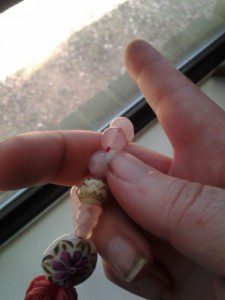
When not in use, it’s good to store the beads within a box or a bag in your puja room. Many malas will come with storage bags.
Some believe that a mala becomes energized with the mantra that you infuse it with, and so you can wear the mala or touch it to someone and have the effects of the mantra you meditated on felt. For this reason, some people keep a different mala for each different purpose or mantra that they wish to use.
Types of Materials
“…the properties of the beads are said to have specific energetic effects.”
Rudraksha Beads: Common for prayers to Shiva.
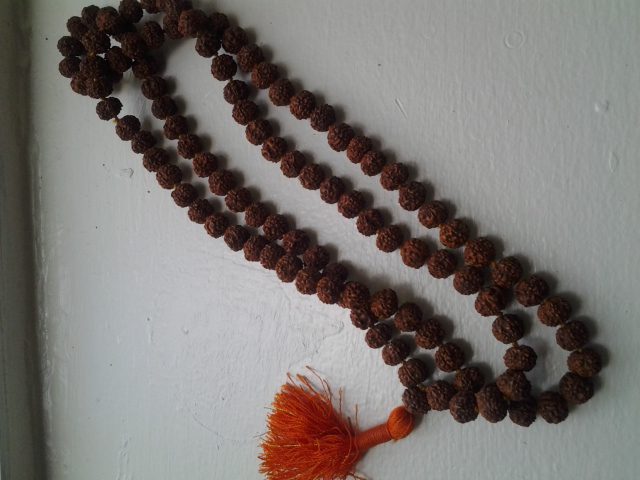
Tulsi Root: Common material for Vaishnava malas and prayers to Krishna, Vishnu, or Rama.

Rosewood: Said to be good for prayers to Ganesha. Also popular among Tibetan Buddhists.
Sandalwood Beads: Said to be good for prosperity.
Gemstone Beads: Different stones and colors can have different meanings and effects. Crystal beads of clear or white are supposed to be best for healing mantras. Some people, such as my husband, believe that different stones and metals and other natural materials have a particular energy to them that makes them good for helping people with particular problems. Each gemstone has properties that it is known for.
Ehow’s list of mala bead materials: http://www.ehow.com/list_6750699_types-mala-beads.html
Tell me, do you mala beads for your meditations?
Previous Post

November 25, 2013
How to Have an American Thanksgiving
Next Post
November 26, 2013 Puja Help From A Surprising Source!
Browse Our Archives
Select a Category Book Club Hindu Holiday How Am I Being a Hindu This Week? Inside the Life Meet a God Meet a Guru Movie Club Philosophy Corner Resources Scripture Uncategorized Wild Card
Select a Month February 2020 September 2019 May 2019 January 2019 December 2018 November 2018 October 2018 September 2018 August 2018 June 2018 May 2018 April 2018 March 2018 February 2018 January 2018 December 2017 November 2017 October 2017 September 2017 August 2017 July 2017 June 2017 May 2017 April 2017 March 2017 February 2017 January 2017 December 2016 November 2016 October 2016 September 2016 August 2016 July 2016 June 2016 May 2016 April 2016 March 2016 February 2016 January 2016 December 2015 November 2015 October 2015 September 2015 August 2015 July 2015 June 2015 May 2015 April 2015 March 2015 February 2015 January 2015 December 2014 November 2014 October 2014 September 2014 August 2014 July 2014 June 2014 May 2014 April 2014 March 2014 February 2014 January 2014 December 2013 November 2013 October 2013 September 2013 August 2013 July 2013 June 2013 May 2013 April 2013 March 2013 February 2013 January 2013 December 2012
Follow Us!
TAKE THE
Religious Wisdom Quiz
What did Job’s wife tell him to do after his suffering began?
Select your answer to see how you score.
Offer a sacrifice for healing Go to the priests for help Leave the city and start over Curse God and die
Related posts from The White Hindu



Show Your Hindu Pride in New Gear!

TRENDING AT PATHEOS Hindu

Indian Hindu pilot’s valor in line of duty...
There is a hoary maritime tradition that the captain of the...

Movie on Neem Karoli Baba’s life is a...
Neem Karoli Baba’s life (1900-1973) is associated with miracles he made in...

20 Questions to Ask Before an Interfaith Marriage,...
Four questions every interfaith couple should discuss before marriage: Conversion. Will either...

Avadhānam: The Art of Concentration and Intellectual Mastery
What is Avadhānam? In the summer of 2015, during a three-day Sanskrit...

Jesus in the Dharma: Where Christ Fits in...
Where Does Jesus Fit in Hinduism? That’s a question I get often...

Hormuz: A Shared Hindu and Zoroastrian Heritage
Every evening, somewhere in the world, a newsreader utters the words: "The...
view all Hindu blogs
Ad-Free & Subscriber Log-In Subscription Support
- About Us
- 2026 Calendar
- Videos
- Podcasts
- Library of World Religions
- Faith In Media Tracker
- Advertise With Us
- Write for Us
- Privacy Policy
- Terms of Service
- Do Not Sell My Data
- Contact Us
- Radiant Digital
- Manage Newsletter Subscriptions
- Unsubscribe From Notifications
- Sitemap
Copyright 2008-2026, Patheos. All rights reserved.
Subscription Support Ad-Free & Subscriber Log-In
Follow Patheos