
BuddhistCatholicContemplativeEvangelicalGeneral ChristianHinduJewishLatter-day SaintMuslimNew VisionsProgressive Christian
Beliefs
- Buddhist
- Catholic
- Contemplative
- Evangelical
- General Christian
- Hindu
- Jewish
- Latter-day Saint
- More Voices
- Muslim
- New Visions
- Pagan
- Progressive Christian
Topics
- Religion News
- Food and Religion
- Sports and Religion
- Religious Art
- Religious Music and Entertainment
- Religious Events
- History and Religion
- Style and Religion
- Politics and Religion
- Women in Religion
- Recreation Outdoors and Religion
- Business Finance and Religion
- Careers Workplace and Religion
- Education and Religion
- Family Parenting and Religion
- Health Fitness and Religion
- Home and Religion
- Relationships and Religion
- Technology and Religion
- Travel and Religion
Columnists
- Buddhist Columnists
- Business Finance and Religion Columnists
- Careers Workplace and Religion Columnists
- Catholic Columnists
- Contemplative Columnists
- Education and Religion Columnists
- Evangelists Columnists
- Family Parenting and Religion Columnists
- General Christian Columnists
- Health Fitness and Religion Columnists
- Hindu Columnists
- History and Religion Columnists
- Home and Religion Columnists
- Jewish Columnists
- More Voices Columnists
- Latter Day Columnists
- Muslim Columnists
- New Visions Columnists
- Nonreligious Columnists
- Pagan Columnists
- Politics and Religion Columnists
- Progressive Columnists
- Recreation Outdoors and Religion Columnists
- Relationships and Religion Columnists
- Religion News Columnists
- Religious Art Columnists
- Religious Events Columnists
- Religious Music and Entertainment Columnists
- Sports and Religion Columnists
- Style and Religion Columnists
- Technology and Religion Columnists
- Travel and Religion Columnists
- Women in Religion Columnists
Resource Library
- 2026 Calendar
- Library of World Religions
- The 100 Most Holy Places on Earth
- Patheos Answers
- Podcasts
- Videos
- Faith Leaders Database
- Anglican Episcopalian
- Bahai
- Baptist
- Buddhism
- Christianity
- Confucianism
- Eastern Orthodoxy
- Hinduism
- Holiness and Pentecostal
- ISKCON
- Islam
- Judaism
- Lutheran
- Methodist
- The Church of Jesus Christ of Latter-day Saints
- New Age
- Paganism
- Presbytarian and Reformed
- Protestantism
- Religion Behind the Scenes
- Roman Catholic
- Scientology
- Shia Islam
- Sikhism
- Sufism
- Sunni Islam
- Taoism
- Zen
- See all religions
Research Tools
 Ad-Free & Subscriber Log-In Subscription Support
Ad-Free & Subscriber Log-In Subscription Support
Follow Patheos 

- Trending:
- Forgiveness
- |
- Marriage
- |
- Consciousness
- |
- Death Penalty
- |
- Election
- |
- Halloween
 Poets and Lunatics
-
Categories
- Home
- New Visions
- Remembering Mister Rogers and the Light He Left
Remembering Mister Rogers and the Light He Left
Last updated on: February 16, 2018 at 8:40 am by Wendy Murray
Remembering Mister Rogers and the Light He Left 2018-02-16T08:39:12-05:00 Wendy Murray
Patheos Explore the world's faith through different perspectives on religion and spirituality! Patheos has the views of the prevalent religions and spiritualities of the world.

Copyright © 2018 Benjamin Zoba. All rights reserved. Used with permission.
By Wendy Murray
Fred “Mister” Rogers died 15 years ago this month. I always think of him in February as the dregs of winter cloak me in discouragement. Thoughts of him bring light and hope. I miss him and I dare say the world misses him. He was a light amid darkness and in his silent, subtle, mighty way, he rescued children — and grown-ups too — from a world that would warp souls.
I had the opportunity to spend a day with him shortly before he died and write a profile about him, and not simply about the wild popularity of his children’s program Mister Rogers’ Neighborhood, but specifically about his personal faith and the theology he brought to developing the show.
The assignment proved a highlight in my career. And, as time would have it, it was the last major feature article written about Fred Rogers before he died in February 2003. It was also the only feature article to peek into the spiritual side of the Neighborhood, to explore the belief system of Fred Rogers — who was an ordained minister — embraced it in his television visits and in his every-day life.
During my visit with him so many years ago I sat with him in his “office,” a small, cramped, eclectic room in Pittsburgh that was a testimony to the people who have “loved him into existence” (his way of putting it). He sat on a well-worn couch and I in a velveteen chair, both from his childhood home of Latrobe, Pennsylvania. He had no desk. He was flanked by stuffed animals and baseball caps, and sometimes stuffed animals wearing baseball caps, that his many neighbors had given him over the years. He showed me a sign that he kept on the table near the door: Freddie, I like you just the way you are. “It was my Grandfather McFeely who said such things as that,” he said. “We used to visit him in the country almost every Sunday. He was the kind of person who would say, ‘You know, you’ve made this a special day by being here.'”
He called his viewers “neighbors” and, for him, the world was filled with neighbors. He called himself a neighbor. And his daily half-hour children’s program, called Mister Rogers’ Neighborhood, was his invitation for children and mothers to come to a safe place filled with quiet moments, like feeding the fish and the arrival of a dinging trolley.
Then he opened his wallet to show me pictures. “I love to know about people,” he says. The “tour through the wallet” included photographs of people he’d known, children of the people he’d known, and, in some instances, people he didn’t know but heard about and cared about:
“This is one of my special friends, Yo-Yo Ma, who is a cellist, and his son,” he said. “He’s a great man. Oh. This is Jonathan Kozol—he writes about children.” There was a picture of Mother Martha and “some of the kids in the Bronx”; a little boy from his church; and another boy with autism who was fixated on hangers. There is a picture of a woman whose husband “was sucked into coal slag and suffocated”; and there is a picture of her two children.
“That’s Chef Brockett.” He paused.
“Oh, that’s what I was looking for: here is Dr. Orr, and Mrs. Orr. She’s still living.”
He told me that in seminary he studied systematic theology with Dr. William S. Orr and that “from then on I took everything he offered; it could have been underwater basket weaving.He was a great influence on many of our lives. Not just because he was brilliant. He was the kind of person who would go out on a winter’s day for lunch and come back without his overcoat.
“Every Sunday my wife and I used to go to the nursing home to visit him. One Sunday we had just sung ‘A Mighty Fortress Is Our God’ and I was full of this one verse. I said, ‘Dr. Orr, we just sang this hymn and I’ve got to ask you about part of it.
” ‘You know where it says—The prince of darkness grim, we tremble not for him. For, lo, his doom is sure . . . . one little word will fell him? Dr. Orr, what is that one thing that would wipe out evil?’
“He said, ‘Evil simply disintegrates in the presence of forgiveness. When you look with accusing eyes at your neighbor, that is what evil would want, because the more the Accuser’—which, of course, is the word Satan in Hebrew—’can spread the accusing spirit, the greater evil spreads.’ Dr. Orr said, ‘On the other hand, if you can look with the eyes of the Advocate on your neighbor, those are the eyes of Jesus.’ I’ve never forgotten that.”
“Life is deep and simple, and what our society gives us is shallow and complicated,” he says. At its worst television can be “degrading, reducing important human feelings to the status of caricature or trivia,” and even “encouraging pathology,” he says.
“Life isn’t cheap. It is the greatest mystery and we all only have one life to live on earth. Through television we can demean or cherish it.”
“I have seen in my life too many indications of what is wonderful about human beings. I think the Accuser would have us be so despairing that we wouldn’t do anything good at all. But you know the effect of one little candlelight in great darkness. That sounds simple, but it’s true. The older I get the more impressed I am with simplicity and silence.
“I do believe that that’s where we can be inspired. Whenever I give a speech now I give a minute of silence for people to think about all those who have helped them to become who they are. Invariably, that’s what people will remember—that silence.”
I asked Mister Rogers if he thought the Neighborhood could be a metaphor for heaven. “We deal with a lot of gritty stuff on the Neighborhood —death, divorce, the need for childcare, separation,” he says. “The Neighborhood is not a Pollyannish state.
“When I think about heaven, it is a state in which we are so greatly loved that there is no fear and doubt and disillusionment and anxiety. It is where people really do look at you with those eyes of Jesus.
“The underlying message of the Neighborhood,” he said, “is that if somebody cares about you, it’s possible that you’ll care about others. ‘You are special, and so is your neighbor’—that part is essential: that you’re not the only special person in the world. The person you happen to be with at the moment is loved, too.
“God, in his great mercy, accepts us exactly as we are. Who could ever stand if God’s faithfulness did not endure?”
Before my day with Mister Rogers came to an end, I asked if I could take his picture.
“Oh, let me take your picture,” he says. “I love 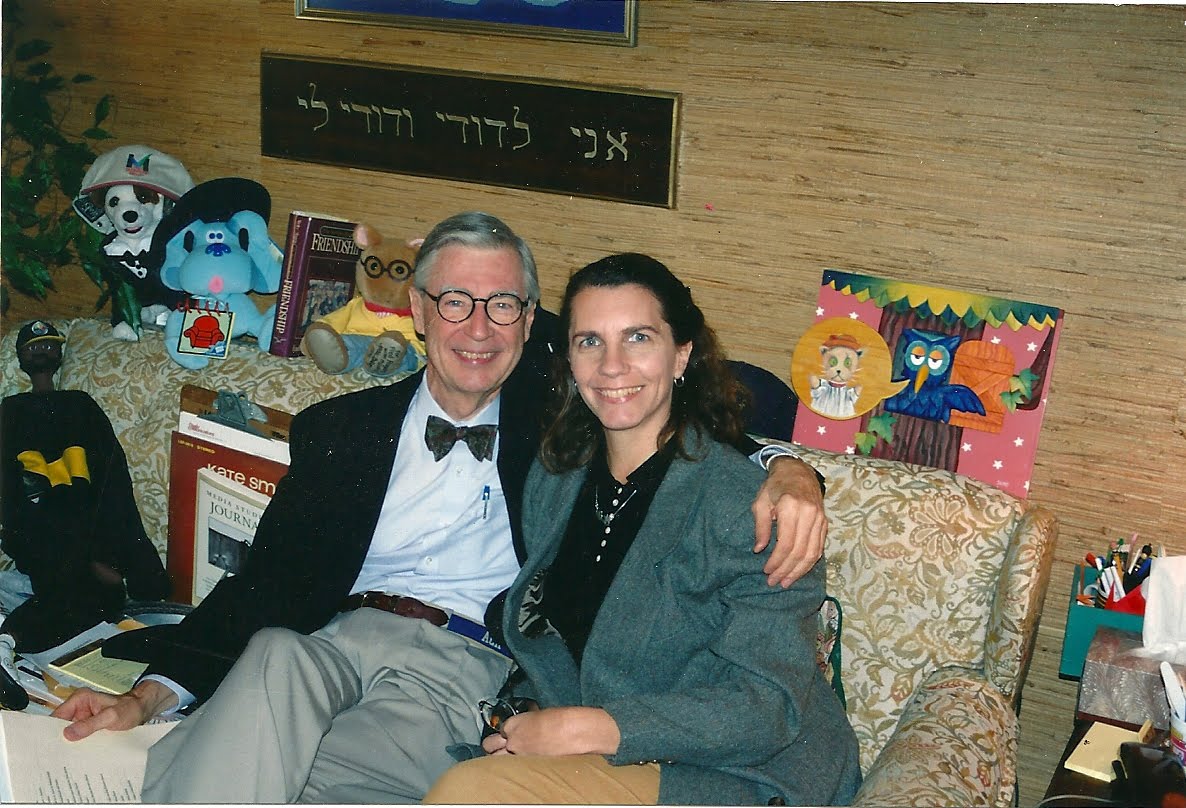 taking pictures of people.”
I sit on his couch—he wanted the illustration of X the Owl and Henrietta Pussycat in the background—and he took my picture. Then “Mr. McFeely” (David Newell) took our picture — Fred Rogers and me, together on his couch, X the Owl over our shoulders, sitting, smiling and safe, together, as neighbors.
Read Fred Rogers’ thoughts about the media here.

Almighty God, bestow upon us the meaning of words, the light of understanding, the nobility of diction, and the faith of the true nature. And grant that what we believe we may also speak.
Saint Hilary (c. 315-368), Bishop of Poitiers
Follow me on Twitter: @WenMurray
Support me on Patreon:
Previous Post

December 20, 2017
Christmas Magic, Actually
Next Post
February 22, 2018 That Time Billy Graham Saved My Faith
Browse Our Archives
Select a Category Abortion Advent Aging Augustine Celtic Prayers Christmas Church Civic Duty Current Events & Issues Dante Depression Divorce Easter Faith Family Fiction Finances God's Love Government Health History Holiness Insanity Interviews Islam Jesus Jesus & Prayer Jesus and Women Jesus' Birth Jesus' Death Journalism Justice Lunatics Medication Mental Health Miracles Money Mothers Mothers and Sons Mystery Pastors Patheos Book Club Plymouth Colony Podcasts Pop Culture Reflections Religion Saint Francis Saints & Champions Sermons Suffering Uncategorized Weddings Woman Caught in Adultery Women Women's Spirituality Writers and Writing
Select a Month March 2018 February 2018 December 2017 November 2017 October 2017 September 2017 July 2017 June 2017 May 2017 April 2017 March 2017 May 2015 April 2015 February 2015 January 2015 October 2014 April 2014 February 2014 January 2014 December 2013 October 2013 August 2013 July 2013 June 2013 April 2013
Follow Us!
TAKE THE
Religious Wisdom Quiz
The glory of this present house will be greater than the glory of the former house. What building is being reconstructed?
Select your answer to see how you score.
The city wall The temple The whole of Jerusalem The palace
Support this
Column


Related posts from Poets and Lunatics

Christmas: From Jesus' Birth to Santa ~ But...

The Catholic Who Paved the Way for Martin...

The Antidote for the World-weary: Spiritual Practice
TRENDING AT PATHEOS New Visions

Did Prayer Cure His Cancer? Or Was It...
At 4 AM one morning, Joshua W. Brown’s wife awoke to a...

8 Ways a Near-Death Experience Rewires the Soul
Does Consciousness Survive Physical Death? After 50 Years of Research, Dr. Raymond...

Holy Longing: What Our Restlessness Is Telling Us
“One can find so many pains when the rain is falling.” -John...

What this is NOT about. This blog is definitely not about...

Who said the Israelites were God’s chosen? That’s right, they did. Who...

The Spirit World Is the Real World: God...
A Monk’s Wisdom on Body and Spirit I sit with Brother Martin...
view all New Visions blogs
Ad-Free & Subscriber Log-In Subscription Support
- About Us
- 2026 Calendar
- Videos
- Podcasts
- Library of World Religions
- Faith In Media Tracker
- Advertise With Us
- Write for Us
- Privacy Policy
- Terms of Service
- Do Not Sell My Data
- Contact Us
- Radiant Digital
- Manage Newsletter Subscriptions
- Unsubscribe From Notifications
- Sitemap
Copyright 2008-2026, Patheos. All rights reserved.
Subscription Support Ad-Free & Subscriber Log-In
Follow Patheos