
BuddhistCatholicContemplativeEvangelicalGeneral ChristianHinduJewishLatter-day SaintMuslimNew VisionsProgressive Christian
Beliefs
- Buddhist
- Catholic
- Contemplative
- Evangelical
- General Christian
- Hindu
- Jewish
- Latter-day Saint
- More Voices
- Muslim
- New Visions
- Pagan
- Progressive Christian
Topics
- Religion News
- Food and Religion
- Sports and Religion
- Religious Art
- Religious Music and Entertainment
- Religious Events
- History and Religion
- Style and Religion
- Politics and Religion
- Women in Religion
- Recreation Outdoors and Religion
- Business Finance and Religion
- Careers Workplace and Religion
- Education and Religion
- Family Parenting and Religion
- Health Fitness and Religion
- Home and Religion
- Relationships and Religion
- Technology and Religion
- Travel and Religion
Columnists
- Buddhist Columnists
- Business Finance and Religion Columnists
- Careers Workplace and Religion Columnists
- Catholic Columnists
- Contemplative Columnists
- Education and Religion Columnists
- Evangelists Columnists
- Family Parenting and Religion Columnists
- General Christian Columnists
- Health Fitness and Religion Columnists
- Hindu Columnists
- History and Religion Columnists
- Home and Religion Columnists
- Jewish Columnists
- More Voices Columnists
- Latter Day Columnists
- Muslim Columnists
- New Visions Columnists
- Nonreligious Columnists
- Pagan Columnists
- Politics and Religion Columnists
- Progressive Columnists
- Recreation Outdoors and Religion Columnists
- Relationships and Religion Columnists
- Religion News Columnists
- Religious Art Columnists
- Religious Events Columnists
- Religious Music and Entertainment Columnists
- Sports and Religion Columnists
- Style and Religion Columnists
- Technology and Religion Columnists
- Travel and Religion Columnists
- Women in Religion Columnists
Resource Library
- 2026 Calendar
- Library of World Religions
- The 100 Most Holy Places on Earth
- Patheos Answers
- Podcasts
- Videos
- Faith Leaders Database
- Anglican Episcopalian
- Bahai
- Baptist
- Buddhism
- Christianity
- Confucianism
- Eastern Orthodoxy
- Hinduism
- Holiness and Pentecostal
- ISKCON
- Islam
- Judaism
- Lutheran
- Methodist
- The Church of Jesus Christ of Latter-day Saints
- New Age
- Paganism
- Presbytarian and Reformed
- Protestantism
- Religion Behind the Scenes
- Roman Catholic
- Scientology
- Shia Islam
- Sikhism
- Sufism
- Sunni Islam
- Taoism
- Zen
- See all religions
Research Tools
 Ad-Free & Subscriber Log-In Subscription Support
Ad-Free & Subscriber Log-In Subscription Support
Follow Patheos 

- Trending:
- Forgiveness
- |
- Marriage
- |
- Consciousness
- |
- Death Penalty
- |
- Election
- |
- Halloween
 Poets and Lunatics
-
Categories
- Home
- New Visions
- Christmas: From Jesus’ Birth to Santa ~ But How?
Christmas: From Jesus’ Birth to Santa ~ But How?
Last updated on: December 14, 2017 at 4:30 pm by Wendy Murray
Christmas: From Jesus’ Birth to Santa ~ But How? 2017-12-14T16:30:04-05:00 Wendy Murray
Patheos Explore the world's faith through different perspectives on religion and spirituality! Patheos has the views of the prevalent religions and spiritualities of the world.
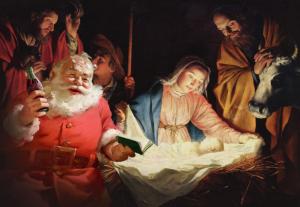
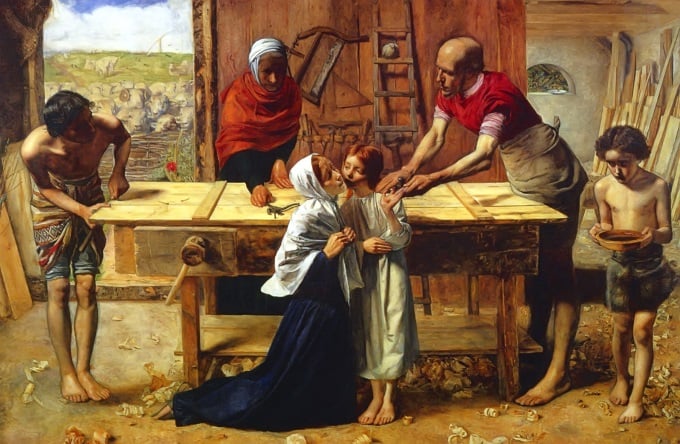
(Public Domain)
Where Did “Christmas” Come From?
Christmas is typically associated with the birth of Jesus, a Jew born in Bethlehem over 2000 years ago. I think we can all agree that the way the holiday is celebrated today carries little resemblance to a barn with animals and hay for a bed. There is an interesting, if convoluted, evolution about this holiday that clearly departs from any logical association of the birth of Jesus and thus the term “Christmas” ought not to invoke outrage. It has as little to do with the actual birth of Jesus as does the term “Kleenex” with all known tissues everywhere used to wipe peoples’ noses.
Some experts in astronomy and other sciences have speculated that Jesus was not born in December, but August, probably around 7 B.C. This conclusion is based upon an extraordinary conjunction of Jupiter and Saturn in the constellation of Pisces that took place same year. No one lied about “the star of Bethlehem.” The conjunction looked liked a blazing transient star in the sky. So those in attendance who documented the events conveyed the only science they knew. And as we all know, nature works in wondrous and miraculous ways.
So how then did Dec. 25 become the epicenter of the Christian holiday (the eight days of Hanukkah, notwithstanding)? And how, in God’s name, did the festivities become associated with a jolly fat man who flies around the world in a sleigh pulled by flying reindeer?
It’s complicated.
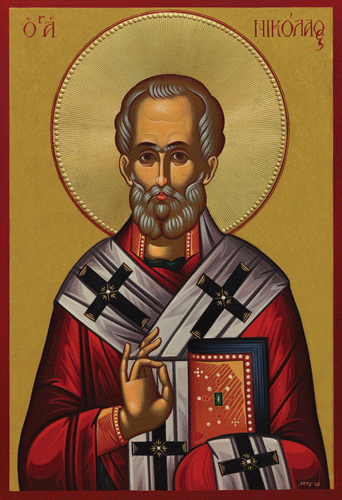 The first Santa Claus had his roots in the early Christian church. His name was Nicholas, bishop of Myra (an ancient city along the Mediterranean coast of what is now Turkey). Other than his living in the fourth century, very little is known about him historically, though oral tradition abounds.
Myra was a key port city where ships stopped on their way to and from Rome, Egypt, and Byzantium. Nicholas is said to have saved Myra from starvation by seizing grain off a ship bound for Byzantium. Because the stolen cargo was never missed it was counted as a miracle. Thus the bishop became the patron saint of sailors.

(Lorenzetti, Ambrogio: Saving Myra from Famine, detail of a panel from Four Stories from the Life of St. Nicholas, tempera on wood by Ambrogio Lorenzetti, c. 1330–32; in the Uffizi Gallery, Florence, Italy)
A second “miracle” associated with Nicholas set the stage for his becoming the inspiration behind Santa Claus. According to tradition, a poor family in Myra had three daughters who were being courted for marriage but who had no dowries. This doomed the girls to a life of shame and possible prostitution. The good bishop took it upon himself to supply their dowries, anonymously slipping bags of gold into their home–some say into stockings that were hanging up to dry. In securing their dowries–and so their right to marry–he rescued them from an otherwise degrading destiny. When Nicholas’s identity as the benefactor became known, so began the adulation of this gift-bearing saint. As a result, he also became the patron saint of children.
He died on December 6, A.D. 345 or 352, and was buried in a small church in Myra. But the story of what became of him after his death is almost more fantastic than the works he was said to have performed during his life.
In that day, the bodies of holy men were of immense value, for both religious and commercial reasons. So on May 9, 1087, sailors from the southern port city of Bari, Italy, raided Myra and stole Nicholas’s remains. The bishop’s bones remain in Bari to this day. The heist effectively transferred the mystery and magic of the oral tradition surrounding Nicholas from the East to the West. It was the first step in the transformation of the provincial bishop into the omniscient superstar.
It didn’t take long for the Westernized Nicholas stories to assume a place in each country’s individual context and tradition. In 16th-century Germany, for example, church Reformers banned celebration of the Feast of St. Nicholas on Dec. 6. Instead, they moved the date a few days after the winter solstice, when the days started to get longer. They sought to emphasize the Christ child, or Christkindlein, who, taking his cue from Nicholas, brought gifts to children on Christmas Eve. This figure evolved into “kristkingle” and eventually “Kriss Kringle,” who was more or less indistinguishable from the mythical Nicholas figure.
The Dutch tradition behind Sinterklaas is the most direct link to the modern American Santa Claus.
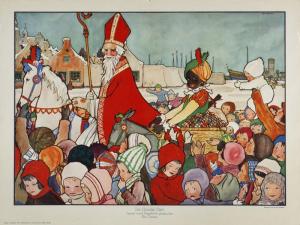
(Drawing By Rie Kramer) is supposed to have sailed from Spain with a Moorish helper named Black Peter and filled Dutch children’s shoes with nuts and candies. had the uncanny ability to know about children’s good or bad behavior. is supposed to have sailed from Spain with a Moorish helper named Black Peter and filled Dutch children’s shoes with nuts and candies. had the uncanny ability to know about children’s good or bad behavior.
This mythical figure is supposed to have sailed from Spain with a Moorish helper named Black Peter and filled Dutch children’s shoes with nuts and candies. Sinterklaas had the uncanny ability to know about children’s good or bad behavior.
The Germans, the Dutch, and others brought their Nicholas traditions when they migrated to the New World. Once ensconced in the United States, the literary community embellished the myth and brought it to the levels it has assumed today. The American Santa was shaped most notably by Union Seminary professor Clement Clark Moore’s 1822 children’s poem “A Visit from St. Nicholas,” which begins with the legendary line: “‘Twas the night before Christmas . . . ” 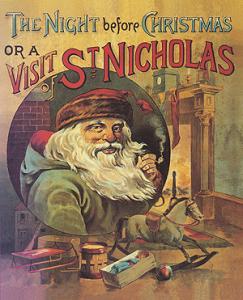
By the early 20th century, Santa appeared in department stores and mail-order houses that vied to be his “official headquarters.” Post offices were overrun with letters to Santa from children who addressed them to “the North Pole.”
The present-day Santa, in his most secular manifestation, is divorced from the spiritual moorings and motivation of the real-life Nicholas. But he still personifies goodness and a kind of justice, which might help explain the terror that arises in some children when they enter his presence. The evolution of the Nicholas story, beyond attesting to the American spirit of entrepreneurial innovation, bears out the overwhelming need people feel to believe in something and to celebrate something greater than themselves.
Next Post

December 11, 2017 Joseph, God's Ordinary Man
Browse Our Archives
Select a Category Abortion Advent Aging Augustine Celtic Prayers Christmas Church Civic Duty Current Events & Issues Dante Depression Divorce Easter Faith Family Fiction Finances God's Love Government Health History Holiness Insanity Interviews Islam Jesus Jesus & Prayer Jesus and Women Jesus' Birth Jesus' Death Journalism Justice Lunatics Medication Mental Health Miracles Money Mothers Mothers and Sons Mystery Pastors Patheos Book Club Plymouth Colony Podcasts Pop Culture Reflections Religion Saint Francis Saints & Champions Sermons Suffering Uncategorized Weddings Woman Caught in Adultery Women Women's Spirituality Writers and Writing
Select a Month March 2018 February 2018 December 2017 November 2017 October 2017 September 2017 July 2017 June 2017 May 2017 April 2017 March 2017 May 2015 April 2015 February 2015 January 2015 October 2014 April 2014 February 2014 January 2014 December 2013 October 2013 August 2013 July 2013 June 2013 April 2013
Follow Us!
TAKE THE
Religious Wisdom Quiz
What empire destroyed Jerusalem in 70 AD?
Select your answer to see how you score.
Babylonian Greek Roman Persian
Support this
Column


Related posts from Poets and Lunatics

That Time Billy Graham Saved My Faith

The Catholic Who Paved the Way for Martin...
TRENDING AT PATHEOS New Visions

Did Prayer Cure His Cancer? Or Was It...
At 4 AM one morning, Joshua W. Brown’s wife awoke to a...

8 Ways a Near-Death Experience Rewires the Soul
Does Consciousness Survive Physical Death? After 50 Years of Research, Dr. Raymond...

Holy Longing: What Our Restlessness Is Telling Us
“One can find so many pains when the rain is falling.” -John...

What this is NOT about. This blog is definitely not about...

Who said the Israelites were God’s chosen? That’s right, they did. Who...

The Spirit World Is the Real World: God...
A Monk’s Wisdom on Body and Spirit I sit with Brother Martin...
view all New Visions blogs
Ad-Free & Subscriber Log-In Subscription Support
- About Us
- 2026 Calendar
- Videos
- Podcasts
- Library of World Religions
- Faith In Media Tracker
- Advertise With Us
- Write for Us
- Privacy Policy
- Terms of Service
- Do Not Sell My Data
- Contact Us
- Radiant Digital
- Manage Newsletter Subscriptions
- Unsubscribe From Notifications
- Sitemap
Copyright 2008-2026, Patheos. All rights reserved.
Subscription Support Ad-Free & Subscriber Log-In
Follow Patheos