
BuddhistCatholicContemplativeEvangelicalGeneral ChristianHinduJewishLatter-day SaintMuslimNew VisionsProgressive Christian
Beliefs
- Buddhist
- Catholic
- Contemplative
- Evangelical
- General Christian
- Hindu
- Jewish
- Latter-day Saint
- More Voices
- Muslim
- New Visions
- Pagan
- Progressive Christian
Topics
- Religion News
- Food and Religion
- Sports and Religion
- Religious Art
- Religious Music and Entertainment
- Religious Events
- History and Religion
- Style and Religion
- Politics and Religion
- Women in Religion
- Recreation Outdoors and Religion
- Business Finance and Religion
- Careers Workplace and Religion
- Education and Religion
- Family Parenting and Religion
- Health Fitness and Religion
- Home and Religion
- Relationships and Religion
- Technology and Religion
- Travel and Religion
Columnists
- Buddhist Columnists
- Business Finance and Religion Columnists
- Careers Workplace and Religion Columnists
- Catholic Columnists
- Contemplative Columnists
- Education and Religion Columnists
- Evangelists Columnists
- Family Parenting and Religion Columnists
- General Christian Columnists
- Health Fitness and Religion Columnists
- Hindu Columnists
- History and Religion Columnists
- Home and Religion Columnists
- Jewish Columnists
- More Voices Columnists
- Latter Day Columnists
- Muslim Columnists
- New Visions Columnists
- Nonreligious Columnists
- Pagan Columnists
- Politics and Religion Columnists
- Progressive Columnists
- Recreation Outdoors and Religion Columnists
- Relationships and Religion Columnists
- Religion News Columnists
- Religious Art Columnists
- Religious Events Columnists
- Religious Music and Entertainment Columnists
- Sports and Religion Columnists
- Style and Religion Columnists
- Technology and Religion Columnists
- Travel and Religion Columnists
- Women in Religion Columnists
Resource Library
- 2026 Calendar
- Library of World Religions
- The 100 Most Holy Places on Earth
- Patheos Answers
- Podcasts
- Videos
- Faith Leaders Database
- Anglican Episcopalian
- Bahai
- Baptist
- Buddhism
- Christianity
- Confucianism
- Eastern Orthodoxy
- Hinduism
- Holiness and Pentecostal
- ISKCON
- Islam
- Judaism
- Lutheran
- Methodist
- The Church of Jesus Christ of Latter-day Saints
- New Age
- Paganism
- Presbytarian and Reformed
- Protestantism
- Religion Behind the Scenes
- Roman Catholic
- Scientology
- Shia Islam
- Sikhism
- Sufism
- Sunni Islam
- Taoism
- Zen
- See all religions
Research Tools
 Ad-Free & Subscriber Log-In Subscription Support
Ad-Free & Subscriber Log-In Subscription Support
Follow Patheos 

- Trending:
- Forgiveness
- |
- Marriage
- |
- Consciousness
- |
- Death Penalty
- |
- Election
- |
- Halloween
 Poets and Lunatics
-
Categories
- Home
- New Visions
- The Mayflower Compact, Harsh Though It Was, Helped the Struggling Pilgrims Survive
The Mayflower Compact, Harsh Though It Was, Helped the Struggling Pilgrims Survive
Last updated on: November 20, 2017 at 9:27 am by Wendy Murray
The Mayflower Compact, Harsh Though It Was, Helped the Struggling Pilgrims Survive 2017-11-20T09:27:15-05:00 Wendy Murray
Patheos Explore the world's faith through different perspectives on religion and spirituality! Patheos has the views of the prevalent religions and spiritualities of the world.
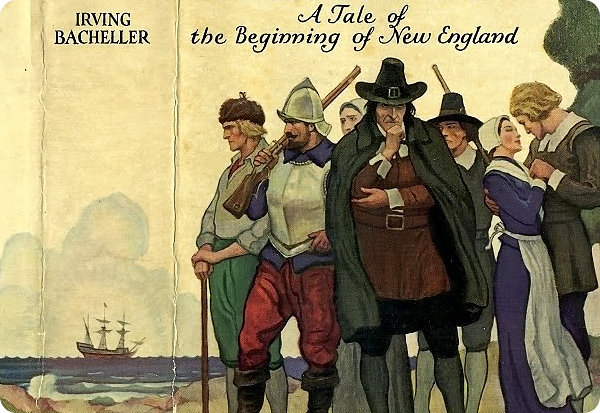
NC Wyeth Illustrates cover for Addison Irving Bacheller
Thanksgiving approaches and we ponder giving thanks, it seems an appropriate time to reflect upon those forebears who put their lives on the line (and among whom many lives were lost), in order to stake a claim for religious freedom and govern by mutual covenant. These sojourners at the Plimouth Colony, known also as the Separatists, or Pilgrims, had plenty of problems to contend with in forming their system of governing in the midst of the precarious and hostile environment they confronted upon their landing on Cape Cod. (Their intention had been to reach Virginia; but inclement weather forced them farther north, in what is now Massachusetts.)
The Pilgrims were fleeing religious persecution under King James of England and had traveled from Holland, where they had been displaced from England, aboard the Mayflower in 1620 along with adventurers and tradesmen. (Here is the list of all passengers.) They fashioned the document called The Mayflower Compact, and was signed aboard ship on November 11, 1620 by 41 of the ship’s 101 (male) passengers while the ship was anchored in what is now Provincetown Harbor at the northern tip of Cape Cod. Soon after the document was signed, William Bradford was elected the first governor of the new colony. It reads:
IN THE NAME OF GOD, AMEN. We, whose names are underwritten, the Loyal Subjects of our dread Sovereign Lord King James, by the Grace of God, of Great Britain, France, and Ireland, King, Defender of the Faith, &c. Having undertaken for the Glory of God, and Advancement of the Christian Faith, and the Honour of our King and Country, a Voyage to plant the first Colony in the northern Parts of Virginia; Do by these Presents, solemnly and mutually, in the Presence of God and one another, covenant and combine ourselves together into a civil Body Politick, for our better Ordering and Preservation, and Furtherance of the Ends aforesaid: And by Virtue hereof do enact, constitute, and frame, such just and equal Laws, Ordinances, Acts, Constitutions, and Officers, from time to time, as shall be thought most meet and convenient for the general Good of the Colony; unto which we promise all due Submission and Obedience. IN WITNESS whereof we have hereunto subscribed our names at Cape-Cod the eleventh of November, in the Reign of our Sovereign Lord King James, of England, France, and Ireland, the eighteenth, and of Scotland the fifty-fourth, Anno Domini; 1620.
Mr. John Carver, Mr. William Bradford, Mr Edward Winslow, Mr. William Brewster, Isaac Allerton, Myles Standish, John Alden, John Turner, Francis Eaton, James Chilton, John Craxton, John Billington, Joses Fletcher, John Goodman, Mr. Samuel Fuller, Mr. Christopher Martin, Mr. William Mullins, Mr. William White, Mr. Richard Warren, John Howland, Mr. Steven Hopkins, Digery Priest, Thomas Williams, Gilbert Winslow, Edmund Margesson, Peter Brown, Richard Britteridge George Soule, Edward Tilly, John Tilly, Francis Cooke, Thomas Rogers, Thomas Tinker, John Ridgdale, Edward Fuller, Richard Clark, Richard Gardiner, Mr. John Allerton, Thomas English, Edward Doten, Edward Liester.
Records from Plymouth Colony’s earliest courts have survived and (just prior to the Civil War) were published in a 12-volume set edited by Nathaniel B. Shurtleff and David Pulsifer.
Court records date back to 1623 and continue through 1691, when Plymouth Colony merged with the Massachusetts Bay.
These records offer a glimpse into how the Pilgrims interpreted scriptural and English law. (The following information, delineating the crimes and judgments rendered, comes from the website Mayflower History, whose work is gratefully acknowledged.)
For example, in 1636, the Plymouth Colony codified five crimes that were punishable by death:
- willful murder
- forming a solemn compact with the devil by way of witchcraft
- the willful burning of ships or houses
- sodomy, rape, and buggery
- adultery
The subsequent years’ records show an array of violations that were redressed according to these laws:
In 1639, Mrs. Mary Mendame of Duxbury was convicted of “uncleanness” with an Indian named Tinsin, and was sentenced to be whipped at a cart’s-tail through the town streets and to wear an AD badge. (If she was found without, it would be branded onto her forehead.)
In 1641, an adulterous affair between singleman Thomas Bray and Mrs. Anne Linceford was discovered and both parties were sentenced to public whipping at the post and to wear the AD badge on their clothing.
In 1658 the law was finally rewritten to define the punishment for adultery as two severe whippings, once right after conviction and once at a second time to be determined by the magistrates; and the individual would have to wear the letters AD “cut out in cloth and sowed on their uppermost garment on their arm or back.”
In 1662 Thomas Bird was sentenced to double whippings for committing “several adulterous practices and attempts, so far as strength of nature would permit” with Hannah Bumpass, who was also sentenced to be whipped once “for yielding to him, and not making such resistance against him as she ought.” Bird was also sentenced to pay Hannah £10 for “satisfaction for the wrong he hath done her.”
The first person executed for murder was Mayflower passenger John Billington, who was hanged in September 1630. He had gunned down John Newcomen in the heat of an ongoing quarrel.
The same year Arthur Peach, Thomas Jackson, Richard Stinnings and Daniel Cross were convicted of murdering an Indian named Penowanyanquis in 1638: the motive was robbery. Daniel Cross escaped custody, but the others were executed by hanging. The triple-hanging sent a strong message that Plymouth Colony would treat the murder of Native Americans equally.
In 1648 Alice Bishop was hanged for slashing the neck of her 4-year old daughter Martha with a knife, while Martha was sleeping in her bed: perhaps the most shocking and horrific crime in Plymouth Colony’s history.
Nobody in Plymouth Colony was ever charged with intentionally burning a house or ship, so arson as a capital crime was never tested in Plymouth court.
There were two witchcraft trials in Plymouth Colony, decades before the more famous Salem Witchcraft trials of 1692. Both Plymouth Colony witchcraft trials ended in not guilty verdicts: in fact the accusers were fined by the court for having made false accusations.
The Mayflower Compact remained in effect from 1620 until 1691, when the Plymouth Colony was absorbed into the Massachusetts Bay Colony.
Previous Post

October 31, 2017
The Catholic Who Paved the Way for Martin Luther's Reform
Next Post
December 6, 2017 Christmas: From Jesus' Birth to Santa ~ But How?
Browse Our Archives
Select a Category Abortion Advent Aging Augustine Celtic Prayers Christmas Church Civic Duty Current Events & Issues Dante Depression Divorce Easter Faith Family Fiction Finances God's Love Government Health History Holiness Insanity Interviews Islam Jesus Jesus & Prayer Jesus and Women Jesus' Birth Jesus' Death Journalism Justice Lunatics Medication Mental Health Miracles Money Mothers Mothers and Sons Mystery Pastors Patheos Book Club Plymouth Colony Podcasts Pop Culture Reflections Religion Saint Francis Saints & Champions Sermons Suffering Uncategorized Weddings Woman Caught in Adultery Women Women's Spirituality Writers and Writing
Select a Month March 2018 February 2018 December 2017 November 2017 October 2017 September 2017 July 2017 June 2017 May 2017 April 2017 March 2017 May 2015 April 2015 February 2015 January 2015 October 2014 April 2014 February 2014 January 2014 December 2013 October 2013 August 2013 July 2013 June 2013 April 2013
Follow Us!
TAKE THE
Religious Wisdom Quiz
What does 1 Peter say believers are being built into?
Select your answer to see how you score.
A holy nation Living stones God's temple A spiritual house
Support this
Column


Related posts from Poets and Lunatics
The Catholic Who Paved the Way for Martin...
What Was Muhammad's Intention for Islam?

What To Do When You Are Unceremoniously Insulted

That Time Billy Graham Saved My Faith
TRENDING AT PATHEOS New Visions

Did Prayer Cure His Cancer? Or Was It...
At 4 AM one morning, Joshua W. Brown’s wife awoke to a...

8 Ways a Near-Death Experience Rewires the Soul
Does Consciousness Survive Physical Death? After 50 Years of Research, Dr. Raymond...

Holy Longing: What Our Restlessness Is Telling Us
“One can find so many pains when the rain is falling.” -John...

What this is NOT about. This blog is definitely not about...

Who said the Israelites were God’s chosen? That’s right, they did. Who...

The Spirit World Is the Real World: God...
A Monk’s Wisdom on Body and Spirit I sit with Brother Martin...
view all New Visions blogs
Ad-Free & Subscriber Log-In Subscription Support
- About Us
- 2026 Calendar
- Videos
- Podcasts
- Library of World Religions
- Faith In Media Tracker
- Advertise With Us
- Write for Us
- Privacy Policy
- Terms of Service
- Do Not Sell My Data
- Contact Us
- Radiant Digital
- Manage Newsletter Subscriptions
- Unsubscribe From Notifications
- Sitemap
Copyright 2008-2026, Patheos. All rights reserved.
Subscription Support Ad-Free & Subscriber Log-In
Follow Patheos