
BuddhistCatholicContemplativeEvangelicalGeneral ChristianHinduJewishLatter-day SaintMuslimNew VisionsProgressive Christian
Beliefs
- Buddhist
- Catholic
- Contemplative
- Evangelical
- General Christian
- Hindu
- Jewish
- Latter-day Saint
- More Voices
- Muslim
- New Visions
- Pagan
- Progressive Christian
Topics
- Religion News
- Food and Religion
- Sports and Religion
- Religious Art
- Religious Music and Entertainment
- Religious Events
- History and Religion
- Style and Religion
- Politics and Religion
- Women in Religion
- Recreation Outdoors and Religion
- Business Finance and Religion
- Careers Workplace and Religion
- Education and Religion
- Family Parenting and Religion
- Health Fitness and Religion
- Home and Religion
- Relationships and Religion
- Technology and Religion
- Travel and Religion
Columnists
- Buddhist Columnists
- Business Finance and Religion Columnists
- Careers Workplace and Religion Columnists
- Catholic Columnists
- Contemplative Columnists
- Education and Religion Columnists
- Evangelists Columnists
- Family Parenting and Religion Columnists
- General Christian Columnists
- Health Fitness and Religion Columnists
- Hindu Columnists
- History and Religion Columnists
- Home and Religion Columnists
- Jewish Columnists
- More Voices Columnists
- Latter Day Columnists
- Muslim Columnists
- New Visions Columnists
- Nonreligious Columnists
- Pagan Columnists
- Politics and Religion Columnists
- Progressive Columnists
- Recreation Outdoors and Religion Columnists
- Relationships and Religion Columnists
- Religion News Columnists
- Religious Art Columnists
- Religious Events Columnists
- Religious Music and Entertainment Columnists
- Sports and Religion Columnists
- Style and Religion Columnists
- Technology and Religion Columnists
- Travel and Religion Columnists
- Women in Religion Columnists
Resource Library
- 2026 Calendar
- Library of World Religions
- The 100 Most Holy Places on Earth
- Patheos Answers
- Podcasts
- Videos
- Faith Leaders Database
- Anglican Episcopalian
- Bahai
- Baptist
- Buddhism
- Christianity
- Confucianism
- Eastern Orthodoxy
- Hinduism
- Holiness and Pentecostal
- ISKCON
- Islam
- Judaism
- Lutheran
- Methodist
- The Church of Jesus Christ of Latter-day Saints
- New Age
- Paganism
- Presbytarian and Reformed
- Protestantism
- Religion Behind the Scenes
- Roman Catholic
- Scientology
- Shia Islam
- Sikhism
- Sufism
- Sunni Islam
- Taoism
- Zen
- See all religions
Research Tools
 Ad-Free & Subscriber Log-In Subscription Support
Ad-Free & Subscriber Log-In Subscription Support
Follow Patheos 

- Trending:
- Forgiveness
- |
- Marriage
- |
- Consciousness
- |
- Death Penalty
- |
- Election
- |
- Halloween
 Poets and Lunatics
-
Categories
- Home
- New Visions
- Happy St. George Day! And Who Is Saint George?
Happy St. George Day! And Who Is Saint George?
Last updated on: April 24, 2017 at 7:19 am by Wendy Murray
Happy St. George Day! And Who Is Saint George? 2017-04-24T07:19:39-04:00 Wendy Murray
Patheos Explore the world's faith through different perspectives on religion and spirituality! Patheos has the views of the prevalent religions and spiritualities of the world.
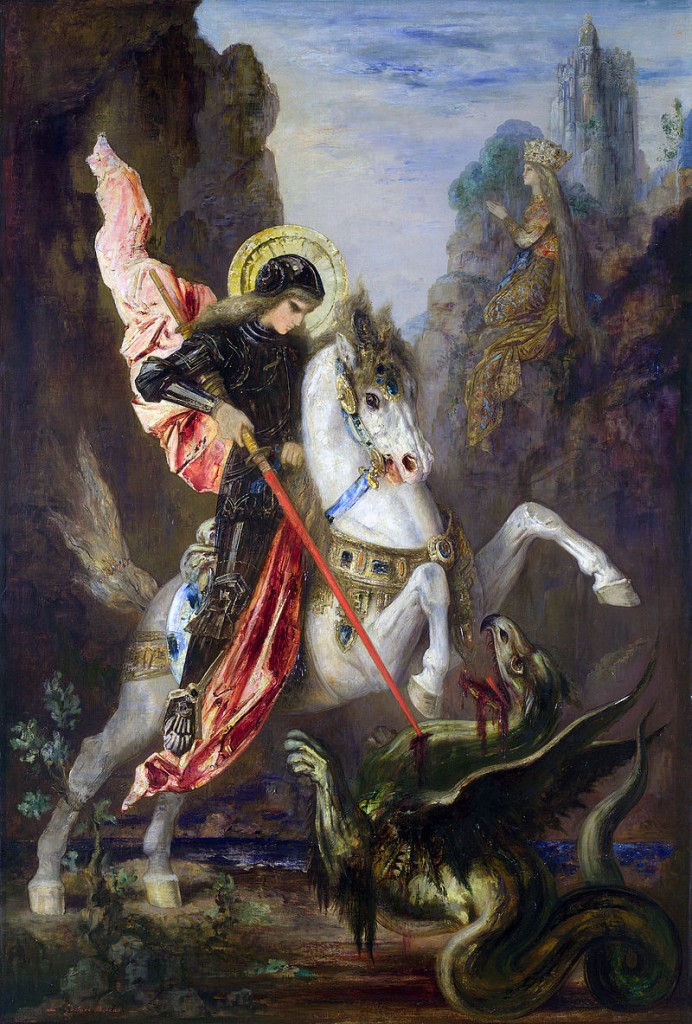
Saint George and the Dragon by Gustave Moreau, 1889/1890; public domain
April 23 celebrates the date of the martyrdom of St. George, a little-known saint by Americans, but one who, through the centuries, has stood as a shining star among all saints. He is also the patron saint of England.
His origins, however, are obscure. George is thought to have been a British soldier who was put to death in April a.d. 303, under Diocletian, though the story’s origins are uncertain. According to the fifth-century Apocryphal Acts of Saint George, he held the rank of tribune in the Roman army and was beheaded by Diocletian for protesting the emperor’s persecution of Christians. George rapidly became venerated as an example of bravery and military prowess and thus was adopted as the patron saint of soldiers. In time, it began to be reported during the Crusades that George appeared and aided the Christians in battle.
When I was writing my book about Saint Francis of Assisi, I became intimately familiar with Saint George because of the significant influence he had on shaping Francis’ thinking, inspiring Francis’ vision of God, his sense of vocation and his aspirations of valor.
Francis’ boyhood school was named for San Giorgio and  he would have learned of the saint’s prowess from his earliest years at primary school.
Beyond stories told in school, Francis also would have learned about George in the many troubadour songs he learned, and later himself sang, while traveling to France with his father on business. Francis was well-known around Assisi in his youth for singing these songs as he himself longed to be a troubadour and the kind of hero they glorified. Foremost of these would have been the great San Giorgio, whose devotion and valor in slaying a dragon was hailed throughout the Christianized world.
Here is the legend as Francis and all medieval knights would have heard it (taken from my book):
There was in that land a terrible dragon, which came out of the sea and went into the city and killed many persons and ate them. And one day all the people of the city armed themselves, the people and the knights, and went out after that dragon. And the dragon was so terrible to look at that the people began to run away. And the knights, more than two thousand of them, also ran away. In order to appease the fury of the dragon, the king ordered that a maiden be given to him and that the choice of the maiden be made by lot. It happened that the lot fell to the daughter of the king, who was the most beautiful maiden of the time. And the king, held by his duty to the people, wept bitterly. But since there was nothing he could do, he had his daughter dressed nobly, like a bride, with a crown on her head, like a queen. He pressed her to him, then with terrible sorrow and weeping he sent her to the island where the dragon that was to devour her could be found. Left alone, so adorned and so beautiful, she waited, trembling, for the dragon.
(Public Domain)
Then the blessed Giorgio appeared on his great horse. He was the handsomest young man to be found anywhere and wore beautifully decorated armor. He went to the princess, who was crying, and said to her: “Gentle maiden, why are you crying here all by yourself?” She replied, “O most noble young man, I am waiting for the dragon that is to devour me. I beg you in courtesy to go away at once, so that you do not have to die with me, because it is to me that this cruel fate has fallen.” At this point the dragon came out of the water and hissed loudly and came toward her. Blessed Giorgio ran to meet him and gave him a blow with his lance that immediately knocked him down. Then he called the maiden and had her take off her girdle and put it on the neck of the dragon. Thus the young princess drew it along behind her, like a lamb, all the way to the city. All the people greatly marveled in seeing such courage and such wisdom in so young a knight.
The king could not express his joy, seeing that his daughter escaped from so cruel a death. When the dragon was before the king, Blessed Giorgio killed it, and six pairs of oxen were required to drag it out of the city. Then he preached the Christian faith to the king and to all the people. And through the miracle they had seen all believed perfectly in Christ. The king had churches built in honor of God and in reverence for the blessed knight San Giorgio. And when everyone had been taught how to serve and to love God, San Giorgio left the realm. Before leaving he gave to the poor the noble horse that he had been riding and his knight’s armor, nobly and richly decorated, for the love of God.**
(Source: Arnaldo Fortini, Francis of Assisi; A Translation of Nova Vita di San Francesco)
Previous Post

April 19, 2017
The Brontës' Grand Hope for the Master Wave of Calm
Next Post
May 1, 2017 Before Starting Antidepressants, Please Think Again
Browse Our Archives
Select a Category Abortion Advent Aging Augustine Celtic Prayers Christmas Church Civic Duty Current Events & Issues Dante Depression Divorce Easter Faith Family Fiction Finances God's Love Government Health History Holiness Insanity Interviews Islam Jesus Jesus & Prayer Jesus and Women Jesus' Birth Jesus' Death Journalism Justice Lunatics Medication Mental Health Miracles Money Mothers Mothers and Sons Mystery Pastors Patheos Book Club Plymouth Colony Podcasts Pop Culture Reflections Religion Saint Francis Saints & Champions Sermons Suffering Uncategorized Weddings Woman Caught in Adultery Women Women's Spirituality Writers and Writing
Select a Month March 2018 February 2018 December 2017 November 2017 October 2017 September 2017 July 2017 June 2017 May 2017 April 2017 March 2017 May 2015 April 2015 February 2015 January 2015 October 2014 April 2014 February 2014 January 2014 December 2013 October 2013 August 2013 July 2013 June 2013 April 2013
Follow Us!
TAKE THE
Religious Wisdom Quiz
True or False: David committed adultery with Bathsheba and arranged for her husband Uriah to be killed.
Select your answer to see how you score.
TRUE FALSE
Support this
Column


Related posts from Poets and Lunatics


Christmas: From Jesus' Birth to Santa ~ But...

The Catholic Who Paved the Way for Martin...

The Antidote for the World-weary: Spiritual Practice
TRENDING AT PATHEOS New Visions

Did Prayer Cure His Cancer? Or Was It...
At 4 AM one morning, Joshua W. Brown’s wife awoke to a...

8 Ways a Near-Death Experience Rewires the Soul
Does Consciousness Survive Physical Death? After 50 Years of Research, Dr. Raymond...

Holy Longing: What Our Restlessness Is Telling Us
“One can find so many pains when the rain is falling.” -John...

What this is NOT about. This blog is definitely not about...

Who said the Israelites were God’s chosen? That’s right, they did. Who...

The Spirit World Is the Real World: God...
A Monk’s Wisdom on Body and Spirit I sit with Brother Martin...
view all New Visions blogs
Ad-Free & Subscriber Log-In Subscription Support
- About Us
- 2026 Calendar
- Videos
- Podcasts
- Library of World Religions
- Faith In Media Tracker
- Advertise With Us
- Write for Us
- Privacy Policy
- Terms of Service
- Do Not Sell My Data
- Contact Us
- Radiant Digital
- Manage Newsletter Subscriptions
- Unsubscribe From Notifications
- Sitemap
Copyright 2008-2026, Patheos. All rights reserved.
Subscription Support Ad-Free & Subscriber Log-In
Follow Patheos