
BuddhistCatholicContemplativeEvangelicalGeneral ChristianHinduJewishLatter-day SaintMuslimNew VisionsProgressive Christian
Beliefs
- Buddhist
- Catholic
- Contemplative
- Evangelical
- General Christian
- Hindu
- Jewish
- Latter-day Saint
- More Voices
- Muslim
- New Visions
- Pagan
- Progressive Christian
Topics
- Religion News
- Food and Religion
- Sports and Religion
- Religious Art
- Religious Music and Entertainment
- Religious Events
- History and Religion
- Style and Religion
- Politics and Religion
- Women in Religion
- Recreation Outdoors and Religion
- Business Finance and Religion
- Careers Workplace and Religion
- Education and Religion
- Family Parenting and Religion
- Health Fitness and Religion
- Home and Religion
- Relationships and Religion
- Technology and Religion
- Travel and Religion
Columnists
- Buddhist Columnists
- Business Finance and Religion Columnists
- Careers Workplace and Religion Columnists
- Catholic Columnists
- Contemplative Columnists
- Education and Religion Columnists
- Evangelists Columnists
- Family Parenting and Religion Columnists
- General Christian Columnists
- Health Fitness and Religion Columnists
- Hindu Columnists
- History and Religion Columnists
- Home and Religion Columnists
- Jewish Columnists
- More Voices Columnists
- Latter Day Columnists
- Muslim Columnists
- New Visions Columnists
- Nonreligious Columnists
- Pagan Columnists
- Politics and Religion Columnists
- Progressive Columnists
- Recreation Outdoors and Religion Columnists
- Relationships and Religion Columnists
- Religion News Columnists
- Religious Art Columnists
- Religious Events Columnists
- Religious Music and Entertainment Columnists
- Sports and Religion Columnists
- Style and Religion Columnists
- Technology and Religion Columnists
- Travel and Religion Columnists
- Women in Religion Columnists
Resource Library
- 2026 Calendar
- Library of World Religions
- The 100 Most Holy Places on Earth
- Patheos Answers
- Podcasts
- Videos
- Faith Leaders Database
- Anglican Episcopalian
- Bahai
- Baptist
- Buddhism
- Christianity
- Confucianism
- Eastern Orthodoxy
- Hinduism
- Holiness and Pentecostal
- ISKCON
- Islam
- Judaism
- Lutheran
- Methodist
- The Church of Jesus Christ of Latter-day Saints
- New Age
- Paganism
- Presbytarian and Reformed
- Protestantism
- Religion Behind the Scenes
- Roman Catholic
- Scientology
- Shia Islam
- Sikhism
- Sufism
- Sunni Islam
- Taoism
- Zen
- See all religions
Research Tools
 Ad-Free & Subscriber Log-In Subscription Support
Ad-Free & Subscriber Log-In Subscription Support
Follow Patheos 

- Trending:
- Forgiveness
- |
- Marriage
- |
- Consciousness
- |
- Death Penalty
- |
- Election
- |
- Halloween
 Poets and Lunatics
-
Categories
- Home
- New Visions
- What Was Muhammad’s Intention for Islam?
What Was Muhammad’s Intention for Islam?
Last updated on: March 23, 2017 at 7:49 am by Wendy Murray
What Was Muhammad’s Intention for Islam? 2017-03-23T07:49:55-04:00 Wendy Murray
Patheos Explore the world's faith through different perspectives on religion and spirituality! Patheos has the views of the prevalent religions and spiritualities of the world.
by Wendy Murray
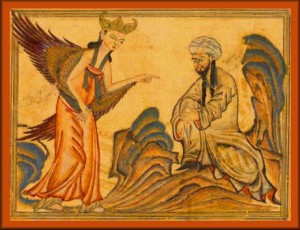
Muhammad receives a “recitation” of the Qu`ran (Public Domain)
I heard a pundit say recently that “Jesus probably would have been okay with Muslims; he was around a lot of Muslims — it was the Middle East.” That was the moment I decided the time had come for a brief refresher on the beginnings of Islam and the paradigm forged by its founder, Muhammad. What was his intention for his new-found system of belief? How did he determine to advance it? Just as–in trying to understand Christians one must continually look to the person of Jesus– so too, to understand Islam one must look at its beginnings as forged by its leader Muhammad. This is especially needful today, in a wider culture that presumes much about Islam (such as the above-noted pundit, who got it all wrong) or wrestles with how to understand Islam’s advance and the violence associated with that.
To clarify the pundit’s mistake, Jesus lived 600 years before Islam came into being, so, for the record, he was not “around a lot of Muslims.” He lived and died between the approximate years of 3 B.C. and A.D. 30 whereas Muhammad did not come onto the scene, some 600 miles away, until 570. In fact, a little-known aspect of the propelling force beh ind his founding of Islam was Muhammad’s desire to be like the Christians (and the Jews) as “People of the Book.”
Here is a brief summary of Islam’s beginnings derived from research I did for a cover story I wrote for Christianity Today several years ago (April 2000).
Muhammad was born in A.D. 570 in Mecca (in what is today Saudi Arabia), where the heart of worship was the local Ka`bah (shrine), or the Black Stone, and its numerous idols. According to Islamic tradition, Abraham’s firstborn son Ishmael and Ishmael’s mother Hagar, after being banished by Sarah, ended up in the desert surrounding Mecca, where they were miraculously rescued. Abraham — or Ibraham, as he is known is Arabic — visited them there and he and Ishamel built the Ka`bah. Muslims believe they are the true heirs, through Ishmael, to the promise God made to Abraham.
Muhammad learned about the “People of the Book” — Jews and Christians — in his youth. He felt troubled that his own people, the Arabs, did not have a book of their own. As he reflected despondently on this one day in a cave on Mount Hira (in A.D. 609 or 610), Muhammad said the angel Gabriel appeared to him: “Recite: In the Name of thy Lord who created Man of a blood-clot. Recite: And thy Lord is the Most Generous, who taught by the pen, taught Man that he knew not” (Surah 96:1-4). The injunction to “recite” meant “make vocal what is already written,” writes author and Islamacist Kenneth Cragg. In other words, “recite” means it was the “sending down” of a preexistent book (Qur’an is Arabic for “recitation”).
At first Muhammad feared he had been overtaken by a jinn, a troubling spirit. But in time Muhammad’s fear gave way to acquiescence and the visions recurred with greater frequency.
His recitation denounced idol worship and proclaimed the total sovereignty of the One True God. Because the People of the Book also claimed allegiance to this God, his early recitations about Christianity and Judaism in the Qur’an were irenic: “O believers, be you God’s helpers, as Jesus Mary’s son, said to the Apostles. ‘Who will be my helpers unto God?’ The Apostles said, ‘We will be helpers of God’ ” (Surah 61:14).
His small circle of followers, composed mostly of family members and domestic help, became increasingly assertive in their belief that Muhammad was a prophet, and this aroused the consternation of the people of Mecca, many of whom felt their vested interests in idol worship and commerce were being threatened.
The deaths of his first wife Khadijah (15 years his senior) in 619, and his uncle Abu Talib, who was also his protector, precipitated a crisis for Muhammad. He and his followers could stay in Mecca in perpetual jeopardy as a despised minority, or he could move to a new location where the fledgling faith could gain a foothold and grow. Some of his disciples had succeeded in their missionary undertakings to the north, in a place called Yathrib, later called Medina. So in 622 Muhammad migrated to that city to form a new base of activity. The famous hijrah (emigration) occurred in September of that year and became the historical fulcrum of Islam.
Several things happened with this move that solidified and redefined Islam. First, despite the previous missionary successes in Medina, Muhammad’s new religion was generally rebuffed. Some resisted his presumption and others eschewed the notion of converting. Second, Muhammad had anticipated, at the very least, a warm reception from the People of the Book — primarily the Jews — in Medina, since they too were “Scripture people.” Instead they treated him with “amused disdain,” says Cragg, “and rejected his claims as pretentious.”
These difficulties triggered a shift in Muhammad’s message. The portions of the Qur’an “sent down” during this period took on a more aggressive political and legal tone, in contrast to the previous poetic and mystical reflections. During the Medinan years (622-630) Muhammad consolidated Islam into a functioning, overarching political and religious community — the umma — and built a mosque. He also fashioned his revelations into principles and administered the social, political, economic and religious affairs of the Medinans. Recitations regarding the People of the Book became more belligerent: “God fight them, what liars they are (Surah 9:30) and “O believers, take not Jews and Christians as friends; … God guides not the people of the evildoers” (Surah 5:56).
At the same time, hostilities with the Meccans in the south, continued as Muhammad raided their caravans traveling north. The Battle of Badr (624), the first major engagement between Muhammad’s forces and Mecca, proved decisive for establishing Islam as an aggressive force. “[T]he sword was unleashed and the scabbard cast away. The jihad, or appeal to battle, had been irrevocably invoked,” Cragg says.
In 630 Muhammad returned as victor to Mecca in geopolitical advancement of his new-found religion. He claimed the city for Islam and destroyed the idols being worshiped at the Ka`bah. The action introduced the notion of “manifest success” — geographical dominance — as a validating sign of Islam, which defines their identity to this day.
Muhammad died in 632, two years after the conquest of Mecca. The recitations were complete. The canon, so to speak, was closed. But a new religion, predicated on geographical advancement and conquest, was born.
Previous Post

March 21, 2017
Reflection: Jesus Would Not Trust Them
Browse Our Archives
Select a Category Abortion Advent Aging Augustine Celtic Prayers Christmas Church Civic Duty Current Events & Issues Dante Depression Divorce Easter Faith Family Fiction Finances God's Love Government Health History Holiness Insanity Interviews Islam Jesus Jesus & Prayer Jesus and Women Jesus' Birth Jesus' Death Journalism Justice Lunatics Medication Mental Health Miracles Money Mothers Mothers and Sons Mystery Pastors Patheos Book Club Plymouth Colony Podcasts Pop Culture Reflections Religion Saint Francis Saints & Champions Sermons Suffering Uncategorized Weddings Woman Caught in Adultery Women Women's Spirituality Writers and Writing
Select a Month March 2018 February 2018 December 2017 November 2017 October 2017 September 2017 July 2017 June 2017 May 2017 April 2017 March 2017 May 2015 April 2015 February 2015 January 2015 October 2014 April 2014 February 2014 January 2014 December 2013 October 2013 August 2013 July 2013 June 2013 April 2013
Follow Us!
TAKE THE
Religious Wisdom Quiz
What did the soldier dress Jesus in after he was accused?
Select your answer to see how you score.
Thorns Nothing Golden Robe Scarlet Robe
Support this
Column


Related posts from Poets and Lunatics

That Time Billy Graham Saved My Faith

Christmas: From Jesus' Birth to Santa ~ But...
The Catholic Who Paved the Way for Martin...
TRENDING AT PATHEOS New Visions

Did Prayer Cure His Cancer? Or Was It...
At 4 AM one morning, Joshua W. Brown’s wife awoke to a...

8 Ways a Near-Death Experience Rewires the Soul
Does Consciousness Survive Physical Death? After 50 Years of Research, Dr. Raymond...

Holy Longing: What Our Restlessness Is Telling Us
“One can find so many pains when the rain is falling.” -John...

What this is NOT about. This blog is definitely not about...

Who said the Israelites were God’s chosen? That’s right, they did. Who...

The Spirit World Is the Real World: God...
A Monk’s Wisdom on Body and Spirit I sit with Brother Martin...
view all New Visions blogs
Ad-Free & Subscriber Log-In Subscription Support
- About Us
- 2026 Calendar
- Videos
- Podcasts
- Library of World Religions
- Faith In Media Tracker
- Advertise With Us
- Write for Us
- Privacy Policy
- Terms of Service
- Do Not Sell My Data
- Contact Us
- Radiant Digital
- Manage Newsletter Subscriptions
- Unsubscribe From Notifications
- Sitemap
Copyright 2008-2026, Patheos. All rights reserved.
Subscription Support Ad-Free & Subscriber Log-In
Follow Patheos