
BuddhistCatholicContemplativeEvangelicalGeneral ChristianHinduJewishLatter-day SaintMuslimNew VisionsProgressive Christian
Beliefs
- Buddhist
- Catholic
- Contemplative
- Evangelical
- General Christian
- Hindu
- Jewish
- Latter-day Saint
- More Voices
- Muslim
- New Visions
- Pagan
- Progressive Christian
Topics
- Religion News
- Food and Religion
- Sports and Religion
- Religious Art
- Religious Music and Entertainment
- Religious Events
- History and Religion
- Style and Religion
- Politics and Religion
- Women in Religion
- Recreation Outdoors and Religion
- Business Finance and Religion
- Careers Workplace and Religion
- Education and Religion
- Family Parenting and Religion
- Health Fitness and Religion
- Home and Religion
- Relationships and Religion
- Technology and Religion
- Travel and Religion
Columnists
- Buddhist Columnists
- Business Finance and Religion Columnists
- Careers Workplace and Religion Columnists
- Catholic Columnists
- Contemplative Columnists
- Education and Religion Columnists
- Evangelists Columnists
- Family Parenting and Religion Columnists
- General Christian Columnists
- Health Fitness and Religion Columnists
- Hindu Columnists
- History and Religion Columnists
- Home and Religion Columnists
- Jewish Columnists
- More Voices Columnists
- Latter Day Columnists
- Muslim Columnists
- New Visions Columnists
- Nonreligious Columnists
- Pagan Columnists
- Politics and Religion Columnists
- Progressive Columnists
- Recreation Outdoors and Religion Columnists
- Relationships and Religion Columnists
- Religion News Columnists
- Religious Art Columnists
- Religious Events Columnists
- Religious Music and Entertainment Columnists
- Sports and Religion Columnists
- Style and Religion Columnists
- Technology and Religion Columnists
- Travel and Religion Columnists
- Women in Religion Columnists
Resource Library
- 2026 Calendar
- Library of World Religions
- The 100 Most Holy Places on Earth
- Patheos Answers
- Podcasts
- Videos
- Faith Leaders Database
- Anglican Episcopalian
- Bahai
- Baptist
- Buddhism
- Christianity
- Confucianism
- Eastern Orthodoxy
- Hinduism
- Holiness and Pentecostal
- ISKCON
- Islam
- Judaism
- Lutheran
- Methodist
- The Church of Jesus Christ of Latter-day Saints
- New Age
- Paganism
- Presbytarian and Reformed
- Protestantism
- Religion Behind the Scenes
- Roman Catholic
- Scientology
- Shia Islam
- Sikhism
- Sufism
- Sunni Islam
- Taoism
- Zen
- See all religions
Research Tools
 Ad-Free & Subscriber Log-In Subscription Support
Ad-Free & Subscriber Log-In Subscription Support
Follow Patheos 

- Trending:
- Forgiveness
- |
- Marriage
- |
- Consciousness
- |
- Death Penalty
- |
- Election
- |
- Halloween

- Home
- Latter-day Saint
- June 8 for Mormons (part 2): The RB factor
June 8 for Mormons (part 2): The RB factor
Last updated on: June 17, 2023 at 1:33 pm by Margaret Blair Young
June 8 for Mormons (part 2): The RB factor 2023-06-17T13:33:37-07:00 Margaret Blair Young
Patheos Explore the world's faith through different perspectives on religion and spirituality! Patheos has the views of the prevalent religions and spiritualities of the world.
In the summer of 1998, I went to a conference for teachers of LDS seminaries and institutes. I was one of those teachers, and my classes were in Spanish. Therefore, whatever I got at the conference would ultimately be translated into Spanish if I chose to use it. I was given a binder of supplementary material provided by religion professors, including RB. (I will not name RB, though the Washington Post article and the church response both name him. I was sad that the church used his name when it repudiated his ideas, as shaming is always unfortunate.) Nonetheless, I saw the hand of God in the way RB’s material ironically and unintentionally paved the road for a more direct Church statement on race.
I was halfway through the year of teaching when I finally opened my shrink-wrapped binder of lessons for seminary and Institute teachers. I turned to the supplement page geared towards my next lesson and found RB’s entry. He quoted various church leaders, including the third church president, John Taylor, about mortal trials.
By this time, I had been working with Darius Gray on our black LDS history books, and was familiar with the folk beliefs which had supported the priesthood restriction from 1852-1978. The most common and insideous teaching was that those “of African descent” were descendants or representatives of Cain.
I was translating the words as I read them, and stopped cold. Before me was this paragraph:
Why did not the Lord kill Satan long ago? Because…He needed the devil and a great many of those who do his bidding just to keep men straight, that we may learn to place our dependence upon God…He suffered a descendant of Cain to come through the flood in order that he might be properly represented upon the earth.
I knew exactly what “descendant of Cain” meant: Black people. This notion of “the curse of Cain” was prominent in the 19th century (and earlier) and was Brigham Young’s justification for instating the priesthood restriction. Young stated in 1852: “Any man having one drop of the seed of Cane in him Cannot hold the priesthood, & if no other Prophet ever spake it Before I will say it now in the name of Jesus Christ.”
I wrote an email to RB suggesting that he did not understand the implications of the Taylor quote or he would not have used it. (By an interesting coincidence, Darius was contacted at the same time by a black man who had seen another iteration of the Taylor quote, and had found it repugnant. This is the one he had read: “And after the flood we are told that the curse that had been pronounced upon Cain was continued through Ham’s wife, as he had married a wife of that seed. And why did it pass through the flood? Because it was necessary that the devil should have a representation upon the earth as well as God.” (JoD Vol. 22 page 304).
I asked RB if we could meet to further discuss this. His response was that he was accustomed to students asking him theological questions, but they generally did not question church leaders. He declined my invitation. The next day, I received a second email from RB in which he said he would be willing to meet. However, I had already brought Darius into the conversation. Darius had a meeting with a church authority already scheduled, so I gave him the page from my supplement.
At the meeting, Darius asked the leader (who I will also not name), “Do you think I’m a representative of Satan?” The leader chuckled and said, “Of course not!” Darius said, “How would you feel if that idea were being taught in seminaries?” The leader answered, “That would be very upsetting.” Darius then gave him the page from my supplement. The leader said, “Who is R.B.?”
The path to clarity in race issues within the LDS Church widened significantly in that moment.
In February, 2012, Jason Horowitz of The Washington Post, visited the religion department at Brigham Young University with the goal of interviewing someone there on the genesis of the priesthood restriction, inasmuch as Mitt Romney was running for the presidency. The “chance” encounter with RB is documented on the blog Gospel Tangents in a conversation with Matt Harris.
Matt: So I said to Horowitz. I said, “Tell me, How did you come across Bott?” He said, “Well, I just went to BYU, and I didn’t have an appointment.” He probably should have let the administration know that he was coming because this is a high-profile campaign. This is a BYU graduate, a high-profile Mormon person, Mitt Romney. So, Horowitz didn’t do that. He just went to the religion building and started knocking on doors.
GT: No way. (Chuckling)
Matt: There’s a policy at BYU that you’re supposed to go through this protocol to talk to people about certain high profile issues. This certainly would have been one of them, a Washington Post reporter. This wasn’t from the Provo Daily Herald. This is the Washington Post. So, he knocks on a door and one of the professors opens up the door. “I’m Jason Horowitz, Washington Post. Can I interview you about Mitt Romney? I just want some stuff about Mitt Romney.” The first professor says, “Oh, I can’t talk to you because you didn’t go through the protocols.” He knocks on another door. He went through a handful of this door knocking when they just said, “No, we can’t talk to you.” Randy Bott says, “Sure, come on in.” So, keep in mind, it wasn’t a gotcha story. It wasn’t like, “Oh, I heard Mormons have some weird things to say about race. Let me try to get them on record and embarrass their candidate.” It wasn’t that at all. Horowitz flew to Provo because he wanted to do a story on Mitt Romney. That’s all it was.
Matt: So, he told him “We’re just going to do a story of Mitt Romney.” Bott said, “Okay, fine.” He said, “I want to ask you about his faith,” all of that. So, the first part of this story that Horowitz told me, he said it was pretty normal. We were just talking about Mitt Romney and the Mormon faith and what Mormons believe and all of this stuff. Then Randy Bott starts talking about race and how black people could not hold the priesthood. It would be like giving keys to a child to drive a car. They weren’t ready. I mean, it was so humiliating. I asked Horowitz. I said, “What did you think when he started telling you about black people being cursed and comparing their inability to hold the priesthood to a child driving a car?” He just said, “Oh, I knew there was a story.”
Horowitz’s article was published on February 28th, 2012. It made headlines. My personal response was, “Behold the hand of God.” I already knew that RB was the perfect interview subject for a national article about the priesthood restriction–if we actually needed to clarify and undo the racism stoked into policy in 1852 .
The church was quick to respond to the WAPO article, and RB was not spared. This is the Church statement.
The positions attributed to BYU professor Randy Bott in a recent Washington Post article absolutely do not represent the teachings and doctrines of The Church of Jesus Christ of Latter-day Saints. BYU faculty members do not speak for the Church. It is unfortunate that the Church was not given a chance to respond to what others said. The Church’s position is clear — we believe all people are God’s children and are equal in His eyes and in the Church. We do not tolerate racism in any form.
RB had been one of the most popular professors at BYU. But he had not understood the full implications of “equal in His eyes and in the Church.” Nor had general authority Bruce R. McConkie, whose book Mormon Doctrine had claimed, “The negroes are not equal with other races where the receipt of certain spiritual blessings are concerned, particularly the priesthood and the temple blessings that flow therefrom, but this inequality is not of man’s origin. It is the Lord’s doing, is based on his eternal laws of justice, and grows out of the lack of spiritual valiance of those concerned in their first estate.” McConkie revised himself in 1978, when the priesthood restriction was undone: “Forget everything that I have said, or what President Brigham Young or President George Q. Cannon or whomsoever has said in days past that is contrary to the present revelation.”
Nonetheless, modifications of his book still included references to the “curse of Cain” even after the revisions in 1978. Eventually, in 2010, the publisher took Mormon Doctrine out of print. It is still found in many LDS households.
Not until 2013 did the LDS Church publish a clear and full disavowal of its previous teachings. The essay “Race and Priesthood” in “Gospel Topics” on the Church website stated this:
Today, the Church disavows the theories advanced in the past that black skin is a sign of divine disfavor or curse, or that it reflects unrighteous actions in a premortal life; that mixed-race marriages are a sin; or that blacks or people of any other race or ethnicity are inferior in any way to anyone else. Church leaders today unequivocally condemn all racism, past and present, in any form.24
Since that day in 1978, the Church has looked to the future, as membership among Africans, African Americans and others of African descent has continued to grow rapidly. While Church records for individual members do not indicate an individual’s race or ethnicity, the number of Church members of African descent is now in the hundreds of thousands.
Since Brigham Young based his exclusionary policies on the curse of Cain folklore, the 2013 Church statement officially undid any justification for it. And other opinions (such as McConkie’s and others’ that skin color marked levels of righteousness or valiancy in a premortal life) were also repudiated.
So, has the church changed? Is the church able to “lead out in abandoning attitudes and actions of prejudice” as its president Russell M. Nelson charged members?
We are still shackled by what the Book of Mormon refers to as “wicked traditions of the fathers”. Just as RB did not recognize his teachings as racist and NOT doctrinal, many LDS people do not recognize that some of the notions they grew up with are fundamentally wrong. As a sixty-eight year old Latter-day Saint woman, I have seen some remarkable progress towards true inclusion. Not enough progress, but significant steps. I consider that RB was a vital part of that progress, as his careless yet sincere words reflected the actual understanding of many of his age and even in his position as a church leader/teacher.
I look at depictions of congregations in LDS church publications now and recognize a growing celebration of diversity. This has happened especially over the past decade. In September 2012 (the year of the RB fiasco), the cover of the Liahona Magazine showed a white couple guiding an African woman and her son to the Salt Lake City Temple. Unfortunately, the cover was perceived by many (including me) as dominated by white people, who were tall and clearly in charge of the black people. Over the years, I have seen significant changes which have brought people of color to the forefront of visual representations. In fact, the past three covers of The Friend feature people of color. The temple ritual images now include some diversity in skin tone, and I predict that such representation will become more widespread. The highest baptizing mission of the Church of Jesus Christ of Latter-day Saints is in Mbuji Mayi, Democratic Republic of the Congo.
I know that there are still many Mormons who believe the folklore they were taught at the same time that I was taught it. Nobody has “untaught” them, and without clear discussions, nobody will. Added to that is some political posturing which refuses to see what comprises systemic racism–including within churches.
I have my own preparatory “articles of faith” to guard me from deception.
- You were given a gift of mortal life by your Heavenly parents, and will be subject to all the evils of mortality, including tribalism, meanness, and betrayal.
- You will screw up. That is part of mortality. Even people you respect deeply–your parents and ancestors, your teachers, and your church leaders–will or have already screwed up many times. Love them anyway, because you must extend mercy to understand and to receive mercy. Learn to humbly recognize when authority figures in your life have spoken from culture or tradition rather than from divine inspiration or certain knowledge.
- You may learn to recognize untruths through the spirit of love.
- Our Heavenly parents invite everybody to become like them. There are no exceptions.
The go-to scripture for most Mormons dealing with racism is “All are alike unto God” (2 Nephi 26:33). I have another on, from the Book of Mormon, 4th Nephi, verse 17, describing Zion: “There were no robbers, nor murderers, neither were there Lamanites, nor any manner of -ites; but they were one, the children of Christ, and heirs to the kingdom of God.”
Among my favorite statements by LDS church leaders is this one by Lorenzo Snow, an early church president. Though I think he overestimated the maturity of the church when he wrote this, it holds true and makes me hopeful for our future.
Seventy years ago this Church was organized with six members. We commenced, so to speak, as an infant. We had our prejudices to combat. Our ignorance troubled us in regard to what the Lord intended to do and what He wanted us to do … We advanced to boyhood, and still we undoubtedly made some mistakes, which … generally arise from a …lack of experience. We understand very well, when we reflect back upon our own lives, that we did many foolish things when we were boys … Yet as we advanced, the experience of the past materially assisted us to avoid such mistakes as we had made in our boyhood. It has been so with the Church. Our errors have generally arisen from a lack of comprehending what the Lord required of us to do. But now we are pretty well along to manhood … When we examine ourselves, however, we discover that we are still not doing exactly as we ought to do, notwithstanding all our experience. We discern that there are things which we fail to do that the Lord expects us to perform, some of which He requires us to do in our boyhood. … While we congratulate ourselves in this direction, we certainly ought to feel that we have not yet arrived at perfection. There are many things for us to do yet. [Lorenzo Snow, 6 April, 1900, Conference Report (Salt Lake City, UT: The Church of Jesus Christ of Latter-day Saints, 1900), 1-2.]
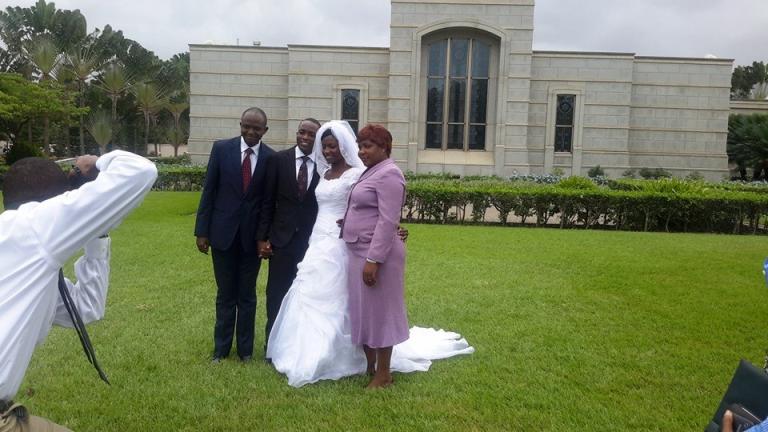
Aime and Steffy Mbuyi with Huisman Kabango and his wife, Ghana temple
Previous Post

June 8, 2023
What is June 8th to Mormons?
Next Post
September 6, 2023 The Exploited Mines of the Congo: How the Atomic Bomb was Built
Recent Comments
"Margaret, excellent post as I would expect from you. Yes, things are getting better. We ..."
""
""
Tshiluba–post #2 on language learning
""
Browse Our Archives
Select a Category Ancestors family conflict in the scriptures race and religion Uncategorized
Select a Month August 2026 March 2026 January 2026 December 2025 November 2025 October 2025 September 2025 July 2025 April 2025 March 2025 January 2025 November 2024 May 2024 April 2024 November 2023 October 2023 September 2023 June 2023 September 2022 August 2022 July 2022 May 2022 April 2022 March 2022 January 2022 December 2021 October 2021 September 2021 July 2021 June 2021 October 2020 August 2020 July 2020 June 2020 March 2020 January 2020 December 2019 November 2019 October 2019 June 2019 January 2019 December 2018 November 2018 September 2018 August 2018 May 2018 March 2018 January 2018 November 2017 October 2017 August 2017 July 2017 June 2017 May 2017 March 2017 February 2017 November 2016 October 2016 August 2016 July 2016 June 2016 May 2016 April 2016 March 2016 February 2016 January 2016 November 2015 August 2015 July 2015 May 2015 April 2015 March 2015 February 2015 January 2015 December 2014 November 2014 October 2014 August 2014 July 2014 June 2014 May 2014 April 2014 March 2014 February 2014 January 2014 December 2013 November 2013 October 2013 September 2013 August 2013 July 2013 June 2013 May 2013 April 2013 March 2013 February 2013 January 2013 December 2012
Follow Us!
TAKE THE
Religious Wisdom Quiz
How many chapters are in Isaiah?
Select your answer to see how you score.
72 50 40 66
Related posts from The Welcome Table


Church Ball and the Genesis Team
TRENDING AT PATHEOS Latter-day Saint

Did Prayer Cure His Cancer? Or Was It...
At 4 AM one morning, Joshua W. Brown’s wife awoke to a...

8 Ways a Near-Death Experience Rewires the Soul
Does Consciousness Survive Physical Death? After 50 Years of Research, Dr. Raymond...

Holy Longing: What Our Restlessness Is Telling Us
“One can find so many pains when the rain is falling.” -John...

What this is NOT about. This blog is definitely not about...

Who said the Israelites were God’s chosen? That’s right, they did. Who...

The Spirit World Is the Real World: God...
A Monk’s Wisdom on Body and Spirit I sit with Brother Martin...
view all Latter-day Saint blogs
What Are Your Thoughts?leave a comment
Ad-Free & Subscriber Log-In Subscription Support
- About Us
- 2026 Calendar
- Videos
- Podcasts
- Library of World Religions
- Faith In Media Tracker
- Advertise With Us
- Write for Us
- Privacy Policy
- Terms of Service
- Do Not Sell My Data
- Contact Us
- Radiant Digital
- Manage Newsletter Subscriptions
- Unsubscribe From Notifications
- Sitemap
Copyright 2008-2026, Patheos. All rights reserved.
Subscription Support Ad-Free & Subscriber Log-In
Follow Patheos