
BuddhistCatholicContemplativeEvangelicalGeneral ChristianHinduJewishLatter-day SaintMuslimNew VisionsProgressive Christian
Beliefs
- Buddhist
- Catholic
- Contemplative
- Evangelical
- General Christian
- Hindu
- Jewish
- Latter-day Saint
- More Voices
- Muslim
- New Visions
- Pagan
- Progressive Christian
Topics
- Religion News
- Food and Religion
- Sports and Religion
- Religious Art
- Religious Music and Entertainment
- Religious Events
- History and Religion
- Style and Religion
- Politics and Religion
- Women in Religion
- Recreation Outdoors and Religion
- Business Finance and Religion
- Careers Workplace and Religion
- Education and Religion
- Family Parenting and Religion
- Health Fitness and Religion
- Home and Religion
- Relationships and Religion
- Technology and Religion
- Travel and Religion
Columnists
- Buddhist Columnists
- Business Finance and Religion Columnists
- Careers Workplace and Religion Columnists
- Catholic Columnists
- Contemplative Columnists
- Education and Religion Columnists
- Evangelists Columnists
- Family Parenting and Religion Columnists
- General Christian Columnists
- Health Fitness and Religion Columnists
- Hindu Columnists
- History and Religion Columnists
- Home and Religion Columnists
- Jewish Columnists
- More Voices Columnists
- Latter Day Columnists
- Muslim Columnists
- New Visions Columnists
- Nonreligious Columnists
- Pagan Columnists
- Politics and Religion Columnists
- Progressive Columnists
- Recreation Outdoors and Religion Columnists
- Relationships and Religion Columnists
- Religion News Columnists
- Religious Art Columnists
- Religious Events Columnists
- Religious Music and Entertainment Columnists
- Sports and Religion Columnists
- Style and Religion Columnists
- Technology and Religion Columnists
- Travel and Religion Columnists
- Women in Religion Columnists
Resource Library
- 2026 Calendar
- Library of World Religions
- The 100 Most Holy Places on Earth
- Patheos Answers
- Podcasts
- Videos
- Faith Leaders Database
- Anglican Episcopalian
- Bahai
- Baptist
- Buddhism
- Christianity
- Confucianism
- Eastern Orthodoxy
- Hinduism
- Holiness and Pentecostal
- ISKCON
- Islam
- Judaism
- Lutheran
- Methodist
- The Church of Jesus Christ of Latter-day Saints
- New Age
- Paganism
- Presbytarian and Reformed
- Protestantism
- Religion Behind the Scenes
- Roman Catholic
- Scientology
- Shia Islam
- Sikhism
- Sufism
- Sunni Islam
- Taoism
- Zen
- See all religions
Research Tools
 Ad-Free & Subscriber Log-In Subscription Support
Ad-Free & Subscriber Log-In Subscription Support
Follow Patheos 

- Trending:
- Forgiveness
- |
- Marriage
- |
- Consciousness
- |
- Death Penalty
- |
- Election
- |
- Halloween

- Home
- Latter-day Saint
- Gobo Fango and my Family
Gobo Fango and my Family
Last updated on: July 16, 2020 at 8:20 am by Margaret Blair Young
Gobo Fango and my Family 2020-07-16T08:20:33-07:00 Margaret Blair Young
Patheos Explore the world's faith through different perspectives on religion and spirituality! Patheos has the views of the prevalent religions and spiritualities of the world.
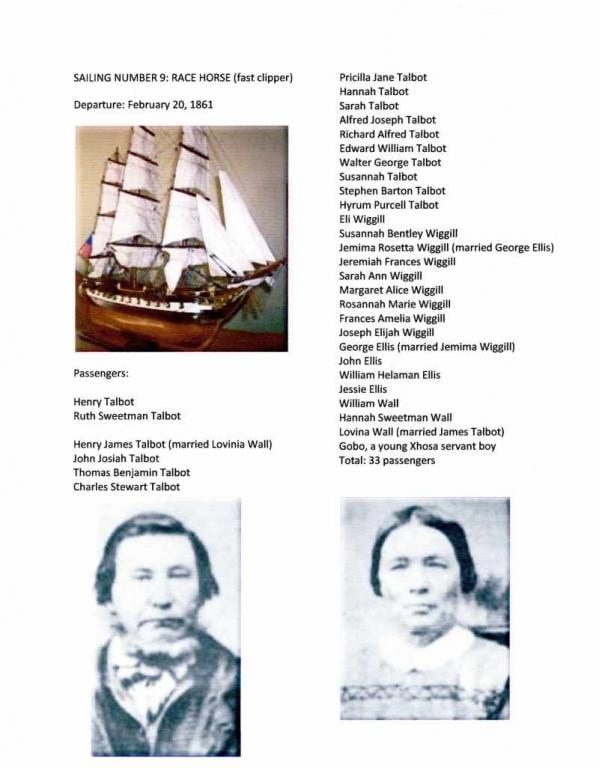
This is the roster for The Race Horse, a ship which sailed from South Africa to the USA. On it were Susan Talbot, one of my ancestors on my Blair line, her many family members, and a Xhosa slave, Gobo Fango. (Xhosa refers to a particular area/dialect in South Africa.)
I knew the history of Gobo Fango before I realized that I had a family connection. In fact, I wrote an article about him for BlackPast .
Gobo Fango’s history has been written from a few perspectives, some depicting him crawling to his deathbed and willing all of his money to the building of the Salt Lake Temple. I already knew the narratives which pioneer descendants tended to believe about slaves in their family. It’s a three-point narrative:
1) When my ancestors joined the LDS Church, they freed their slaves.
2) My family offered freedom to their slaves, but they wanted to remain slaves. (You should see the eye rolls when black audience members hear this.)
3) My family treated their slaves like one of their own children.
An article in The Friend, March 2003, shows this narrative. Here’s a quote: “Gobo was a valiant Saint… a courageous child from South Africa. He was one of the first African pioneers to join the early Saints in the West, and he is a member of our family.”
Actually, there is no record indicating that Gobo Fango was ever baptized. Was he a “member of our family”?
What we know is that he slept in a shed and suffered frostbite on his feet as a result. He had a noticeable limp for the rest of his life. We know that the Talbot family sold him to another family (Whitesides) who subsequently sold him to another family. Note that the families arrived in Utah in 1861, the year the Civil War started. Slavery was abolished in 1863 by the Emancipation Proclamation, so sales of Gobo Fango after that year were illegal. There were two sales.
Gobo was shot and killed by Frank Bedke over property issues in 1886. Gobo himself was unarmed. The first hearing of the case against Bedke ended in a mistrial. The second trial found that he had killed Gobo Fango as in an act of self-defense.
The article in The Friend describes one of the Talbots protecting Gobo Fango from discovery on the ship:
“Quickly Sister Talbot lifted her large hoop skirt and hid him underneath. Gobo pulled his knees tightly against his chest and held his breath until the mob left and his mother took him upon her lap. She reminded him that he was a child of God and explained that their home with the Saints in Utah would be a place of acceptance and love for their entire family, including Gobo. She assured him that their fellow brothers and sisters in the gospel understood what it was like to be persecuted and judged. Surely they would not turn Gobo away.”
We desperately want to believe that our pioneer ancestors treated everyone as children of God. We want to believe that our people provided “acceptance and love” to all. In this particular case, I already knew the tragedy of Gobo Fango’s life before I realized that my own family was involved.
Gobo Fango was a lone black man in Oakley, Idaho, separated from the white families. He slept in a shed, resulting in frostbite, and he became a sheep herder. He was killed by a man who was subsequently acquitted of the murder. Anything beyond those facts is speculation.
My experience in researching stories of black pioneers has revealed the ways we adjust the narratives to exonerate our own families. The narratives are transmitted down the generations, and some research (along with an open mind) is needed to challenge them.
The need for acknowledgment of our historical wrongs–even those of our ancestors–is essential to healing. As Desmond Tutu said of Truth and Reconciliation:
“How could anyone really think that true reconciliation could avoid a proper confrontation? After a husband and wife or two friends have quarreled, if they merely seek to gloss over their differences or metaphorically paper over the cracks, they must not be surprised when they are soon at it again, perhaps more violently than before, because they have tried to heal their ailment lightly.”
Previous Post

July 15, 2020
Weeping with Darius as we wrote the auction scene
Next Post
July 17, 2020 Darius: Growing up Black in the 1950s
Browse Our Archives
Select a Category Ancestors family conflict in the scriptures race and religion Uncategorized
Select a Month August 2026 March 2026 January 2026 December 2025 November 2025 October 2025 September 2025 July 2025 April 2025 March 2025 January 2025 November 2024 May 2024 April 2024 November 2023 October 2023 September 2023 June 2023 September 2022 August 2022 July 2022 May 2022 April 2022 March 2022 January 2022 December 2021 October 2021 September 2021 July 2021 June 2021 October 2020 August 2020 July 2020 June 2020 March 2020 January 2020 December 2019 November 2019 October 2019 June 2019 January 2019 December 2018 November 2018 September 2018 August 2018 May 2018 March 2018 January 2018 November 2017 October 2017 August 2017 July 2017 June 2017 May 2017 March 2017 February 2017 November 2016 October 2016 August 2016 July 2016 June 2016 May 2016 April 2016 March 2016 February 2016 January 2016 November 2015 August 2015 July 2015 May 2015 April 2015 March 2015 February 2015 January 2015 December 2014 November 2014 October 2014 August 2014 July 2014 June 2014 May 2014 April 2014 March 2014 February 2014 January 2014 December 2013 November 2013 October 2013 September 2013 August 2013 July 2013 June 2013 May 2013 April 2013 March 2013 February 2013 January 2013 December 2012
Follow Us!
TAKE THE
Religious Wisdom Quiz
What prophet was taken up to heaven in a chariot of fire?
Select your answer to see how you score.
Jeremiah Elisha Elijah Isaiah
Related posts from The Welcome Table


Church Ball and the Genesis Team
TRENDING AT PATHEOS Latter-day Saint

Did Prayer Cure His Cancer? Or Was It...
At 4 AM one morning, Joshua W. Brown’s wife awoke to a...

8 Ways a Near-Death Experience Rewires the Soul
Does Consciousness Survive Physical Death? After 50 Years of Research, Dr. Raymond...

Holy Longing: What Our Restlessness Is Telling Us
“One can find so many pains when the rain is falling.” -John...

What this is NOT about. This blog is definitely not about...

Who said the Israelites were God’s chosen? That’s right, they did. Who...

The Spirit World Is the Real World: God...
A Monk’s Wisdom on Body and Spirit I sit with Brother Martin...
view all Latter-day Saint blogs
Ad-Free & Subscriber Log-In Subscription Support
- About Us
- 2026 Calendar
- Videos
- Podcasts
- Library of World Religions
- Faith In Media Tracker
- Advertise With Us
- Write for Us
- Privacy Policy
- Terms of Service
- Do Not Sell My Data
- Contact Us
- Radiant Digital
- Manage Newsletter Subscriptions
- Unsubscribe From Notifications
- Sitemap
Copyright 2008-2026, Patheos. All rights reserved.
Subscription Support Ad-Free & Subscriber Log-In
Follow Patheos