
BuddhistCatholicContemplativeEvangelicalGeneral ChristianHinduJewishLatter-day SaintMuslimNew VisionsProgressive Christian
Beliefs
- Buddhist
- Catholic
- Contemplative
- Evangelical
- General Christian
- Hindu
- Jewish
- Latter-day Saint
- More Voices
- Muslim
- New Visions
- Pagan
- Progressive Christian
Topics
- Religion News
- Food and Religion
- Sports and Religion
- Religious Art
- Religious Music and Entertainment
- Religious Events
- History and Religion
- Style and Religion
- Politics and Religion
- Women in Religion
- Recreation Outdoors and Religion
- Business Finance and Religion
- Careers Workplace and Religion
- Education and Religion
- Family Parenting and Religion
- Health Fitness and Religion
- Home and Religion
- Relationships and Religion
- Technology and Religion
- Travel and Religion
Columnists
- Buddhist Columnists
- Business Finance and Religion Columnists
- Careers Workplace and Religion Columnists
- Catholic Columnists
- Contemplative Columnists
- Education and Religion Columnists
- Evangelists Columnists
- Family Parenting and Religion Columnists
- General Christian Columnists
- Health Fitness and Religion Columnists
- Hindu Columnists
- History and Religion Columnists
- Home and Religion Columnists
- Jewish Columnists
- More Voices Columnists
- Latter Day Columnists
- Muslim Columnists
- New Visions Columnists
- Nonreligious Columnists
- Pagan Columnists
- Politics and Religion Columnists
- Progressive Columnists
- Recreation Outdoors and Religion Columnists
- Relationships and Religion Columnists
- Religion News Columnists
- Religious Art Columnists
- Religious Events Columnists
- Religious Music and Entertainment Columnists
- Sports and Religion Columnists
- Style and Religion Columnists
- Technology and Religion Columnists
- Travel and Religion Columnists
- Women in Religion Columnists
Resource Library
- 2026 Calendar
- Library of World Religions
- The 100 Most Holy Places on Earth
- Patheos Answers
- Podcasts
- Videos
- Faith Leaders Database
- Anglican Episcopalian
- Bahai
- Baptist
- Buddhism
- Christianity
- Confucianism
- Eastern Orthodoxy
- Hinduism
- Holiness and Pentecostal
- ISKCON
- Islam
- Judaism
- Lutheran
- Methodist
- The Church of Jesus Christ of Latter-day Saints
- New Age
- Paganism
- Presbytarian and Reformed
- Protestantism
- Religion Behind the Scenes
- Roman Catholic
- Scientology
- Shia Islam
- Sikhism
- Sufism
- Sunni Islam
- Taoism
- Zen
- See all religions
Research Tools
 Ad-Free & Subscriber Log-In Subscription Support
Ad-Free & Subscriber Log-In Subscription Support
Follow Patheos 

- Trending:
- Forgiveness
- |
- Marriage
- |
- Consciousness
- |
- Death Penalty
- |
- Election
- |
- Halloween

- Home
- Latter-day Saint
- Disruptions
Disruptions
Last updated on: March 2, 2018 at 7:07 pm by Margaret Blair Young
Disruptions 2018-03-02T19:07:45-07:00 Margaret Blair Young
Patheos Explore the world's faith through different perspectives on religion and spirituality! Patheos has the views of the prevalent religions and spiritualities of the world.
 Twice a week, I babysit my granddaughter, who is quite certain that she is the center of the universe. Until last month, she could sleep between her mother and father and say simply, “Some” and a nipple would be placed in her mouth.
She will remain the center of the universe at least for awhile—maybe until a sibling joins her. And then—disruption! Disruption to all assumptions, disruption to all days, disruption to her own disruptions. She will eventually join other children, who have been similarly persuaded that they control the sun and the moon—and that they can control other children. She will undoubtedly encounter a bully or two and by the time she hits puberty, she will begin to wonder if she matters at all. Is she pretty? Is she likeable? Is she thin enough or smart enough or righteous enough?
And thus the plagues of doubt will disrupt her first illusions.
What was it like for those sons of Leah–Reuben, Simeon, Levi, Judah, Issachar and Zebulun–when their father (whose own wedding night had been disrupted by the surprise of the wrong bride) saw that their father loved Rachel’s son, Joseph, more than he loved them? And for the sons of Jacob’s other wives, Zilpah and Bilhah (Gad, Asher, Dan, and Naphtali), what was it like to learn that Joseph had tattled on them—had given an “evil report” (Gen. 37:2) of their work? Jacob’s favoritism was surely disruptive enough to their brotherhood, but soon Joseph was dreaming dreams and wearing special clothing. Clearly, Joseph had not yet been disabused of the fantasy of his own centricity. He even took on his father by reporting on a dream in which all family members—including Jacob—knelt before him.
These brothers decided that it was time for Joseph’s life to be disrupted—or even ended. “Come now therefore, and let us slay him,” they said, “and cast him into some pit, and we will say, Some evil beast hath devoured him: and we shall see what will become of his dreams. (Gen. 37:20)
Reuben, the first born (who had already lost his inheritance [Gen. 35] by sleeping with his father’ concubine) hatched his own plan which would keep Joseph alive but also appease his brothers’ bullying. He suggested that they cast Joseph into a pit, and secretly planned to rescue the boy himself later.
Indeed, the brothers cast the favorite into a pit—but Reuben’s rescue was disrupted by a traveling band of Ishmaelites. Judah was the disrupter-in-chief for this and did something similar to what Cain had done in seeking to profit from his brother’s demise. LDS scripture tells us: “And Cain said: Truly I am Mahan, the master of this great secret, that I may murder and get gain” (Moses 5:31).
In the story of Cain and Abel, as interpreted in various cultures, we see conscience emerging. A Palestinian text tells us that Cain “carried the dead body on his shoulders for a considerable time, not knowing where to conceal it, till it stank horribly.”
In what ways did Joseph’s brothers continue to carry their brother and the unbearable secret of what they had done to him? We can only imagine, because the brothers’ story is disrupted after they find that they have effectually killed their father through the evil done to Joseph. We then follow Joseph as he is sold and re-sold, finally ending up at Potipher’s house.
And then—
We leave the Joseph story entirely and turn to Judah, who is about to learn new lessons in deception with the ultimate lesson being that whatever he threatens to do to another is ultimately a threat to himself. It is the Judah and Tamar story—far more than a lesson chastity, though some have reduced it to that. In many ways, Tamar’s disguises as a vulnerable woman without power even over her body pre-figure Joseph’s careful disguises in which he will do exactly the opposite: refuse to show his identity or his vulnerability to his brothers.
Judah repents of his quick temper and of his refusal to grant Tamar what Old Testament law afforded her, and he is humbled.
Finally, we return to Joseph. The story’s brief detour has left time for Joseph to grow up and show that he is indeed a son of the covenant. He will risk false accusation by angering the seductive wife of Potiphar. He is cast into prison—but just as he did in Potiphar’s house, he manages to “find favor” with his guards.
The story continues. How much time goes by? There are no specifics except for the two years which pass after Joseph interprets the dreams of fellow prisoners. The butler, after these two years, finally remembers to tell Pharoah about him and Joseph is positioned in a place of power, able to deliver all from a coming famine. Including his own brothers.
How old is he by now? He was seventeen when he was sold into slavery and is now thirty-nine.
When the brothers approach him the first time, he does not reveal his fraternal identity but stands as their master able to cast any of them into slavery. Though he uses an interpreter, he understands them perfectly as they speak of the secret burden each carries—even as (in the Palestinian re-telling) Cain carried Abel’s body, acting very much like his “brother’s keeper”. The scriptures recount the regretful conversation between Jacob’s sons:
And they said one to another, We are verily guilty concerning our brother, in that we saw the anguish of his soul, when he besought us, and we would not hear; therefore is this distress come upon us. 22And Reuben answered them, saying, Spake I not unto you, saying, Do not sin against the child; and ye would not hear? therefore, behold, also his blood is required.
Before his brothers’ eyes, Joseph has Simeon bound—a re-enactment of what they had done to him. He releases the others to return to their home for Benjamin—after secretly commanding that the money each had paid for grain be returned to their bags—a generous but underhanded act calculated to make each of his brothers feel the threat of bondage or death.
What of Simeon, the brother who becomes the ransom? According to Jewish lore, it was Simeon who said: “Behold, this dreamer cometh. Come now therefore, and let us slay him” (Gen. xxxvii. 19-20). The Rabbis hold that it was Simeon, too, who cast Joseph into the pit, and that he afterward ordered that stones be thrown therein (Gen. R. lxxxiv. 15; Tan., Wayesheb, 13).
According to the rabbinical tales cited above, Joseph had particular reasons for selecting Simeon as the ranson:
Joseph desired to punish Simeon for having thrown him into the pit; and (2) he wished to separate Simeon from Levi, lest they together might destroy Egypt as they had destroyed Shechem (Gen. R. xci. 6). Simeon naturally was not willing to go to prison; and when, at Joseph’s call, seventy mighty Egyptians approached to take him by force, he uttered a cry so terrible that they became frightened and ran away. It was Manasseh, Joseph’s son, who subdued Simeon and led him to prison (“Sefer ha-Yashar,” section “Miḳḳeẓ,” p. 86a)
Simeon, says The Testament of the Twelve Patriarchs (Simeon, 4), “recognized the justice of his punishment, and did not complain, but went willingly to prison.”
The Book of Simeon gets specific and interprets the events with reverence to Joseph and acceptance of a just punishment:
2 I was born of Jacob as my father’s second son; And my mother Leah called me Simeon, Because the Lord had heard her prayer. 3 Moreover, I became strong exceedingly; I shrank from no achievement, Nor was I afraid of ought. 4 For my heart was hard, And my liver was immovable, And my bowels without compassion. . .For in the time of my youth I was jealous in many things of Joseph, because my father loved him beyond 7 all. And I set my mind against him to destroy him, because the prince of deceit sent forth the spirit of jealousy and blinded my mind, so that I regarded him not as a brother, nor did I spare even Jacob my father. . . 1 And my father asked Concerning me, because he saw that I was sad; and I said unto him, I am 2 pained in my liver. For I mourned more than they all, because I was guilty of the selling of Joseph. 3 And when we went down into Egypt, and he bound me as a spy, I knew that I was suffering justly, and I grieved not.
More time passes before the brothers again meet their deliverer, whom they do not yet recognize as Joseph. More tricks and snares ensue. Simeon is returned and Judah offers himself in the place of Benjamin, whose freedom is at risk.
At last, Joseph reveals himself in what is perhaps the most touching scene in the entire Old Testament.
My point in all of this is to note the multiple disruptions of the story. A full twenty-two years have gone by from the time when Joseph is cast into a pit until the moment when he reveals himself, in all his power, as the one who Jacob’s sons thought to have been sold away.
Disruption is as much a theme of the story as is reunion.
And so it is for us. We may want to return to the first story we knew about ourselves: that we are the center of the universe and our needs should be met by our simply stating them. We are the favorites. But the disruptions have always been calculated to turn us to others, to leave the selfishness of our early stories and to move into others’ stories. We may well endure false accusations, inaccurate presumptions about ourselves or our motives, betrayal, deception. We will certainly experience loss.
Joseph’s story, after the many disruptions, shows him in robes far more glorious and symbolic of power than was the coat of many colors.
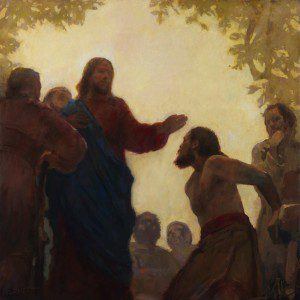
His story prepares us for the story of Jesus, born in a stable and rejected as one from Nazereth. (“Can any good come out of Nazereth?) His dearest friends betray him or deny him, and his enemies crucify him. The resurrected Lord, able to deliver all, is beyond mortal restraints, however, and has already forgiven all who have abandoned or betrayed him. Through his mortality, he has shown his brotherhood; through his godliness, he has shown his eternal nature. The renewed invitation to follow him comes with the understanding that we will be stretched into new identities, that we will leave our first presumptions of a world which is all about us and our own needs. When we agree to follow Him, we agree to His cross as well as to His glory. We agree to be disrupted, understanding that only through disruption can we go beyond ourselves and into a life where our natural desires are crucified and we are elevated into godly compassion. We may even become deliverers as we recognize divinity in the most lowly of conditions; glory in stables and huts; brotherhood in every human relation.

From Mark Mabry’s _Another Testament_.
Joseph and the coat of many colors
Previous Post

January 15, 2018
Perturbations
Next Post
May 8, 2018 The Richest Land, the Poorest People
Browse Our Archives
Select a Category Ancestors family conflict in the scriptures race and religion Uncategorized
Select a Month August 2026 March 2026 January 2026 December 2025 November 2025 October 2025 September 2025 July 2025 April 2025 March 2025 January 2025 November 2024 May 2024 April 2024 November 2023 October 2023 September 2023 June 2023 September 2022 August 2022 July 2022 May 2022 April 2022 March 2022 January 2022 December 2021 October 2021 September 2021 July 2021 June 2021 October 2020 August 2020 July 2020 June 2020 March 2020 January 2020 December 2019 November 2019 October 2019 June 2019 January 2019 December 2018 November 2018 September 2018 August 2018 May 2018 March 2018 January 2018 November 2017 October 2017 August 2017 July 2017 June 2017 May 2017 March 2017 February 2017 November 2016 October 2016 August 2016 July 2016 June 2016 May 2016 April 2016 March 2016 February 2016 January 2016 November 2015 August 2015 July 2015 May 2015 April 2015 March 2015 February 2015 January 2015 December 2014 November 2014 October 2014 August 2014 July 2014 June 2014 May 2014 April 2014 March 2014 February 2014 January 2014 December 2013 November 2013 October 2013 September 2013 August 2013 July 2013 June 2013 May 2013 April 2013 March 2013 February 2013 January 2013 December 2012
Follow Us!
TAKE THE
Religious Wisdom Quiz
In which garden did Jesus pray before His arrest?
Select your answer to see how you score.
Eden Paradise Golgotha Gethsemane
Related posts from The Welcome Table

Three Doors (A Choose-Your-Own-Adventure Post)

One of the Best Talks I've Ever Heard

My brother--in an Otavalo cemetery
TRENDING AT PATHEOS Latter-day Saint

Did Prayer Cure His Cancer? Or Was It...
At 4 AM one morning, Joshua W. Brown’s wife awoke to a...

8 Ways a Near-Death Experience Rewires the Soul
Does Consciousness Survive Physical Death? After 50 Years of Research, Dr. Raymond...

Holy Longing: What Our Restlessness Is Telling Us
“One can find so many pains when the rain is falling.” -John...

What this is NOT about. This blog is definitely not about...

Who said the Israelites were God’s chosen? That’s right, they did. Who...

The Spirit World Is the Real World: God...
A Monk’s Wisdom on Body and Spirit I sit with Brother Martin...
view all Latter-day Saint blogs
Ad-Free & Subscriber Log-In Subscription Support
- About Us
- 2026 Calendar
- Videos
- Podcasts
- Library of World Religions
- Faith In Media Tracker
- Advertise With Us
- Write for Us
- Privacy Policy
- Terms of Service
- Do Not Sell My Data
- Contact Us
- Radiant Digital
- Manage Newsletter Subscriptions
- Unsubscribe From Notifications
- Sitemap
Copyright 2008-2026, Patheos. All rights reserved.
Subscription Support Ad-Free & Subscriber Log-In
Follow Patheos